
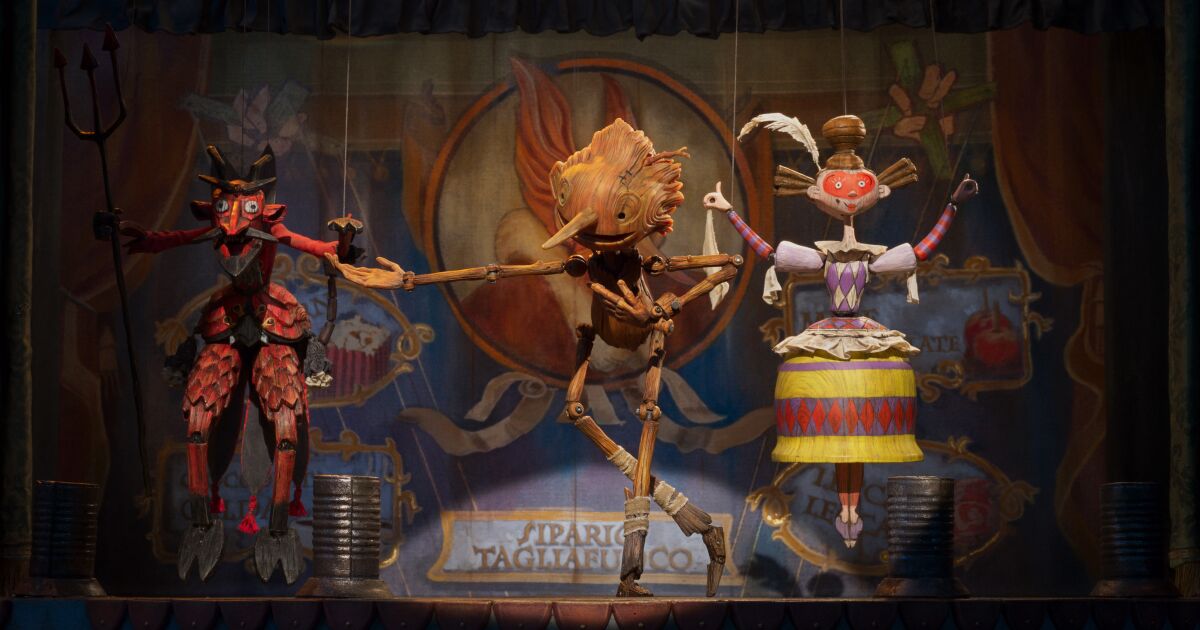
In the animated “Guillermo del Toro’s Pinocchio,” the titular wooden boy decides he must leave home — and his beloved father, Geppetto — with a ragged traveling circus in the hopes of earning needed funds for the family. He’s shown onstage (voiced and sung by young Gregory Mann) performing a delicate, lovely song dedicated to his father: “Ciao Papa.” It’s pure and almost angelic. It enumerates the things from home the brave boy will hold to his heart for comfort. And visually, Del Toro reminds viewers of the time and place in which his version of the story is set: fascist Italy under Mussolini.
It’s all part of the heady mix of “joyous melancholy” within something resembling an Italian folk song. It’s also a sample of the storied filmmaker’s first foray into songwriting, in collaboration with Oscar-winning composer Alexandre Desplat (who helped talk him into the task) and lyricist Roeban Katz.
When the three gather by video conference to discuss the song with The Envelope, technical issues prevent Del Toro from initially joining. When he finally does, his first words are, “I did it all!”
Without missing a beat, Desplat says, “Guillermo played everything on trumpet.”
The others laugh, then explain how their mostly video-conferenced collaboration worked during the pandemic. Katz says Del Toro was “the captain of the ship,” with very specific ideas about what each song in the musical should be, lines the characters would have.
“He started with throwing me a few words, gave me direction, and I took it from there. It’s a triangular collaboration where Guillermo will talk to me, then I will talk to Alexandre and we will send it back to Guillermo, who gives us notes,” Katz says. “We’re not sitting shoulder to shoulder: You write a word, I write a word. He’s telling us where he wants us to go, what we should be talking about, and we get inspired and serve his vision.”
Del Toro admires Katz’s ability to cut to the core of “Ciao Papa”: “When Pinocchio’s taking an inventory of what he’s going to take with him, it’s so poetic and moving. It speaks volumes of how simple his love is for his dad. It’s very hard to capture simplicity like that. It’s like a lullaby, but instead of a parent singing to a baby, it’s a son singing to a father.”
The director with a model of his star on the set of the stop-motion “Guillermo del Toro’s Pinocchio.”
(Jason Schmidt / Netflix)
“If I am gone for a long, long time / I’ll pack away a fine piece of shine,” goes the first verse: “The sound of birds chirping with bells / Drawings of plums, two bags of shells / The smell of bread, a drop of wine / Your memory, father of mine.”
“I was thinking of the days when I left France a long time ago,” Katz says. “I was not a kid, I was a young man. But I tried to remember what I was leaving behind, the things I liked. The smell of bread, the sound of birds. This is very French!” He laughs.
Desplat, whose suggestion it was to use only wood instruments in the score, says they wanted to avoid anachronism, with nothing like today’s pop music to score the tale.
“We decided to be more inspired by what was written in the late ’30s, ’20s, which was Cole Porter, Gershwin. It’s melodies that are very easy to remember; they sound like they are whistled by a peasant walking in the countryside or a worker by the road changing tires. Something very simple, very pure, very beautiful. We tried to go there, to find this sophisticated simplicity.
“I think I share with Katz, and also with Guillermo, we share this joyous melancholy. We are joyous people in life but we have this deep, strong melancholy inside. So the music we refer to — Italian folk songs, even Cole Porter — there’s a deep melancholy there. It’s present when you hear ‘Ciao Papa.’ ”
Del Toro says, “We discussed the fact that this needed to appeal to the people that would go to that little [circus] tent. It needed to have that simple charm, that almost lullaby charm so people would sing it coming out of the tent.”
But there was more to the song as used in the film, something layered into its visual presentation: harsh reminders of fascism and the war.
“In an early cut of the song, I asked to make room for the radio, with a real speech from Mussolini. The movie is constructed through paternal stories — Pinocchio and Geppetto, Spazzatura and Volpe, Candlewick and the Podestà — and I wanted to say, at the same time, the country has this horribly artificial father figure in this strongman because fascism is a corrosive version of paternalism,” Del Toro says.
Then he adds, “The way Katz and Alexandre would take [my] basic ideas and articulate them, it’s a gift. I feel very humbled and grateful. And if I ever do it again, it’ll be under great, great strain and trepidation.”

In the animated “Guillermo del Toro’s Pinocchio,” the titular wooden boy decides he must leave home — and his beloved father, Geppetto — with a ragged traveling circus in the hopes of earning needed funds for the family. He’s shown onstage (voiced and sung by young Gregory Mann) performing a delicate, lovely song dedicated to his father: “Ciao Papa.” It’s pure and almost angelic. It enumerates the things from home the brave boy will hold to his heart for comfort. And visually, Del Toro reminds viewers of the time and place in which his version of the story is set: fascist Italy under Mussolini.
It’s all part of the heady mix of “joyous melancholy” within something resembling an Italian folk song. It’s also a sample of the storied filmmaker’s first foray into songwriting, in collaboration with Oscar-winning composer Alexandre Desplat (who helped talk him into the task) and lyricist Roeban Katz.
When the three gather by video conference to discuss the song with The Envelope, technical issues prevent Del Toro from initially joining. When he finally does, his first words are, “I did it all!”
Without missing a beat, Desplat says, “Guillermo played everything on trumpet.”
The others laugh, then explain how their mostly video-conferenced collaboration worked during the pandemic. Katz says Del Toro was “the captain of the ship,” with very specific ideas about what each song in the musical should be, lines the characters would have.
“He started with throwing me a few words, gave me direction, and I took it from there. It’s a triangular collaboration where Guillermo will talk to me, then I will talk to Alexandre and we will send it back to Guillermo, who gives us notes,” Katz says. “We’re not sitting shoulder to shoulder: You write a word, I write a word. He’s telling us where he wants us to go, what we should be talking about, and we get inspired and serve his vision.”
Del Toro admires Katz’s ability to cut to the core of “Ciao Papa”: “When Pinocchio’s taking an inventory of what he’s going to take with him, it’s so poetic and moving. It speaks volumes of how simple his love is for his dad. It’s very hard to capture simplicity like that. It’s like a lullaby, but instead of a parent singing to a baby, it’s a son singing to a father.”
The director with a model of his star on the set of the stop-motion “Guillermo del Toro’s Pinocchio.”
(Jason Schmidt / Netflix)
“If I am gone for a long, long time / I’ll pack away a fine piece of shine,” goes the first verse: “The sound of birds chirping with bells / Drawings of plums, two bags of shells / The smell of bread, a drop of wine / Your memory, father of mine.”
“I was thinking of the days when I left France a long time ago,” Katz says. “I was not a kid, I was a young man. But I tried to remember what I was leaving behind, the things I liked. The smell of bread, the sound of birds. This is very French!” He laughs.
Desplat, whose suggestion it was to use only wood instruments in the score, says they wanted to avoid anachronism, with nothing like today’s pop music to score the tale.
“We decided to be more inspired by what was written in the late ’30s, ’20s, which was Cole Porter, Gershwin. It’s melodies that are very easy to remember; they sound like they are whistled by a peasant walking in the countryside or a worker by the road changing tires. Something very simple, very pure, very beautiful. We tried to go there, to find this sophisticated simplicity.
“I think I share with Katz, and also with Guillermo, we share this joyous melancholy. We are joyous people in life but we have this deep, strong melancholy inside. So the music we refer to — Italian folk songs, even Cole Porter — there’s a deep melancholy there. It’s present when you hear ‘Ciao Papa.’ ”
Del Toro says, “We discussed the fact that this needed to appeal to the people that would go to that little [circus] tent. It needed to have that simple charm, that almost lullaby charm so people would sing it coming out of the tent.”
But there was more to the song as used in the film, something layered into its visual presentation: harsh reminders of fascism and the war.
“In an early cut of the song, I asked to make room for the radio, with a real speech from Mussolini. The movie is constructed through paternal stories — Pinocchio and Geppetto, Spazzatura and Volpe, Candlewick and the Podestà — and I wanted to say, at the same time, the country has this horribly artificial father figure in this strongman because fascism is a corrosive version of paternalism,” Del Toro says.
Then he adds, “The way Katz and Alexandre would take [my] basic ideas and articulate them, it’s a gift. I feel very humbled and grateful. And if I ever do it again, it’ll be under great, great strain and trepidation.”

In the animated “Guillermo del Toro’s Pinocchio,” the titular wooden boy decides he must leave home — and his beloved father, Geppetto — with a ragged traveling circus in the hopes of earning needed funds for the family. He’s shown onstage (voiced and sung by young Gregory Mann) performing a delicate, lovely song dedicated to his father: “Ciao Papa.” It’s pure and almost angelic. It enumerates the things from home the brave boy will hold to his heart for comfort. And visually, Del Toro reminds viewers of the time and place in which his version of the story is set: fascist Italy under Mussolini.
It’s all part of the heady mix of “joyous melancholy” within something resembling an Italian folk song. It’s also a sample of the storied filmmaker’s first foray into songwriting, in collaboration with Oscar-winning composer Alexandre Desplat (who helped talk him into the task) and lyricist Roeban Katz.
When the three gather by video conference to discuss the song with The Envelope, technical issues prevent Del Toro from initially joining. When he finally does, his first words are, “I did it all!”
Without missing a beat, Desplat says, “Guillermo played everything on trumpet.”
The others laugh, then explain how their mostly video-conferenced collaboration worked during the pandemic. Katz says Del Toro was “the captain of the ship,” with very specific ideas about what each song in the musical should be, lines the characters would have.
“He started with throwing me a few words, gave me direction, and I took it from there. It’s a triangular collaboration where Guillermo will talk to me, then I will talk to Alexandre and we will send it back to Guillermo, who gives us notes,” Katz says. “We’re not sitting shoulder to shoulder: You write a word, I write a word. He’s telling us where he wants us to go, what we should be talking about, and we get inspired and serve his vision.”
Del Toro admires Katz’s ability to cut to the core of “Ciao Papa”: “When Pinocchio’s taking an inventory of what he’s going to take with him, it’s so poetic and moving. It speaks volumes of how simple his love is for his dad. It’s very hard to capture simplicity like that. It’s like a lullaby, but instead of a parent singing to a baby, it’s a son singing to a father.”
The director with a model of his star on the set of the stop-motion “Guillermo del Toro’s Pinocchio.”
(Jason Schmidt / Netflix)
“If I am gone for a long, long time / I’ll pack away a fine piece of shine,” goes the first verse: “The sound of birds chirping with bells / Drawings of plums, two bags of shells / The smell of bread, a drop of wine / Your memory, father of mine.”
“I was thinking of the days when I left France a long time ago,” Katz says. “I was not a kid, I was a young man. But I tried to remember what I was leaving behind, the things I liked. The smell of bread, the sound of birds. This is very French!” He laughs.
Desplat, whose suggestion it was to use only wood instruments in the score, says they wanted to avoid anachronism, with nothing like today’s pop music to score the tale.
“We decided to be more inspired by what was written in the late ’30s, ’20s, which was Cole Porter, Gershwin. It’s melodies that are very easy to remember; they sound like they are whistled by a peasant walking in the countryside or a worker by the road changing tires. Something very simple, very pure, very beautiful. We tried to go there, to find this sophisticated simplicity.
“I think I share with Katz, and also with Guillermo, we share this joyous melancholy. We are joyous people in life but we have this deep, strong melancholy inside. So the music we refer to — Italian folk songs, even Cole Porter — there’s a deep melancholy there. It’s present when you hear ‘Ciao Papa.’ ”
Del Toro says, “We discussed the fact that this needed to appeal to the people that would go to that little [circus] tent. It needed to have that simple charm, that almost lullaby charm so people would sing it coming out of the tent.”
But there was more to the song as used in the film, something layered into its visual presentation: harsh reminders of fascism and the war.
“In an early cut of the song, I asked to make room for the radio, with a real speech from Mussolini. The movie is constructed through paternal stories — Pinocchio and Geppetto, Spazzatura and Volpe, Candlewick and the Podestà — and I wanted to say, at the same time, the country has this horribly artificial father figure in this strongman because fascism is a corrosive version of paternalism,” Del Toro says.
Then he adds, “The way Katz and Alexandre would take [my] basic ideas and articulate them, it’s a gift. I feel very humbled and grateful. And if I ever do it again, it’ll be under great, great strain and trepidation.”
In the animated “Guillermo del Toro’s Pinocchio,” the titular wooden boy decides he must leave home — and his beloved father, Geppetto — with a ragged traveling circus in the hopes of earning needed funds for the family. He’s shown onstage (voiced and sung by young Gregory Mann) performing a delicate, lovely song dedicated to his father: “Ciao Papa.” It’s pure and almost angelic. It enumerates the things from home the brave boy will hold to his heart for comfort. And visually, Del Toro reminds viewers of the time and place in which his version of the story is set: fascist Italy under Mussolini.
It’s all part of the heady mix of “joyous melancholy” within something resembling an Italian folk song. It’s also a sample of the storied filmmaker’s first foray into songwriting, in collaboration with Oscar-winning composer Alexandre Desplat (who helped talk him into the task) and lyricist Roeban Katz.
When the three gather by video conference to discuss the song with The Envelope, technical issues prevent Del Toro from initially joining. When he finally does, his first words are, “I did it all!”
Without missing a beat, Desplat says, “Guillermo played everything on trumpet.”
The others laugh, then explain how their mostly video-conferenced collaboration worked during the pandemic. Katz says Del Toro was “the captain of the ship,” with very specific ideas about what each song in the musical should be, lines the characters would have.
“He started with throwing me a few words, gave me direction, and I took it from there. It’s a triangular collaboration where Guillermo will talk to me, then I will talk to Alexandre and we will send it back to Guillermo, who gives us notes,” Katz says. “We’re not sitting shoulder to shoulder: You write a word, I write a word. He’s telling us where he wants us to go, what we should be talking about, and we get inspired and serve his vision.”
Del Toro admires Katz’s ability to cut to the core of “Ciao Papa”: “When Pinocchio’s taking an inventory of what he’s going to take with him, it’s so poetic and moving. It speaks volumes of how simple his love is for his dad. It’s very hard to capture simplicity like that. It’s like a lullaby, but instead of a parent singing to a baby, it’s a son singing to a father.”
The director with a model of his star on the set of the stop-motion “Guillermo del Toro’s Pinocchio.”
(Jason Schmidt / Netflix)
“If I am gone for a long, long time / I’ll pack away a fine piece of shine,” goes the first verse: “The sound of birds chirping with bells / Drawings of plums, two bags of shells / The smell of bread, a drop of wine / Your memory, father of mine.”
“I was thinking of the days when I left France a long time ago,” Katz says. “I was not a kid, I was a young man. But I tried to remember what I was leaving behind, the things I liked. The smell of bread, the sound of birds. This is very French!” He laughs.
Desplat, whose suggestion it was to use only wood instruments in the score, says they wanted to avoid anachronism, with nothing like today’s pop music to score the tale.
“We decided to be more inspired by what was written in the late ’30s, ’20s, which was Cole Porter, Gershwin. It’s melodies that are very easy to remember; they sound like they are whistled by a peasant walking in the countryside or a worker by the road changing tires. Something very simple, very pure, very beautiful. We tried to go there, to find this sophisticated simplicity.
“I think I share with Katz, and also with Guillermo, we share this joyous melancholy. We are joyous people in life but we have this deep, strong melancholy inside. So the music we refer to — Italian folk songs, even Cole Porter — there’s a deep melancholy there. It’s present when you hear ‘Ciao Papa.’ ”
Del Toro says, “We discussed the fact that this needed to appeal to the people that would go to that little [circus] tent. It needed to have that simple charm, that almost lullaby charm so people would sing it coming out of the tent.”
But there was more to the song as used in the film, something layered into its visual presentation: harsh reminders of fascism and the war.
“In an early cut of the song, I asked to make room for the radio, with a real speech from Mussolini. The movie is constructed through paternal stories — Pinocchio and Geppetto, Spazzatura and Volpe, Candlewick and the Podestà — and I wanted to say, at the same time, the country has this horribly artificial father figure in this strongman because fascism is a corrosive version of paternalism,” Del Toro says.
Then he adds, “The way Katz and Alexandre would take [my] basic ideas and articulate them, it’s a gift. I feel very humbled and grateful. And if I ever do it again, it’ll be under great, great strain and trepidation.”

In the animated “Guillermo del Toro’s Pinocchio,” the titular wooden boy decides he must leave home — and his beloved father, Geppetto — with a ragged traveling circus in the hopes of earning needed funds for the family. He’s shown onstage (voiced and sung by young Gregory Mann) performing a delicate, lovely song dedicated to his father: “Ciao Papa.” It’s pure and almost angelic. It enumerates the things from home the brave boy will hold to his heart for comfort. And visually, Del Toro reminds viewers of the time and place in which his version of the story is set: fascist Italy under Mussolini.
It’s all part of the heady mix of “joyous melancholy” within something resembling an Italian folk song. It’s also a sample of the storied filmmaker’s first foray into songwriting, in collaboration with Oscar-winning composer Alexandre Desplat (who helped talk him into the task) and lyricist Roeban Katz.
When the three gather by video conference to discuss the song with The Envelope, technical issues prevent Del Toro from initially joining. When he finally does, his first words are, “I did it all!”
Without missing a beat, Desplat says, “Guillermo played everything on trumpet.”
The others laugh, then explain how their mostly video-conferenced collaboration worked during the pandemic. Katz says Del Toro was “the captain of the ship,” with very specific ideas about what each song in the musical should be, lines the characters would have.
“He started with throwing me a few words, gave me direction, and I took it from there. It’s a triangular collaboration where Guillermo will talk to me, then I will talk to Alexandre and we will send it back to Guillermo, who gives us notes,” Katz says. “We’re not sitting shoulder to shoulder: You write a word, I write a word. He’s telling us where he wants us to go, what we should be talking about, and we get inspired and serve his vision.”
Del Toro admires Katz’s ability to cut to the core of “Ciao Papa”: “When Pinocchio’s taking an inventory of what he’s going to take with him, it’s so poetic and moving. It speaks volumes of how simple his love is for his dad. It’s very hard to capture simplicity like that. It’s like a lullaby, but instead of a parent singing to a baby, it’s a son singing to a father.”
The director with a model of his star on the set of the stop-motion “Guillermo del Toro’s Pinocchio.”
(Jason Schmidt / Netflix)
“If I am gone for a long, long time / I’ll pack away a fine piece of shine,” goes the first verse: “The sound of birds chirping with bells / Drawings of plums, two bags of shells / The smell of bread, a drop of wine / Your memory, father of mine.”
“I was thinking of the days when I left France a long time ago,” Katz says. “I was not a kid, I was a young man. But I tried to remember what I was leaving behind, the things I liked. The smell of bread, the sound of birds. This is very French!” He laughs.
Desplat, whose suggestion it was to use only wood instruments in the score, says they wanted to avoid anachronism, with nothing like today’s pop music to score the tale.
“We decided to be more inspired by what was written in the late ’30s, ’20s, which was Cole Porter, Gershwin. It’s melodies that are very easy to remember; they sound like they are whistled by a peasant walking in the countryside or a worker by the road changing tires. Something very simple, very pure, very beautiful. We tried to go there, to find this sophisticated simplicity.
“I think I share with Katz, and also with Guillermo, we share this joyous melancholy. We are joyous people in life but we have this deep, strong melancholy inside. So the music we refer to — Italian folk songs, even Cole Porter — there’s a deep melancholy there. It’s present when you hear ‘Ciao Papa.’ ”
Del Toro says, “We discussed the fact that this needed to appeal to the people that would go to that little [circus] tent. It needed to have that simple charm, that almost lullaby charm so people would sing it coming out of the tent.”
But there was more to the song as used in the film, something layered into its visual presentation: harsh reminders of fascism and the war.
“In an early cut of the song, I asked to make room for the radio, with a real speech from Mussolini. The movie is constructed through paternal stories — Pinocchio and Geppetto, Spazzatura and Volpe, Candlewick and the Podestà — and I wanted to say, at the same time, the country has this horribly artificial father figure in this strongman because fascism is a corrosive version of paternalism,” Del Toro says.
Then he adds, “The way Katz and Alexandre would take [my] basic ideas and articulate them, it’s a gift. I feel very humbled and grateful. And if I ever do it again, it’ll be under great, great strain and trepidation.”
In the animated “Guillermo del Toro’s Pinocchio,” the titular wooden boy decides he must leave home — and his beloved father, Geppetto — with a ragged traveling circus in the hopes of earning needed funds for the family. He’s shown onstage (voiced and sung by young Gregory Mann) performing a delicate, lovely song dedicated to his father: “Ciao Papa.” It’s pure and almost angelic. It enumerates the things from home the brave boy will hold to his heart for comfort. And visually, Del Toro reminds viewers of the time and place in which his version of the story is set: fascist Italy under Mussolini.
It’s all part of the heady mix of “joyous melancholy” within something resembling an Italian folk song. It’s also a sample of the storied filmmaker’s first foray into songwriting, in collaboration with Oscar-winning composer Alexandre Desplat (who helped talk him into the task) and lyricist Roeban Katz.
When the three gather by video conference to discuss the song with The Envelope, technical issues prevent Del Toro from initially joining. When he finally does, his first words are, “I did it all!”
Without missing a beat, Desplat says, “Guillermo played everything on trumpet.”
The others laugh, then explain how their mostly video-conferenced collaboration worked during the pandemic. Katz says Del Toro was “the captain of the ship,” with very specific ideas about what each song in the musical should be, lines the characters would have.
“He started with throwing me a few words, gave me direction, and I took it from there. It’s a triangular collaboration where Guillermo will talk to me, then I will talk to Alexandre and we will send it back to Guillermo, who gives us notes,” Katz says. “We’re not sitting shoulder to shoulder: You write a word, I write a word. He’s telling us where he wants us to go, what we should be talking about, and we get inspired and serve his vision.”
Del Toro admires Katz’s ability to cut to the core of “Ciao Papa”: “When Pinocchio’s taking an inventory of what he’s going to take with him, it’s so poetic and moving. It speaks volumes of how simple his love is for his dad. It’s very hard to capture simplicity like that. It’s like a lullaby, but instead of a parent singing to a baby, it’s a son singing to a father.”
The director with a model of his star on the set of the stop-motion “Guillermo del Toro’s Pinocchio.”
(Jason Schmidt / Netflix)
“If I am gone for a long, long time / I’ll pack away a fine piece of shine,” goes the first verse: “The sound of birds chirping with bells / Drawings of plums, two bags of shells / The smell of bread, a drop of wine / Your memory, father of mine.”
“I was thinking of the days when I left France a long time ago,” Katz says. “I was not a kid, I was a young man. But I tried to remember what I was leaving behind, the things I liked. The smell of bread, the sound of birds. This is very French!” He laughs.
Desplat, whose suggestion it was to use only wood instruments in the score, says they wanted to avoid anachronism, with nothing like today’s pop music to score the tale.
“We decided to be more inspired by what was written in the late ’30s, ’20s, which was Cole Porter, Gershwin. It’s melodies that are very easy to remember; they sound like they are whistled by a peasant walking in the countryside or a worker by the road changing tires. Something very simple, very pure, very beautiful. We tried to go there, to find this sophisticated simplicity.
“I think I share with Katz, and also with Guillermo, we share this joyous melancholy. We are joyous people in life but we have this deep, strong melancholy inside. So the music we refer to — Italian folk songs, even Cole Porter — there’s a deep melancholy there. It’s present when you hear ‘Ciao Papa.’ ”
Del Toro says, “We discussed the fact that this needed to appeal to the people that would go to that little [circus] tent. It needed to have that simple charm, that almost lullaby charm so people would sing it coming out of the tent.”
But there was more to the song as used in the film, something layered into its visual presentation: harsh reminders of fascism and the war.
“In an early cut of the song, I asked to make room for the radio, with a real speech from Mussolini. The movie is constructed through paternal stories — Pinocchio and Geppetto, Spazzatura and Volpe, Candlewick and the Podestà — and I wanted to say, at the same time, the country has this horribly artificial father figure in this strongman because fascism is a corrosive version of paternalism,” Del Toro says.
Then he adds, “The way Katz and Alexandre would take [my] basic ideas and articulate them, it’s a gift. I feel very humbled and grateful. And if I ever do it again, it’ll be under great, great strain and trepidation.”
In the animated “Guillermo del Toro’s Pinocchio,” the titular wooden boy decides he must leave home — and his beloved father, Geppetto — with a ragged traveling circus in the hopes of earning needed funds for the family. He’s shown onstage (voiced and sung by young Gregory Mann) performing a delicate, lovely song dedicated to his father: “Ciao Papa.” It’s pure and almost angelic. It enumerates the things from home the brave boy will hold to his heart for comfort. And visually, Del Toro reminds viewers of the time and place in which his version of the story is set: fascist Italy under Mussolini.
It’s all part of the heady mix of “joyous melancholy” within something resembling an Italian folk song. It’s also a sample of the storied filmmaker’s first foray into songwriting, in collaboration with Oscar-winning composer Alexandre Desplat (who helped talk him into the task) and lyricist Roeban Katz.
When the three gather by video conference to discuss the song with The Envelope, technical issues prevent Del Toro from initially joining. When he finally does, his first words are, “I did it all!”
Without missing a beat, Desplat says, “Guillermo played everything on trumpet.”
The others laugh, then explain how their mostly video-conferenced collaboration worked during the pandemic. Katz says Del Toro was “the captain of the ship,” with very specific ideas about what each song in the musical should be, lines the characters would have.
“He started with throwing me a few words, gave me direction, and I took it from there. It’s a triangular collaboration where Guillermo will talk to me, then I will talk to Alexandre and we will send it back to Guillermo, who gives us notes,” Katz says. “We’re not sitting shoulder to shoulder: You write a word, I write a word. He’s telling us where he wants us to go, what we should be talking about, and we get inspired and serve his vision.”
Del Toro admires Katz’s ability to cut to the core of “Ciao Papa”: “When Pinocchio’s taking an inventory of what he’s going to take with him, it’s so poetic and moving. It speaks volumes of how simple his love is for his dad. It’s very hard to capture simplicity like that. It’s like a lullaby, but instead of a parent singing to a baby, it’s a son singing to a father.”
The director with a model of his star on the set of the stop-motion “Guillermo del Toro’s Pinocchio.”
(Jason Schmidt / Netflix)
“If I am gone for a long, long time / I’ll pack away a fine piece of shine,” goes the first verse: “The sound of birds chirping with bells / Drawings of plums, two bags of shells / The smell of bread, a drop of wine / Your memory, father of mine.”
“I was thinking of the days when I left France a long time ago,” Katz says. “I was not a kid, I was a young man. But I tried to remember what I was leaving behind, the things I liked. The smell of bread, the sound of birds. This is very French!” He laughs.
Desplat, whose suggestion it was to use only wood instruments in the score, says they wanted to avoid anachronism, with nothing like today’s pop music to score the tale.
“We decided to be more inspired by what was written in the late ’30s, ’20s, which was Cole Porter, Gershwin. It’s melodies that are very easy to remember; they sound like they are whistled by a peasant walking in the countryside or a worker by the road changing tires. Something very simple, very pure, very beautiful. We tried to go there, to find this sophisticated simplicity.
“I think I share with Katz, and also with Guillermo, we share this joyous melancholy. We are joyous people in life but we have this deep, strong melancholy inside. So the music we refer to — Italian folk songs, even Cole Porter — there’s a deep melancholy there. It’s present when you hear ‘Ciao Papa.’ ”
Del Toro says, “We discussed the fact that this needed to appeal to the people that would go to that little [circus] tent. It needed to have that simple charm, that almost lullaby charm so people would sing it coming out of the tent.”
But there was more to the song as used in the film, something layered into its visual presentation: harsh reminders of fascism and the war.
“In an early cut of the song, I asked to make room for the radio, with a real speech from Mussolini. The movie is constructed through paternal stories — Pinocchio and Geppetto, Spazzatura and Volpe, Candlewick and the Podestà — and I wanted to say, at the same time, the country has this horribly artificial father figure in this strongman because fascism is a corrosive version of paternalism,” Del Toro says.
Then he adds, “The way Katz and Alexandre would take [my] basic ideas and articulate them, it’s a gift. I feel very humbled and grateful. And if I ever do it again, it’ll be under great, great strain and trepidation.”
In the animated “Guillermo del Toro’s Pinocchio,” the titular wooden boy decides he must leave home — and his beloved father, Geppetto — with a ragged traveling circus in the hopes of earning needed funds for the family. He’s shown onstage (voiced and sung by young Gregory Mann) performing a delicate, lovely song dedicated to his father: “Ciao Papa.” It’s pure and almost angelic. It enumerates the things from home the brave boy will hold to his heart for comfort. And visually, Del Toro reminds viewers of the time and place in which his version of the story is set: fascist Italy under Mussolini.
It’s all part of the heady mix of “joyous melancholy” within something resembling an Italian folk song. It’s also a sample of the storied filmmaker’s first foray into songwriting, in collaboration with Oscar-winning composer Alexandre Desplat (who helped talk him into the task) and lyricist Roeban Katz.
When the three gather by video conference to discuss the song with The Envelope, technical issues prevent Del Toro from initially joining. When he finally does, his first words are, “I did it all!”
Without missing a beat, Desplat says, “Guillermo played everything on trumpet.”
The others laugh, then explain how their mostly video-conferenced collaboration worked during the pandemic. Katz says Del Toro was “the captain of the ship,” with very specific ideas about what each song in the musical should be, lines the characters would have.
“He started with throwing me a few words, gave me direction, and I took it from there. It’s a triangular collaboration where Guillermo will talk to me, then I will talk to Alexandre and we will send it back to Guillermo, who gives us notes,” Katz says. “We’re not sitting shoulder to shoulder: You write a word, I write a word. He’s telling us where he wants us to go, what we should be talking about, and we get inspired and serve his vision.”
Del Toro admires Katz’s ability to cut to the core of “Ciao Papa”: “When Pinocchio’s taking an inventory of what he’s going to take with him, it’s so poetic and moving. It speaks volumes of how simple his love is for his dad. It’s very hard to capture simplicity like that. It’s like a lullaby, but instead of a parent singing to a baby, it’s a son singing to a father.”
The director with a model of his star on the set of the stop-motion “Guillermo del Toro’s Pinocchio.”
(Jason Schmidt / Netflix)
“If I am gone for a long, long time / I’ll pack away a fine piece of shine,” goes the first verse: “The sound of birds chirping with bells / Drawings of plums, two bags of shells / The smell of bread, a drop of wine / Your memory, father of mine.”
“I was thinking of the days when I left France a long time ago,” Katz says. “I was not a kid, I was a young man. But I tried to remember what I was leaving behind, the things I liked. The smell of bread, the sound of birds. This is very French!” He laughs.
Desplat, whose suggestion it was to use only wood instruments in the score, says they wanted to avoid anachronism, with nothing like today’s pop music to score the tale.
“We decided to be more inspired by what was written in the late ’30s, ’20s, which was Cole Porter, Gershwin. It’s melodies that are very easy to remember; they sound like they are whistled by a peasant walking in the countryside or a worker by the road changing tires. Something very simple, very pure, very beautiful. We tried to go there, to find this sophisticated simplicity.
“I think I share with Katz, and also with Guillermo, we share this joyous melancholy. We are joyous people in life but we have this deep, strong melancholy inside. So the music we refer to — Italian folk songs, even Cole Porter — there’s a deep melancholy there. It’s present when you hear ‘Ciao Papa.’ ”
Del Toro says, “We discussed the fact that this needed to appeal to the people that would go to that little [circus] tent. It needed to have that simple charm, that almost lullaby charm so people would sing it coming out of the tent.”
But there was more to the song as used in the film, something layered into its visual presentation: harsh reminders of fascism and the war.
“In an early cut of the song, I asked to make room for the radio, with a real speech from Mussolini. The movie is constructed through paternal stories — Pinocchio and Geppetto, Spazzatura and Volpe, Candlewick and the Podestà — and I wanted to say, at the same time, the country has this horribly artificial father figure in this strongman because fascism is a corrosive version of paternalism,” Del Toro says.
Then he adds, “The way Katz and Alexandre would take [my] basic ideas and articulate them, it’s a gift. I feel very humbled and grateful. And if I ever do it again, it’ll be under great, great strain and trepidation.”


