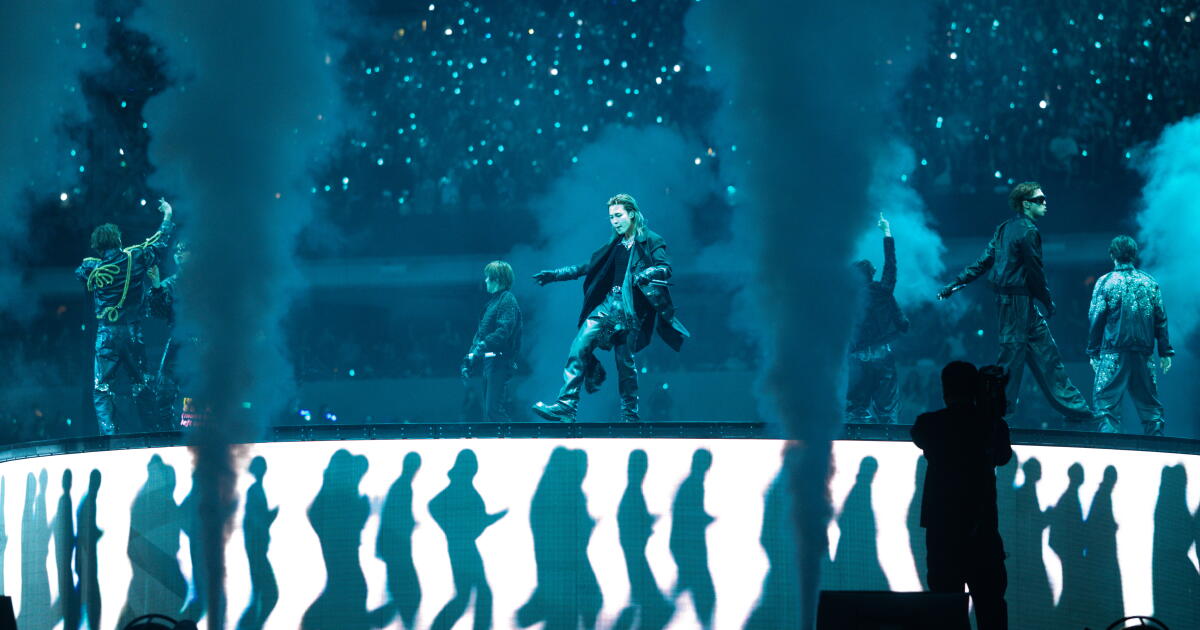
When the members of BTS announced recently that they’d opted not to submit their music for consideration for next year’s Grammy Awards, the seven-man K-pop group’s carefully crafted statement made clear they were protesting the Recording Academy’s introduction of a new category meant to honor — or perhaps to marginalize — the best in Asian pop.
“We hope our music can be heard and loved for what it is, rather than being divided by region or language,” they said, and indeed there was no doubting their across-the-board popularity as they performed Tuesday for a diverse capacity crowd at Inglewood’s SoFi Stadium. The concert was the opener of a four-night stand midway through BTS’ first tour since the members completed their mandatory South Korean military service; the road show follows the release this past March of “Arirang,” BTS’ first studio LP in nearly six years.
“L.A., it’s been a long time, right?” Suga asked in Korean near the end of the two-hour gig as he and his bandmates — Jung Kook, Jimin, V, RM, J-Hope and Jin — sat on the edge of a rotating platform in the center of the enormous stage. The deafening response suggested he’d gotten it almost right: In fact, it had been too long.
Yet if Tuesday’s show convincingly framed BTS as a world-class pop act (no small-bore awards categories required), it also had to be viewed in the context of a transitional moment for K-pop more broadly.
While BTS was away, the genre made strides toward a kind of showbiz ubiquity, none more striking than the success of “Golden,” from Netflix’s “KPop Demon Hunters,” which topped Billboard’s Hot 100 for eight weeks last year and won an Academy Award for original song at the most recent Oscars ceremony. On the other hand, K-pop groups like Enhypen and Stray Kids have struggled to duplicate BTS’ crossover appeal; they sell loads of CDs and merch to their ultra-devoted fans but so far haven’t managed to reach casual listeners as BTS did before its hiatus with hits like “Butter” and “Dynamite.” (Folks in the Enhypen or Stray Kids standoms might argue that’s because Top 40 radio shares the Recording Academy’s tendency to ghettoize.)
Think of the return of BTS, then, as a test of K-pop’s lasting cultural penetration, particularly in the United States, which BTS has long treated as something of a second home. You can hear the tension between the band’s loyalty toward home and its global aspirations on “Arirang,” which folds traces of traditional Korean folk music into glossy pop tunes and throbbing hip-hop tracks; you could see it too at SoFi during a song like “Body to Body,” which came accompanied on giant video screens by images of women in traditional Korean dress.
Between songs, the members spoke mostly in Korean, though much of the music was sung in English — a decision BTS is shown grappling with in a Netflix documentary about the making of the new album.
“Now is the time to sing this big song,” RM said somewhat dutifully on Tuesday before the group did “Butter.”
In spite of all this baggage, the show was more or less a blast, especially in a loosey-goosey third act that followed two sections full of intricate pyrotechnics and well-practiced choreography. Tuesday was Jung Kook’s 29th birthday — an occasion that had many in the crowd wearing paper party hats — and here his bandmates took the opportunity to present him with a crown and to lead the audience in an appealingly sloppy rendition of “Happy Birthday”; the energy reminded me a bit of peak-era One Direction, when the members of that British boy band would spend large stretches of their concerts just hanging out onstage trying to crack one another up.
Also: top-shelf looks. After years of what you can imagine were arduous meetings about wardrobe strategy, it was a delight to see BTS having entered its grown-up wear-whatever-you-like era. (I realize the meetings are probably still taking place.) Jimin, his hair grown long and dyed blond, was the night’s standout in a mesh top he paired with what looked an awful lot like somebody’s grandpa’s fishing vest.
Where’s the award for that?

When the members of BTS announced recently that they’d opted not to submit their music for consideration for next year’s Grammy Awards, the seven-man K-pop group’s carefully crafted statement made clear they were protesting the Recording Academy’s introduction of a new category meant to honor — or perhaps to marginalize — the best in Asian pop.
“We hope our music can be heard and loved for what it is, rather than being divided by region or language,” they said, and indeed there was no doubting their across-the-board popularity as they performed Tuesday for a diverse capacity crowd at Inglewood’s SoFi Stadium. The concert was the opener of a four-night stand midway through BTS’ first tour since the members completed their mandatory South Korean military service; the road show follows the release this past March of “Arirang,” BTS’ first studio LP in nearly six years.
“L.A., it’s been a long time, right?” Suga asked in Korean near the end of the two-hour gig as he and his bandmates — Jung Kook, Jimin, V, RM, J-Hope and Jin — sat on the edge of a rotating platform in the center of the enormous stage. The deafening response suggested he’d gotten it almost right: In fact, it had been too long.
Yet if Tuesday’s show convincingly framed BTS as a world-class pop act (no small-bore awards categories required), it also had to be viewed in the context of a transitional moment for K-pop more broadly.
While BTS was away, the genre made strides toward a kind of showbiz ubiquity, none more striking than the success of “Golden,” from Netflix’s “KPop Demon Hunters,” which topped Billboard’s Hot 100 for eight weeks last year and won an Academy Award for original song at the most recent Oscars ceremony. On the other hand, K-pop groups like Enhypen and Stray Kids have struggled to duplicate BTS’ crossover appeal; they sell loads of CDs and merch to their ultra-devoted fans but so far haven’t managed to reach casual listeners as BTS did before its hiatus with hits like “Butter” and “Dynamite.” (Folks in the Enhypen or Stray Kids standoms might argue that’s because Top 40 radio shares the Recording Academy’s tendency to ghettoize.)
Think of the return of BTS, then, as a test of K-pop’s lasting cultural penetration, particularly in the United States, which BTS has long treated as something of a second home. You can hear the tension between the band’s loyalty toward home and its global aspirations on “Arirang,” which folds traces of traditional Korean folk music into glossy pop tunes and throbbing hip-hop tracks; you could see it too at SoFi during a song like “Body to Body,” which came accompanied on giant video screens by images of women in traditional Korean dress.
Between songs, the members spoke mostly in Korean, though much of the music was sung in English — a decision BTS is shown grappling with in a Netflix documentary about the making of the new album.
“Now is the time to sing this big song,” RM said somewhat dutifully on Tuesday before the group did “Butter.”
In spite of all this baggage, the show was more or less a blast, especially in a loosey-goosey third act that followed two sections full of intricate pyrotechnics and well-practiced choreography. Tuesday was Jung Kook’s 29th birthday — an occasion that had many in the crowd wearing paper party hats — and here his bandmates took the opportunity to present him with a crown and to lead the audience in an appealingly sloppy rendition of “Happy Birthday”; the energy reminded me a bit of peak-era One Direction, when the members of that British boy band would spend large stretches of their concerts just hanging out onstage trying to crack one another up.
Also: top-shelf looks. After years of what you can imagine were arduous meetings about wardrobe strategy, it was a delight to see BTS having entered its grown-up wear-whatever-you-like era. (I realize the meetings are probably still taking place.) Jimin, his hair grown long and dyed blond, was the night’s standout in a mesh top he paired with what looked an awful lot like somebody’s grandpa’s fishing vest.
Where’s the award for that?

When the members of BTS announced recently that they’d opted not to submit their music for consideration for next year’s Grammy Awards, the seven-man K-pop group’s carefully crafted statement made clear they were protesting the Recording Academy’s introduction of a new category meant to honor — or perhaps to marginalize — the best in Asian pop.
“We hope our music can be heard and loved for what it is, rather than being divided by region or language,” they said, and indeed there was no doubting their across-the-board popularity as they performed Tuesday for a diverse capacity crowd at Inglewood’s SoFi Stadium. The concert was the opener of a four-night stand midway through BTS’ first tour since the members completed their mandatory South Korean military service; the road show follows the release this past March of “Arirang,” BTS’ first studio LP in nearly six years.
“L.A., it’s been a long time, right?” Suga asked in Korean near the end of the two-hour gig as he and his bandmates — Jung Kook, Jimin, V, RM, J-Hope and Jin — sat on the edge of a rotating platform in the center of the enormous stage. The deafening response suggested he’d gotten it almost right: In fact, it had been too long.
Yet if Tuesday’s show convincingly framed BTS as a world-class pop act (no small-bore awards categories required), it also had to be viewed in the context of a transitional moment for K-pop more broadly.
While BTS was away, the genre made strides toward a kind of showbiz ubiquity, none more striking than the success of “Golden,” from Netflix’s “KPop Demon Hunters,” which topped Billboard’s Hot 100 for eight weeks last year and won an Academy Award for original song at the most recent Oscars ceremony. On the other hand, K-pop groups like Enhypen and Stray Kids have struggled to duplicate BTS’ crossover appeal; they sell loads of CDs and merch to their ultra-devoted fans but so far haven’t managed to reach casual listeners as BTS did before its hiatus with hits like “Butter” and “Dynamite.” (Folks in the Enhypen or Stray Kids standoms might argue that’s because Top 40 radio shares the Recording Academy’s tendency to ghettoize.)
Think of the return of BTS, then, as a test of K-pop’s lasting cultural penetration, particularly in the United States, which BTS has long treated as something of a second home. You can hear the tension between the band’s loyalty toward home and its global aspirations on “Arirang,” which folds traces of traditional Korean folk music into glossy pop tunes and throbbing hip-hop tracks; you could see it too at SoFi during a song like “Body to Body,” which came accompanied on giant video screens by images of women in traditional Korean dress.
Between songs, the members spoke mostly in Korean, though much of the music was sung in English — a decision BTS is shown grappling with in a Netflix documentary about the making of the new album.
“Now is the time to sing this big song,” RM said somewhat dutifully on Tuesday before the group did “Butter.”
In spite of all this baggage, the show was more or less a blast, especially in a loosey-goosey third act that followed two sections full of intricate pyrotechnics and well-practiced choreography. Tuesday was Jung Kook’s 29th birthday — an occasion that had many in the crowd wearing paper party hats — and here his bandmates took the opportunity to present him with a crown and to lead the audience in an appealingly sloppy rendition of “Happy Birthday”; the energy reminded me a bit of peak-era One Direction, when the members of that British boy band would spend large stretches of their concerts just hanging out onstage trying to crack one another up.
Also: top-shelf looks. After years of what you can imagine were arduous meetings about wardrobe strategy, it was a delight to see BTS having entered its grown-up wear-whatever-you-like era. (I realize the meetings are probably still taking place.) Jimin, his hair grown long and dyed blond, was the night’s standout in a mesh top he paired with what looked an awful lot like somebody’s grandpa’s fishing vest.
Where’s the award for that?
When the members of BTS announced recently that they’d opted not to submit their music for consideration for next year’s Grammy Awards, the seven-man K-pop group’s carefully crafted statement made clear they were protesting the Recording Academy’s introduction of a new category meant to honor — or perhaps to marginalize — the best in Asian pop.
“We hope our music can be heard and loved for what it is, rather than being divided by region or language,” they said, and indeed there was no doubting their across-the-board popularity as they performed Tuesday for a diverse capacity crowd at Inglewood’s SoFi Stadium. The concert was the opener of a four-night stand midway through BTS’ first tour since the members completed their mandatory South Korean military service; the road show follows the release this past March of “Arirang,” BTS’ first studio LP in nearly six years.
“L.A., it’s been a long time, right?” Suga asked in Korean near the end of the two-hour gig as he and his bandmates — Jung Kook, Jimin, V, RM, J-Hope and Jin — sat on the edge of a rotating platform in the center of the enormous stage. The deafening response suggested he’d gotten it almost right: In fact, it had been too long.
Yet if Tuesday’s show convincingly framed BTS as a world-class pop act (no small-bore awards categories required), it also had to be viewed in the context of a transitional moment for K-pop more broadly.
While BTS was away, the genre made strides toward a kind of showbiz ubiquity, none more striking than the success of “Golden,” from Netflix’s “KPop Demon Hunters,” which topped Billboard’s Hot 100 for eight weeks last year and won an Academy Award for original song at the most recent Oscars ceremony. On the other hand, K-pop groups like Enhypen and Stray Kids have struggled to duplicate BTS’ crossover appeal; they sell loads of CDs and merch to their ultra-devoted fans but so far haven’t managed to reach casual listeners as BTS did before its hiatus with hits like “Butter” and “Dynamite.” (Folks in the Enhypen or Stray Kids standoms might argue that’s because Top 40 radio shares the Recording Academy’s tendency to ghettoize.)
Think of the return of BTS, then, as a test of K-pop’s lasting cultural penetration, particularly in the United States, which BTS has long treated as something of a second home. You can hear the tension between the band’s loyalty toward home and its global aspirations on “Arirang,” which folds traces of traditional Korean folk music into glossy pop tunes and throbbing hip-hop tracks; you could see it too at SoFi during a song like “Body to Body,” which came accompanied on giant video screens by images of women in traditional Korean dress.
Between songs, the members spoke mostly in Korean, though much of the music was sung in English — a decision BTS is shown grappling with in a Netflix documentary about the making of the new album.
“Now is the time to sing this big song,” RM said somewhat dutifully on Tuesday before the group did “Butter.”
In spite of all this baggage, the show was more or less a blast, especially in a loosey-goosey third act that followed two sections full of intricate pyrotechnics and well-practiced choreography. Tuesday was Jung Kook’s 29th birthday — an occasion that had many in the crowd wearing paper party hats — and here his bandmates took the opportunity to present him with a crown and to lead the audience in an appealingly sloppy rendition of “Happy Birthday”; the energy reminded me a bit of peak-era One Direction, when the members of that British boy band would spend large stretches of their concerts just hanging out onstage trying to crack one another up.
Also: top-shelf looks. After years of what you can imagine were arduous meetings about wardrobe strategy, it was a delight to see BTS having entered its grown-up wear-whatever-you-like era. (I realize the meetings are probably still taking place.) Jimin, his hair grown long and dyed blond, was the night’s standout in a mesh top he paired with what looked an awful lot like somebody’s grandpa’s fishing vest.
Where’s the award for that?

When the members of BTS announced recently that they’d opted not to submit their music for consideration for next year’s Grammy Awards, the seven-man K-pop group’s carefully crafted statement made clear they were protesting the Recording Academy’s introduction of a new category meant to honor — or perhaps to marginalize — the best in Asian pop.
“We hope our music can be heard and loved for what it is, rather than being divided by region or language,” they said, and indeed there was no doubting their across-the-board popularity as they performed Tuesday for a diverse capacity crowd at Inglewood’s SoFi Stadium. The concert was the opener of a four-night stand midway through BTS’ first tour since the members completed their mandatory South Korean military service; the road show follows the release this past March of “Arirang,” BTS’ first studio LP in nearly six years.
“L.A., it’s been a long time, right?” Suga asked in Korean near the end of the two-hour gig as he and his bandmates — Jung Kook, Jimin, V, RM, J-Hope and Jin — sat on the edge of a rotating platform in the center of the enormous stage. The deafening response suggested he’d gotten it almost right: In fact, it had been too long.
Yet if Tuesday’s show convincingly framed BTS as a world-class pop act (no small-bore awards categories required), it also had to be viewed in the context of a transitional moment for K-pop more broadly.
While BTS was away, the genre made strides toward a kind of showbiz ubiquity, none more striking than the success of “Golden,” from Netflix’s “KPop Demon Hunters,” which topped Billboard’s Hot 100 for eight weeks last year and won an Academy Award for original song at the most recent Oscars ceremony. On the other hand, K-pop groups like Enhypen and Stray Kids have struggled to duplicate BTS’ crossover appeal; they sell loads of CDs and merch to their ultra-devoted fans but so far haven’t managed to reach casual listeners as BTS did before its hiatus with hits like “Butter” and “Dynamite.” (Folks in the Enhypen or Stray Kids standoms might argue that’s because Top 40 radio shares the Recording Academy’s tendency to ghettoize.)
Think of the return of BTS, then, as a test of K-pop’s lasting cultural penetration, particularly in the United States, which BTS has long treated as something of a second home. You can hear the tension between the band’s loyalty toward home and its global aspirations on “Arirang,” which folds traces of traditional Korean folk music into glossy pop tunes and throbbing hip-hop tracks; you could see it too at SoFi during a song like “Body to Body,” which came accompanied on giant video screens by images of women in traditional Korean dress.
Between songs, the members spoke mostly in Korean, though much of the music was sung in English — a decision BTS is shown grappling with in a Netflix documentary about the making of the new album.
“Now is the time to sing this big song,” RM said somewhat dutifully on Tuesday before the group did “Butter.”
In spite of all this baggage, the show was more or less a blast, especially in a loosey-goosey third act that followed two sections full of intricate pyrotechnics and well-practiced choreography. Tuesday was Jung Kook’s 29th birthday — an occasion that had many in the crowd wearing paper party hats — and here his bandmates took the opportunity to present him with a crown and to lead the audience in an appealingly sloppy rendition of “Happy Birthday”; the energy reminded me a bit of peak-era One Direction, when the members of that British boy band would spend large stretches of their concerts just hanging out onstage trying to crack one another up.
Also: top-shelf looks. After years of what you can imagine were arduous meetings about wardrobe strategy, it was a delight to see BTS having entered its grown-up wear-whatever-you-like era. (I realize the meetings are probably still taking place.) Jimin, his hair grown long and dyed blond, was the night’s standout in a mesh top he paired with what looked an awful lot like somebody’s grandpa’s fishing vest.
Where’s the award for that?
When the members of BTS announced recently that they’d opted not to submit their music for consideration for next year’s Grammy Awards, the seven-man K-pop group’s carefully crafted statement made clear they were protesting the Recording Academy’s introduction of a new category meant to honor — or perhaps to marginalize — the best in Asian pop.
“We hope our music can be heard and loved for what it is, rather than being divided by region or language,” they said, and indeed there was no doubting their across-the-board popularity as they performed Tuesday for a diverse capacity crowd at Inglewood’s SoFi Stadium. The concert was the opener of a four-night stand midway through BTS’ first tour since the members completed their mandatory South Korean military service; the road show follows the release this past March of “Arirang,” BTS’ first studio LP in nearly six years.
“L.A., it’s been a long time, right?” Suga asked in Korean near the end of the two-hour gig as he and his bandmates — Jung Kook, Jimin, V, RM, J-Hope and Jin — sat on the edge of a rotating platform in the center of the enormous stage. The deafening response suggested he’d gotten it almost right: In fact, it had been too long.
Yet if Tuesday’s show convincingly framed BTS as a world-class pop act (no small-bore awards categories required), it also had to be viewed in the context of a transitional moment for K-pop more broadly.
While BTS was away, the genre made strides toward a kind of showbiz ubiquity, none more striking than the success of “Golden,” from Netflix’s “KPop Demon Hunters,” which topped Billboard’s Hot 100 for eight weeks last year and won an Academy Award for original song at the most recent Oscars ceremony. On the other hand, K-pop groups like Enhypen and Stray Kids have struggled to duplicate BTS’ crossover appeal; they sell loads of CDs and merch to their ultra-devoted fans but so far haven’t managed to reach casual listeners as BTS did before its hiatus with hits like “Butter” and “Dynamite.” (Folks in the Enhypen or Stray Kids standoms might argue that’s because Top 40 radio shares the Recording Academy’s tendency to ghettoize.)
Think of the return of BTS, then, as a test of K-pop’s lasting cultural penetration, particularly in the United States, which BTS has long treated as something of a second home. You can hear the tension between the band’s loyalty toward home and its global aspirations on “Arirang,” which folds traces of traditional Korean folk music into glossy pop tunes and throbbing hip-hop tracks; you could see it too at SoFi during a song like “Body to Body,” which came accompanied on giant video screens by images of women in traditional Korean dress.
Between songs, the members spoke mostly in Korean, though much of the music was sung in English — a decision BTS is shown grappling with in a Netflix documentary about the making of the new album.
“Now is the time to sing this big song,” RM said somewhat dutifully on Tuesday before the group did “Butter.”
In spite of all this baggage, the show was more or less a blast, especially in a loosey-goosey third act that followed two sections full of intricate pyrotechnics and well-practiced choreography. Tuesday was Jung Kook’s 29th birthday — an occasion that had many in the crowd wearing paper party hats — and here his bandmates took the opportunity to present him with a crown and to lead the audience in an appealingly sloppy rendition of “Happy Birthday”; the energy reminded me a bit of peak-era One Direction, when the members of that British boy band would spend large stretches of their concerts just hanging out onstage trying to crack one another up.
Also: top-shelf looks. After years of what you can imagine were arduous meetings about wardrobe strategy, it was a delight to see BTS having entered its grown-up wear-whatever-you-like era. (I realize the meetings are probably still taking place.) Jimin, his hair grown long and dyed blond, was the night’s standout in a mesh top he paired with what looked an awful lot like somebody’s grandpa’s fishing vest.
Where’s the award for that?
When the members of BTS announced recently that they’d opted not to submit their music for consideration for next year’s Grammy Awards, the seven-man K-pop group’s carefully crafted statement made clear they were protesting the Recording Academy’s introduction of a new category meant to honor — or perhaps to marginalize — the best in Asian pop.
“We hope our music can be heard and loved for what it is, rather than being divided by region or language,” they said, and indeed there was no doubting their across-the-board popularity as they performed Tuesday for a diverse capacity crowd at Inglewood’s SoFi Stadium. The concert was the opener of a four-night stand midway through BTS’ first tour since the members completed their mandatory South Korean military service; the road show follows the release this past March of “Arirang,” BTS’ first studio LP in nearly six years.
“L.A., it’s been a long time, right?” Suga asked in Korean near the end of the two-hour gig as he and his bandmates — Jung Kook, Jimin, V, RM, J-Hope and Jin — sat on the edge of a rotating platform in the center of the enormous stage. The deafening response suggested he’d gotten it almost right: In fact, it had been too long.
Yet if Tuesday’s show convincingly framed BTS as a world-class pop act (no small-bore awards categories required), it also had to be viewed in the context of a transitional moment for K-pop more broadly.
While BTS was away, the genre made strides toward a kind of showbiz ubiquity, none more striking than the success of “Golden,” from Netflix’s “KPop Demon Hunters,” which topped Billboard’s Hot 100 for eight weeks last year and won an Academy Award for original song at the most recent Oscars ceremony. On the other hand, K-pop groups like Enhypen and Stray Kids have struggled to duplicate BTS’ crossover appeal; they sell loads of CDs and merch to their ultra-devoted fans but so far haven’t managed to reach casual listeners as BTS did before its hiatus with hits like “Butter” and “Dynamite.” (Folks in the Enhypen or Stray Kids standoms might argue that’s because Top 40 radio shares the Recording Academy’s tendency to ghettoize.)
Think of the return of BTS, then, as a test of K-pop’s lasting cultural penetration, particularly in the United States, which BTS has long treated as something of a second home. You can hear the tension between the band’s loyalty toward home and its global aspirations on “Arirang,” which folds traces of traditional Korean folk music into glossy pop tunes and throbbing hip-hop tracks; you could see it too at SoFi during a song like “Body to Body,” which came accompanied on giant video screens by images of women in traditional Korean dress.
Between songs, the members spoke mostly in Korean, though much of the music was sung in English — a decision BTS is shown grappling with in a Netflix documentary about the making of the new album.
“Now is the time to sing this big song,” RM said somewhat dutifully on Tuesday before the group did “Butter.”
In spite of all this baggage, the show was more or less a blast, especially in a loosey-goosey third act that followed two sections full of intricate pyrotechnics and well-practiced choreography. Tuesday was Jung Kook’s 29th birthday — an occasion that had many in the crowd wearing paper party hats — and here his bandmates took the opportunity to present him with a crown and to lead the audience in an appealingly sloppy rendition of “Happy Birthday”; the energy reminded me a bit of peak-era One Direction, when the members of that British boy band would spend large stretches of their concerts just hanging out onstage trying to crack one another up.
Also: top-shelf looks. After years of what you can imagine were arduous meetings about wardrobe strategy, it was a delight to see BTS having entered its grown-up wear-whatever-you-like era. (I realize the meetings are probably still taking place.) Jimin, his hair grown long and dyed blond, was the night’s standout in a mesh top he paired with what looked an awful lot like somebody’s grandpa’s fishing vest.
Where’s the award for that?
When the members of BTS announced recently that they’d opted not to submit their music for consideration for next year’s Grammy Awards, the seven-man K-pop group’s carefully crafted statement made clear they were protesting the Recording Academy’s introduction of a new category meant to honor — or perhaps to marginalize — the best in Asian pop.
“We hope our music can be heard and loved for what it is, rather than being divided by region or language,” they said, and indeed there was no doubting their across-the-board popularity as they performed Tuesday for a diverse capacity crowd at Inglewood’s SoFi Stadium. The concert was the opener of a four-night stand midway through BTS’ first tour since the members completed their mandatory South Korean military service; the road show follows the release this past March of “Arirang,” BTS’ first studio LP in nearly six years.
“L.A., it’s been a long time, right?” Suga asked in Korean near the end of the two-hour gig as he and his bandmates — Jung Kook, Jimin, V, RM, J-Hope and Jin — sat on the edge of a rotating platform in the center of the enormous stage. The deafening response suggested he’d gotten it almost right: In fact, it had been too long.
Yet if Tuesday’s show convincingly framed BTS as a world-class pop act (no small-bore awards categories required), it also had to be viewed in the context of a transitional moment for K-pop more broadly.
While BTS was away, the genre made strides toward a kind of showbiz ubiquity, none more striking than the success of “Golden,” from Netflix’s “KPop Demon Hunters,” which topped Billboard’s Hot 100 for eight weeks last year and won an Academy Award for original song at the most recent Oscars ceremony. On the other hand, K-pop groups like Enhypen and Stray Kids have struggled to duplicate BTS’ crossover appeal; they sell loads of CDs and merch to their ultra-devoted fans but so far haven’t managed to reach casual listeners as BTS did before its hiatus with hits like “Butter” and “Dynamite.” (Folks in the Enhypen or Stray Kids standoms might argue that’s because Top 40 radio shares the Recording Academy’s tendency to ghettoize.)
Think of the return of BTS, then, as a test of K-pop’s lasting cultural penetration, particularly in the United States, which BTS has long treated as something of a second home. You can hear the tension between the band’s loyalty toward home and its global aspirations on “Arirang,” which folds traces of traditional Korean folk music into glossy pop tunes and throbbing hip-hop tracks; you could see it too at SoFi during a song like “Body to Body,” which came accompanied on giant video screens by images of women in traditional Korean dress.
Between songs, the members spoke mostly in Korean, though much of the music was sung in English — a decision BTS is shown grappling with in a Netflix documentary about the making of the new album.
“Now is the time to sing this big song,” RM said somewhat dutifully on Tuesday before the group did “Butter.”
In spite of all this baggage, the show was more or less a blast, especially in a loosey-goosey third act that followed two sections full of intricate pyrotechnics and well-practiced choreography. Tuesday was Jung Kook’s 29th birthday — an occasion that had many in the crowd wearing paper party hats — and here his bandmates took the opportunity to present him with a crown and to lead the audience in an appealingly sloppy rendition of “Happy Birthday”; the energy reminded me a bit of peak-era One Direction, when the members of that British boy band would spend large stretches of their concerts just hanging out onstage trying to crack one another up.
Also: top-shelf looks. After years of what you can imagine were arduous meetings about wardrobe strategy, it was a delight to see BTS having entered its grown-up wear-whatever-you-like era. (I realize the meetings are probably still taking place.) Jimin, his hair grown long and dyed blond, was the night’s standout in a mesh top he paired with what looked an awful lot like somebody’s grandpa’s fishing vest.
Where’s the award for that?