

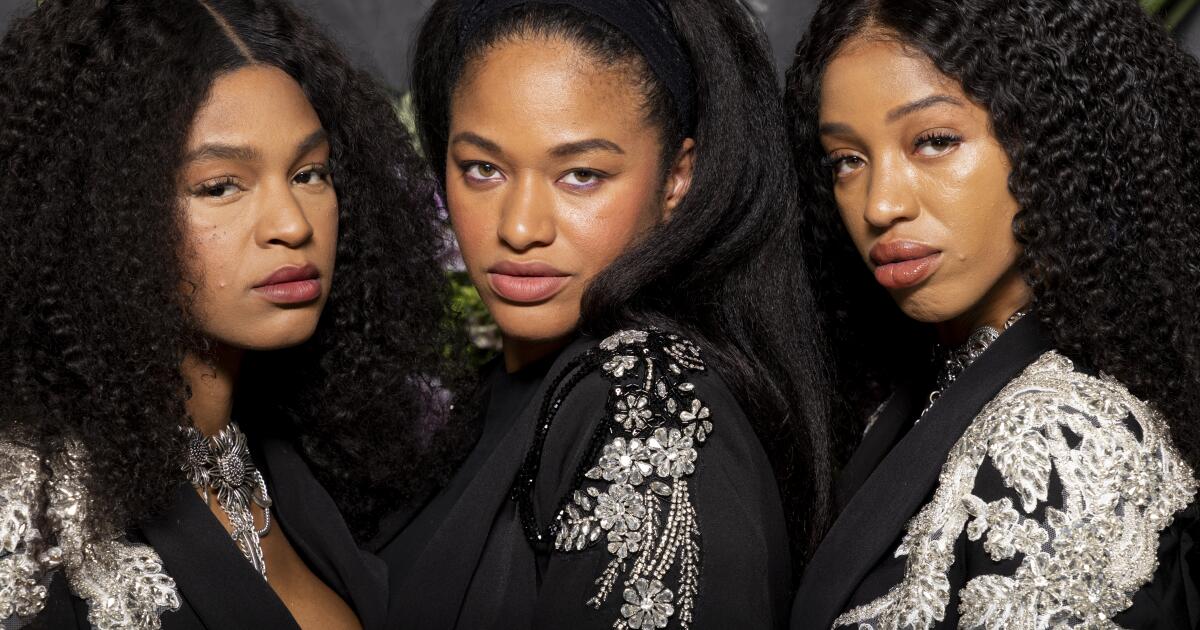

It was the early ‘90s, and sisters BG, Zeimani and Kucha were at a family reunion on a horse ranch in West Virginia. While gathered around a crackling campfire, they swayed to the sounds of guitar strings and buttery baritone vocals, ensconced in a halo of warmth. But what made this particular family sing-along remarkable was that one of the lead voices belonged to soul legend Bobby Womack. The three sisters, who were children at the time, were his nieces, who lovingly referred to him as “Uncle Bob.”
Known as the Womack Sisters, BG, Zeimani and Kucha, come from an illustrious musical lineage. In addition to their famous uncle, whose more than 60-year career gave the world songs like “Across 110th Street” and a haunting rendition of “California Dreamin’,” their maternal grandfather is celebrated Chicago singer and songwriter Sam Cooke, who was dubbed “King of Soul.” Cooke was fatally shot by a motel manager in South Central Los Angeles in 1964 under mysterious and contentious circumstances. His death robbed the Womack Sisters of a grandfather, but his musical legacy continues to influence them today.
Though the Womacks come from a line of West Virginian horse breeders, there was nothing Americana about the childhoods of BG, Zeimani and Kucha. They were three of seven home-schooled children, so their parents were their best friends and teachers. As the children grew up, their parents also became their mentors, managers and producers. Providing an education for their brood that no classroom or textbook could offer, Cecil and Linda Womack (née Linda Cooke) traveled the globe with their kids in tow, bouncing between languages and countries, recording albums, playing shows and picking up threads of each city’s culture along the way.
“Our parents wanted to see the world,” BG says with a beaming smile. “It was a beautiful immersive experience coming up on the road with our parents. It was life-changing, the way we moved around with them. We were in all of their interviews, all of their performances, so I felt like we were born into a [musical] group. That’s really what molded our love of music and our work ethic.”
“We’ve definitely been bred up in this music,” BG reflects. “Our family’s been doing this for five generations, all the way back to gospel, but if you ask us what genres we relate to most, it’s a little bit of everything.”
(Ian Spanier / For The Times)
Cecil and Linda performed together as Womack & Womack, best known for their 1988 hit “Teardrops,” and later as Zekkariyas & Zeriiya, respectively. A talented songwriter, Cecil wrote tracks for Patti Labelle, the Four Tops and the O’Jays. He also wrote Teddy Pendergrass’ “Love T.K.O.,” which was famously sampled in Ahmed Lewis’ 1994 nostalgic hip-hop single, “Back in the Day,” among others. In the early 1960s, brothers Cecil and Bobby Womack performed together in the Valentinos, whose biggest hit, “It’s All Over Now,” was covered by the Rolling Stones in 1964.
Cecil, Linda and their seven children connected with the rich sounds of each culture they passed through. Those connections particularly influenced BG, Zeimani and Kucha. From the sonorous morna of Cape Verdean singer Cesária Évora to the Catalan-French rumba, flamenco and salsa of the Gipsy Kings, the sisters’ musical sensibilities were incrementally layered over time like the compressed strata of sedimentary stone, creating a dense audio IQ.

“We’ve definitely been bred up in this music,” BG reflects. “Our family’s been doing this for five generations, all the way back to gospel, but if you ask us what genres we relate to most, it’s a little bit of everything. We have all that culture bottled up inside of us, and it’s a collage of culture that comes out.”
One might assume that three talented artists with “Womack” and “Cooke” attached to their names would have an easy path, but that wasn’t the case for the Womack Sisters. With their debut full-length self-titled album released Friday, the same day as their first Hollywood Bowl appearance supporting Al Green, this moment was not handed to them on a silver platter. Though they had plenty of guidance from family and their connections, not to mention a musical upbringing, their journey was fraught with grief, criticism, rejection, racism and disappointment. Even with the advantages into which they were born, their career was not easily won; it was earned.

After their independently released single and EP “Legacy” sparked renewed industry interest, the Womack Sisters signed with Daptone and now debut an LP that spotlights uncompromising, cross-cultural soul.
(Ian Spanier / For The Times)
Their journey began in 2007, when BG, Zeimani and Kucha moved to Los Angeles to pursue music with minds full of inspiration and melodies. They connected with their uncle Bobby Womack and brother Meech Wells, singing at open mics, working as background vocalists, and arranging and writing for artists like Mya, Earl St. Clair, the Game, B.O.B, Eddie Murphy and Solange Knowles. Their trajectory toward success seemed iron-clad.
By 2013, they were working on their debut album, produced by their manager, who was also their father, Cecil. When he became ill and died shortly thereafter, the sisters’ lives and careers ground to a halt. As they retreated from music into grief, their Uncle Bob stepped in to help them finish what his brother Cecil had started — the Womack Sisters’ first album. But then in 2014, there was more sad news. While the sisters were still in the throes of mourning their father, Bobby Womack also died.

“Besides the fact that they were both hands-on with our career, these are two people who were our besties,” BG recounts.
“People don’t understand that we were extremely close to our parents,” Kucha adds. “Typically, when you’re growing up as a kid, you have other outlets or cool things to do, but for us, everything was related back to them. When our dad passed, we had to figure out how to live again.”
Grief weighed heavily on them, and at the same time, the industry’s relentless criticism disillusioned them. They were not welcomed by industry gatekeepers, whom they declined to name. According to BG, Kucha and Zeimani, they were told by various labels to get rhinoplasties, that they didn’t look like stars, that their skin could be lighter, that soul music looks different now, and whatever it supposedly looks like, apparently it isn’t the Womack Sisters. With no career prospects and their ballasts gone, they were adrift.
While healing from their losses, they hustled, working as caregivers, nannies, Uber drivers and house cleaners. Despite their hardships, they refused to compromise or mold themselves into someone else’s narrow, antiquated vision. Instead, they patiently and independently funded, recorded, and released their first single, “Darling” in 2017, in honor of the late Womack brothers. Later, they became involved with a label that was embroiled in a lawsuit, which proved to be yet another dead-end. As their legal ordeal came to a close, they finally got their big break: Solange Knowles asked them to join her tour. They accepted, but then everyone’s favorite year arrived, and along with it, a global pandemic.
“Every time we started taking off, we’d hit another roadblock,” BG says.
“We started to feel like maybe we’re not supposed to do this,” Zeimani adds. “These roadblocks keep coming up, and it can make you feel like maybe God’s trying to tell me something.”
“There were a lot of setbacks in a row,” BG says, “but we refocused and realized this was a time for us to get settled in our ways and not be so flexible and foldable. We were like, ‘This is who we are; this is how we look.’ If we have to work three or four jobs, we will, ‘cause we wanna get the music right.’ ”

Kucha, from left, Zeimani and BG Womack.
(Ian Spanier / For The Times)
And get it right, they did. In 2022, they returned to the studio and recorded their EP “Legacy,” which featured a cover of Sam Cooke’s “A Change Is Gonna Come,” a tribute to their grandfather. Like a mass awakening, labels and executives began courting them, making offers that were unimaginable just a few years earlier. Many of the offers centered on capitalizing on their family names and pigeonholing them into commercial pop or hip-hop, which they tried and ultimately disliked. Having gained insight from past experiences, they no longer sought the biggest name or highest bidder but, rather, the best collaborator. They eventually found their unicorn in Gabriel “Bosco Mann” Roth, producer, songwriter and co-founder of Daptone Records.
Though they first connected with Roth in 2016, they signed with Daptone in 2025 adding their names to a roster that includes Thee Sacred Souls, the Budos Band, Antibalas, the late Sharon Jones and the late Charles Bradley .
The Womack Sisters’ debut eponymous LP hits that sweet spot between familiar and fresh, and puts their “collage of culture” on full display. It features the Latin-influenced soul bop “If I Let You,” which quickly went viral and garnered praise from artists such as Questlove, Ghostface Killah, Erykah Badu, Pharrell Williams, SZA and Timbaland. You’ll also hear the relatable ballad “Chauffeur,” which chronicles their time working as Uber drivers, and the poignant ode “My Sisters and Me,” whose wholesome chorus croons, “People come and go, darlin’, this I know, it will always be my sisters and me.”
It seems the Womack Sisters are finally on the trajectory they have earned, which they did with sincerity and without settling.
“We stuck to our guns,” BG says. “We’re very high on quality, and we’re high on authenticity. Music was always the main goal, and that’s why we chose Daptone; we’re on the same page about that, ‘cause music is a vibration. It really does affect your soul, so you don’t wanna mess with those frequencies.”

It was the early ‘90s, and sisters BG, Zeimani and Kucha were at a family reunion on a horse ranch in West Virginia. While gathered around a crackling campfire, they swayed to the sounds of guitar strings and buttery baritone vocals, ensconced in a halo of warmth. But what made this particular family sing-along remarkable was that one of the lead voices belonged to soul legend Bobby Womack. The three sisters, who were children at the time, were his nieces, who lovingly referred to him as “Uncle Bob.”
Known as the Womack Sisters, BG, Zeimani and Kucha, come from an illustrious musical lineage. In addition to their famous uncle, whose more than 60-year career gave the world songs like “Across 110th Street” and a haunting rendition of “California Dreamin’,” their maternal grandfather is celebrated Chicago singer and songwriter Sam Cooke, who was dubbed “King of Soul.” Cooke was fatally shot by a motel manager in South Central Los Angeles in 1964 under mysterious and contentious circumstances. His death robbed the Womack Sisters of a grandfather, but his musical legacy continues to influence them today.
Though the Womacks come from a line of West Virginian horse breeders, there was nothing Americana about the childhoods of BG, Zeimani and Kucha. They were three of seven home-schooled children, so their parents were their best friends and teachers. As the children grew up, their parents also became their mentors, managers and producers. Providing an education for their brood that no classroom or textbook could offer, Cecil and Linda Womack (née Linda Cooke) traveled the globe with their kids in tow, bouncing between languages and countries, recording albums, playing shows and picking up threads of each city’s culture along the way.
“Our parents wanted to see the world,” BG says with a beaming smile. “It was a beautiful immersive experience coming up on the road with our parents. It was life-changing, the way we moved around with them. We were in all of their interviews, all of their performances, so I felt like we were born into a [musical] group. That’s really what molded our love of music and our work ethic.”
“We’ve definitely been bred up in this music,” BG reflects. “Our family’s been doing this for five generations, all the way back to gospel, but if you ask us what genres we relate to most, it’s a little bit of everything.”
(Ian Spanier / For The Times)
Cecil and Linda performed together as Womack & Womack, best known for their 1988 hit “Teardrops,” and later as Zekkariyas & Zeriiya, respectively. A talented songwriter, Cecil wrote tracks for Patti Labelle, the Four Tops and the O’Jays. He also wrote Teddy Pendergrass’ “Love T.K.O.,” which was famously sampled in Ahmed Lewis’ 1994 nostalgic hip-hop single, “Back in the Day,” among others. In the early 1960s, brothers Cecil and Bobby Womack performed together in the Valentinos, whose biggest hit, “It’s All Over Now,” was covered by the Rolling Stones in 1964.
Cecil, Linda and their seven children connected with the rich sounds of each culture they passed through. Those connections particularly influenced BG, Zeimani and Kucha. From the sonorous morna of Cape Verdean singer Cesária Évora to the Catalan-French rumba, flamenco and salsa of the Gipsy Kings, the sisters’ musical sensibilities were incrementally layered over time like the compressed strata of sedimentary stone, creating a dense audio IQ.
“We’ve definitely been bred up in this music,” BG reflects. “Our family’s been doing this for five generations, all the way back to gospel, but if you ask us what genres we relate to most, it’s a little bit of everything. We have all that culture bottled up inside of us, and it’s a collage of culture that comes out.”
One might assume that three talented artists with “Womack” and “Cooke” attached to their names would have an easy path, but that wasn’t the case for the Womack Sisters. With their debut full-length self-titled album released Friday, the same day as their first Hollywood Bowl appearance supporting Al Green, this moment was not handed to them on a silver platter. Though they had plenty of guidance from family and their connections, not to mention a musical upbringing, their journey was fraught with grief, criticism, rejection, racism and disappointment. Even with the advantages into which they were born, their career was not easily won; it was earned.
After their independently released single and EP “Legacy” sparked renewed industry interest, the Womack Sisters signed with Daptone and now debut an LP that spotlights uncompromising, cross-cultural soul.
(Ian Spanier / For The Times)
Their journey began in 2007, when BG, Zeimani and Kucha moved to Los Angeles to pursue music with minds full of inspiration and melodies. They connected with their uncle Bobby Womack and brother Meech Wells, singing at open mics, working as background vocalists, and arranging and writing for artists like Mya, Earl St. Clair, the Game, B.O.B, Eddie Murphy and Solange Knowles. Their trajectory toward success seemed iron-clad.
By 2013, they were working on their debut album, produced by their manager, who was also their father, Cecil. When he became ill and died shortly thereafter, the sisters’ lives and careers ground to a halt. As they retreated from music into grief, their Uncle Bob stepped in to help them finish what his brother Cecil had started — the Womack Sisters’ first album. But then in 2014, there was more sad news. While the sisters were still in the throes of mourning their father, Bobby Womack also died.
“Besides the fact that they were both hands-on with our career, these are two people who were our besties,” BG recounts.
“People don’t understand that we were extremely close to our parents,” Kucha adds. “Typically, when you’re growing up as a kid, you have other outlets or cool things to do, but for us, everything was related back to them. When our dad passed, we had to figure out how to live again.”
Grief weighed heavily on them, and at the same time, the industry’s relentless criticism disillusioned them. They were not welcomed by industry gatekeepers, whom they declined to name. According to BG, Kucha and Zeimani, they were told by various labels to get rhinoplasties, that they didn’t look like stars, that their skin could be lighter, that soul music looks different now, and whatever it supposedly looks like, apparently it isn’t the Womack Sisters. With no career prospects and their ballasts gone, they were adrift.
While healing from their losses, they hustled, working as caregivers, nannies, Uber drivers and house cleaners. Despite their hardships, they refused to compromise or mold themselves into someone else’s narrow, antiquated vision. Instead, they patiently and independently funded, recorded, and released their first single, “Darling” in 2017, in honor of the late Womack brothers. Later, they became involved with a label that was embroiled in a lawsuit, which proved to be yet another dead-end. As their legal ordeal came to a close, they finally got their big break: Solange Knowles asked them to join her tour. They accepted, but then everyone’s favorite year arrived, and along with it, a global pandemic.
“Every time we started taking off, we’d hit another roadblock,” BG says.
“We started to feel like maybe we’re not supposed to do this,” Zeimani adds. “These roadblocks keep coming up, and it can make you feel like maybe God’s trying to tell me something.”
“There were a lot of setbacks in a row,” BG says, “but we refocused and realized this was a time for us to get settled in our ways and not be so flexible and foldable. We were like, ‘This is who we are; this is how we look.’ If we have to work three or four jobs, we will, ‘cause we wanna get the music right.’ ”
Kucha, from left, Zeimani and BG Womack.
(Ian Spanier / For The Times)
And get it right, they did. In 2022, they returned to the studio and recorded their EP “Legacy,” which featured a cover of Sam Cooke’s “A Change Is Gonna Come,” a tribute to their grandfather. Like a mass awakening, labels and executives began courting them, making offers that were unimaginable just a few years earlier. Many of the offers centered on capitalizing on their family names and pigeonholing them into commercial pop or hip-hop, which they tried and ultimately disliked. Having gained insight from past experiences, they no longer sought the biggest name or highest bidder but, rather, the best collaborator. They eventually found their unicorn in Gabriel “Bosco Mann” Roth, producer, songwriter and co-founder of Daptone Records.
Though they first connected with Roth in 2016, they signed with Daptone in 2025 adding their names to a roster that includes Thee Sacred Souls, the Budos Band, Antibalas, the late Sharon Jones and the late Charles Bradley .
The Womack Sisters’ debut eponymous LP hits that sweet spot between familiar and fresh, and puts their “collage of culture” on full display. It features the Latin-influenced soul bop “If I Let You,” which quickly went viral and garnered praise from artists such as Questlove, Ghostface Killah, Erykah Badu, Pharrell Williams, SZA and Timbaland. You’ll also hear the relatable ballad “Chauffeur,” which chronicles their time working as Uber drivers, and the poignant ode “My Sisters and Me,” whose wholesome chorus croons, “People come and go, darlin’, this I know, it will always be my sisters and me.”
It seems the Womack Sisters are finally on the trajectory they have earned, which they did with sincerity and without settling.
“We stuck to our guns,” BG says. “We’re very high on quality, and we’re high on authenticity. Music was always the main goal, and that’s why we chose Daptone; we’re on the same page about that, ‘cause music is a vibration. It really does affect your soul, so you don’t wanna mess with those frequencies.”

It was the early ‘90s, and sisters BG, Zeimani and Kucha were at a family reunion on a horse ranch in West Virginia. While gathered around a crackling campfire, they swayed to the sounds of guitar strings and buttery baritone vocals, ensconced in a halo of warmth. But what made this particular family sing-along remarkable was that one of the lead voices belonged to soul legend Bobby Womack. The three sisters, who were children at the time, were his nieces, who lovingly referred to him as “Uncle Bob.”
Known as the Womack Sisters, BG, Zeimani and Kucha, come from an illustrious musical lineage. In addition to their famous uncle, whose more than 60-year career gave the world songs like “Across 110th Street” and a haunting rendition of “California Dreamin’,” their maternal grandfather is celebrated Chicago singer and songwriter Sam Cooke, who was dubbed “King of Soul.” Cooke was fatally shot by a motel manager in South Central Los Angeles in 1964 under mysterious and contentious circumstances. His death robbed the Womack Sisters of a grandfather, but his musical legacy continues to influence them today.
Though the Womacks come from a line of West Virginian horse breeders, there was nothing Americana about the childhoods of BG, Zeimani and Kucha. They were three of seven home-schooled children, so their parents were their best friends and teachers. As the children grew up, their parents also became their mentors, managers and producers. Providing an education for their brood that no classroom or textbook could offer, Cecil and Linda Womack (née Linda Cooke) traveled the globe with their kids in tow, bouncing between languages and countries, recording albums, playing shows and picking up threads of each city’s culture along the way.
“Our parents wanted to see the world,” BG says with a beaming smile. “It was a beautiful immersive experience coming up on the road with our parents. It was life-changing, the way we moved around with them. We were in all of their interviews, all of their performances, so I felt like we were born into a [musical] group. That’s really what molded our love of music and our work ethic.”
“We’ve definitely been bred up in this music,” BG reflects. “Our family’s been doing this for five generations, all the way back to gospel, but if you ask us what genres we relate to most, it’s a little bit of everything.”
(Ian Spanier / For The Times)
Cecil and Linda performed together as Womack & Womack, best known for their 1988 hit “Teardrops,” and later as Zekkariyas & Zeriiya, respectively. A talented songwriter, Cecil wrote tracks for Patti Labelle, the Four Tops and the O’Jays. He also wrote Teddy Pendergrass’ “Love T.K.O.,” which was famously sampled in Ahmed Lewis’ 1994 nostalgic hip-hop single, “Back in the Day,” among others. In the early 1960s, brothers Cecil and Bobby Womack performed together in the Valentinos, whose biggest hit, “It’s All Over Now,” was covered by the Rolling Stones in 1964.
Cecil, Linda and their seven children connected with the rich sounds of each culture they passed through. Those connections particularly influenced BG, Zeimani and Kucha. From the sonorous morna of Cape Verdean singer Cesária Évora to the Catalan-French rumba, flamenco and salsa of the Gipsy Kings, the sisters’ musical sensibilities were incrementally layered over time like the compressed strata of sedimentary stone, creating a dense audio IQ.
“We’ve definitely been bred up in this music,” BG reflects. “Our family’s been doing this for five generations, all the way back to gospel, but if you ask us what genres we relate to most, it’s a little bit of everything. We have all that culture bottled up inside of us, and it’s a collage of culture that comes out.”
One might assume that three talented artists with “Womack” and “Cooke” attached to their names would have an easy path, but that wasn’t the case for the Womack Sisters. With their debut full-length self-titled album released Friday, the same day as their first Hollywood Bowl appearance supporting Al Green, this moment was not handed to them on a silver platter. Though they had plenty of guidance from family and their connections, not to mention a musical upbringing, their journey was fraught with grief, criticism, rejection, racism and disappointment. Even with the advantages into which they were born, their career was not easily won; it was earned.
After their independently released single and EP “Legacy” sparked renewed industry interest, the Womack Sisters signed with Daptone and now debut an LP that spotlights uncompromising, cross-cultural soul.
(Ian Spanier / For The Times)
Their journey began in 2007, when BG, Zeimani and Kucha moved to Los Angeles to pursue music with minds full of inspiration and melodies. They connected with their uncle Bobby Womack and brother Meech Wells, singing at open mics, working as background vocalists, and arranging and writing for artists like Mya, Earl St. Clair, the Game, B.O.B, Eddie Murphy and Solange Knowles. Their trajectory toward success seemed iron-clad.
By 2013, they were working on their debut album, produced by their manager, who was also their father, Cecil. When he became ill and died shortly thereafter, the sisters’ lives and careers ground to a halt. As they retreated from music into grief, their Uncle Bob stepped in to help them finish what his brother Cecil had started — the Womack Sisters’ first album. But then in 2014, there was more sad news. While the sisters were still in the throes of mourning their father, Bobby Womack also died.
“Besides the fact that they were both hands-on with our career, these are two people who were our besties,” BG recounts.
“People don’t understand that we were extremely close to our parents,” Kucha adds. “Typically, when you’re growing up as a kid, you have other outlets or cool things to do, but for us, everything was related back to them. When our dad passed, we had to figure out how to live again.”
Grief weighed heavily on them, and at the same time, the industry’s relentless criticism disillusioned them. They were not welcomed by industry gatekeepers, whom they declined to name. According to BG, Kucha and Zeimani, they were told by various labels to get rhinoplasties, that they didn’t look like stars, that their skin could be lighter, that soul music looks different now, and whatever it supposedly looks like, apparently it isn’t the Womack Sisters. With no career prospects and their ballasts gone, they were adrift.
While healing from their losses, they hustled, working as caregivers, nannies, Uber drivers and house cleaners. Despite their hardships, they refused to compromise or mold themselves into someone else’s narrow, antiquated vision. Instead, they patiently and independently funded, recorded, and released their first single, “Darling” in 2017, in honor of the late Womack brothers. Later, they became involved with a label that was embroiled in a lawsuit, which proved to be yet another dead-end. As their legal ordeal came to a close, they finally got their big break: Solange Knowles asked them to join her tour. They accepted, but then everyone’s favorite year arrived, and along with it, a global pandemic.
“Every time we started taking off, we’d hit another roadblock,” BG says.
“We started to feel like maybe we’re not supposed to do this,” Zeimani adds. “These roadblocks keep coming up, and it can make you feel like maybe God’s trying to tell me something.”
“There were a lot of setbacks in a row,” BG says, “but we refocused and realized this was a time for us to get settled in our ways and not be so flexible and foldable. We were like, ‘This is who we are; this is how we look.’ If we have to work three or four jobs, we will, ‘cause we wanna get the music right.’ ”
Kucha, from left, Zeimani and BG Womack.
(Ian Spanier / For The Times)
And get it right, they did. In 2022, they returned to the studio and recorded their EP “Legacy,” which featured a cover of Sam Cooke’s “A Change Is Gonna Come,” a tribute to their grandfather. Like a mass awakening, labels and executives began courting them, making offers that were unimaginable just a few years earlier. Many of the offers centered on capitalizing on their family names and pigeonholing them into commercial pop or hip-hop, which they tried and ultimately disliked. Having gained insight from past experiences, they no longer sought the biggest name or highest bidder but, rather, the best collaborator. They eventually found their unicorn in Gabriel “Bosco Mann” Roth, producer, songwriter and co-founder of Daptone Records.
Though they first connected with Roth in 2016, they signed with Daptone in 2025 adding their names to a roster that includes Thee Sacred Souls, the Budos Band, Antibalas, the late Sharon Jones and the late Charles Bradley .
The Womack Sisters’ debut eponymous LP hits that sweet spot between familiar and fresh, and puts their “collage of culture” on full display. It features the Latin-influenced soul bop “If I Let You,” which quickly went viral and garnered praise from artists such as Questlove, Ghostface Killah, Erykah Badu, Pharrell Williams, SZA and Timbaland. You’ll also hear the relatable ballad “Chauffeur,” which chronicles their time working as Uber drivers, and the poignant ode “My Sisters and Me,” whose wholesome chorus croons, “People come and go, darlin’, this I know, it will always be my sisters and me.”
It seems the Womack Sisters are finally on the trajectory they have earned, which they did with sincerity and without settling.
“We stuck to our guns,” BG says. “We’re very high on quality, and we’re high on authenticity. Music was always the main goal, and that’s why we chose Daptone; we’re on the same page about that, ‘cause music is a vibration. It really does affect your soul, so you don’t wanna mess with those frequencies.”
It was the early ‘90s, and sisters BG, Zeimani and Kucha were at a family reunion on a horse ranch in West Virginia. While gathered around a crackling campfire, they swayed to the sounds of guitar strings and buttery baritone vocals, ensconced in a halo of warmth. But what made this particular family sing-along remarkable was that one of the lead voices belonged to soul legend Bobby Womack. The three sisters, who were children at the time, were his nieces, who lovingly referred to him as “Uncle Bob.”
Known as the Womack Sisters, BG, Zeimani and Kucha, come from an illustrious musical lineage. In addition to their famous uncle, whose more than 60-year career gave the world songs like “Across 110th Street” and a haunting rendition of “California Dreamin’,” their maternal grandfather is celebrated Chicago singer and songwriter Sam Cooke, who was dubbed “King of Soul.” Cooke was fatally shot by a motel manager in South Central Los Angeles in 1964 under mysterious and contentious circumstances. His death robbed the Womack Sisters of a grandfather, but his musical legacy continues to influence them today.
Though the Womacks come from a line of West Virginian horse breeders, there was nothing Americana about the childhoods of BG, Zeimani and Kucha. They were three of seven home-schooled children, so their parents were their best friends and teachers. As the children grew up, their parents also became their mentors, managers and producers. Providing an education for their brood that no classroom or textbook could offer, Cecil and Linda Womack (née Linda Cooke) traveled the globe with their kids in tow, bouncing between languages and countries, recording albums, playing shows and picking up threads of each city’s culture along the way.
“Our parents wanted to see the world,” BG says with a beaming smile. “It was a beautiful immersive experience coming up on the road with our parents. It was life-changing, the way we moved around with them. We were in all of their interviews, all of their performances, so I felt like we were born into a [musical] group. That’s really what molded our love of music and our work ethic.”
“We’ve definitely been bred up in this music,” BG reflects. “Our family’s been doing this for five generations, all the way back to gospel, but if you ask us what genres we relate to most, it’s a little bit of everything.”
(Ian Spanier / For The Times)
Cecil and Linda performed together as Womack & Womack, best known for their 1988 hit “Teardrops,” and later as Zekkariyas & Zeriiya, respectively. A talented songwriter, Cecil wrote tracks for Patti Labelle, the Four Tops and the O’Jays. He also wrote Teddy Pendergrass’ “Love T.K.O.,” which was famously sampled in Ahmed Lewis’ 1994 nostalgic hip-hop single, “Back in the Day,” among others. In the early 1960s, brothers Cecil and Bobby Womack performed together in the Valentinos, whose biggest hit, “It’s All Over Now,” was covered by the Rolling Stones in 1964.
Cecil, Linda and their seven children connected with the rich sounds of each culture they passed through. Those connections particularly influenced BG, Zeimani and Kucha. From the sonorous morna of Cape Verdean singer Cesária Évora to the Catalan-French rumba, flamenco and salsa of the Gipsy Kings, the sisters’ musical sensibilities were incrementally layered over time like the compressed strata of sedimentary stone, creating a dense audio IQ.
“We’ve definitely been bred up in this music,” BG reflects. “Our family’s been doing this for five generations, all the way back to gospel, but if you ask us what genres we relate to most, it’s a little bit of everything. We have all that culture bottled up inside of us, and it’s a collage of culture that comes out.”
One might assume that three talented artists with “Womack” and “Cooke” attached to their names would have an easy path, but that wasn’t the case for the Womack Sisters. With their debut full-length self-titled album released Friday, the same day as their first Hollywood Bowl appearance supporting Al Green, this moment was not handed to them on a silver platter. Though they had plenty of guidance from family and their connections, not to mention a musical upbringing, their journey was fraught with grief, criticism, rejection, racism and disappointment. Even with the advantages into which they were born, their career was not easily won; it was earned.
After their independently released single and EP “Legacy” sparked renewed industry interest, the Womack Sisters signed with Daptone and now debut an LP that spotlights uncompromising, cross-cultural soul.
(Ian Spanier / For The Times)
Their journey began in 2007, when BG, Zeimani and Kucha moved to Los Angeles to pursue music with minds full of inspiration and melodies. They connected with their uncle Bobby Womack and brother Meech Wells, singing at open mics, working as background vocalists, and arranging and writing for artists like Mya, Earl St. Clair, the Game, B.O.B, Eddie Murphy and Solange Knowles. Their trajectory toward success seemed iron-clad.
By 2013, they were working on their debut album, produced by their manager, who was also their father, Cecil. When he became ill and died shortly thereafter, the sisters’ lives and careers ground to a halt. As they retreated from music into grief, their Uncle Bob stepped in to help them finish what his brother Cecil had started — the Womack Sisters’ first album. But then in 2014, there was more sad news. While the sisters were still in the throes of mourning their father, Bobby Womack also died.
“Besides the fact that they were both hands-on with our career, these are two people who were our besties,” BG recounts.
“People don’t understand that we were extremely close to our parents,” Kucha adds. “Typically, when you’re growing up as a kid, you have other outlets or cool things to do, but for us, everything was related back to them. When our dad passed, we had to figure out how to live again.”
Grief weighed heavily on them, and at the same time, the industry’s relentless criticism disillusioned them. They were not welcomed by industry gatekeepers, whom they declined to name. According to BG, Kucha and Zeimani, they were told by various labels to get rhinoplasties, that they didn’t look like stars, that their skin could be lighter, that soul music looks different now, and whatever it supposedly looks like, apparently it isn’t the Womack Sisters. With no career prospects and their ballasts gone, they were adrift.
While healing from their losses, they hustled, working as caregivers, nannies, Uber drivers and house cleaners. Despite their hardships, they refused to compromise or mold themselves into someone else’s narrow, antiquated vision. Instead, they patiently and independently funded, recorded, and released their first single, “Darling” in 2017, in honor of the late Womack brothers. Later, they became involved with a label that was embroiled in a lawsuit, which proved to be yet another dead-end. As their legal ordeal came to a close, they finally got their big break: Solange Knowles asked them to join her tour. They accepted, but then everyone’s favorite year arrived, and along with it, a global pandemic.
“Every time we started taking off, we’d hit another roadblock,” BG says.
“We started to feel like maybe we’re not supposed to do this,” Zeimani adds. “These roadblocks keep coming up, and it can make you feel like maybe God’s trying to tell me something.”
“There were a lot of setbacks in a row,” BG says, “but we refocused and realized this was a time for us to get settled in our ways and not be so flexible and foldable. We were like, ‘This is who we are; this is how we look.’ If we have to work three or four jobs, we will, ‘cause we wanna get the music right.’ ”
Kucha, from left, Zeimani and BG Womack.
(Ian Spanier / For The Times)
And get it right, they did. In 2022, they returned to the studio and recorded their EP “Legacy,” which featured a cover of Sam Cooke’s “A Change Is Gonna Come,” a tribute to their grandfather. Like a mass awakening, labels and executives began courting them, making offers that were unimaginable just a few years earlier. Many of the offers centered on capitalizing on their family names and pigeonholing them into commercial pop or hip-hop, which they tried and ultimately disliked. Having gained insight from past experiences, they no longer sought the biggest name or highest bidder but, rather, the best collaborator. They eventually found their unicorn in Gabriel “Bosco Mann” Roth, producer, songwriter and co-founder of Daptone Records.
Though they first connected with Roth in 2016, they signed with Daptone in 2025 adding their names to a roster that includes Thee Sacred Souls, the Budos Band, Antibalas, the late Sharon Jones and the late Charles Bradley .
The Womack Sisters’ debut eponymous LP hits that sweet spot between familiar and fresh, and puts their “collage of culture” on full display. It features the Latin-influenced soul bop “If I Let You,” which quickly went viral and garnered praise from artists such as Questlove, Ghostface Killah, Erykah Badu, Pharrell Williams, SZA and Timbaland. You’ll also hear the relatable ballad “Chauffeur,” which chronicles their time working as Uber drivers, and the poignant ode “My Sisters and Me,” whose wholesome chorus croons, “People come and go, darlin’, this I know, it will always be my sisters and me.”
It seems the Womack Sisters are finally on the trajectory they have earned, which they did with sincerity and without settling.
“We stuck to our guns,” BG says. “We’re very high on quality, and we’re high on authenticity. Music was always the main goal, and that’s why we chose Daptone; we’re on the same page about that, ‘cause music is a vibration. It really does affect your soul, so you don’t wanna mess with those frequencies.”


