In case the world needed reminding, autocrats don’t give up power easily. And they don’t take criticism well — especially from a beloved pop star with a huge platform and an eye on their jobs.
“Bobi Wine: The People’s President” shows what happens when a prominent public figure tries to unseat a ruler who has held power since 1986. Wine, an Afrobeat singer and songwriter, becomes a member of parliament and runs for the Ugandan presidency. The documentary captures the obstacles put in the singer’s path, from a pandemic to imprisonment, torture and worse. Its narrative flaws (and there are serious ones) are more or less overcome by its compelling protagonist and the loving marital relationship at its center.
Wine (born Robert Kyagulanyi Ssentamu) is magnetic. He commands the stage — or the top of a moving car — with the best of them. The documentary provides ample evidence of this, as crowds amass and follow him, and individuals resonate with his message of restoring democracy. He came “from the ghetto” (“I was a ragamuffin — bruised knuckles,” Wine says), earning him the nickname “Ghetto President.” Despite his success, he still codes as a serious-minded family man, with lyrics that can be convincingly specific, as when he complains about the price of electricity.
He’s no dilettante. Wine is in this for real, against an establishment that is not shy about intimidating its opposition. And, as we see, it doesn’t take long for those tactics to include violence.
“The People’s President” is anchored by a touching personal story, Wine’s enduring romance with wife Barbara “Barbie” Itungo Kyagulanyi. (The film never reveals that she is a published author with a master’s in human-rights law.) Their close bond, first established when they were in college, provides a steady emotional foundation amid the swirling madness of the presidential campaign and the increasing oppression Wine faces.
Unfortunately, the documentary’s narrative lacks important context. The filmmakers make the odd choice of entirely skipping over Wine’s pre-parliament musical career (he has won many awards and released more than 70 songs, many of them socially-oriented), so apart from hearing about him as a starving student, we drop in on him already a star running for office.
Ugandan pop star and presidential candidate Bobi Wine with his wife, Barbara ltungo Kyagulanyi, campaigning in November 2020.
(Lookman Kampala)
Additionally, “The People’s President” expects its audiences to understand that longtime Ugandan President Yoweri Museveni is an autocrat (the validity of several of his elections have been challenged by independent observers, and his party has removed term and age limits). It doesn’t explain how his policies have harmed the Ugandan people, or what Wine would do differently.
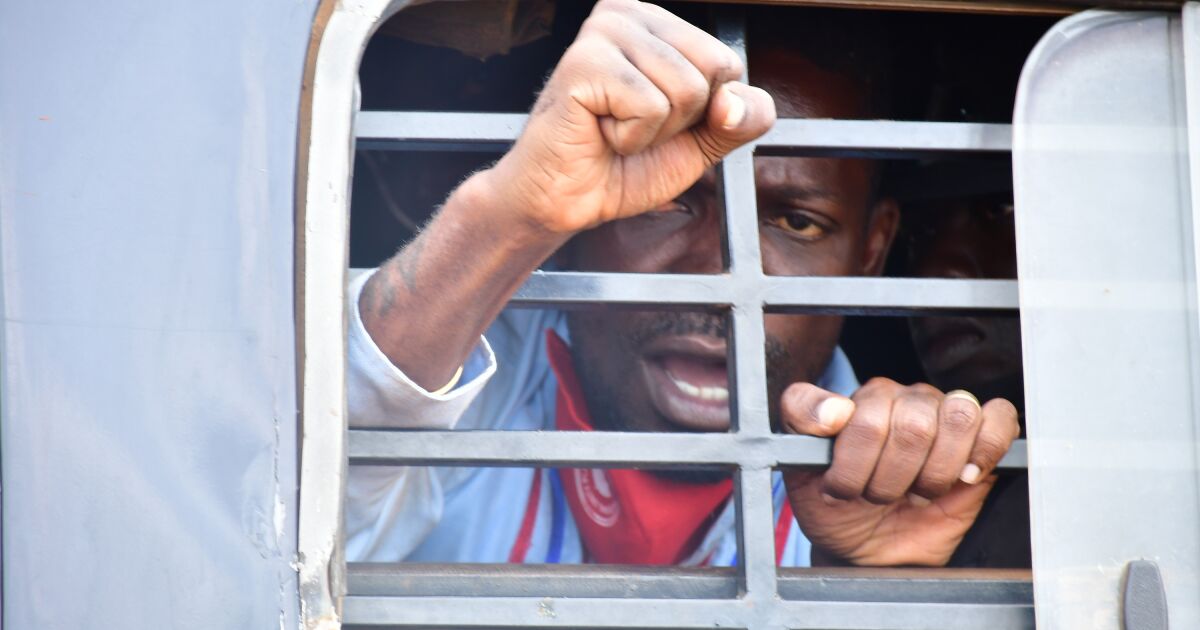
We eventually witness how Museveni uses military force to crush his opponents, including arresting Wine on questionable charges and having him tortured in custody. But even then, though the election’s integrity is dubious at best, it’s unclear in the film how popular or unpopular Museveni is. Viewers will be left to Google on their own.
Threads are introduced and abandoned. Wine claims he was possibly poisoned while in custody — he says he was injected with an unknown substance — and goes to America to seek treatment, but we never hear if anything was found. When serious charges are brought against him, including treason, we learn how only some of them play out.
Nevertheless, Wine’s undaunted courage shines through, as does his blunt message to the West. To an interviewer, he says, “They are propping up a monster in Uganda.”
On these grounds alone, it’s hard not to be swept up in the film, a delivery device for outrage in a moment that could use it.
‘Bobi Wine: The People’s President’
In English and Swahili, with English subtitles
Rating: PG-13, for strong violent content, bloody images and thematic elements
Running time: 1 hour, 58 minutes.
Playing: Starts July 28, Laemmle Royal, West Los Angeles.

In case the world needed reminding, autocrats don’t give up power easily. And they don’t take criticism well — especially from a beloved pop star with a huge platform and an eye on their jobs.
“Bobi Wine: The People’s President” shows what happens when a prominent public figure tries to unseat a ruler who has held power since 1986. Wine, an Afrobeat singer and songwriter, becomes a member of parliament and runs for the Ugandan presidency. The documentary captures the obstacles put in the singer’s path, from a pandemic to imprisonment, torture and worse. Its narrative flaws (and there are serious ones) are more or less overcome by its compelling protagonist and the loving marital relationship at its center.
Wine (born Robert Kyagulanyi Ssentamu) is magnetic. He commands the stage — or the top of a moving car — with the best of them. The documentary provides ample evidence of this, as crowds amass and follow him, and individuals resonate with his message of restoring democracy. He came “from the ghetto” (“I was a ragamuffin — bruised knuckles,” Wine says), earning him the nickname “Ghetto President.” Despite his success, he still codes as a serious-minded family man, with lyrics that can be convincingly specific, as when he complains about the price of electricity.
He’s no dilettante. Wine is in this for real, against an establishment that is not shy about intimidating its opposition. And, as we see, it doesn’t take long for those tactics to include violence.
“The People’s President” is anchored by a touching personal story, Wine’s enduring romance with wife Barbara “Barbie” Itungo Kyagulanyi. (The film never reveals that she is a published author with a master’s in human-rights law.) Their close bond, first established when they were in college, provides a steady emotional foundation amid the swirling madness of the presidential campaign and the increasing oppression Wine faces.
Unfortunately, the documentary’s narrative lacks important context. The filmmakers make the odd choice of entirely skipping over Wine’s pre-parliament musical career (he has won many awards and released more than 70 songs, many of them socially-oriented), so apart from hearing about him as a starving student, we drop in on him already a star running for office.
Ugandan pop star and presidential candidate Bobi Wine with his wife, Barbara ltungo Kyagulanyi, campaigning in November 2020.
(Lookman Kampala)
Additionally, “The People’s President” expects its audiences to understand that longtime Ugandan President Yoweri Museveni is an autocrat (the validity of several of his elections have been challenged by independent observers, and his party has removed term and age limits). It doesn’t explain how his policies have harmed the Ugandan people, or what Wine would do differently.
We eventually witness how Museveni uses military force to crush his opponents, including arresting Wine on questionable charges and having him tortured in custody. But even then, though the election’s integrity is dubious at best, it’s unclear in the film how popular or unpopular Museveni is. Viewers will be left to Google on their own.
Threads are introduced and abandoned. Wine claims he was possibly poisoned while in custody — he says he was injected with an unknown substance — and goes to America to seek treatment, but we never hear if anything was found. When serious charges are brought against him, including treason, we learn how only some of them play out.
Nevertheless, Wine’s undaunted courage shines through, as does his blunt message to the West. To an interviewer, he says, “They are propping up a monster in Uganda.”
On these grounds alone, it’s hard not to be swept up in the film, a delivery device for outrage in a moment that could use it.
‘Bobi Wine: The People’s President’
In English and Swahili, with English subtitles
Rating: PG-13, for strong violent content, bloody images and thematic elements
Running time: 1 hour, 58 minutes.
Playing: Starts July 28, Laemmle Royal, West Los Angeles.

In case the world needed reminding, autocrats don’t give up power easily. And they don’t take criticism well — especially from a beloved pop star with a huge platform and an eye on their jobs.
“Bobi Wine: The People’s President” shows what happens when a prominent public figure tries to unseat a ruler who has held power since 1986. Wine, an Afrobeat singer and songwriter, becomes a member of parliament and runs for the Ugandan presidency. The documentary captures the obstacles put in the singer’s path, from a pandemic to imprisonment, torture and worse. Its narrative flaws (and there are serious ones) are more or less overcome by its compelling protagonist and the loving marital relationship at its center.
Wine (born Robert Kyagulanyi Ssentamu) is magnetic. He commands the stage — or the top of a moving car — with the best of them. The documentary provides ample evidence of this, as crowds amass and follow him, and individuals resonate with his message of restoring democracy. He came “from the ghetto” (“I was a ragamuffin — bruised knuckles,” Wine says), earning him the nickname “Ghetto President.” Despite his success, he still codes as a serious-minded family man, with lyrics that can be convincingly specific, as when he complains about the price of electricity.
He’s no dilettante. Wine is in this for real, against an establishment that is not shy about intimidating its opposition. And, as we see, it doesn’t take long for those tactics to include violence.
“The People’s President” is anchored by a touching personal story, Wine’s enduring romance with wife Barbara “Barbie” Itungo Kyagulanyi. (The film never reveals that she is a published author with a master’s in human-rights law.) Their close bond, first established when they were in college, provides a steady emotional foundation amid the swirling madness of the presidential campaign and the increasing oppression Wine faces.
Unfortunately, the documentary’s narrative lacks important context. The filmmakers make the odd choice of entirely skipping over Wine’s pre-parliament musical career (he has won many awards and released more than 70 songs, many of them socially-oriented), so apart from hearing about him as a starving student, we drop in on him already a star running for office.
Ugandan pop star and presidential candidate Bobi Wine with his wife, Barbara ltungo Kyagulanyi, campaigning in November 2020.
(Lookman Kampala)
Additionally, “The People’s President” expects its audiences to understand that longtime Ugandan President Yoweri Museveni is an autocrat (the validity of several of his elections have been challenged by independent observers, and his party has removed term and age limits). It doesn’t explain how his policies have harmed the Ugandan people, or what Wine would do differently.
We eventually witness how Museveni uses military force to crush his opponents, including arresting Wine on questionable charges and having him tortured in custody. But even then, though the election’s integrity is dubious at best, it’s unclear in the film how popular or unpopular Museveni is. Viewers will be left to Google on their own.
Threads are introduced and abandoned. Wine claims he was possibly poisoned while in custody — he says he was injected with an unknown substance — and goes to America to seek treatment, but we never hear if anything was found. When serious charges are brought against him, including treason, we learn how only some of them play out.
Nevertheless, Wine’s undaunted courage shines through, as does his blunt message to the West. To an interviewer, he says, “They are propping up a monster in Uganda.”
On these grounds alone, it’s hard not to be swept up in the film, a delivery device for outrage in a moment that could use it.
‘Bobi Wine: The People’s President’
In English and Swahili, with English subtitles
Rating: PG-13, for strong violent content, bloody images and thematic elements
Running time: 1 hour, 58 minutes.
Playing: Starts July 28, Laemmle Royal, West Los Angeles.
In case the world needed reminding, autocrats don’t give up power easily. And they don’t take criticism well — especially from a beloved pop star with a huge platform and an eye on their jobs.
“Bobi Wine: The People’s President” shows what happens when a prominent public figure tries to unseat a ruler who has held power since 1986. Wine, an Afrobeat singer and songwriter, becomes a member of parliament and runs for the Ugandan presidency. The documentary captures the obstacles put in the singer’s path, from a pandemic to imprisonment, torture and worse. Its narrative flaws (and there are serious ones) are more or less overcome by its compelling protagonist and the loving marital relationship at its center.
Wine (born Robert Kyagulanyi Ssentamu) is magnetic. He commands the stage — or the top of a moving car — with the best of them. The documentary provides ample evidence of this, as crowds amass and follow him, and individuals resonate with his message of restoring democracy. He came “from the ghetto” (“I was a ragamuffin — bruised knuckles,” Wine says), earning him the nickname “Ghetto President.” Despite his success, he still codes as a serious-minded family man, with lyrics that can be convincingly specific, as when he complains about the price of electricity.
He’s no dilettante. Wine is in this for real, against an establishment that is not shy about intimidating its opposition. And, as we see, it doesn’t take long for those tactics to include violence.
“The People’s President” is anchored by a touching personal story, Wine’s enduring romance with wife Barbara “Barbie” Itungo Kyagulanyi. (The film never reveals that she is a published author with a master’s in human-rights law.) Their close bond, first established when they were in college, provides a steady emotional foundation amid the swirling madness of the presidential campaign and the increasing oppression Wine faces.
Unfortunately, the documentary’s narrative lacks important context. The filmmakers make the odd choice of entirely skipping over Wine’s pre-parliament musical career (he has won many awards and released more than 70 songs, many of them socially-oriented), so apart from hearing about him as a starving student, we drop in on him already a star running for office.
Ugandan pop star and presidential candidate Bobi Wine with his wife, Barbara ltungo Kyagulanyi, campaigning in November 2020.
(Lookman Kampala)
Additionally, “The People’s President” expects its audiences to understand that longtime Ugandan President Yoweri Museveni is an autocrat (the validity of several of his elections have been challenged by independent observers, and his party has removed term and age limits). It doesn’t explain how his policies have harmed the Ugandan people, or what Wine would do differently.
We eventually witness how Museveni uses military force to crush his opponents, including arresting Wine on questionable charges and having him tortured in custody. But even then, though the election’s integrity is dubious at best, it’s unclear in the film how popular or unpopular Museveni is. Viewers will be left to Google on their own.
Threads are introduced and abandoned. Wine claims he was possibly poisoned while in custody — he says he was injected with an unknown substance — and goes to America to seek treatment, but we never hear if anything was found. When serious charges are brought against him, including treason, we learn how only some of them play out.
Nevertheless, Wine’s undaunted courage shines through, as does his blunt message to the West. To an interviewer, he says, “They are propping up a monster in Uganda.”
On these grounds alone, it’s hard not to be swept up in the film, a delivery device for outrage in a moment that could use it.
‘Bobi Wine: The People’s President’
In English and Swahili, with English subtitles
Rating: PG-13, for strong violent content, bloody images and thematic elements
Running time: 1 hour, 58 minutes.
Playing: Starts July 28, Laemmle Royal, West Los Angeles.

In case the world needed reminding, autocrats don’t give up power easily. And they don’t take criticism well — especially from a beloved pop star with a huge platform and an eye on their jobs.
“Bobi Wine: The People’s President” shows what happens when a prominent public figure tries to unseat a ruler who has held power since 1986. Wine, an Afrobeat singer and songwriter, becomes a member of parliament and runs for the Ugandan presidency. The documentary captures the obstacles put in the singer’s path, from a pandemic to imprisonment, torture and worse. Its narrative flaws (and there are serious ones) are more or less overcome by its compelling protagonist and the loving marital relationship at its center.
Wine (born Robert Kyagulanyi Ssentamu) is magnetic. He commands the stage — or the top of a moving car — with the best of them. The documentary provides ample evidence of this, as crowds amass and follow him, and individuals resonate with his message of restoring democracy. He came “from the ghetto” (“I was a ragamuffin — bruised knuckles,” Wine says), earning him the nickname “Ghetto President.” Despite his success, he still codes as a serious-minded family man, with lyrics that can be convincingly specific, as when he complains about the price of electricity.
He’s no dilettante. Wine is in this for real, against an establishment that is not shy about intimidating its opposition. And, as we see, it doesn’t take long for those tactics to include violence.
“The People’s President” is anchored by a touching personal story, Wine’s enduring romance with wife Barbara “Barbie” Itungo Kyagulanyi. (The film never reveals that she is a published author with a master’s in human-rights law.) Their close bond, first established when they were in college, provides a steady emotional foundation amid the swirling madness of the presidential campaign and the increasing oppression Wine faces.
Unfortunately, the documentary’s narrative lacks important context. The filmmakers make the odd choice of entirely skipping over Wine’s pre-parliament musical career (he has won many awards and released more than 70 songs, many of them socially-oriented), so apart from hearing about him as a starving student, we drop in on him already a star running for office.
Ugandan pop star and presidential candidate Bobi Wine with his wife, Barbara ltungo Kyagulanyi, campaigning in November 2020.
(Lookman Kampala)
Additionally, “The People’s President” expects its audiences to understand that longtime Ugandan President Yoweri Museveni is an autocrat (the validity of several of his elections have been challenged by independent observers, and his party has removed term and age limits). It doesn’t explain how his policies have harmed the Ugandan people, or what Wine would do differently.
We eventually witness how Museveni uses military force to crush his opponents, including arresting Wine on questionable charges and having him tortured in custody. But even then, though the election’s integrity is dubious at best, it’s unclear in the film how popular or unpopular Museveni is. Viewers will be left to Google on their own.
Threads are introduced and abandoned. Wine claims he was possibly poisoned while in custody — he says he was injected with an unknown substance — and goes to America to seek treatment, but we never hear if anything was found. When serious charges are brought against him, including treason, we learn how only some of them play out.
Nevertheless, Wine’s undaunted courage shines through, as does his blunt message to the West. To an interviewer, he says, “They are propping up a monster in Uganda.”
On these grounds alone, it’s hard not to be swept up in the film, a delivery device for outrage in a moment that could use it.
‘Bobi Wine: The People’s President’
In English and Swahili, with English subtitles
Rating: PG-13, for strong violent content, bloody images and thematic elements
Running time: 1 hour, 58 minutes.
Playing: Starts July 28, Laemmle Royal, West Los Angeles.
In case the world needed reminding, autocrats don’t give up power easily. And they don’t take criticism well — especially from a beloved pop star with a huge platform and an eye on their jobs.
“Bobi Wine: The People’s President” shows what happens when a prominent public figure tries to unseat a ruler who has held power since 1986. Wine, an Afrobeat singer and songwriter, becomes a member of parliament and runs for the Ugandan presidency. The documentary captures the obstacles put in the singer’s path, from a pandemic to imprisonment, torture and worse. Its narrative flaws (and there are serious ones) are more or less overcome by its compelling protagonist and the loving marital relationship at its center.
Wine (born Robert Kyagulanyi Ssentamu) is magnetic. He commands the stage — or the top of a moving car — with the best of them. The documentary provides ample evidence of this, as crowds amass and follow him, and individuals resonate with his message of restoring democracy. He came “from the ghetto” (“I was a ragamuffin — bruised knuckles,” Wine says), earning him the nickname “Ghetto President.” Despite his success, he still codes as a serious-minded family man, with lyrics that can be convincingly specific, as when he complains about the price of electricity.
He’s no dilettante. Wine is in this for real, against an establishment that is not shy about intimidating its opposition. And, as we see, it doesn’t take long for those tactics to include violence.
“The People’s President” is anchored by a touching personal story, Wine’s enduring romance with wife Barbara “Barbie” Itungo Kyagulanyi. (The film never reveals that she is a published author with a master’s in human-rights law.) Their close bond, first established when they were in college, provides a steady emotional foundation amid the swirling madness of the presidential campaign and the increasing oppression Wine faces.
Unfortunately, the documentary’s narrative lacks important context. The filmmakers make the odd choice of entirely skipping over Wine’s pre-parliament musical career (he has won many awards and released more than 70 songs, many of them socially-oriented), so apart from hearing about him as a starving student, we drop in on him already a star running for office.
Ugandan pop star and presidential candidate Bobi Wine with his wife, Barbara ltungo Kyagulanyi, campaigning in November 2020.
(Lookman Kampala)
Additionally, “The People’s President” expects its audiences to understand that longtime Ugandan President Yoweri Museveni is an autocrat (the validity of several of his elections have been challenged by independent observers, and his party has removed term and age limits). It doesn’t explain how his policies have harmed the Ugandan people, or what Wine would do differently.
We eventually witness how Museveni uses military force to crush his opponents, including arresting Wine on questionable charges and having him tortured in custody. But even then, though the election’s integrity is dubious at best, it’s unclear in the film how popular or unpopular Museveni is. Viewers will be left to Google on their own.
Threads are introduced and abandoned. Wine claims he was possibly poisoned while in custody — he says he was injected with an unknown substance — and goes to America to seek treatment, but we never hear if anything was found. When serious charges are brought against him, including treason, we learn how only some of them play out.
Nevertheless, Wine’s undaunted courage shines through, as does his blunt message to the West. To an interviewer, he says, “They are propping up a monster in Uganda.”
On these grounds alone, it’s hard not to be swept up in the film, a delivery device for outrage in a moment that could use it.
‘Bobi Wine: The People’s President’
In English and Swahili, with English subtitles
Rating: PG-13, for strong violent content, bloody images and thematic elements
Running time: 1 hour, 58 minutes.
Playing: Starts July 28, Laemmle Royal, West Los Angeles.
In case the world needed reminding, autocrats don’t give up power easily. And they don’t take criticism well — especially from a beloved pop star with a huge platform and an eye on their jobs.
“Bobi Wine: The People’s President” shows what happens when a prominent public figure tries to unseat a ruler who has held power since 1986. Wine, an Afrobeat singer and songwriter, becomes a member of parliament and runs for the Ugandan presidency. The documentary captures the obstacles put in the singer’s path, from a pandemic to imprisonment, torture and worse. Its narrative flaws (and there are serious ones) are more or less overcome by its compelling protagonist and the loving marital relationship at its center.
Wine (born Robert Kyagulanyi Ssentamu) is magnetic. He commands the stage — or the top of a moving car — with the best of them. The documentary provides ample evidence of this, as crowds amass and follow him, and individuals resonate with his message of restoring democracy. He came “from the ghetto” (“I was a ragamuffin — bruised knuckles,” Wine says), earning him the nickname “Ghetto President.” Despite his success, he still codes as a serious-minded family man, with lyrics that can be convincingly specific, as when he complains about the price of electricity.
He’s no dilettante. Wine is in this for real, against an establishment that is not shy about intimidating its opposition. And, as we see, it doesn’t take long for those tactics to include violence.
“The People’s President” is anchored by a touching personal story, Wine’s enduring romance with wife Barbara “Barbie” Itungo Kyagulanyi. (The film never reveals that she is a published author with a master’s in human-rights law.) Their close bond, first established when they were in college, provides a steady emotional foundation amid the swirling madness of the presidential campaign and the increasing oppression Wine faces.
Unfortunately, the documentary’s narrative lacks important context. The filmmakers make the odd choice of entirely skipping over Wine’s pre-parliament musical career (he has won many awards and released more than 70 songs, many of them socially-oriented), so apart from hearing about him as a starving student, we drop in on him already a star running for office.
Ugandan pop star and presidential candidate Bobi Wine with his wife, Barbara ltungo Kyagulanyi, campaigning in November 2020.
(Lookman Kampala)
Additionally, “The People’s President” expects its audiences to understand that longtime Ugandan President Yoweri Museveni is an autocrat (the validity of several of his elections have been challenged by independent observers, and his party has removed term and age limits). It doesn’t explain how his policies have harmed the Ugandan people, or what Wine would do differently.
We eventually witness how Museveni uses military force to crush his opponents, including arresting Wine on questionable charges and having him tortured in custody. But even then, though the election’s integrity is dubious at best, it’s unclear in the film how popular or unpopular Museveni is. Viewers will be left to Google on their own.
Threads are introduced and abandoned. Wine claims he was possibly poisoned while in custody — he says he was injected with an unknown substance — and goes to America to seek treatment, but we never hear if anything was found. When serious charges are brought against him, including treason, we learn how only some of them play out.
Nevertheless, Wine’s undaunted courage shines through, as does his blunt message to the West. To an interviewer, he says, “They are propping up a monster in Uganda.”
On these grounds alone, it’s hard not to be swept up in the film, a delivery device for outrage in a moment that could use it.
‘Bobi Wine: The People’s President’
In English and Swahili, with English subtitles
Rating: PG-13, for strong violent content, bloody images and thematic elements
Running time: 1 hour, 58 minutes.
Playing: Starts July 28, Laemmle Royal, West Los Angeles.
In case the world needed reminding, autocrats don’t give up power easily. And they don’t take criticism well — especially from a beloved pop star with a huge platform and an eye on their jobs.
“Bobi Wine: The People’s President” shows what happens when a prominent public figure tries to unseat a ruler who has held power since 1986. Wine, an Afrobeat singer and songwriter, becomes a member of parliament and runs for the Ugandan presidency. The documentary captures the obstacles put in the singer’s path, from a pandemic to imprisonment, torture and worse. Its narrative flaws (and there are serious ones) are more or less overcome by its compelling protagonist and the loving marital relationship at its center.
Wine (born Robert Kyagulanyi Ssentamu) is magnetic. He commands the stage — or the top of a moving car — with the best of them. The documentary provides ample evidence of this, as crowds amass and follow him, and individuals resonate with his message of restoring democracy. He came “from the ghetto” (“I was a ragamuffin — bruised knuckles,” Wine says), earning him the nickname “Ghetto President.” Despite his success, he still codes as a serious-minded family man, with lyrics that can be convincingly specific, as when he complains about the price of electricity.
He’s no dilettante. Wine is in this for real, against an establishment that is not shy about intimidating its opposition. And, as we see, it doesn’t take long for those tactics to include violence.
“The People’s President” is anchored by a touching personal story, Wine’s enduring romance with wife Barbara “Barbie” Itungo Kyagulanyi. (The film never reveals that she is a published author with a master’s in human-rights law.) Their close bond, first established when they were in college, provides a steady emotional foundation amid the swirling madness of the presidential campaign and the increasing oppression Wine faces.
Unfortunately, the documentary’s narrative lacks important context. The filmmakers make the odd choice of entirely skipping over Wine’s pre-parliament musical career (he has won many awards and released more than 70 songs, many of them socially-oriented), so apart from hearing about him as a starving student, we drop in on him already a star running for office.
Ugandan pop star and presidential candidate Bobi Wine with his wife, Barbara ltungo Kyagulanyi, campaigning in November 2020.
(Lookman Kampala)
Additionally, “The People’s President” expects its audiences to understand that longtime Ugandan President Yoweri Museveni is an autocrat (the validity of several of his elections have been challenged by independent observers, and his party has removed term and age limits). It doesn’t explain how his policies have harmed the Ugandan people, or what Wine would do differently.
We eventually witness how Museveni uses military force to crush his opponents, including arresting Wine on questionable charges and having him tortured in custody. But even then, though the election’s integrity is dubious at best, it’s unclear in the film how popular or unpopular Museveni is. Viewers will be left to Google on their own.
Threads are introduced and abandoned. Wine claims he was possibly poisoned while in custody — he says he was injected with an unknown substance — and goes to America to seek treatment, but we never hear if anything was found. When serious charges are brought against him, including treason, we learn how only some of them play out.
Nevertheless, Wine’s undaunted courage shines through, as does his blunt message to the West. To an interviewer, he says, “They are propping up a monster in Uganda.”
On these grounds alone, it’s hard not to be swept up in the film, a delivery device for outrage in a moment that could use it.
‘Bobi Wine: The People’s President’
In English and Swahili, with English subtitles
Rating: PG-13, for strong violent content, bloody images and thematic elements
Running time: 1 hour, 58 minutes.
Playing: Starts July 28, Laemmle Royal, West Los Angeles.