
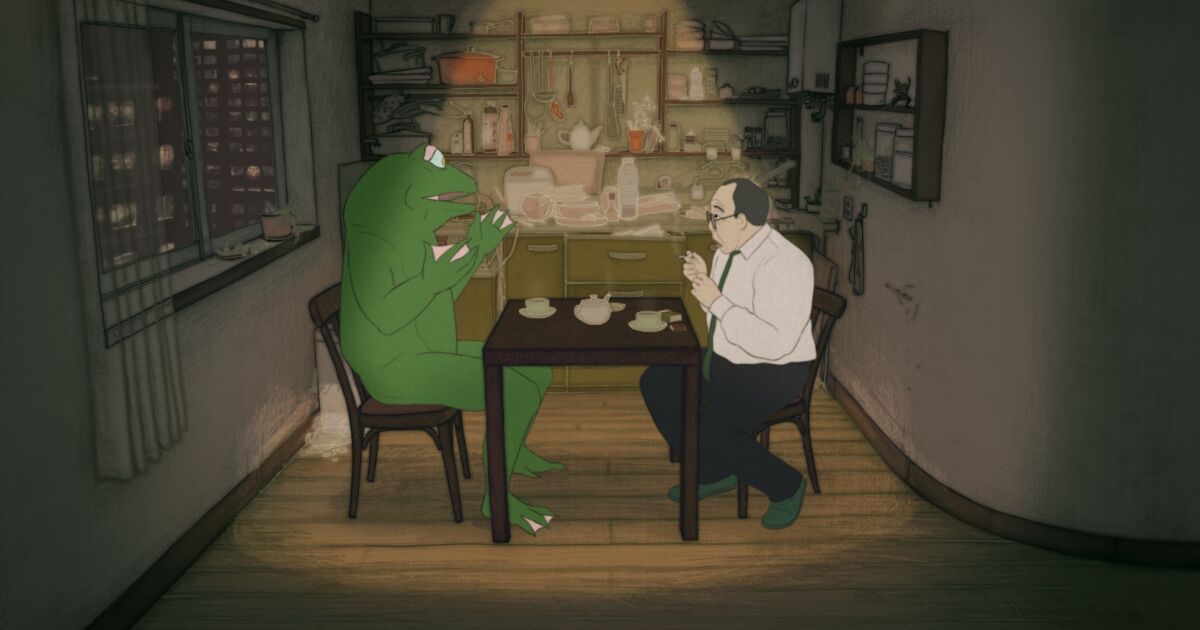
Days after the 2011 Tōhoku earthquake and tsunami that ravaged northern Japan, an anthropomorphic, human-size, chatty frog sits at the kitchen table of Mr. Katagiri (voiced by Marcelo Arroyo), a despondent employee at a lending firm, to inform him that an even larger tremor will soon destroy Tokyo.
The liminal state that such a bizarrely amusing scene invokes, where reality and imagination convene without distinction between the two, encapsulates how the captivating and thoughtfully whimsical animated vision “Blind Willow, Sleeping Woman” operates.
From French director and composer Pierre Földes, the film is a cleverly linear amalgamation of half-a-dozen short stories taken from three different anthologies by acclaimed Japanese author Haruki Murakami — one of which lends it its title.
“Blind Willow” joins recent standout Murakami adaptations such as the Oscar-winning “Drive My Car” or the slow-burn thriller “Burning” by audaciously exploiting its distinct medium.
Closer to the aesthetic of European hand-drawn features than to Japanese anime, the inventive style Földes employs here combined live-action footage with 3-D elements, all of which was ultimately processed by hand to achieve the tactile look of 2-D animation.
For much of the segmented story, Katagiri’s younger co-worker, Komura (Ryan Bommarito), takes the lead. His wife Kyoko (Shoshana Wilder) has left him arguing that he has the emotional substance of “a chunk of air.” The disparaging remark, written in her goodbye note, percolates in his mind throughout his attempts at understanding the separation as he takes a week off from his dull office job.
Through his rearrangement of the short tales, Földes presents each of the three characters with a catalyst that puts their uninspired lives into perspective. While Murakami’s genius ability to ponder grand existential conundrums via seemingly mundane circumstances is the foundation, Földes’ interpretation and preservation of its surrealist quality and absurdist humor forges his own pathway into the material, both faithful and creatively free.
Well-read, the talking frog (vivaciously voiced by Földes himself) drops literary references as he tries to convince sad-sack Katagiri to help him prevent destruction by fighting a giant worm that lives underground. Meanwhile, Komura is offered a free trip in exchange of delivering a small package to a colleague’s sister. For Kyoko, the earthquake reminded her of an encounter in her youth when a stranger granted her a wish on her birthday.
But as the subtext ultimately reveals, the giant amphibian’s proposition, the mysterious black box Komura transports without knowing its contents and Kyoko’s secret wish all symbolize their respective desires to attain an elusive sense of happiness and purpose.
The real-life catastrophe that serves as the adult fable’s backdrop asks these mostly unremarkable individuals to see the fragility of our fleeting time and to reconsider how they move through the world. Background characters are presented as translucid entities reinforcing the idea that most of us, trapped in routinary hells, are already ghosts.
Murakami’s signature feline, a recurrent agent of intrigue in his stories, appears here as a manifestation of Schrödinger’s cat, the theory that suggest a hypothetical animal inside a closed box with a dangerous chemical substance is perceived to be both dead and live until we open the container. Extrapolated to the modern despair depicted in the film, the concept refers to how one can be at once physically alive while emotional inert. Only a drastic change can perhaps open one’s entrapment to reveal there’s something to live for.
Porous enough in their philosophical intent though as not to impose a strict meaning, and yet sufficiently potent to make us reassess our priorities, the array of interpersonal conflicts floating in the idiosyncratic “Blind Willow” feel like elegantly animated lucid dreams full of poetic imagery: far from realistic but viscerally truthful.
‘Blind Willow, Sleeping Woman’
Not Rated
Running time: 1 hour, 50 minutes
Playing: Laemmle’s Royal

Days after the 2011 Tōhoku earthquake and tsunami that ravaged northern Japan, an anthropomorphic, human-size, chatty frog sits at the kitchen table of Mr. Katagiri (voiced by Marcelo Arroyo), a despondent employee at a lending firm, to inform him that an even larger tremor will soon destroy Tokyo.
The liminal state that such a bizarrely amusing scene invokes, where reality and imagination convene without distinction between the two, encapsulates how the captivating and thoughtfully whimsical animated vision “Blind Willow, Sleeping Woman” operates.
From French director and composer Pierre Földes, the film is a cleverly linear amalgamation of half-a-dozen short stories taken from three different anthologies by acclaimed Japanese author Haruki Murakami — one of which lends it its title.
“Blind Willow” joins recent standout Murakami adaptations such as the Oscar-winning “Drive My Car” or the slow-burn thriller “Burning” by audaciously exploiting its distinct medium.
Closer to the aesthetic of European hand-drawn features than to Japanese anime, the inventive style Földes employs here combined live-action footage with 3-D elements, all of which was ultimately processed by hand to achieve the tactile look of 2-D animation.
For much of the segmented story, Katagiri’s younger co-worker, Komura (Ryan Bommarito), takes the lead. His wife Kyoko (Shoshana Wilder) has left him arguing that he has the emotional substance of “a chunk of air.” The disparaging remark, written in her goodbye note, percolates in his mind throughout his attempts at understanding the separation as he takes a week off from his dull office job.
Through his rearrangement of the short tales, Földes presents each of the three characters with a catalyst that puts their uninspired lives into perspective. While Murakami’s genius ability to ponder grand existential conundrums via seemingly mundane circumstances is the foundation, Földes’ interpretation and preservation of its surrealist quality and absurdist humor forges his own pathway into the material, both faithful and creatively free.
Well-read, the talking frog (vivaciously voiced by Földes himself) drops literary references as he tries to convince sad-sack Katagiri to help him prevent destruction by fighting a giant worm that lives underground. Meanwhile, Komura is offered a free trip in exchange of delivering a small package to a colleague’s sister. For Kyoko, the earthquake reminded her of an encounter in her youth when a stranger granted her a wish on her birthday.
But as the subtext ultimately reveals, the giant amphibian’s proposition, the mysterious black box Komura transports without knowing its contents and Kyoko’s secret wish all symbolize their respective desires to attain an elusive sense of happiness and purpose.
The real-life catastrophe that serves as the adult fable’s backdrop asks these mostly unremarkable individuals to see the fragility of our fleeting time and to reconsider how they move through the world. Background characters are presented as translucid entities reinforcing the idea that most of us, trapped in routinary hells, are already ghosts.
Murakami’s signature feline, a recurrent agent of intrigue in his stories, appears here as a manifestation of Schrödinger’s cat, the theory that suggest a hypothetical animal inside a closed box with a dangerous chemical substance is perceived to be both dead and live until we open the container. Extrapolated to the modern despair depicted in the film, the concept refers to how one can be at once physically alive while emotional inert. Only a drastic change can perhaps open one’s entrapment to reveal there’s something to live for.
Porous enough in their philosophical intent though as not to impose a strict meaning, and yet sufficiently potent to make us reassess our priorities, the array of interpersonal conflicts floating in the idiosyncratic “Blind Willow” feel like elegantly animated lucid dreams full of poetic imagery: far from realistic but viscerally truthful.
‘Blind Willow, Sleeping Woman’
Not Rated
Running time: 1 hour, 50 minutes
Playing: Laemmle’s Royal

Days after the 2011 Tōhoku earthquake and tsunami that ravaged northern Japan, an anthropomorphic, human-size, chatty frog sits at the kitchen table of Mr. Katagiri (voiced by Marcelo Arroyo), a despondent employee at a lending firm, to inform him that an even larger tremor will soon destroy Tokyo.
The liminal state that such a bizarrely amusing scene invokes, where reality and imagination convene without distinction between the two, encapsulates how the captivating and thoughtfully whimsical animated vision “Blind Willow, Sleeping Woman” operates.
From French director and composer Pierre Földes, the film is a cleverly linear amalgamation of half-a-dozen short stories taken from three different anthologies by acclaimed Japanese author Haruki Murakami — one of which lends it its title.
“Blind Willow” joins recent standout Murakami adaptations such as the Oscar-winning “Drive My Car” or the slow-burn thriller “Burning” by audaciously exploiting its distinct medium.
Closer to the aesthetic of European hand-drawn features than to Japanese anime, the inventive style Földes employs here combined live-action footage with 3-D elements, all of which was ultimately processed by hand to achieve the tactile look of 2-D animation.
For much of the segmented story, Katagiri’s younger co-worker, Komura (Ryan Bommarito), takes the lead. His wife Kyoko (Shoshana Wilder) has left him arguing that he has the emotional substance of “a chunk of air.” The disparaging remark, written in her goodbye note, percolates in his mind throughout his attempts at understanding the separation as he takes a week off from his dull office job.
Through his rearrangement of the short tales, Földes presents each of the three characters with a catalyst that puts their uninspired lives into perspective. While Murakami’s genius ability to ponder grand existential conundrums via seemingly mundane circumstances is the foundation, Földes’ interpretation and preservation of its surrealist quality and absurdist humor forges his own pathway into the material, both faithful and creatively free.
Well-read, the talking frog (vivaciously voiced by Földes himself) drops literary references as he tries to convince sad-sack Katagiri to help him prevent destruction by fighting a giant worm that lives underground. Meanwhile, Komura is offered a free trip in exchange of delivering a small package to a colleague’s sister. For Kyoko, the earthquake reminded her of an encounter in her youth when a stranger granted her a wish on her birthday.
But as the subtext ultimately reveals, the giant amphibian’s proposition, the mysterious black box Komura transports without knowing its contents and Kyoko’s secret wish all symbolize their respective desires to attain an elusive sense of happiness and purpose.
The real-life catastrophe that serves as the adult fable’s backdrop asks these mostly unremarkable individuals to see the fragility of our fleeting time and to reconsider how they move through the world. Background characters are presented as translucid entities reinforcing the idea that most of us, trapped in routinary hells, are already ghosts.
Murakami’s signature feline, a recurrent agent of intrigue in his stories, appears here as a manifestation of Schrödinger’s cat, the theory that suggest a hypothetical animal inside a closed box with a dangerous chemical substance is perceived to be both dead and live until we open the container. Extrapolated to the modern despair depicted in the film, the concept refers to how one can be at once physically alive while emotional inert. Only a drastic change can perhaps open one’s entrapment to reveal there’s something to live for.
Porous enough in their philosophical intent though as not to impose a strict meaning, and yet sufficiently potent to make us reassess our priorities, the array of interpersonal conflicts floating in the idiosyncratic “Blind Willow” feel like elegantly animated lucid dreams full of poetic imagery: far from realistic but viscerally truthful.
‘Blind Willow, Sleeping Woman’
Not Rated
Running time: 1 hour, 50 minutes
Playing: Laemmle’s Royal
Days after the 2011 Tōhoku earthquake and tsunami that ravaged northern Japan, an anthropomorphic, human-size, chatty frog sits at the kitchen table of Mr. Katagiri (voiced by Marcelo Arroyo), a despondent employee at a lending firm, to inform him that an even larger tremor will soon destroy Tokyo.
The liminal state that such a bizarrely amusing scene invokes, where reality and imagination convene without distinction between the two, encapsulates how the captivating and thoughtfully whimsical animated vision “Blind Willow, Sleeping Woman” operates.
From French director and composer Pierre Földes, the film is a cleverly linear amalgamation of half-a-dozen short stories taken from three different anthologies by acclaimed Japanese author Haruki Murakami — one of which lends it its title.
“Blind Willow” joins recent standout Murakami adaptations such as the Oscar-winning “Drive My Car” or the slow-burn thriller “Burning” by audaciously exploiting its distinct medium.
Closer to the aesthetic of European hand-drawn features than to Japanese anime, the inventive style Földes employs here combined live-action footage with 3-D elements, all of which was ultimately processed by hand to achieve the tactile look of 2-D animation.
For much of the segmented story, Katagiri’s younger co-worker, Komura (Ryan Bommarito), takes the lead. His wife Kyoko (Shoshana Wilder) has left him arguing that he has the emotional substance of “a chunk of air.” The disparaging remark, written in her goodbye note, percolates in his mind throughout his attempts at understanding the separation as he takes a week off from his dull office job.
Through his rearrangement of the short tales, Földes presents each of the three characters with a catalyst that puts their uninspired lives into perspective. While Murakami’s genius ability to ponder grand existential conundrums via seemingly mundane circumstances is the foundation, Földes’ interpretation and preservation of its surrealist quality and absurdist humor forges his own pathway into the material, both faithful and creatively free.
Well-read, the talking frog (vivaciously voiced by Földes himself) drops literary references as he tries to convince sad-sack Katagiri to help him prevent destruction by fighting a giant worm that lives underground. Meanwhile, Komura is offered a free trip in exchange of delivering a small package to a colleague’s sister. For Kyoko, the earthquake reminded her of an encounter in her youth when a stranger granted her a wish on her birthday.
But as the subtext ultimately reveals, the giant amphibian’s proposition, the mysterious black box Komura transports without knowing its contents and Kyoko’s secret wish all symbolize their respective desires to attain an elusive sense of happiness and purpose.
The real-life catastrophe that serves as the adult fable’s backdrop asks these mostly unremarkable individuals to see the fragility of our fleeting time and to reconsider how they move through the world. Background characters are presented as translucid entities reinforcing the idea that most of us, trapped in routinary hells, are already ghosts.
Murakami’s signature feline, a recurrent agent of intrigue in his stories, appears here as a manifestation of Schrödinger’s cat, the theory that suggest a hypothetical animal inside a closed box with a dangerous chemical substance is perceived to be both dead and live until we open the container. Extrapolated to the modern despair depicted in the film, the concept refers to how one can be at once physically alive while emotional inert. Only a drastic change can perhaps open one’s entrapment to reveal there’s something to live for.
Porous enough in their philosophical intent though as not to impose a strict meaning, and yet sufficiently potent to make us reassess our priorities, the array of interpersonal conflicts floating in the idiosyncratic “Blind Willow” feel like elegantly animated lucid dreams full of poetic imagery: far from realistic but viscerally truthful.
‘Blind Willow, Sleeping Woman’
Not Rated
Running time: 1 hour, 50 minutes
Playing: Laemmle’s Royal

Days after the 2011 Tōhoku earthquake and tsunami that ravaged northern Japan, an anthropomorphic, human-size, chatty frog sits at the kitchen table of Mr. Katagiri (voiced by Marcelo Arroyo), a despondent employee at a lending firm, to inform him that an even larger tremor will soon destroy Tokyo.
The liminal state that such a bizarrely amusing scene invokes, where reality and imagination convene without distinction between the two, encapsulates how the captivating and thoughtfully whimsical animated vision “Blind Willow, Sleeping Woman” operates.
From French director and composer Pierre Földes, the film is a cleverly linear amalgamation of half-a-dozen short stories taken from three different anthologies by acclaimed Japanese author Haruki Murakami — one of which lends it its title.
“Blind Willow” joins recent standout Murakami adaptations such as the Oscar-winning “Drive My Car” or the slow-burn thriller “Burning” by audaciously exploiting its distinct medium.
Closer to the aesthetic of European hand-drawn features than to Japanese anime, the inventive style Földes employs here combined live-action footage with 3-D elements, all of which was ultimately processed by hand to achieve the tactile look of 2-D animation.
For much of the segmented story, Katagiri’s younger co-worker, Komura (Ryan Bommarito), takes the lead. His wife Kyoko (Shoshana Wilder) has left him arguing that he has the emotional substance of “a chunk of air.” The disparaging remark, written in her goodbye note, percolates in his mind throughout his attempts at understanding the separation as he takes a week off from his dull office job.
Through his rearrangement of the short tales, Földes presents each of the three characters with a catalyst that puts their uninspired lives into perspective. While Murakami’s genius ability to ponder grand existential conundrums via seemingly mundane circumstances is the foundation, Földes’ interpretation and preservation of its surrealist quality and absurdist humor forges his own pathway into the material, both faithful and creatively free.
Well-read, the talking frog (vivaciously voiced by Földes himself) drops literary references as he tries to convince sad-sack Katagiri to help him prevent destruction by fighting a giant worm that lives underground. Meanwhile, Komura is offered a free trip in exchange of delivering a small package to a colleague’s sister. For Kyoko, the earthquake reminded her of an encounter in her youth when a stranger granted her a wish on her birthday.
But as the subtext ultimately reveals, the giant amphibian’s proposition, the mysterious black box Komura transports without knowing its contents and Kyoko’s secret wish all symbolize their respective desires to attain an elusive sense of happiness and purpose.
The real-life catastrophe that serves as the adult fable’s backdrop asks these mostly unremarkable individuals to see the fragility of our fleeting time and to reconsider how they move through the world. Background characters are presented as translucid entities reinforcing the idea that most of us, trapped in routinary hells, are already ghosts.
Murakami’s signature feline, a recurrent agent of intrigue in his stories, appears here as a manifestation of Schrödinger’s cat, the theory that suggest a hypothetical animal inside a closed box with a dangerous chemical substance is perceived to be both dead and live until we open the container. Extrapolated to the modern despair depicted in the film, the concept refers to how one can be at once physically alive while emotional inert. Only a drastic change can perhaps open one’s entrapment to reveal there’s something to live for.
Porous enough in their philosophical intent though as not to impose a strict meaning, and yet sufficiently potent to make us reassess our priorities, the array of interpersonal conflicts floating in the idiosyncratic “Blind Willow” feel like elegantly animated lucid dreams full of poetic imagery: far from realistic but viscerally truthful.
‘Blind Willow, Sleeping Woman’
Not Rated
Running time: 1 hour, 50 minutes
Playing: Laemmle’s Royal
Days after the 2011 Tōhoku earthquake and tsunami that ravaged northern Japan, an anthropomorphic, human-size, chatty frog sits at the kitchen table of Mr. Katagiri (voiced by Marcelo Arroyo), a despondent employee at a lending firm, to inform him that an even larger tremor will soon destroy Tokyo.
The liminal state that such a bizarrely amusing scene invokes, where reality and imagination convene without distinction between the two, encapsulates how the captivating and thoughtfully whimsical animated vision “Blind Willow, Sleeping Woman” operates.
From French director and composer Pierre Földes, the film is a cleverly linear amalgamation of half-a-dozen short stories taken from three different anthologies by acclaimed Japanese author Haruki Murakami — one of which lends it its title.
“Blind Willow” joins recent standout Murakami adaptations such as the Oscar-winning “Drive My Car” or the slow-burn thriller “Burning” by audaciously exploiting its distinct medium.
Closer to the aesthetic of European hand-drawn features than to Japanese anime, the inventive style Földes employs here combined live-action footage with 3-D elements, all of which was ultimately processed by hand to achieve the tactile look of 2-D animation.
For much of the segmented story, Katagiri’s younger co-worker, Komura (Ryan Bommarito), takes the lead. His wife Kyoko (Shoshana Wilder) has left him arguing that he has the emotional substance of “a chunk of air.” The disparaging remark, written in her goodbye note, percolates in his mind throughout his attempts at understanding the separation as he takes a week off from his dull office job.
Through his rearrangement of the short tales, Földes presents each of the three characters with a catalyst that puts their uninspired lives into perspective. While Murakami’s genius ability to ponder grand existential conundrums via seemingly mundane circumstances is the foundation, Földes’ interpretation and preservation of its surrealist quality and absurdist humor forges his own pathway into the material, both faithful and creatively free.
Well-read, the talking frog (vivaciously voiced by Földes himself) drops literary references as he tries to convince sad-sack Katagiri to help him prevent destruction by fighting a giant worm that lives underground. Meanwhile, Komura is offered a free trip in exchange of delivering a small package to a colleague’s sister. For Kyoko, the earthquake reminded her of an encounter in her youth when a stranger granted her a wish on her birthday.
But as the subtext ultimately reveals, the giant amphibian’s proposition, the mysterious black box Komura transports without knowing its contents and Kyoko’s secret wish all symbolize their respective desires to attain an elusive sense of happiness and purpose.
The real-life catastrophe that serves as the adult fable’s backdrop asks these mostly unremarkable individuals to see the fragility of our fleeting time and to reconsider how they move through the world. Background characters are presented as translucid entities reinforcing the idea that most of us, trapped in routinary hells, are already ghosts.
Murakami’s signature feline, a recurrent agent of intrigue in his stories, appears here as a manifestation of Schrödinger’s cat, the theory that suggest a hypothetical animal inside a closed box with a dangerous chemical substance is perceived to be both dead and live until we open the container. Extrapolated to the modern despair depicted in the film, the concept refers to how one can be at once physically alive while emotional inert. Only a drastic change can perhaps open one’s entrapment to reveal there’s something to live for.
Porous enough in their philosophical intent though as not to impose a strict meaning, and yet sufficiently potent to make us reassess our priorities, the array of interpersonal conflicts floating in the idiosyncratic “Blind Willow” feel like elegantly animated lucid dreams full of poetic imagery: far from realistic but viscerally truthful.
‘Blind Willow, Sleeping Woman’
Not Rated
Running time: 1 hour, 50 minutes
Playing: Laemmle’s Royal
Days after the 2011 Tōhoku earthquake and tsunami that ravaged northern Japan, an anthropomorphic, human-size, chatty frog sits at the kitchen table of Mr. Katagiri (voiced by Marcelo Arroyo), a despondent employee at a lending firm, to inform him that an even larger tremor will soon destroy Tokyo.
The liminal state that such a bizarrely amusing scene invokes, where reality and imagination convene without distinction between the two, encapsulates how the captivating and thoughtfully whimsical animated vision “Blind Willow, Sleeping Woman” operates.
From French director and composer Pierre Földes, the film is a cleverly linear amalgamation of half-a-dozen short stories taken from three different anthologies by acclaimed Japanese author Haruki Murakami — one of which lends it its title.
“Blind Willow” joins recent standout Murakami adaptations such as the Oscar-winning “Drive My Car” or the slow-burn thriller “Burning” by audaciously exploiting its distinct medium.
Closer to the aesthetic of European hand-drawn features than to Japanese anime, the inventive style Földes employs here combined live-action footage with 3-D elements, all of which was ultimately processed by hand to achieve the tactile look of 2-D animation.
For much of the segmented story, Katagiri’s younger co-worker, Komura (Ryan Bommarito), takes the lead. His wife Kyoko (Shoshana Wilder) has left him arguing that he has the emotional substance of “a chunk of air.” The disparaging remark, written in her goodbye note, percolates in his mind throughout his attempts at understanding the separation as he takes a week off from his dull office job.
Through his rearrangement of the short tales, Földes presents each of the three characters with a catalyst that puts their uninspired lives into perspective. While Murakami’s genius ability to ponder grand existential conundrums via seemingly mundane circumstances is the foundation, Földes’ interpretation and preservation of its surrealist quality and absurdist humor forges his own pathway into the material, both faithful and creatively free.
Well-read, the talking frog (vivaciously voiced by Földes himself) drops literary references as he tries to convince sad-sack Katagiri to help him prevent destruction by fighting a giant worm that lives underground. Meanwhile, Komura is offered a free trip in exchange of delivering a small package to a colleague’s sister. For Kyoko, the earthquake reminded her of an encounter in her youth when a stranger granted her a wish on her birthday.
But as the subtext ultimately reveals, the giant amphibian’s proposition, the mysterious black box Komura transports without knowing its contents and Kyoko’s secret wish all symbolize their respective desires to attain an elusive sense of happiness and purpose.
The real-life catastrophe that serves as the adult fable’s backdrop asks these mostly unremarkable individuals to see the fragility of our fleeting time and to reconsider how they move through the world. Background characters are presented as translucid entities reinforcing the idea that most of us, trapped in routinary hells, are already ghosts.
Murakami’s signature feline, a recurrent agent of intrigue in his stories, appears here as a manifestation of Schrödinger’s cat, the theory that suggest a hypothetical animal inside a closed box with a dangerous chemical substance is perceived to be both dead and live until we open the container. Extrapolated to the modern despair depicted in the film, the concept refers to how one can be at once physically alive while emotional inert. Only a drastic change can perhaps open one’s entrapment to reveal there’s something to live for.
Porous enough in their philosophical intent though as not to impose a strict meaning, and yet sufficiently potent to make us reassess our priorities, the array of interpersonal conflicts floating in the idiosyncratic “Blind Willow” feel like elegantly animated lucid dreams full of poetic imagery: far from realistic but viscerally truthful.
‘Blind Willow, Sleeping Woman’
Not Rated
Running time: 1 hour, 50 minutes
Playing: Laemmle’s Royal
Days after the 2011 Tōhoku earthquake and tsunami that ravaged northern Japan, an anthropomorphic, human-size, chatty frog sits at the kitchen table of Mr. Katagiri (voiced by Marcelo Arroyo), a despondent employee at a lending firm, to inform him that an even larger tremor will soon destroy Tokyo.
The liminal state that such a bizarrely amusing scene invokes, where reality and imagination convene without distinction between the two, encapsulates how the captivating and thoughtfully whimsical animated vision “Blind Willow, Sleeping Woman” operates.
From French director and composer Pierre Földes, the film is a cleverly linear amalgamation of half-a-dozen short stories taken from three different anthologies by acclaimed Japanese author Haruki Murakami — one of which lends it its title.
“Blind Willow” joins recent standout Murakami adaptations such as the Oscar-winning “Drive My Car” or the slow-burn thriller “Burning” by audaciously exploiting its distinct medium.
Closer to the aesthetic of European hand-drawn features than to Japanese anime, the inventive style Földes employs here combined live-action footage with 3-D elements, all of which was ultimately processed by hand to achieve the tactile look of 2-D animation.
For much of the segmented story, Katagiri’s younger co-worker, Komura (Ryan Bommarito), takes the lead. His wife Kyoko (Shoshana Wilder) has left him arguing that he has the emotional substance of “a chunk of air.” The disparaging remark, written in her goodbye note, percolates in his mind throughout his attempts at understanding the separation as he takes a week off from his dull office job.
Through his rearrangement of the short tales, Földes presents each of the three characters with a catalyst that puts their uninspired lives into perspective. While Murakami’s genius ability to ponder grand existential conundrums via seemingly mundane circumstances is the foundation, Földes’ interpretation and preservation of its surrealist quality and absurdist humor forges his own pathway into the material, both faithful and creatively free.
Well-read, the talking frog (vivaciously voiced by Földes himself) drops literary references as he tries to convince sad-sack Katagiri to help him prevent destruction by fighting a giant worm that lives underground. Meanwhile, Komura is offered a free trip in exchange of delivering a small package to a colleague’s sister. For Kyoko, the earthquake reminded her of an encounter in her youth when a stranger granted her a wish on her birthday.
But as the subtext ultimately reveals, the giant amphibian’s proposition, the mysterious black box Komura transports without knowing its contents and Kyoko’s secret wish all symbolize their respective desires to attain an elusive sense of happiness and purpose.
The real-life catastrophe that serves as the adult fable’s backdrop asks these mostly unremarkable individuals to see the fragility of our fleeting time and to reconsider how they move through the world. Background characters are presented as translucid entities reinforcing the idea that most of us, trapped in routinary hells, are already ghosts.
Murakami’s signature feline, a recurrent agent of intrigue in his stories, appears here as a manifestation of Schrödinger’s cat, the theory that suggest a hypothetical animal inside a closed box with a dangerous chemical substance is perceived to be both dead and live until we open the container. Extrapolated to the modern despair depicted in the film, the concept refers to how one can be at once physically alive while emotional inert. Only a drastic change can perhaps open one’s entrapment to reveal there’s something to live for.
Porous enough in their philosophical intent though as not to impose a strict meaning, and yet sufficiently potent to make us reassess our priorities, the array of interpersonal conflicts floating in the idiosyncratic “Blind Willow” feel like elegantly animated lucid dreams full of poetic imagery: far from realistic but viscerally truthful.
‘Blind Willow, Sleeping Woman’
Not Rated
Running time: 1 hour, 50 minutes
Playing: Laemmle’s Royal