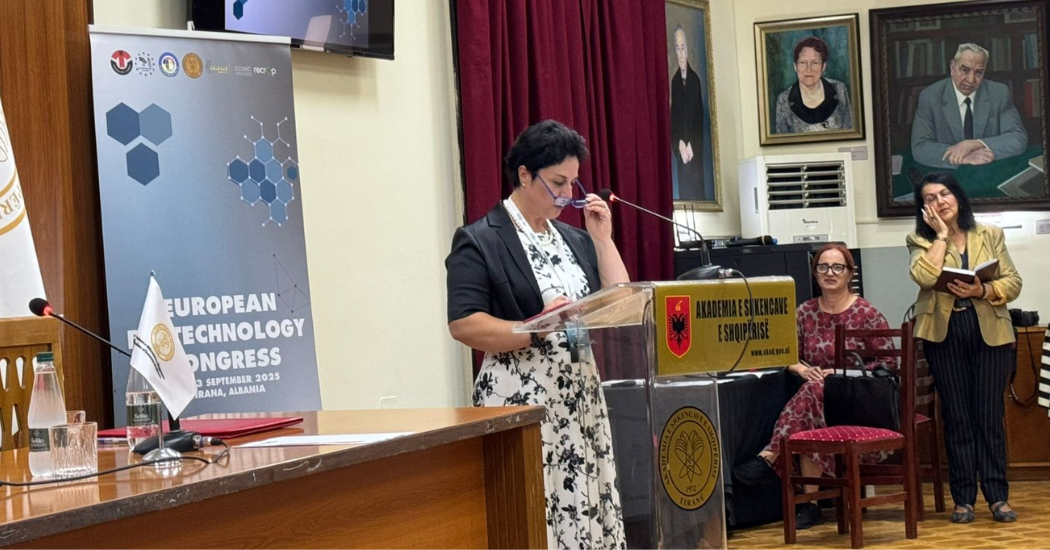
Tirana – More than just global science, the European Biotechnology Congress 2025, held in Tirana from September 11 to 13, emphasized the importance of connecting international innovation with the development of research centers in the Mediterranean and Southeast Europe.
Organized by the European Biotechnology Thematic Network Association (EBTNA) in collaboration with the Academy of Sciences of Albania and the University of Tirana, the congress brought together academics and researchers from over twenty countries, with a particular focus on strengthening the scientific community of the Euro-Mediterranean and Balkan regions.
Albania in the Spotlight: University of Tirana and the Academy of Sciences


The congress opened with institutional remarks from Prof. Skënder Gjinushi, President of the Academy of Sciences of Albania, and Prof. Ariola Bacu, chair of the local organizing committee and professor at the University of Tirana.

The opening sessions highlighted the work of Albanian research teams, who presented advanced studies in genomics, nanotechnologies, and environmental biotechnologies. Among the most notable contributions:

- Prof. Anila Hoda, Secretary General of the Academy of Sciences, on the potential of biotechnology to promote sustainable livestock and aquaculture in Albania and Kosovo
- Prof. Anila Babameto-Laku, head of the genetics laboratory at “Mother Teresa” University Hospital, on the diagnostic challenges of rare diseases
- Prof. Bashkim Ziberi (University of Tetova, North Macedonia), who presented a pioneering study on immunogenic biomaterials for oncological radiotherapy
Kosovo and North Macedonia: Science as a Bridge
The congress also featured active participation from Kosovo, with Prof. Hysen Bytyqi (University of Pristina) emphasizing the importance of making biotechnological innovation accessible in developing regions.
From North Macedonia, in addition to Prof. Ziberi, researchers shared insights on regional scientific cooperation, underlining the emergence of a growing Balkan research network with a clear European perspective.
Turkey and the Leadership of Munis Dundar
Turkey played a leading role in the event. The congress was chaired by Prof. Munis Dundar, President of EBTNA, who coordinated key sessions on genomics, innovative therapies, and international scientific training.
A particularly impactful presentation came from Prof. Ercüment Ovalı, who showcased the latest progress in CAR-T cell therapy for cancer, demonstrating how Turkish research is fully integrated into the global biotechnology ecosystem.
A Strong Euro-Mediterranean Identity
The identity of the congress emerged clearly: an event that welcomed global guests, but also emphasized the strategic importance of universities and research centers in the Euro-Mediterranean and Balkan areas.
Tirana, a city at the intersection of cultures and regions, symbolized the scientific dialogue that the congress aimed to foster—a place where contributions from Southern and Eastern Europe, the Mediterranean, and neighboring regions are not peripheral but central to shaping a more inclusive and collaborative biotechnological agenda.
Collaborations and Future Perspectives
Beyond local and regional contributions, the congress encouraged new synergies between Balkan groups and international partners. Collaborations with Israel, Canada, France, the United Kingdom, and the United States formed part of a wider global network, yet the heart of the congress reaffirmed the growing role of Albania, Kosovo, and Turkey in the European research landscape.
Training young researchers was a core theme, with practical courses and workshops, notably the third biotechnology course organized by MAGI Balkan for students from the University of Tirana.
Conclusion: A New Role for the Balkans
The European Biotechnology Congress 2025 was more than an international showcase. It confirmed that the Balkans and the wider Euro-Mediterranean region are an integral part of the future of biotechnological science.
Albania, Kosovo, and Turkey demonstrated not only scientific capacity, but also a strong commitment to dialogue, cooperation, and openness. With its designation as 2025 Mediterranean Capital of Culture and Dialogue, Tirana provided the ideal setting for such a meeting.
Once again, science proved to be a powerful instrument of unity and shared progress.