
On the Shelf
The Brightness
By Chad Harbach
Little Brown & Co.: 672 pages, $32
If you buy books linked on our site, The Times may earn a commission from Bookshop.org, whose fees support independent bookstores.
The author Chad Harbach just had a banner week. His second novel, “The Brightness,” hit bookstores. A24 announced his television adaptation. And the Milwaukee Brewers, his beloved hometown team, finally won their first World Series.
It was a lot all at once, considering the onetime literary superstar hasn’t made a peep in nearly a decade.
In 2011, Harbach became something of a literary unicorn: His debut, “The Art of Fielding,” inspired a bidding war, a $665,000 advance and near-universal predictions as the Next Great American Novel.
The hype, for once, panned out. He toured, made a chunk of money and worked on a few projects. Then — poof. For years, there was scarcely a sign of him online or out in the world. Until last month.
Harbach, it turned out, was emerging from the woods just outside Palo Alto. “It’s not exactly the social, cultural milieu that I expected to find myself in,” he said on the phone from his Portola Valley home.
And besides, the unlikely Californian moved west a few years back. In his mind, at least, he remains a Midwesterner.
“The Brightness: A Novel” by Chad Harbach
(Little, Brown)
When we met at the Hollywood Roosevelt in mid-October, hours before his podcast with comedian-turned-bookfluencer Anthony Jeselnik, Harbach toted an early edition of Eve Babitz’s “Slow Days, Fast Company.” He credited journalist Liz Brown with helping spark Babitz’s revival, tracing a chain of book recommendations and literary connections that reflected the inside-baseball stories he’d picked up as a co-founder of the highly influential lit mag n+1 he helped start in 2004.
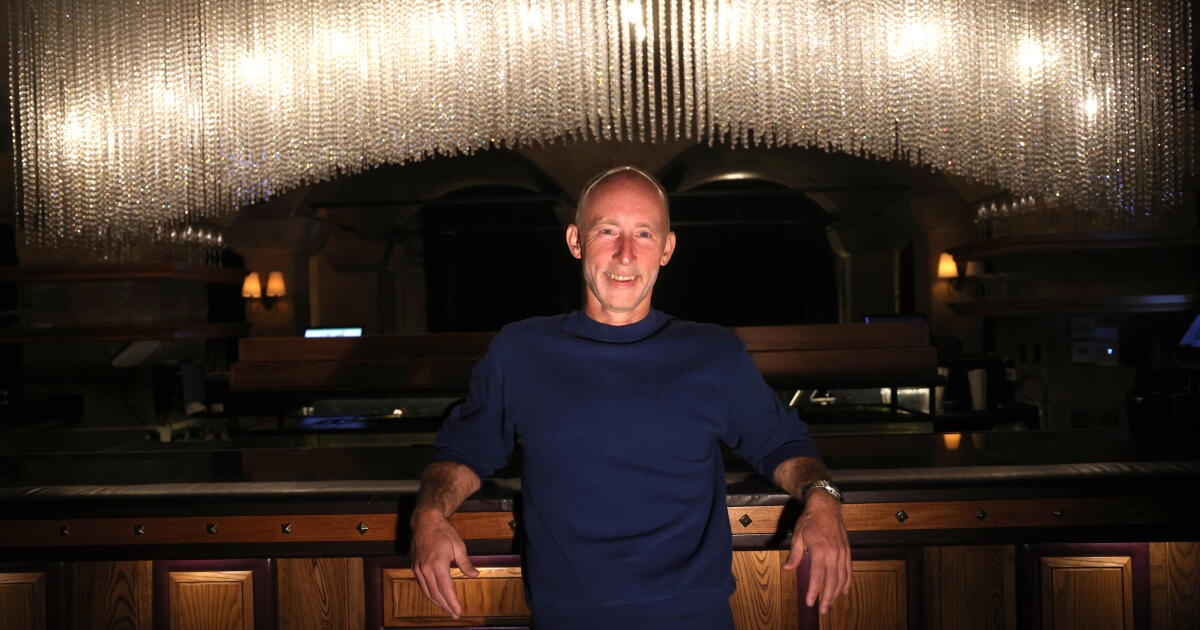
The 50-year-old — wearing a cotton blue sweater, skinny jeans and Earth Runner sandals — was feeling good after watching the Brewers beat the Dodgers in their own stadium in Game 3. A self-described shy guy, he seemed more comfortable with the press, and more at ease in his own body, than he had been during the publicity blitz for “The Art of Fielding,” his bestselling 2011 debut about a college baseball team in his native Wisconsin.
But for all his years in the New York literary world — and later in Charlottesville, Va., where he earned his MFA at the University of Virginia — Harbach’s fiction has never strayed far from its roots. His hometown of Racine, Wis., “a city on the floor of Lake Michigan,” remains the gravitational center of his fictional universe.
After spending two years touring “The Art of Fielding,” Harbach was eager to move on. He sat down with his notebook, he said, hoping to “dig in, tap into the place that was going to let me know what I needed to work on next.” He had no intention of returning to Westish or the world of his first novel. “I didn’t think it would be a good idea, like commercially or artistically,” he said.
But he kept coming back to Pella, the college president’s wayward daughter from the first novel. “I just kind of kept doing that until I had to relent and say, ‘OK, I’m going to follow this for a while, and see where it wants to go.’ ”
The recently published, “The Brightness,” is set four years after “The Art of Fielding.” It returns to fictional Westish College, swapping baseball for literature and art, male friendship for female. The old characters recede; new ones take center stage, most notably classmates Pella Affenlicht and Irma Friske. Its Byzantine plot revolves around a performance-art stunt intended to draw attention to campus rape culture, which soon attracts the national media.

Author Chad Harbach.
(Genaro Molina / Los Angeles Times)
Whereas “The Art of Fielding” inhabited a kind of Pollyannaish liberal-arts idealism, “The Brightness” can be read as a reckoning with that Obama-era millennial optimism.
“At first you think you’re back in magical Westish, but it’s sort of the dark side of it,” said Keith Gessen, one of Harbach’s co-founders at n+1.
Gessen, who wrote the seminal Vanity Fair profile chronicling Harbach’s literary ascent, has known him since their undergraduate days at Harvard. He recalled a class the two took on Herman Melville, in which their professor introduced them to the idea of “unwriting:” not rewriting a text, but unwriting it, revealing things that had been there all along but remained just beyond view.
“The characters in the book are sort of trapped and beguiled, and want to stay at Westish. And the book is like, you can’t.”
Returning to Westish, Harbach also had to see it anew, this time through the eyes of its young women in 2015, on the cusp of #MeToo and the first Trump presidential term. Lisa Borst, a current editor at n+1 and one of Harbach’s trusted manuscript readers, brought this perspective to the project. “One of his real gifts,” she said, is writing dialogue, “even in spaces or institutions that he himself doesn’t necessarily have firsthand, present-tense experience of.”
And within the worlds he does know, Harbach defaults to an almost anti-autofiction. Borst pointed to a storyline in which the New York literati descend on Block Island for the wedding of Owen Dunne, a young novelist whose book bears an uncanny resemblance to “The Art of Fielding.” It’s one of several meta-moments where Harbach retcons his own first novel.
A lesser writer, Borst said, might have populated the scene with thinly disguised versions of recognizable literary-world figures. “But he’s like actually too inventive and imaginative to indulge in that kind of thing.”
Still, there were moments where Borst’s eye — what she called “millennial woman sensitivity read” — helped bridge the gender and generational divide. She recalled having a conversation with Harbach about how campuses have evolved and pointed to a key scene where a student dies by suicide, and how the campus responds.
“I went to Brown in the 2010s, and a couple of students passed away over the course of my time there,” she said. “And it was always a big deal.”
Harbach’s experience at Harvard in the ‘90s had been different. “It made me think how crisis PR and university comms have really come a long way,” Borst said.
Despite a brief online debate over Pella using toilet paper as a tampon versus a pad, the response to “The Brightness” so far is decidedly positive. Reviewers have embraced it as a big, sprawling, unapologetically old-fashioned social-realist novel, one that was worth the wait.

“As a young writer, you think, ‘I’ll write this book that everyone likes, and then I’ll just sort of ascend into heaven, and life will be solved.’ But actually nothing is solved,” Chad Harbach says.
(Genaro Molina / Los Angeles Times)
There was considerable anticipation, given the stakes: a sophomore follow-up, nearly 700 pages, that took 12 years to write. But Harbach knew better this time than to count on a successful review to change his life.
The publicity alone wore him out physically during the his first novel’s debut, but he also felt the loneliness of having an experience few people around him could relate to. “It’s very hard to acknowledge the difficulty of it because you are supposed to be unceasingly grateful and happy about all of it.”
Envy and resentment stymied certain relationships, along with the question of what comes after your wildest dreams come true. “You kind of have to really figure it out on your own on the fly,” he said, “and also, maybe most importantly, try to figure out what lies on the other side of it.”
“I think as a young writer, you think, ‘I’ll write this book that everyone likes, and then I’ll just sort of ascend into heaven, and life will be solved.’ But actually nothing is solved.” Except that he can pay his rent.
The money from “The Art of Fielding” — royalties, foreign sales and rights — gave him a cushion. Hollywood called intermittently, too. Options came, then went, then came again. It wasn’t until last month, with the announcement of the A24 TV deal, that an adaptation finally seemed to stick. “And then I basically didn’t change my lifestyle at all,” he said, stretching the money out much longer than people imagined to do it.
By continuing to live modestly, he could buy himself years to write. He remains the treasurer of the board on n+1, and a mentor to the current editors. He’s never made a cent from the magazine, he said. “From day one, it cost money.”
And that’s largely what Harbach has been doing these past 15 years: writing, and being a dad to his 4-year-old son. Until news of “The Brightness” began making the rounds early this year, remarkably little was known about him beyond the old reviews and profiles.
Except the lawsuit.
“No one has asked me about this yet,” he said.
In 2015, Harbach received what he called a “creepily cryptic email” from a reporter, giving him a heads-up about an impending front-page story. A writer named Charles Green was accusing Harbach of lifting elements of his unpublished baseball novel.
But Harbach had never heard of this writer, who lived in Texas, or seen his manuscript. “It was terrifying,” Harbach recalled. “It was draining. It was disorienting.” Ultimately, though, the story never ran. “Then in 2017 I’m like walking back to my apartment, and I got served.”
What followed was a years-long legal battle. A federal judge ultimately dismissed Green’s copyright infringement suit in 2018, a decision upheld on appeal the following year.
“It’s not the worst thing that’s ever happened to me in my life,” Harbach said. “But it was an ongoing period of just really disturbing. … There were months when it was really hard to think about anything else.”
A lodestar for Harbach remains David Foster Wallace, a fellow Midwesterner who could move effortlessly among mathematics, sports and American fiction. For all his years in the New York literary world, Harbach has never entirely shed the sensibility of the place he came from.
“Having grown up in Racine, Wis., not from a literary or intellectual family or community,” Harbach said, “I think I wanted to write a book that matched my highest ideals of literature, but that my friends from Wisconsin would read and like and comprehend. You know, just a real down-to-earth kind of quality.”
Rudi, an L.A. native, is a freelance art and culture writer. She’s at work on her debut novel about a stuttering student journalist.

On the Shelf
The Brightness
By Chad Harbach
Little Brown & Co.: 672 pages, $32
If you buy books linked on our site, The Times may earn a commission from Bookshop.org, whose fees support independent bookstores.
The author Chad Harbach just had a banner week. His second novel, “The Brightness,” hit bookstores. A24 announced his television adaptation. And the Milwaukee Brewers, his beloved hometown team, finally won their first World Series.
It was a lot all at once, considering the onetime literary superstar hasn’t made a peep in nearly a decade.
In 2011, Harbach became something of a literary unicorn: His debut, “The Art of Fielding,” inspired a bidding war, a $665,000 advance and near-universal predictions as the Next Great American Novel.
The hype, for once, panned out. He toured, made a chunk of money and worked on a few projects. Then — poof. For years, there was scarcely a sign of him online or out in the world. Until last month.
Harbach, it turned out, was emerging from the woods just outside Palo Alto. “It’s not exactly the social, cultural milieu that I expected to find myself in,” he said on the phone from his Portola Valley home.
And besides, the unlikely Californian moved west a few years back. In his mind, at least, he remains a Midwesterner.
“The Brightness: A Novel” by Chad Harbach
(Little, Brown)
When we met at the Hollywood Roosevelt in mid-October, hours before his podcast with comedian-turned-bookfluencer Anthony Jeselnik, Harbach toted an early edition of Eve Babitz’s “Slow Days, Fast Company.” He credited journalist Liz Brown with helping spark Babitz’s revival, tracing a chain of book recommendations and literary connections that reflected the inside-baseball stories he’d picked up as a co-founder of the highly influential lit mag n+1 he helped start in 2004.
The 50-year-old — wearing a cotton blue sweater, skinny jeans and Earth Runner sandals — was feeling good after watching the Brewers beat the Dodgers in their own stadium in Game 3. A self-described shy guy, he seemed more comfortable with the press, and more at ease in his own body, than he had been during the publicity blitz for “The Art of Fielding,” his bestselling 2011 debut about a college baseball team in his native Wisconsin.
But for all his years in the New York literary world — and later in Charlottesville, Va., where he earned his MFA at the University of Virginia — Harbach’s fiction has never strayed far from its roots. His hometown of Racine, Wis., “a city on the floor of Lake Michigan,” remains the gravitational center of his fictional universe.
After spending two years touring “The Art of Fielding,” Harbach was eager to move on. He sat down with his notebook, he said, hoping to “dig in, tap into the place that was going to let me know what I needed to work on next.” He had no intention of returning to Westish or the world of his first novel. “I didn’t think it would be a good idea, like commercially or artistically,” he said.
But he kept coming back to Pella, the college president’s wayward daughter from the first novel. “I just kind of kept doing that until I had to relent and say, ‘OK, I’m going to follow this for a while, and see where it wants to go.’ ”
The recently published, “The Brightness,” is set four years after “The Art of Fielding.” It returns to fictional Westish College, swapping baseball for literature and art, male friendship for female. The old characters recede; new ones take center stage, most notably classmates Pella Affenlicht and Irma Friske. Its Byzantine plot revolves around a performance-art stunt intended to draw attention to campus rape culture, which soon attracts the national media.
Author Chad Harbach.
(Genaro Molina / Los Angeles Times)
Whereas “The Art of Fielding” inhabited a kind of Pollyannaish liberal-arts idealism, “The Brightness” can be read as a reckoning with that Obama-era millennial optimism.
“At first you think you’re back in magical Westish, but it’s sort of the dark side of it,” said Keith Gessen, one of Harbach’s co-founders at n+1.
Gessen, who wrote the seminal Vanity Fair profile chronicling Harbach’s literary ascent, has known him since their undergraduate days at Harvard. He recalled a class the two took on Herman Melville, in which their professor introduced them to the idea of “unwriting:” not rewriting a text, but unwriting it, revealing things that had been there all along but remained just beyond view.
“The characters in the book are sort of trapped and beguiled, and want to stay at Westish. And the book is like, you can’t.”
Returning to Westish, Harbach also had to see it anew, this time through the eyes of its young women in 2015, on the cusp of #MeToo and the first Trump presidential term. Lisa Borst, a current editor at n+1 and one of Harbach’s trusted manuscript readers, brought this perspective to the project. “One of his real gifts,” she said, is writing dialogue, “even in spaces or institutions that he himself doesn’t necessarily have firsthand, present-tense experience of.”
And within the worlds he does know, Harbach defaults to an almost anti-autofiction. Borst pointed to a storyline in which the New York literati descend on Block Island for the wedding of Owen Dunne, a young novelist whose book bears an uncanny resemblance to “The Art of Fielding.” It’s one of several meta-moments where Harbach retcons his own first novel.
A lesser writer, Borst said, might have populated the scene with thinly disguised versions of recognizable literary-world figures. “But he’s like actually too inventive and imaginative to indulge in that kind of thing.”
Still, there were moments where Borst’s eye — what she called “millennial woman sensitivity read” — helped bridge the gender and generational divide. She recalled having a conversation with Harbach about how campuses have evolved and pointed to a key scene where a student dies by suicide, and how the campus responds.
“I went to Brown in the 2010s, and a couple of students passed away over the course of my time there,” she said. “And it was always a big deal.”
Harbach’s experience at Harvard in the ‘90s had been different. “It made me think how crisis PR and university comms have really come a long way,” Borst said.
Despite a brief online debate over Pella using toilet paper as a tampon versus a pad, the response to “The Brightness” so far is decidedly positive. Reviewers have embraced it as a big, sprawling, unapologetically old-fashioned social-realist novel, one that was worth the wait.
“As a young writer, you think, ‘I’ll write this book that everyone likes, and then I’ll just sort of ascend into heaven, and life will be solved.’ But actually nothing is solved,” Chad Harbach says.
(Genaro Molina / Los Angeles Times)
There was considerable anticipation, given the stakes: a sophomore follow-up, nearly 700 pages, that took 12 years to write. But Harbach knew better this time than to count on a successful review to change his life.
The publicity alone wore him out physically during the his first novel’s debut, but he also felt the loneliness of having an experience few people around him could relate to. “It’s very hard to acknowledge the difficulty of it because you are supposed to be unceasingly grateful and happy about all of it.”
Envy and resentment stymied certain relationships, along with the question of what comes after your wildest dreams come true. “You kind of have to really figure it out on your own on the fly,” he said, “and also, maybe most importantly, try to figure out what lies on the other side of it.”
“I think as a young writer, you think, ‘I’ll write this book that everyone likes, and then I’ll just sort of ascend into heaven, and life will be solved.’ But actually nothing is solved.” Except that he can pay his rent.
The money from “The Art of Fielding” — royalties, foreign sales and rights — gave him a cushion. Hollywood called intermittently, too. Options came, then went, then came again. It wasn’t until last month, with the announcement of the A24 TV deal, that an adaptation finally seemed to stick. “And then I basically didn’t change my lifestyle at all,” he said, stretching the money out much longer than people imagined to do it.
By continuing to live modestly, he could buy himself years to write. He remains the treasurer of the board on n+1, and a mentor to the current editors. He’s never made a cent from the magazine, he said. “From day one, it cost money.”
And that’s largely what Harbach has been doing these past 15 years: writing, and being a dad to his 4-year-old son. Until news of “The Brightness” began making the rounds early this year, remarkably little was known about him beyond the old reviews and profiles.
Except the lawsuit.
“No one has asked me about this yet,” he said.
In 2015, Harbach received what he called a “creepily cryptic email” from a reporter, giving him a heads-up about an impending front-page story. A writer named Charles Green was accusing Harbach of lifting elements of his unpublished baseball novel.
But Harbach had never heard of this writer, who lived in Texas, or seen his manuscript. “It was terrifying,” Harbach recalled. “It was draining. It was disorienting.” Ultimately, though, the story never ran. “Then in 2017 I’m like walking back to my apartment, and I got served.”
What followed was a years-long legal battle. A federal judge ultimately dismissed Green’s copyright infringement suit in 2018, a decision upheld on appeal the following year.
“It’s not the worst thing that’s ever happened to me in my life,” Harbach said. “But it was an ongoing period of just really disturbing. … There were months when it was really hard to think about anything else.”
A lodestar for Harbach remains David Foster Wallace, a fellow Midwesterner who could move effortlessly among mathematics, sports and American fiction. For all his years in the New York literary world, Harbach has never entirely shed the sensibility of the place he came from.
“Having grown up in Racine, Wis., not from a literary or intellectual family or community,” Harbach said, “I think I wanted to write a book that matched my highest ideals of literature, but that my friends from Wisconsin would read and like and comprehend. You know, just a real down-to-earth kind of quality.”
Rudi, an L.A. native, is a freelance art and culture writer. She’s at work on her debut novel about a stuttering student journalist.


