

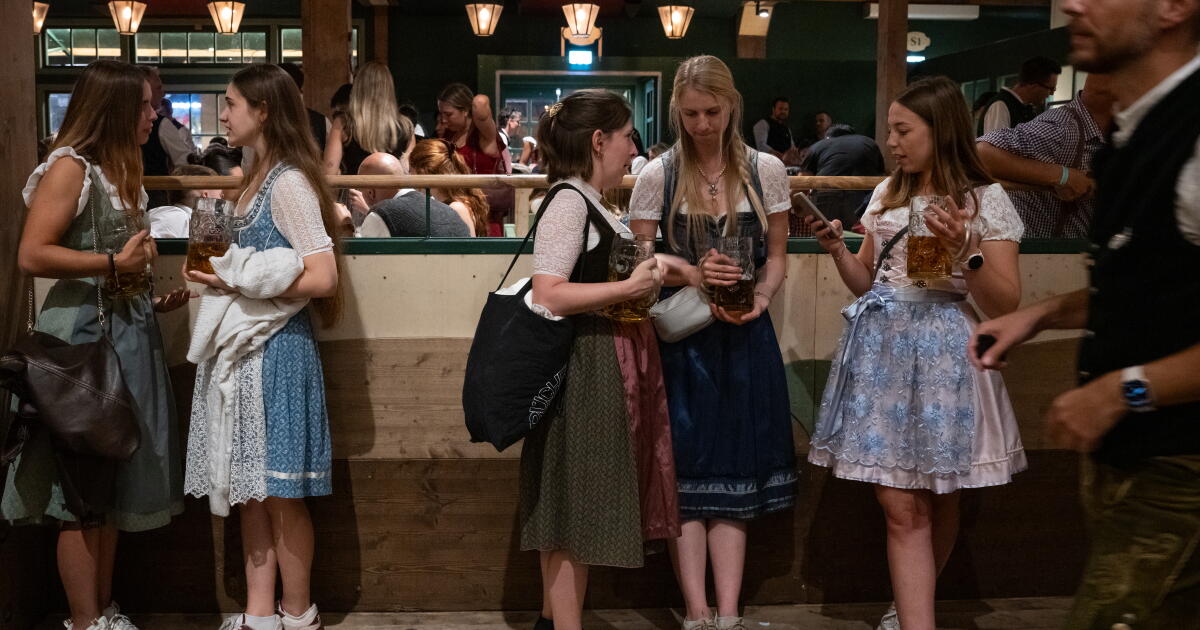
MUNICH, Germany — Can you have a smashing time at Oktoberfest without getting smashed yourself? Increasingly, the answer appears to be “jawohl.”
A global shift toward nonalcoholic drinks — driven by greater health consciousness from California to Cologne and beyond — has reached even the world’s biggest celebration of beer.
Not long ago, ordering a nonalcoholic beer at Oktoberfest could draw puzzled looks. Or disdain. But now Oktoberfest is a proving ground for one of the most profound changes sweeping the global drinks industry as more consumers cut alcohol from their lives.
“When I was growing up and coming here about 20 years ago, if someone ordered a nonalcoholic beer, everyone would look at you and say, ‘What’s wrong with you?’ or ‘Oh, you must be the designated driver,’” said Joerg Biebernick, chief executive of the Paulaner Brewery Group, one of Germany’s largest brewers. “But now it’s totally socially acceptable if you want to drink beer without alcohol.”
Friends enjoy beer in the Pschorr Braurosl Festzelt, a giant tent capable of seating 8,000 guests, at Oktoberfest.
(Viktoria Pezzei / For The Times)
In the tents erected in Munich for Oktoberfest, the atmosphere can be intoxicating enough without the alcohol. Brass bands pound out songs and pop anthems with thumping beats such as Neil Diamond’s “Sweet Caroline” and Robbie Williams’ “Angels” as thousands of voices roar along.
Waiters weave through packed aisles carrying foaming one-liter mugs, and strangers at long wooden tables quickly become friends. Revelers lock arms and sing together, climbing onto benches to dance as entire sections of a tent seem to move as one. Few people lifting a stein here would guess that beer consumption is down worldwide.

A waiter pours alcohol-free Weissbier into a stoneware mug at the Oide Wiesn, the historic section of Oktoberfest.
(Viktoria Pezzei / For The Times)
Celebrants from the U.S., where slugging back brews is also on the decline, are a sizable part of the spectacle. About 285,000 attended last year, making the United States the festival’s largest source of overseas visitors. Former California Gov. Arnold Schwarzenegger is a regular and was back this year, conducting a band and thousands of singing beer drinkers.
This year’s Oktoberfest will end Sunday. At the halfway point of the 16-day festival, sales of nonalcoholic beer were up 4.5% from a year earlier. Sales of the traditional Festbier brewed especially for Oktoberfest — which contains about 6% alcohol, meaning a one-liter mug packs about as much alcohol as three and a half 12-ounce American beers — slipped 1.4% even as attendance rose.
Last year, nonalcoholic beer accounted for nearly 8% of reported beer volume, with more than half a million liters served.

The 16-day Oktoberfest draws thousands of visitors from Germany and across the globe. About 285,000 Americans attended last year.
(Viktoria Pezzei / For The Times)
The trend extends beyond the festival grounds. Germany’s annual per capita consumption of traditional beer has fallen about 40% since 1990 to 77 liters now — an alarming development for an industry whose origins reach back to the Middle Ages.
In 2025, global beer consumption fell 0.7% to 1.896 billion hectoliters — about 50 billion gallons — according to the British Guild of Beer Writers. Germany’s output fell nearly 6% to 79.2 million hectoliters, or about 2.1 billion gallons — a mark below 80 million hectoliters for the first time.
At the same time, nonalcoholic beer has been one of the few hot segments of the global beer industry.
“I really like that there are options and that there’s something for everyone and everyone can enjoy it here,” Amanda Nguyen, a 34-year-old worker with a nongovernmental organization from Los Angeles, said as she took in the scene — thousands dressed in lederhosen or colorful dirndl, the eye-catching dresses with fitted bodices that have become almost as synonymous with Oktoberfest as the beer itself.
Nguyen said she planned to stick with nonalcoholic beer.


1. Annabelle Beyer, 25, sells souvenir “Trachtenhut” hats at Oktoberfest. Vendors like her are informally known as “Schatzis,” German for “sweethearts.” 2. Along with alcohol-free beer, other non-alcoholic drinks sold at Oktoberfest include water, apple spritzer, Spezi (a cola-orange soda) and lemonade.
Oktoberfest did not even begin serving nonalcoholic beer until 1986. What was then widely regarded as a poor imitation of the real thing has since moved into the mainstream.
One reason is simple: The beer got a lot better.
Christian Dahncke, Paulaner’s director of brewing, said important breakthroughs in technology have allowed producers to preserve much more of the flavor and aroma while removing the alcohol, just as increasingly health-conscious consumers began demanding better alternatives to alcoholic drinks. No one is sure which came first in this “chicken-or-the-egg” story — greater demand for more nonalcoholic beer or better quality offerings.
“People want to live healthier nowadays, and that’s especially true for the younger generations,” Dahncke said. “It’s not just Bavaria or Germany but everyone around the world. They want to look and feel as good at 80 as they did when they were 50. Getting rid of the alcohol is all part of that trend.”
Germany has a surprisingly long history of trying to remove alcohol from traditional drinks. As early as the 19th century, vintners began experimenting with dealcoholized wine using a process known as vacuum distillation.
Today, nonalcoholic wine is widely available in Germany, including at some Oktoberfest beer tents and festival stands, though it is far less prominent than nonalcoholic beer.

Friends from Zorneding, a village east of Munich, stand on benches as they enjoy beer at Oktoberfest.
(Viktoria Pezzei / For The Times)
Not everyone is ready for a dry Oktoberfest.
Felix Heide, a German-born engineer and computer scientist at Princeton University who regularly returns to Munich for Oktoberfest, said he could not understand the attraction.
“Nonalcoholic beer doesn’t make any sense to me,” Heide, 39, said while celebrating in the 8,250-seat beer hall. “Beer is so deeply ingrained in our culture. We know exactly what it is. You don’t need to change a thing.”
Brian Oswald, a 69-year-old retired forestry professor from Nacogdoches, Texas, came straight to Oktoberfest after landing on an overnight flight from the United States.
“I love beer,” he said. “I’m sure nonalcoholic is getting better, but I’m not at the point where I have to worry about that.”
France Salvosa, a designer from Knoxville, Tenn., was even more emphatic as she celebrated her 50th birthday with her sister, gripping a frothy mug after watching security carry away a young man who appeared too inebriated to walk straight.
“I like to drink, love the beer here, love the taste, and like the way it hits me right away after the first two sips,” she said.

A tent at Oktoberfest is packed with visitors, most with a beer in front of them but a few with bottles of water or soft drinks.
(Viktoria Pezzei / For The Times)
Her sister, Duch, was celebrating just as enthusiastically — but without the alcohol.
“I want to participate, want to see how this culture works and still want to be here,” she said. “But I’m OK without the alcohol, without a headache the next day.”
Kirschbaum is a special correspondent.

MUNICH, Germany — Can you have a smashing time at Oktoberfest without getting smashed yourself? Increasingly, the answer appears to be “jawohl.”
A global shift toward nonalcoholic drinks — driven by greater health consciousness from California to Cologne and beyond — has reached even the world’s biggest celebration of beer.
Not long ago, ordering a nonalcoholic beer at Oktoberfest could draw puzzled looks. Or disdain. But now Oktoberfest is a proving ground for one of the most profound changes sweeping the global drinks industry as more consumers cut alcohol from their lives.
“When I was growing up and coming here about 20 years ago, if someone ordered a nonalcoholic beer, everyone would look at you and say, ‘What’s wrong with you?’ or ‘Oh, you must be the designated driver,’” said Joerg Biebernick, chief executive of the Paulaner Brewery Group, one of Germany’s largest brewers. “But now it’s totally socially acceptable if you want to drink beer without alcohol.”
Friends enjoy beer in the Pschorr Braurosl Festzelt, a giant tent capable of seating 8,000 guests, at Oktoberfest.
(Viktoria Pezzei / For The Times)
In the tents erected in Munich for Oktoberfest, the atmosphere can be intoxicating enough without the alcohol. Brass bands pound out songs and pop anthems with thumping beats such as Neil Diamond’s “Sweet Caroline” and Robbie Williams’ “Angels” as thousands of voices roar along.
Waiters weave through packed aisles carrying foaming one-liter mugs, and strangers at long wooden tables quickly become friends. Revelers lock arms and sing together, climbing onto benches to dance as entire sections of a tent seem to move as one. Few people lifting a stein here would guess that beer consumption is down worldwide.
A waiter pours alcohol-free Weissbier into a stoneware mug at the Oide Wiesn, the historic section of Oktoberfest.
(Viktoria Pezzei / For The Times)
Celebrants from the U.S., where slugging back brews is also on the decline, are a sizable part of the spectacle. About 285,000 attended last year, making the United States the festival’s largest source of overseas visitors. Former California Gov. Arnold Schwarzenegger is a regular and was back this year, conducting a band and thousands of singing beer drinkers.
This year’s Oktoberfest will end Sunday. At the halfway point of the 16-day festival, sales of nonalcoholic beer were up 4.5% from a year earlier. Sales of the traditional Festbier brewed especially for Oktoberfest — which contains about 6% alcohol, meaning a one-liter mug packs about as much alcohol as three and a half 12-ounce American beers — slipped 1.4% even as attendance rose.
Last year, nonalcoholic beer accounted for nearly 8% of reported beer volume, with more than half a million liters served.
The 16-day Oktoberfest draws thousands of visitors from Germany and across the globe. About 285,000 Americans attended last year.
(Viktoria Pezzei / For The Times)
The trend extends beyond the festival grounds. Germany’s annual per capita consumption of traditional beer has fallen about 40% since 1990 to 77 liters now — an alarming development for an industry whose origins reach back to the Middle Ages.
In 2025, global beer consumption fell 0.7% to 1.896 billion hectoliters — about 50 billion gallons — according to the British Guild of Beer Writers. Germany’s output fell nearly 6% to 79.2 million hectoliters, or about 2.1 billion gallons — a mark below 80 million hectoliters for the first time.
At the same time, nonalcoholic beer has been one of the few hot segments of the global beer industry.
“I really like that there are options and that there’s something for everyone and everyone can enjoy it here,” Amanda Nguyen, a 34-year-old worker with a nongovernmental organization from Los Angeles, said as she took in the scene — thousands dressed in lederhosen or colorful dirndl, the eye-catching dresses with fitted bodices that have become almost as synonymous with Oktoberfest as the beer itself.
Nguyen said she planned to stick with nonalcoholic beer.
1. Annabelle Beyer, 25, sells souvenir “Trachtenhut” hats at Oktoberfest. Vendors like her are informally known as “Schatzis,” German for “sweethearts.” 2. Along with alcohol-free beer, other non-alcoholic drinks sold at Oktoberfest include water, apple spritzer, Spezi (a cola-orange soda) and lemonade.
Oktoberfest did not even begin serving nonalcoholic beer until 1986. What was then widely regarded as a poor imitation of the real thing has since moved into the mainstream.
One reason is simple: The beer got a lot better.
Christian Dahncke, Paulaner’s director of brewing, said important breakthroughs in technology have allowed producers to preserve much more of the flavor and aroma while removing the alcohol, just as increasingly health-conscious consumers began demanding better alternatives to alcoholic drinks. No one is sure which came first in this “chicken-or-the-egg” story — greater demand for more nonalcoholic beer or better quality offerings.
“People want to live healthier nowadays, and that’s especially true for the younger generations,” Dahncke said. “It’s not just Bavaria or Germany but everyone around the world. They want to look and feel as good at 80 as they did when they were 50. Getting rid of the alcohol is all part of that trend.”
Germany has a surprisingly long history of trying to remove alcohol from traditional drinks. As early as the 19th century, vintners began experimenting with dealcoholized wine using a process known as vacuum distillation.
Today, nonalcoholic wine is widely available in Germany, including at some Oktoberfest beer tents and festival stands, though it is far less prominent than nonalcoholic beer.
Friends from Zorneding, a village east of Munich, stand on benches as they enjoy beer at Oktoberfest.
(Viktoria Pezzei / For The Times)
Not everyone is ready for a dry Oktoberfest.
Felix Heide, a German-born engineer and computer scientist at Princeton University who regularly returns to Munich for Oktoberfest, said he could not understand the attraction.
“Nonalcoholic beer doesn’t make any sense to me,” Heide, 39, said while celebrating in the 8,250-seat beer hall. “Beer is so deeply ingrained in our culture. We know exactly what it is. You don’t need to change a thing.”
Brian Oswald, a 69-year-old retired forestry professor from Nacogdoches, Texas, came straight to Oktoberfest after landing on an overnight flight from the United States.
“I love beer,” he said. “I’m sure nonalcoholic is getting better, but I’m not at the point where I have to worry about that.”
France Salvosa, a designer from Knoxville, Tenn., was even more emphatic as she celebrated her 50th birthday with her sister, gripping a frothy mug after watching security carry away a young man who appeared too inebriated to walk straight.
“I like to drink, love the beer here, love the taste, and like the way it hits me right away after the first two sips,” she said.
A tent at Oktoberfest is packed with visitors, most with a beer in front of them but a few with bottles of water or soft drinks.
(Viktoria Pezzei / For The Times)
Her sister, Duch, was celebrating just as enthusiastically — but without the alcohol.
“I want to participate, want to see how this culture works and still want to be here,” she said. “But I’m OK without the alcohol, without a headache the next day.”
Kirschbaum is a special correspondent.

MUNICH, Germany — Can you have a smashing time at Oktoberfest without getting smashed yourself? Increasingly, the answer appears to be “jawohl.”
A global shift toward nonalcoholic drinks — driven by greater health consciousness from California to Cologne and beyond — has reached even the world’s biggest celebration of beer.
Not long ago, ordering a nonalcoholic beer at Oktoberfest could draw puzzled looks. Or disdain. But now Oktoberfest is a proving ground for one of the most profound changes sweeping the global drinks industry as more consumers cut alcohol from their lives.
“When I was growing up and coming here about 20 years ago, if someone ordered a nonalcoholic beer, everyone would look at you and say, ‘What’s wrong with you?’ or ‘Oh, you must be the designated driver,’” said Joerg Biebernick, chief executive of the Paulaner Brewery Group, one of Germany’s largest brewers. “But now it’s totally socially acceptable if you want to drink beer without alcohol.”
Friends enjoy beer in the Pschorr Braurosl Festzelt, a giant tent capable of seating 8,000 guests, at Oktoberfest.
(Viktoria Pezzei / For The Times)
In the tents erected in Munich for Oktoberfest, the atmosphere can be intoxicating enough without the alcohol. Brass bands pound out songs and pop anthems with thumping beats such as Neil Diamond’s “Sweet Caroline” and Robbie Williams’ “Angels” as thousands of voices roar along.
Waiters weave through packed aisles carrying foaming one-liter mugs, and strangers at long wooden tables quickly become friends. Revelers lock arms and sing together, climbing onto benches to dance as entire sections of a tent seem to move as one. Few people lifting a stein here would guess that beer consumption is down worldwide.
A waiter pours alcohol-free Weissbier into a stoneware mug at the Oide Wiesn, the historic section of Oktoberfest.
(Viktoria Pezzei / For The Times)
Celebrants from the U.S., where slugging back brews is also on the decline, are a sizable part of the spectacle. About 285,000 attended last year, making the United States the festival’s largest source of overseas visitors. Former California Gov. Arnold Schwarzenegger is a regular and was back this year, conducting a band and thousands of singing beer drinkers.
This year’s Oktoberfest will end Sunday. At the halfway point of the 16-day festival, sales of nonalcoholic beer were up 4.5% from a year earlier. Sales of the traditional Festbier brewed especially for Oktoberfest — which contains about 6% alcohol, meaning a one-liter mug packs about as much alcohol as three and a half 12-ounce American beers — slipped 1.4% even as attendance rose.
Last year, nonalcoholic beer accounted for nearly 8% of reported beer volume, with more than half a million liters served.
The 16-day Oktoberfest draws thousands of visitors from Germany and across the globe. About 285,000 Americans attended last year.
(Viktoria Pezzei / For The Times)
The trend extends beyond the festival grounds. Germany’s annual per capita consumption of traditional beer has fallen about 40% since 1990 to 77 liters now — an alarming development for an industry whose origins reach back to the Middle Ages.
In 2025, global beer consumption fell 0.7% to 1.896 billion hectoliters — about 50 billion gallons — according to the British Guild of Beer Writers. Germany’s output fell nearly 6% to 79.2 million hectoliters, or about 2.1 billion gallons — a mark below 80 million hectoliters for the first time.
At the same time, nonalcoholic beer has been one of the few hot segments of the global beer industry.
“I really like that there are options and that there’s something for everyone and everyone can enjoy it here,” Amanda Nguyen, a 34-year-old worker with a nongovernmental organization from Los Angeles, said as she took in the scene — thousands dressed in lederhosen or colorful dirndl, the eye-catching dresses with fitted bodices that have become almost as synonymous with Oktoberfest as the beer itself.
Nguyen said she planned to stick with nonalcoholic beer.
1. Annabelle Beyer, 25, sells souvenir “Trachtenhut” hats at Oktoberfest. Vendors like her are informally known as “Schatzis,” German for “sweethearts.” 2. Along with alcohol-free beer, other non-alcoholic drinks sold at Oktoberfest include water, apple spritzer, Spezi (a cola-orange soda) and lemonade.
Oktoberfest did not even begin serving nonalcoholic beer until 1986. What was then widely regarded as a poor imitation of the real thing has since moved into the mainstream.
One reason is simple: The beer got a lot better.
Christian Dahncke, Paulaner’s director of brewing, said important breakthroughs in technology have allowed producers to preserve much more of the flavor and aroma while removing the alcohol, just as increasingly health-conscious consumers began demanding better alternatives to alcoholic drinks. No one is sure which came first in this “chicken-or-the-egg” story — greater demand for more nonalcoholic beer or better quality offerings.
“People want to live healthier nowadays, and that’s especially true for the younger generations,” Dahncke said. “It’s not just Bavaria or Germany but everyone around the world. They want to look and feel as good at 80 as they did when they were 50. Getting rid of the alcohol is all part of that trend.”
Germany has a surprisingly long history of trying to remove alcohol from traditional drinks. As early as the 19th century, vintners began experimenting with dealcoholized wine using a process known as vacuum distillation.
Today, nonalcoholic wine is widely available in Germany, including at some Oktoberfest beer tents and festival stands, though it is far less prominent than nonalcoholic beer.
Friends from Zorneding, a village east of Munich, stand on benches as they enjoy beer at Oktoberfest.
(Viktoria Pezzei / For The Times)
Not everyone is ready for a dry Oktoberfest.
Felix Heide, a German-born engineer and computer scientist at Princeton University who regularly returns to Munich for Oktoberfest, said he could not understand the attraction.
“Nonalcoholic beer doesn’t make any sense to me,” Heide, 39, said while celebrating in the 8,250-seat beer hall. “Beer is so deeply ingrained in our culture. We know exactly what it is. You don’t need to change a thing.”
Brian Oswald, a 69-year-old retired forestry professor from Nacogdoches, Texas, came straight to Oktoberfest after landing on an overnight flight from the United States.
“I love beer,” he said. “I’m sure nonalcoholic is getting better, but I’m not at the point where I have to worry about that.”
France Salvosa, a designer from Knoxville, Tenn., was even more emphatic as she celebrated her 50th birthday with her sister, gripping a frothy mug after watching security carry away a young man who appeared too inebriated to walk straight.
“I like to drink, love the beer here, love the taste, and like the way it hits me right away after the first two sips,” she said.
A tent at Oktoberfest is packed with visitors, most with a beer in front of them but a few with bottles of water or soft drinks.
(Viktoria Pezzei / For The Times)
Her sister, Duch, was celebrating just as enthusiastically — but without the alcohol.
“I want to participate, want to see how this culture works and still want to be here,” she said. “But I’m OK without the alcohol, without a headache the next day.”
Kirschbaum is a special correspondent.
MUNICH, Germany — Can you have a smashing time at Oktoberfest without getting smashed yourself? Increasingly, the answer appears to be “jawohl.”
A global shift toward nonalcoholic drinks — driven by greater health consciousness from California to Cologne and beyond — has reached even the world’s biggest celebration of beer.
Not long ago, ordering a nonalcoholic beer at Oktoberfest could draw puzzled looks. Or disdain. But now Oktoberfest is a proving ground for one of the most profound changes sweeping the global drinks industry as more consumers cut alcohol from their lives.
“When I was growing up and coming here about 20 years ago, if someone ordered a nonalcoholic beer, everyone would look at you and say, ‘What’s wrong with you?’ or ‘Oh, you must be the designated driver,’” said Joerg Biebernick, chief executive of the Paulaner Brewery Group, one of Germany’s largest brewers. “But now it’s totally socially acceptable if you want to drink beer without alcohol.”
Friends enjoy beer in the Pschorr Braurosl Festzelt, a giant tent capable of seating 8,000 guests, at Oktoberfest.
(Viktoria Pezzei / For The Times)
In the tents erected in Munich for Oktoberfest, the atmosphere can be intoxicating enough without the alcohol. Brass bands pound out songs and pop anthems with thumping beats such as Neil Diamond’s “Sweet Caroline” and Robbie Williams’ “Angels” as thousands of voices roar along.
Waiters weave through packed aisles carrying foaming one-liter mugs, and strangers at long wooden tables quickly become friends. Revelers lock arms and sing together, climbing onto benches to dance as entire sections of a tent seem to move as one. Few people lifting a stein here would guess that beer consumption is down worldwide.
A waiter pours alcohol-free Weissbier into a stoneware mug at the Oide Wiesn, the historic section of Oktoberfest.
(Viktoria Pezzei / For The Times)
Celebrants from the U.S., where slugging back brews is also on the decline, are a sizable part of the spectacle. About 285,000 attended last year, making the United States the festival’s largest source of overseas visitors. Former California Gov. Arnold Schwarzenegger is a regular and was back this year, conducting a band and thousands of singing beer drinkers.
This year’s Oktoberfest will end Sunday. At the halfway point of the 16-day festival, sales of nonalcoholic beer were up 4.5% from a year earlier. Sales of the traditional Festbier brewed especially for Oktoberfest — which contains about 6% alcohol, meaning a one-liter mug packs about as much alcohol as three and a half 12-ounce American beers — slipped 1.4% even as attendance rose.
Last year, nonalcoholic beer accounted for nearly 8% of reported beer volume, with more than half a million liters served.
The 16-day Oktoberfest draws thousands of visitors from Germany and across the globe. About 285,000 Americans attended last year.
(Viktoria Pezzei / For The Times)
The trend extends beyond the festival grounds. Germany’s annual per capita consumption of traditional beer has fallen about 40% since 1990 to 77 liters now — an alarming development for an industry whose origins reach back to the Middle Ages.
In 2025, global beer consumption fell 0.7% to 1.896 billion hectoliters — about 50 billion gallons — according to the British Guild of Beer Writers. Germany’s output fell nearly 6% to 79.2 million hectoliters, or about 2.1 billion gallons — a mark below 80 million hectoliters for the first time.
At the same time, nonalcoholic beer has been one of the few hot segments of the global beer industry.
“I really like that there are options and that there’s something for everyone and everyone can enjoy it here,” Amanda Nguyen, a 34-year-old worker with a nongovernmental organization from Los Angeles, said as she took in the scene — thousands dressed in lederhosen or colorful dirndl, the eye-catching dresses with fitted bodices that have become almost as synonymous with Oktoberfest as the beer itself.
Nguyen said she planned to stick with nonalcoholic beer.
1. Annabelle Beyer, 25, sells souvenir “Trachtenhut” hats at Oktoberfest. Vendors like her are informally known as “Schatzis,” German for “sweethearts.” 2. Along with alcohol-free beer, other non-alcoholic drinks sold at Oktoberfest include water, apple spritzer, Spezi (a cola-orange soda) and lemonade.
Oktoberfest did not even begin serving nonalcoholic beer until 1986. What was then widely regarded as a poor imitation of the real thing has since moved into the mainstream.
One reason is simple: The beer got a lot better.
Christian Dahncke, Paulaner’s director of brewing, said important breakthroughs in technology have allowed producers to preserve much more of the flavor and aroma while removing the alcohol, just as increasingly health-conscious consumers began demanding better alternatives to alcoholic drinks. No one is sure which came first in this “chicken-or-the-egg” story — greater demand for more nonalcoholic beer or better quality offerings.
“People want to live healthier nowadays, and that’s especially true for the younger generations,” Dahncke said. “It’s not just Bavaria or Germany but everyone around the world. They want to look and feel as good at 80 as they did when they were 50. Getting rid of the alcohol is all part of that trend.”
Germany has a surprisingly long history of trying to remove alcohol from traditional drinks. As early as the 19th century, vintners began experimenting with dealcoholized wine using a process known as vacuum distillation.
Today, nonalcoholic wine is widely available in Germany, including at some Oktoberfest beer tents and festival stands, though it is far less prominent than nonalcoholic beer.
Friends from Zorneding, a village east of Munich, stand on benches as they enjoy beer at Oktoberfest.
(Viktoria Pezzei / For The Times)
Not everyone is ready for a dry Oktoberfest.
Felix Heide, a German-born engineer and computer scientist at Princeton University who regularly returns to Munich for Oktoberfest, said he could not understand the attraction.
“Nonalcoholic beer doesn’t make any sense to me,” Heide, 39, said while celebrating in the 8,250-seat beer hall. “Beer is so deeply ingrained in our culture. We know exactly what it is. You don’t need to change a thing.”
Brian Oswald, a 69-year-old retired forestry professor from Nacogdoches, Texas, came straight to Oktoberfest after landing on an overnight flight from the United States.
“I love beer,” he said. “I’m sure nonalcoholic is getting better, but I’m not at the point where I have to worry about that.”
France Salvosa, a designer from Knoxville, Tenn., was even more emphatic as she celebrated her 50th birthday with her sister, gripping a frothy mug after watching security carry away a young man who appeared too inebriated to walk straight.
“I like to drink, love the beer here, love the taste, and like the way it hits me right away after the first two sips,” she said.
A tent at Oktoberfest is packed with visitors, most with a beer in front of them but a few with bottles of water or soft drinks.
(Viktoria Pezzei / For The Times)
Her sister, Duch, was celebrating just as enthusiastically — but without the alcohol.
“I want to participate, want to see how this culture works and still want to be here,” she said. “But I’m OK without the alcohol, without a headache the next day.”
Kirschbaum is a special correspondent.

MUNICH, Germany — Can you have a smashing time at Oktoberfest without getting smashed yourself? Increasingly, the answer appears to be “jawohl.”
A global shift toward nonalcoholic drinks — driven by greater health consciousness from California to Cologne and beyond — has reached even the world’s biggest celebration of beer.
Not long ago, ordering a nonalcoholic beer at Oktoberfest could draw puzzled looks. Or disdain. But now Oktoberfest is a proving ground for one of the most profound changes sweeping the global drinks industry as more consumers cut alcohol from their lives.
“When I was growing up and coming here about 20 years ago, if someone ordered a nonalcoholic beer, everyone would look at you and say, ‘What’s wrong with you?’ or ‘Oh, you must be the designated driver,’” said Joerg Biebernick, chief executive of the Paulaner Brewery Group, one of Germany’s largest brewers. “But now it’s totally socially acceptable if you want to drink beer without alcohol.”
Friends enjoy beer in the Pschorr Braurosl Festzelt, a giant tent capable of seating 8,000 guests, at Oktoberfest.
(Viktoria Pezzei / For The Times)
In the tents erected in Munich for Oktoberfest, the atmosphere can be intoxicating enough without the alcohol. Brass bands pound out songs and pop anthems with thumping beats such as Neil Diamond’s “Sweet Caroline” and Robbie Williams’ “Angels” as thousands of voices roar along.
Waiters weave through packed aisles carrying foaming one-liter mugs, and strangers at long wooden tables quickly become friends. Revelers lock arms and sing together, climbing onto benches to dance as entire sections of a tent seem to move as one. Few people lifting a stein here would guess that beer consumption is down worldwide.
A waiter pours alcohol-free Weissbier into a stoneware mug at the Oide Wiesn, the historic section of Oktoberfest.
(Viktoria Pezzei / For The Times)
Celebrants from the U.S., where slugging back brews is also on the decline, are a sizable part of the spectacle. About 285,000 attended last year, making the United States the festival’s largest source of overseas visitors. Former California Gov. Arnold Schwarzenegger is a regular and was back this year, conducting a band and thousands of singing beer drinkers.
This year’s Oktoberfest will end Sunday. At the halfway point of the 16-day festival, sales of nonalcoholic beer were up 4.5% from a year earlier. Sales of the traditional Festbier brewed especially for Oktoberfest — which contains about 6% alcohol, meaning a one-liter mug packs about as much alcohol as three and a half 12-ounce American beers — slipped 1.4% even as attendance rose.
Last year, nonalcoholic beer accounted for nearly 8% of reported beer volume, with more than half a million liters served.
The 16-day Oktoberfest draws thousands of visitors from Germany and across the globe. About 285,000 Americans attended last year.
(Viktoria Pezzei / For The Times)
The trend extends beyond the festival grounds. Germany’s annual per capita consumption of traditional beer has fallen about 40% since 1990 to 77 liters now — an alarming development for an industry whose origins reach back to the Middle Ages.
In 2025, global beer consumption fell 0.7% to 1.896 billion hectoliters — about 50 billion gallons — according to the British Guild of Beer Writers. Germany’s output fell nearly 6% to 79.2 million hectoliters, or about 2.1 billion gallons — a mark below 80 million hectoliters for the first time.
At the same time, nonalcoholic beer has been one of the few hot segments of the global beer industry.
“I really like that there are options and that there’s something for everyone and everyone can enjoy it here,” Amanda Nguyen, a 34-year-old worker with a nongovernmental organization from Los Angeles, said as she took in the scene — thousands dressed in lederhosen or colorful dirndl, the eye-catching dresses with fitted bodices that have become almost as synonymous with Oktoberfest as the beer itself.
Nguyen said she planned to stick with nonalcoholic beer.
1. Annabelle Beyer, 25, sells souvenir “Trachtenhut” hats at Oktoberfest. Vendors like her are informally known as “Schatzis,” German for “sweethearts.” 2. Along with alcohol-free beer, other non-alcoholic drinks sold at Oktoberfest include water, apple spritzer, Spezi (a cola-orange soda) and lemonade.
Oktoberfest did not even begin serving nonalcoholic beer until 1986. What was then widely regarded as a poor imitation of the real thing has since moved into the mainstream.
One reason is simple: The beer got a lot better.
Christian Dahncke, Paulaner’s director of brewing, said important breakthroughs in technology have allowed producers to preserve much more of the flavor and aroma while removing the alcohol, just as increasingly health-conscious consumers began demanding better alternatives to alcoholic drinks. No one is sure which came first in this “chicken-or-the-egg” story — greater demand for more nonalcoholic beer or better quality offerings.
“People want to live healthier nowadays, and that’s especially true for the younger generations,” Dahncke said. “It’s not just Bavaria or Germany but everyone around the world. They want to look and feel as good at 80 as they did when they were 50. Getting rid of the alcohol is all part of that trend.”
Germany has a surprisingly long history of trying to remove alcohol from traditional drinks. As early as the 19th century, vintners began experimenting with dealcoholized wine using a process known as vacuum distillation.
Today, nonalcoholic wine is widely available in Germany, including at some Oktoberfest beer tents and festival stands, though it is far less prominent than nonalcoholic beer.
Friends from Zorneding, a village east of Munich, stand on benches as they enjoy beer at Oktoberfest.
(Viktoria Pezzei / For The Times)
Not everyone is ready for a dry Oktoberfest.
Felix Heide, a German-born engineer and computer scientist at Princeton University who regularly returns to Munich for Oktoberfest, said he could not understand the attraction.
“Nonalcoholic beer doesn’t make any sense to me,” Heide, 39, said while celebrating in the 8,250-seat beer hall. “Beer is so deeply ingrained in our culture. We know exactly what it is. You don’t need to change a thing.”
Brian Oswald, a 69-year-old retired forestry professor from Nacogdoches, Texas, came straight to Oktoberfest after landing on an overnight flight from the United States.
“I love beer,” he said. “I’m sure nonalcoholic is getting better, but I’m not at the point where I have to worry about that.”
France Salvosa, a designer from Knoxville, Tenn., was even more emphatic as she celebrated her 50th birthday with her sister, gripping a frothy mug after watching security carry away a young man who appeared too inebriated to walk straight.
“I like to drink, love the beer here, love the taste, and like the way it hits me right away after the first two sips,” she said.
A tent at Oktoberfest is packed with visitors, most with a beer in front of them but a few with bottles of water or soft drinks.
(Viktoria Pezzei / For The Times)
Her sister, Duch, was celebrating just as enthusiastically — but without the alcohol.
“I want to participate, want to see how this culture works and still want to be here,” she said. “But I’m OK without the alcohol, without a headache the next day.”
Kirschbaum is a special correspondent.
MUNICH, Germany — Can you have a smashing time at Oktoberfest without getting smashed yourself? Increasingly, the answer appears to be “jawohl.”
A global shift toward nonalcoholic drinks — driven by greater health consciousness from California to Cologne and beyond — has reached even the world’s biggest celebration of beer.
Not long ago, ordering a nonalcoholic beer at Oktoberfest could draw puzzled looks. Or disdain. But now Oktoberfest is a proving ground for one of the most profound changes sweeping the global drinks industry as more consumers cut alcohol from their lives.
“When I was growing up and coming here about 20 years ago, if someone ordered a nonalcoholic beer, everyone would look at you and say, ‘What’s wrong with you?’ or ‘Oh, you must be the designated driver,’” said Joerg Biebernick, chief executive of the Paulaner Brewery Group, one of Germany’s largest brewers. “But now it’s totally socially acceptable if you want to drink beer without alcohol.”
Friends enjoy beer in the Pschorr Braurosl Festzelt, a giant tent capable of seating 8,000 guests, at Oktoberfest.
(Viktoria Pezzei / For The Times)
In the tents erected in Munich for Oktoberfest, the atmosphere can be intoxicating enough without the alcohol. Brass bands pound out songs and pop anthems with thumping beats such as Neil Diamond’s “Sweet Caroline” and Robbie Williams’ “Angels” as thousands of voices roar along.
Waiters weave through packed aisles carrying foaming one-liter mugs, and strangers at long wooden tables quickly become friends. Revelers lock arms and sing together, climbing onto benches to dance as entire sections of a tent seem to move as one. Few people lifting a stein here would guess that beer consumption is down worldwide.
A waiter pours alcohol-free Weissbier into a stoneware mug at the Oide Wiesn, the historic section of Oktoberfest.
(Viktoria Pezzei / For The Times)
Celebrants from the U.S., where slugging back brews is also on the decline, are a sizable part of the spectacle. About 285,000 attended last year, making the United States the festival’s largest source of overseas visitors. Former California Gov. Arnold Schwarzenegger is a regular and was back this year, conducting a band and thousands of singing beer drinkers.
This year’s Oktoberfest will end Sunday. At the halfway point of the 16-day festival, sales of nonalcoholic beer were up 4.5% from a year earlier. Sales of the traditional Festbier brewed especially for Oktoberfest — which contains about 6% alcohol, meaning a one-liter mug packs about as much alcohol as three and a half 12-ounce American beers — slipped 1.4% even as attendance rose.
Last year, nonalcoholic beer accounted for nearly 8% of reported beer volume, with more than half a million liters served.
The 16-day Oktoberfest draws thousands of visitors from Germany and across the globe. About 285,000 Americans attended last year.
(Viktoria Pezzei / For The Times)
The trend extends beyond the festival grounds. Germany’s annual per capita consumption of traditional beer has fallen about 40% since 1990 to 77 liters now — an alarming development for an industry whose origins reach back to the Middle Ages.
In 2025, global beer consumption fell 0.7% to 1.896 billion hectoliters — about 50 billion gallons — according to the British Guild of Beer Writers. Germany’s output fell nearly 6% to 79.2 million hectoliters, or about 2.1 billion gallons — a mark below 80 million hectoliters for the first time.
At the same time, nonalcoholic beer has been one of the few hot segments of the global beer industry.
“I really like that there are options and that there’s something for everyone and everyone can enjoy it here,” Amanda Nguyen, a 34-year-old worker with a nongovernmental organization from Los Angeles, said as she took in the scene — thousands dressed in lederhosen or colorful dirndl, the eye-catching dresses with fitted bodices that have become almost as synonymous with Oktoberfest as the beer itself.
Nguyen said she planned to stick with nonalcoholic beer.
1. Annabelle Beyer, 25, sells souvenir “Trachtenhut” hats at Oktoberfest. Vendors like her are informally known as “Schatzis,” German for “sweethearts.” 2. Along with alcohol-free beer, other non-alcoholic drinks sold at Oktoberfest include water, apple spritzer, Spezi (a cola-orange soda) and lemonade.
Oktoberfest did not even begin serving nonalcoholic beer until 1986. What was then widely regarded as a poor imitation of the real thing has since moved into the mainstream.
One reason is simple: The beer got a lot better.
Christian Dahncke, Paulaner’s director of brewing, said important breakthroughs in technology have allowed producers to preserve much more of the flavor and aroma while removing the alcohol, just as increasingly health-conscious consumers began demanding better alternatives to alcoholic drinks. No one is sure which came first in this “chicken-or-the-egg” story — greater demand for more nonalcoholic beer or better quality offerings.
“People want to live healthier nowadays, and that’s especially true for the younger generations,” Dahncke said. “It’s not just Bavaria or Germany but everyone around the world. They want to look and feel as good at 80 as they did when they were 50. Getting rid of the alcohol is all part of that trend.”
Germany has a surprisingly long history of trying to remove alcohol from traditional drinks. As early as the 19th century, vintners began experimenting with dealcoholized wine using a process known as vacuum distillation.
Today, nonalcoholic wine is widely available in Germany, including at some Oktoberfest beer tents and festival stands, though it is far less prominent than nonalcoholic beer.
Friends from Zorneding, a village east of Munich, stand on benches as they enjoy beer at Oktoberfest.
(Viktoria Pezzei / For The Times)
Not everyone is ready for a dry Oktoberfest.
Felix Heide, a German-born engineer and computer scientist at Princeton University who regularly returns to Munich for Oktoberfest, said he could not understand the attraction.
“Nonalcoholic beer doesn’t make any sense to me,” Heide, 39, said while celebrating in the 8,250-seat beer hall. “Beer is so deeply ingrained in our culture. We know exactly what it is. You don’t need to change a thing.”
Brian Oswald, a 69-year-old retired forestry professor from Nacogdoches, Texas, came straight to Oktoberfest after landing on an overnight flight from the United States.
“I love beer,” he said. “I’m sure nonalcoholic is getting better, but I’m not at the point where I have to worry about that.”
France Salvosa, a designer from Knoxville, Tenn., was even more emphatic as she celebrated her 50th birthday with her sister, gripping a frothy mug after watching security carry away a young man who appeared too inebriated to walk straight.
“I like to drink, love the beer here, love the taste, and like the way it hits me right away after the first two sips,” she said.
A tent at Oktoberfest is packed with visitors, most with a beer in front of them but a few with bottles of water or soft drinks.
(Viktoria Pezzei / For The Times)
Her sister, Duch, was celebrating just as enthusiastically — but without the alcohol.
“I want to participate, want to see how this culture works and still want to be here,” she said. “But I’m OK without the alcohol, without a headache the next day.”
Kirschbaum is a special correspondent.
MUNICH, Germany — Can you have a smashing time at Oktoberfest without getting smashed yourself? Increasingly, the answer appears to be “jawohl.”
A global shift toward nonalcoholic drinks — driven by greater health consciousness from California to Cologne and beyond — has reached even the world’s biggest celebration of beer.
Not long ago, ordering a nonalcoholic beer at Oktoberfest could draw puzzled looks. Or disdain. But now Oktoberfest is a proving ground for one of the most profound changes sweeping the global drinks industry as more consumers cut alcohol from their lives.
“When I was growing up and coming here about 20 years ago, if someone ordered a nonalcoholic beer, everyone would look at you and say, ‘What’s wrong with you?’ or ‘Oh, you must be the designated driver,’” said Joerg Biebernick, chief executive of the Paulaner Brewery Group, one of Germany’s largest brewers. “But now it’s totally socially acceptable if you want to drink beer without alcohol.”
Friends enjoy beer in the Pschorr Braurosl Festzelt, a giant tent capable of seating 8,000 guests, at Oktoberfest.
(Viktoria Pezzei / For The Times)
In the tents erected in Munich for Oktoberfest, the atmosphere can be intoxicating enough without the alcohol. Brass bands pound out songs and pop anthems with thumping beats such as Neil Diamond’s “Sweet Caroline” and Robbie Williams’ “Angels” as thousands of voices roar along.
Waiters weave through packed aisles carrying foaming one-liter mugs, and strangers at long wooden tables quickly become friends. Revelers lock arms and sing together, climbing onto benches to dance as entire sections of a tent seem to move as one. Few people lifting a stein here would guess that beer consumption is down worldwide.
A waiter pours alcohol-free Weissbier into a stoneware mug at the Oide Wiesn, the historic section of Oktoberfest.
(Viktoria Pezzei / For The Times)
Celebrants from the U.S., where slugging back brews is also on the decline, are a sizable part of the spectacle. About 285,000 attended last year, making the United States the festival’s largest source of overseas visitors. Former California Gov. Arnold Schwarzenegger is a regular and was back this year, conducting a band and thousands of singing beer drinkers.
This year’s Oktoberfest will end Sunday. At the halfway point of the 16-day festival, sales of nonalcoholic beer were up 4.5% from a year earlier. Sales of the traditional Festbier brewed especially for Oktoberfest — which contains about 6% alcohol, meaning a one-liter mug packs about as much alcohol as three and a half 12-ounce American beers — slipped 1.4% even as attendance rose.
Last year, nonalcoholic beer accounted for nearly 8% of reported beer volume, with more than half a million liters served.
The 16-day Oktoberfest draws thousands of visitors from Germany and across the globe. About 285,000 Americans attended last year.
(Viktoria Pezzei / For The Times)
The trend extends beyond the festival grounds. Germany’s annual per capita consumption of traditional beer has fallen about 40% since 1990 to 77 liters now — an alarming development for an industry whose origins reach back to the Middle Ages.
In 2025, global beer consumption fell 0.7% to 1.896 billion hectoliters — about 50 billion gallons — according to the British Guild of Beer Writers. Germany’s output fell nearly 6% to 79.2 million hectoliters, or about 2.1 billion gallons — a mark below 80 million hectoliters for the first time.
At the same time, nonalcoholic beer has been one of the few hot segments of the global beer industry.
“I really like that there are options and that there’s something for everyone and everyone can enjoy it here,” Amanda Nguyen, a 34-year-old worker with a nongovernmental organization from Los Angeles, said as she took in the scene — thousands dressed in lederhosen or colorful dirndl, the eye-catching dresses with fitted bodices that have become almost as synonymous with Oktoberfest as the beer itself.
Nguyen said she planned to stick with nonalcoholic beer.
1. Annabelle Beyer, 25, sells souvenir “Trachtenhut” hats at Oktoberfest. Vendors like her are informally known as “Schatzis,” German for “sweethearts.” 2. Along with alcohol-free beer, other non-alcoholic drinks sold at Oktoberfest include water, apple spritzer, Spezi (a cola-orange soda) and lemonade.
Oktoberfest did not even begin serving nonalcoholic beer until 1986. What was then widely regarded as a poor imitation of the real thing has since moved into the mainstream.
One reason is simple: The beer got a lot better.
Christian Dahncke, Paulaner’s director of brewing, said important breakthroughs in technology have allowed producers to preserve much more of the flavor and aroma while removing the alcohol, just as increasingly health-conscious consumers began demanding better alternatives to alcoholic drinks. No one is sure which came first in this “chicken-or-the-egg” story — greater demand for more nonalcoholic beer or better quality offerings.
“People want to live healthier nowadays, and that’s especially true for the younger generations,” Dahncke said. “It’s not just Bavaria or Germany but everyone around the world. They want to look and feel as good at 80 as they did when they were 50. Getting rid of the alcohol is all part of that trend.”
Germany has a surprisingly long history of trying to remove alcohol from traditional drinks. As early as the 19th century, vintners began experimenting with dealcoholized wine using a process known as vacuum distillation.
Today, nonalcoholic wine is widely available in Germany, including at some Oktoberfest beer tents and festival stands, though it is far less prominent than nonalcoholic beer.
Friends from Zorneding, a village east of Munich, stand on benches as they enjoy beer at Oktoberfest.
(Viktoria Pezzei / For The Times)
Not everyone is ready for a dry Oktoberfest.
Felix Heide, a German-born engineer and computer scientist at Princeton University who regularly returns to Munich for Oktoberfest, said he could not understand the attraction.
“Nonalcoholic beer doesn’t make any sense to me,” Heide, 39, said while celebrating in the 8,250-seat beer hall. “Beer is so deeply ingrained in our culture. We know exactly what it is. You don’t need to change a thing.”
Brian Oswald, a 69-year-old retired forestry professor from Nacogdoches, Texas, came straight to Oktoberfest after landing on an overnight flight from the United States.
“I love beer,” he said. “I’m sure nonalcoholic is getting better, but I’m not at the point where I have to worry about that.”
France Salvosa, a designer from Knoxville, Tenn., was even more emphatic as she celebrated her 50th birthday with her sister, gripping a frothy mug after watching security carry away a young man who appeared too inebriated to walk straight.
“I like to drink, love the beer here, love the taste, and like the way it hits me right away after the first two sips,” she said.
A tent at Oktoberfest is packed with visitors, most with a beer in front of them but a few with bottles of water or soft drinks.
(Viktoria Pezzei / For The Times)
Her sister, Duch, was celebrating just as enthusiastically — but without the alcohol.
“I want to participate, want to see how this culture works and still want to be here,” she said. “But I’m OK without the alcohol, without a headache the next day.”
Kirschbaum is a special correspondent.
MUNICH, Germany — Can you have a smashing time at Oktoberfest without getting smashed yourself? Increasingly, the answer appears to be “jawohl.”
A global shift toward nonalcoholic drinks — driven by greater health consciousness from California to Cologne and beyond — has reached even the world’s biggest celebration of beer.
Not long ago, ordering a nonalcoholic beer at Oktoberfest could draw puzzled looks. Or disdain. But now Oktoberfest is a proving ground for one of the most profound changes sweeping the global drinks industry as more consumers cut alcohol from their lives.
“When I was growing up and coming here about 20 years ago, if someone ordered a nonalcoholic beer, everyone would look at you and say, ‘What’s wrong with you?’ or ‘Oh, you must be the designated driver,’” said Joerg Biebernick, chief executive of the Paulaner Brewery Group, one of Germany’s largest brewers. “But now it’s totally socially acceptable if you want to drink beer without alcohol.”
Friends enjoy beer in the Pschorr Braurosl Festzelt, a giant tent capable of seating 8,000 guests, at Oktoberfest.
(Viktoria Pezzei / For The Times)
In the tents erected in Munich for Oktoberfest, the atmosphere can be intoxicating enough without the alcohol. Brass bands pound out songs and pop anthems with thumping beats such as Neil Diamond’s “Sweet Caroline” and Robbie Williams’ “Angels” as thousands of voices roar along.
Waiters weave through packed aisles carrying foaming one-liter mugs, and strangers at long wooden tables quickly become friends. Revelers lock arms and sing together, climbing onto benches to dance as entire sections of a tent seem to move as one. Few people lifting a stein here would guess that beer consumption is down worldwide.
A waiter pours alcohol-free Weissbier into a stoneware mug at the Oide Wiesn, the historic section of Oktoberfest.
(Viktoria Pezzei / For The Times)
Celebrants from the U.S., where slugging back brews is also on the decline, are a sizable part of the spectacle. About 285,000 attended last year, making the United States the festival’s largest source of overseas visitors. Former California Gov. Arnold Schwarzenegger is a regular and was back this year, conducting a band and thousands of singing beer drinkers.
This year’s Oktoberfest will end Sunday. At the halfway point of the 16-day festival, sales of nonalcoholic beer were up 4.5% from a year earlier. Sales of the traditional Festbier brewed especially for Oktoberfest — which contains about 6% alcohol, meaning a one-liter mug packs about as much alcohol as three and a half 12-ounce American beers — slipped 1.4% even as attendance rose.
Last year, nonalcoholic beer accounted for nearly 8% of reported beer volume, with more than half a million liters served.
The 16-day Oktoberfest draws thousands of visitors from Germany and across the globe. About 285,000 Americans attended last year.
(Viktoria Pezzei / For The Times)
The trend extends beyond the festival grounds. Germany’s annual per capita consumption of traditional beer has fallen about 40% since 1990 to 77 liters now — an alarming development for an industry whose origins reach back to the Middle Ages.
In 2025, global beer consumption fell 0.7% to 1.896 billion hectoliters — about 50 billion gallons — according to the British Guild of Beer Writers. Germany’s output fell nearly 6% to 79.2 million hectoliters, or about 2.1 billion gallons — a mark below 80 million hectoliters for the first time.
At the same time, nonalcoholic beer has been one of the few hot segments of the global beer industry.
“I really like that there are options and that there’s something for everyone and everyone can enjoy it here,” Amanda Nguyen, a 34-year-old worker with a nongovernmental organization from Los Angeles, said as she took in the scene — thousands dressed in lederhosen or colorful dirndl, the eye-catching dresses with fitted bodices that have become almost as synonymous with Oktoberfest as the beer itself.
Nguyen said she planned to stick with nonalcoholic beer.
1. Annabelle Beyer, 25, sells souvenir “Trachtenhut” hats at Oktoberfest. Vendors like her are informally known as “Schatzis,” German for “sweethearts.” 2. Along with alcohol-free beer, other non-alcoholic drinks sold at Oktoberfest include water, apple spritzer, Spezi (a cola-orange soda) and lemonade.
Oktoberfest did not even begin serving nonalcoholic beer until 1986. What was then widely regarded as a poor imitation of the real thing has since moved into the mainstream.
One reason is simple: The beer got a lot better.
Christian Dahncke, Paulaner’s director of brewing, said important breakthroughs in technology have allowed producers to preserve much more of the flavor and aroma while removing the alcohol, just as increasingly health-conscious consumers began demanding better alternatives to alcoholic drinks. No one is sure which came first in this “chicken-or-the-egg” story — greater demand for more nonalcoholic beer or better quality offerings.
“People want to live healthier nowadays, and that’s especially true for the younger generations,” Dahncke said. “It’s not just Bavaria or Germany but everyone around the world. They want to look and feel as good at 80 as they did when they were 50. Getting rid of the alcohol is all part of that trend.”
Germany has a surprisingly long history of trying to remove alcohol from traditional drinks. As early as the 19th century, vintners began experimenting with dealcoholized wine using a process known as vacuum distillation.
Today, nonalcoholic wine is widely available in Germany, including at some Oktoberfest beer tents and festival stands, though it is far less prominent than nonalcoholic beer.
Friends from Zorneding, a village east of Munich, stand on benches as they enjoy beer at Oktoberfest.
(Viktoria Pezzei / For The Times)
Not everyone is ready for a dry Oktoberfest.
Felix Heide, a German-born engineer and computer scientist at Princeton University who regularly returns to Munich for Oktoberfest, said he could not understand the attraction.
“Nonalcoholic beer doesn’t make any sense to me,” Heide, 39, said while celebrating in the 8,250-seat beer hall. “Beer is so deeply ingrained in our culture. We know exactly what it is. You don’t need to change a thing.”
Brian Oswald, a 69-year-old retired forestry professor from Nacogdoches, Texas, came straight to Oktoberfest after landing on an overnight flight from the United States.
“I love beer,” he said. “I’m sure nonalcoholic is getting better, but I’m not at the point where I have to worry about that.”
France Salvosa, a designer from Knoxville, Tenn., was even more emphatic as she celebrated her 50th birthday with her sister, gripping a frothy mug after watching security carry away a young man who appeared too inebriated to walk straight.
“I like to drink, love the beer here, love the taste, and like the way it hits me right away after the first two sips,” she said.
A tent at Oktoberfest is packed with visitors, most with a beer in front of them but a few with bottles of water or soft drinks.
(Viktoria Pezzei / For The Times)
Her sister, Duch, was celebrating just as enthusiastically — but without the alcohol.
“I want to participate, want to see how this culture works and still want to be here,” she said. “But I’m OK without the alcohol, without a headache the next day.”
Kirschbaum is a special correspondent.


