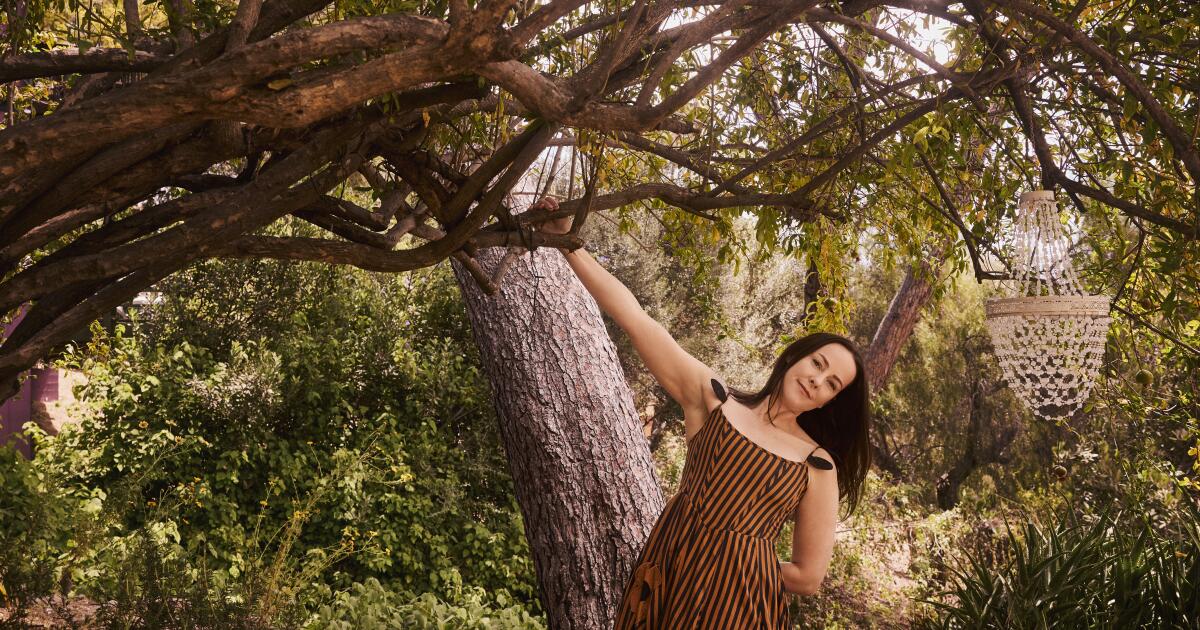
If, god forbid, there’s a natural disaster in L.A. in the near future, Jena Malone might be one of your first responders.
“I’ve been studying Community Emergency Response Team training,” the actor-musician, 41, said, drinking coffee in the living room of her home overlooking pomegranate trees and a canyon in northeast L.A. “Whether it’s fire management or building a neighborhood tool shed, it’s less important for me to hit career milestones now than to transform how I live on this planet. Let’s build something where we’re all taking care of each other’s needs through mutual aid.”
Those are galvanizing priorities from Malone, who’s led generationally beloved films like the sci-fi noir “Donnie Darko,” played the axe-chucking Johanna Mason in two “Hunger Games” tentpoles and recently co-starred in the lesbian bodybuilding revenge flick “Love Lies Bleeding.” For almost as long, she’s also made experimental folk and electronic records that toy with avant-garde noise and quietly poignant songwriting.
This is a wild time in L.A. for anyone concerned about the city and its culture industries, and Malone is deeply invested in both. Just before the release of her new Netflix series, the Duffer Brothers-produced “The Boroughs,” she’s released her first album in nearly a decade. “Flowers For Men” is an effects-shredded, future-primitive record, written after the birth of her son upended her obligations — and expectations — toward the men in her life and the world they’ll inherit.
“It changed everything,” Malone said, about raising a son. “I grew up learning to thrive and mask in masculine spaces. Grind culture is a masculine toxicity that I inherited and indoctrinated myself in. But parenthood offers you this opportunity to burn your entire life down in sacrifice to finding out what’s real. I had no idea what it was to be a man. All of my ideas burned down and not much was being raised back up.”
For millennial film fans, Malone’s been a consistently compelling, trust-anything-she’s-in actor since her child-star turn in 1997’s “Contact.” Few embody a tortured, beguiling Americana quite like her.
“The Boroughs” — a high-profile follow-up to “Stranger Things” from the masters of unreality, created by Jeffrey Addiss and Will Matthews — has a stacked cast that includes Alfred Molina, Geena Davis and Bill Pullman, set amid a bucolic retirement community under supernatural threat. A ragtag group of Duffer Brothers misfits teaming up to fight off eldritch horror might be the last safe bet in television.
Yet that’s also how Malone feels about the current climate of Hollywood — a once-stable neighborhood fending off malign forces. Institutional consolidation and retreat, spiraling costs, technological upheaval — they all add to a creeping sense that an era is over, and worse is coming.
“Film is in such a delicate transition. I think that where music was 20 years ago, film is now,” she said. “It’s like being on an elevator where every floor is on fire. A lot of the things that I loved about it no longer exist, even if what I love about it is still wildly potent. My stress levels go down and my creativity goes up when I’m building a world that does not rely on the film industry, even though it’s my main love.”
That feeling called her back to music on “Flowers For Men,” arriving nine years after her last LP. The ego-shattering experience of giving birth in 2016 and raising a son prompted reflections about what men’s inner lives were really like, and she wanted to write about them.
“I was raised by two moms, and I had this strange aspiration to become the dad,” Malone said, laughing. “I was the breadwinner of my family then. But being a parent was all brand-new to me. I kept seeing my father in him, my grandfather, these older relationships with men. It was asking me to look at him with curious, childlike eyes.”
“Flowers For Men” was written from a sincere curiosity about mens’ strictures, bad influences and better aspirations. To inhabit someone else’s life, she had to sound different, too.
“Film is in such a delicate transition. I think that where music was 20 years ago, film is now,” Malone said. “It’s like being on an elevator where every floor is on fire. A lot of the things that I loved about it no longer exist, even if what I love about it is still wildly potent.
(Evan Mulling/For The Times)
The most prominent instrument on the album is its layers of vocal treatments. Malone has a lovely natural voice — intimately whispered, with hints of ‘70s country rock. But here she douses it in pitch-shifted digital acid, like a late 2000s R&B record dropped in the pool at the Joshua Tree Inn.
It’s an uncanny combo, but its lends modern melancholy to “Barstow,” which has the narrative structure of a Townes Van Zandt banger but is corroded with bleary effects. “Create In Your Name” has a Billie Eilish-worthy late-night murk, with lyrics so devotional they almost sound consumptive. “Disaster Zones” is all blown-out ambience, and the LP closes on a showstopping cover of John Prine’s classic “Angel From Montgomery.”
“I just love that a man wrote a song where the first line is ‘I’m an old woman,’” Malone said. “As a female songwriter, it gives me so much permission. Now all the doors are open. If I was to give flowers to all of the different men that have touched or changed things that deserve celebration, John Prine would be one of them.”
That idea — celebrating men for the good they’re capable of — felt transgressive enough today that it cohered the album for her. But it also came with questions about how romantic partnership fit into her life. Settling into motherhood, she read up on relationship anarchy — which she sees as not abiding by tiers of connection. She bought books on ethical nonmonogamy (“Sex at Dawn” was a big one) to learn how other lives were not just possible, but maybe even more fulfilling.
(Perhaps this was not a stretch from an actor who played the wild child Lydia Bennet in “Pride and Prejudice.”)
“I had been under this societal understanding that hierarchical love, placing one partner above everything else, was the ultimate romantic expression. I could name hundreds of movies that brought that up,” she said. “But while I’m learning to take care of this child, I’m realizing that self-love is one of the most important parts of this equation. I need to have expression, some work in life that felt like another love. And then my family, and how important friends were. And all of a sudden there’s no world where I would just have one love, not even just romantic love.”

“I had been under this societal understanding that hierarchical love, placing one partner above everything else, was the ultimate romantic expression. I could name hundreds of movies that brought that up,” Malone said. “But while I’m learning to take care of this child, I’m realizing that self-love is one of the most important parts of this equation. I need to have expression, some work in life that felt like another love.
(Evan Mulling/For The Times)
“Flowers For Men” is, in her way, a bargain with that contradiction — to love men deeply, but never put them above all else, even as she got engaged to her partner, actor Jack Buckley, earlier this year.
She’s still sorting out how to present this album live. She said she’s a fan of the Dead City Punx model of renegade shows in forgotten corners of L.A. Maybe as the city seems to fall apart, she’ll find a leafy park or the back of a dingy bar that’s the right home for these strange, lonely yet hopeful songs.
“I want someone to walk into the bathroom and be like, ‘Whoa, why is there a woman singing to me?’” Malone said. “I like the idea that art makes you a little uncomfortable and you don’t have the previously held expectations to know how to hold it.”

If, god forbid, there’s a natural disaster in L.A. in the near future, Jena Malone might be one of your first responders.
“I’ve been studying Community Emergency Response Team training,” the actor-musician, 41, said, drinking coffee in the living room of her home overlooking pomegranate trees and a canyon in northeast L.A. “Whether it’s fire management or building a neighborhood tool shed, it’s less important for me to hit career milestones now than to transform how I live on this planet. Let’s build something where we’re all taking care of each other’s needs through mutual aid.”
Those are galvanizing priorities from Malone, who’s led generationally beloved films like the sci-fi noir “Donnie Darko,” played the axe-chucking Johanna Mason in two “Hunger Games” tentpoles and recently co-starred in the lesbian bodybuilding revenge flick “Love Lies Bleeding.” For almost as long, she’s also made experimental folk and electronic records that toy with avant-garde noise and quietly poignant songwriting.
This is a wild time in L.A. for anyone concerned about the city and its culture industries, and Malone is deeply invested in both. Just before the release of her new Netflix series, the Duffer Brothers-produced “The Boroughs,” she’s released her first album in nearly a decade. “Flowers For Men” is an effects-shredded, future-primitive record, written after the birth of her son upended her obligations — and expectations — toward the men in her life and the world they’ll inherit.
“It changed everything,” Malone said, about raising a son. “I grew up learning to thrive and mask in masculine spaces. Grind culture is a masculine toxicity that I inherited and indoctrinated myself in. But parenthood offers you this opportunity to burn your entire life down in sacrifice to finding out what’s real. I had no idea what it was to be a man. All of my ideas burned down and not much was being raised back up.”
For millennial film fans, Malone’s been a consistently compelling, trust-anything-she’s-in actor since her child-star turn in 1997’s “Contact.” Few embody a tortured, beguiling Americana quite like her.
“The Boroughs” — a high-profile follow-up to “Stranger Things” from the masters of unreality, created by Jeffrey Addiss and Will Matthews — has a stacked cast that includes Alfred Molina, Geena Davis and Bill Pullman, set amid a bucolic retirement community under supernatural threat. A ragtag group of Duffer Brothers misfits teaming up to fight off eldritch horror might be the last safe bet in television.
Yet that’s also how Malone feels about the current climate of Hollywood — a once-stable neighborhood fending off malign forces. Institutional consolidation and retreat, spiraling costs, technological upheaval — they all add to a creeping sense that an era is over, and worse is coming.
“Film is in such a delicate transition. I think that where music was 20 years ago, film is now,” she said. “It’s like being on an elevator where every floor is on fire. A lot of the things that I loved about it no longer exist, even if what I love about it is still wildly potent. My stress levels go down and my creativity goes up when I’m building a world that does not rely on the film industry, even though it’s my main love.”
That feeling called her back to music on “Flowers For Men,” arriving nine years after her last LP. The ego-shattering experience of giving birth in 2016 and raising a son prompted reflections about what men’s inner lives were really like, and she wanted to write about them.
“I was raised by two moms, and I had this strange aspiration to become the dad,” Malone said, laughing. “I was the breadwinner of my family then. But being a parent was all brand-new to me. I kept seeing my father in him, my grandfather, these older relationships with men. It was asking me to look at him with curious, childlike eyes.”
“Flowers For Men” was written from a sincere curiosity about mens’ strictures, bad influences and better aspirations. To inhabit someone else’s life, she had to sound different, too.
“Film is in such a delicate transition. I think that where music was 20 years ago, film is now,” Malone said. “It’s like being on an elevator where every floor is on fire. A lot of the things that I loved about it no longer exist, even if what I love about it is still wildly potent.
(Evan Mulling/For The Times)
The most prominent instrument on the album is its layers of vocal treatments. Malone has a lovely natural voice — intimately whispered, with hints of ‘70s country rock. But here she douses it in pitch-shifted digital acid, like a late 2000s R&B record dropped in the pool at the Joshua Tree Inn.
It’s an uncanny combo, but its lends modern melancholy to “Barstow,” which has the narrative structure of a Townes Van Zandt banger but is corroded with bleary effects. “Create In Your Name” has a Billie Eilish-worthy late-night murk, with lyrics so devotional they almost sound consumptive. “Disaster Zones” is all blown-out ambience, and the LP closes on a showstopping cover of John Prine’s classic “Angel From Montgomery.”
“I just love that a man wrote a song where the first line is ‘I’m an old woman,’” Malone said. “As a female songwriter, it gives me so much permission. Now all the doors are open. If I was to give flowers to all of the different men that have touched or changed things that deserve celebration, John Prine would be one of them.”
That idea — celebrating men for the good they’re capable of — felt transgressive enough today that it cohered the album for her. But it also came with questions about how romantic partnership fit into her life. Settling into motherhood, she read up on relationship anarchy — which she sees as not abiding by tiers of connection. She bought books on ethical nonmonogamy (“Sex at Dawn” was a big one) to learn how other lives were not just possible, but maybe even more fulfilling.
(Perhaps this was not a stretch from an actor who played the wild child Lydia Bennet in “Pride and Prejudice.”)
“I had been under this societal understanding that hierarchical love, placing one partner above everything else, was the ultimate romantic expression. I could name hundreds of movies that brought that up,” she said. “But while I’m learning to take care of this child, I’m realizing that self-love is one of the most important parts of this equation. I need to have expression, some work in life that felt like another love. And then my family, and how important friends were. And all of a sudden there’s no world where I would just have one love, not even just romantic love.”
“I had been under this societal understanding that hierarchical love, placing one partner above everything else, was the ultimate romantic expression. I could name hundreds of movies that brought that up,” Malone said. “But while I’m learning to take care of this child, I’m realizing that self-love is one of the most important parts of this equation. I need to have expression, some work in life that felt like another love.
(Evan Mulling/For The Times)
“Flowers For Men” is, in her way, a bargain with that contradiction — to love men deeply, but never put them above all else, even as she got engaged to her partner, actor Jack Buckley, earlier this year.
She’s still sorting out how to present this album live. She said she’s a fan of the Dead City Punx model of renegade shows in forgotten corners of L.A. Maybe as the city seems to fall apart, she’ll find a leafy park or the back of a dingy bar that’s the right home for these strange, lonely yet hopeful songs.
“I want someone to walk into the bathroom and be like, ‘Whoa, why is there a woman singing to me?’” Malone said. “I like the idea that art makes you a little uncomfortable and you don’t have the previously held expectations to know how to hold it.”

If, god forbid, there’s a natural disaster in L.A. in the near future, Jena Malone might be one of your first responders.
“I’ve been studying Community Emergency Response Team training,” the actor-musician, 41, said, drinking coffee in the living room of her home overlooking pomegranate trees and a canyon in northeast L.A. “Whether it’s fire management or building a neighborhood tool shed, it’s less important for me to hit career milestones now than to transform how I live on this planet. Let’s build something where we’re all taking care of each other’s needs through mutual aid.”
Those are galvanizing priorities from Malone, who’s led generationally beloved films like the sci-fi noir “Donnie Darko,” played the axe-chucking Johanna Mason in two “Hunger Games” tentpoles and recently co-starred in the lesbian bodybuilding revenge flick “Love Lies Bleeding.” For almost as long, she’s also made experimental folk and electronic records that toy with avant-garde noise and quietly poignant songwriting.
This is a wild time in L.A. for anyone concerned about the city and its culture industries, and Malone is deeply invested in both. Just before the release of her new Netflix series, the Duffer Brothers-produced “The Boroughs,” she’s released her first album in nearly a decade. “Flowers For Men” is an effects-shredded, future-primitive record, written after the birth of her son upended her obligations — and expectations — toward the men in her life and the world they’ll inherit.
“It changed everything,” Malone said, about raising a son. “I grew up learning to thrive and mask in masculine spaces. Grind culture is a masculine toxicity that I inherited and indoctrinated myself in. But parenthood offers you this opportunity to burn your entire life down in sacrifice to finding out what’s real. I had no idea what it was to be a man. All of my ideas burned down and not much was being raised back up.”
For millennial film fans, Malone’s been a consistently compelling, trust-anything-she’s-in actor since her child-star turn in 1997’s “Contact.” Few embody a tortured, beguiling Americana quite like her.
“The Boroughs” — a high-profile follow-up to “Stranger Things” from the masters of unreality, created by Jeffrey Addiss and Will Matthews — has a stacked cast that includes Alfred Molina, Geena Davis and Bill Pullman, set amid a bucolic retirement community under supernatural threat. A ragtag group of Duffer Brothers misfits teaming up to fight off eldritch horror might be the last safe bet in television.
Yet that’s also how Malone feels about the current climate of Hollywood — a once-stable neighborhood fending off malign forces. Institutional consolidation and retreat, spiraling costs, technological upheaval — they all add to a creeping sense that an era is over, and worse is coming.
“Film is in such a delicate transition. I think that where music was 20 years ago, film is now,” she said. “It’s like being on an elevator where every floor is on fire. A lot of the things that I loved about it no longer exist, even if what I love about it is still wildly potent. My stress levels go down and my creativity goes up when I’m building a world that does not rely on the film industry, even though it’s my main love.”
That feeling called her back to music on “Flowers For Men,” arriving nine years after her last LP. The ego-shattering experience of giving birth in 2016 and raising a son prompted reflections about what men’s inner lives were really like, and she wanted to write about them.
“I was raised by two moms, and I had this strange aspiration to become the dad,” Malone said, laughing. “I was the breadwinner of my family then. But being a parent was all brand-new to me. I kept seeing my father in him, my grandfather, these older relationships with men. It was asking me to look at him with curious, childlike eyes.”
“Flowers For Men” was written from a sincere curiosity about mens’ strictures, bad influences and better aspirations. To inhabit someone else’s life, she had to sound different, too.
“Film is in such a delicate transition. I think that where music was 20 years ago, film is now,” Malone said. “It’s like being on an elevator where every floor is on fire. A lot of the things that I loved about it no longer exist, even if what I love about it is still wildly potent.
(Evan Mulling/For The Times)
The most prominent instrument on the album is its layers of vocal treatments. Malone has a lovely natural voice — intimately whispered, with hints of ‘70s country rock. But here she douses it in pitch-shifted digital acid, like a late 2000s R&B record dropped in the pool at the Joshua Tree Inn.
It’s an uncanny combo, but its lends modern melancholy to “Barstow,” which has the narrative structure of a Townes Van Zandt banger but is corroded with bleary effects. “Create In Your Name” has a Billie Eilish-worthy late-night murk, with lyrics so devotional they almost sound consumptive. “Disaster Zones” is all blown-out ambience, and the LP closes on a showstopping cover of John Prine’s classic “Angel From Montgomery.”
“I just love that a man wrote a song where the first line is ‘I’m an old woman,’” Malone said. “As a female songwriter, it gives me so much permission. Now all the doors are open. If I was to give flowers to all of the different men that have touched or changed things that deserve celebration, John Prine would be one of them.”
That idea — celebrating men for the good they’re capable of — felt transgressive enough today that it cohered the album for her. But it also came with questions about how romantic partnership fit into her life. Settling into motherhood, she read up on relationship anarchy — which she sees as not abiding by tiers of connection. She bought books on ethical nonmonogamy (“Sex at Dawn” was a big one) to learn how other lives were not just possible, but maybe even more fulfilling.
(Perhaps this was not a stretch from an actor who played the wild child Lydia Bennet in “Pride and Prejudice.”)
“I had been under this societal understanding that hierarchical love, placing one partner above everything else, was the ultimate romantic expression. I could name hundreds of movies that brought that up,” she said. “But while I’m learning to take care of this child, I’m realizing that self-love is one of the most important parts of this equation. I need to have expression, some work in life that felt like another love. And then my family, and how important friends were. And all of a sudden there’s no world where I would just have one love, not even just romantic love.”
“I had been under this societal understanding that hierarchical love, placing one partner above everything else, was the ultimate romantic expression. I could name hundreds of movies that brought that up,” Malone said. “But while I’m learning to take care of this child, I’m realizing that self-love is one of the most important parts of this equation. I need to have expression, some work in life that felt like another love.
(Evan Mulling/For The Times)
“Flowers For Men” is, in her way, a bargain with that contradiction — to love men deeply, but never put them above all else, even as she got engaged to her partner, actor Jack Buckley, earlier this year.
She’s still sorting out how to present this album live. She said she’s a fan of the Dead City Punx model of renegade shows in forgotten corners of L.A. Maybe as the city seems to fall apart, she’ll find a leafy park or the back of a dingy bar that’s the right home for these strange, lonely yet hopeful songs.
“I want someone to walk into the bathroom and be like, ‘Whoa, why is there a woman singing to me?’” Malone said. “I like the idea that art makes you a little uncomfortable and you don’t have the previously held expectations to know how to hold it.”
If, god forbid, there’s a natural disaster in L.A. in the near future, Jena Malone might be one of your first responders.
“I’ve been studying Community Emergency Response Team training,” the actor-musician, 41, said, drinking coffee in the living room of her home overlooking pomegranate trees and a canyon in northeast L.A. “Whether it’s fire management or building a neighborhood tool shed, it’s less important for me to hit career milestones now than to transform how I live on this planet. Let’s build something where we’re all taking care of each other’s needs through mutual aid.”
Those are galvanizing priorities from Malone, who’s led generationally beloved films like the sci-fi noir “Donnie Darko,” played the axe-chucking Johanna Mason in two “Hunger Games” tentpoles and recently co-starred in the lesbian bodybuilding revenge flick “Love Lies Bleeding.” For almost as long, she’s also made experimental folk and electronic records that toy with avant-garde noise and quietly poignant songwriting.
This is a wild time in L.A. for anyone concerned about the city and its culture industries, and Malone is deeply invested in both. Just before the release of her new Netflix series, the Duffer Brothers-produced “The Boroughs,” she’s released her first album in nearly a decade. “Flowers For Men” is an effects-shredded, future-primitive record, written after the birth of her son upended her obligations — and expectations — toward the men in her life and the world they’ll inherit.
“It changed everything,” Malone said, about raising a son. “I grew up learning to thrive and mask in masculine spaces. Grind culture is a masculine toxicity that I inherited and indoctrinated myself in. But parenthood offers you this opportunity to burn your entire life down in sacrifice to finding out what’s real. I had no idea what it was to be a man. All of my ideas burned down and not much was being raised back up.”
For millennial film fans, Malone’s been a consistently compelling, trust-anything-she’s-in actor since her child-star turn in 1997’s “Contact.” Few embody a tortured, beguiling Americana quite like her.
“The Boroughs” — a high-profile follow-up to “Stranger Things” from the masters of unreality, created by Jeffrey Addiss and Will Matthews — has a stacked cast that includes Alfred Molina, Geena Davis and Bill Pullman, set amid a bucolic retirement community under supernatural threat. A ragtag group of Duffer Brothers misfits teaming up to fight off eldritch horror might be the last safe bet in television.
Yet that’s also how Malone feels about the current climate of Hollywood — a once-stable neighborhood fending off malign forces. Institutional consolidation and retreat, spiraling costs, technological upheaval — they all add to a creeping sense that an era is over, and worse is coming.
“Film is in such a delicate transition. I think that where music was 20 years ago, film is now,” she said. “It’s like being on an elevator where every floor is on fire. A lot of the things that I loved about it no longer exist, even if what I love about it is still wildly potent. My stress levels go down and my creativity goes up when I’m building a world that does not rely on the film industry, even though it’s my main love.”
That feeling called her back to music on “Flowers For Men,” arriving nine years after her last LP. The ego-shattering experience of giving birth in 2016 and raising a son prompted reflections about what men’s inner lives were really like, and she wanted to write about them.
“I was raised by two moms, and I had this strange aspiration to become the dad,” Malone said, laughing. “I was the breadwinner of my family then. But being a parent was all brand-new to me. I kept seeing my father in him, my grandfather, these older relationships with men. It was asking me to look at him with curious, childlike eyes.”
“Flowers For Men” was written from a sincere curiosity about mens’ strictures, bad influences and better aspirations. To inhabit someone else’s life, she had to sound different, too.
“Film is in such a delicate transition. I think that where music was 20 years ago, film is now,” Malone said. “It’s like being on an elevator where every floor is on fire. A lot of the things that I loved about it no longer exist, even if what I love about it is still wildly potent.
(Evan Mulling/For The Times)
The most prominent instrument on the album is its layers of vocal treatments. Malone has a lovely natural voice — intimately whispered, with hints of ‘70s country rock. But here she douses it in pitch-shifted digital acid, like a late 2000s R&B record dropped in the pool at the Joshua Tree Inn.
It’s an uncanny combo, but its lends modern melancholy to “Barstow,” which has the narrative structure of a Townes Van Zandt banger but is corroded with bleary effects. “Create In Your Name” has a Billie Eilish-worthy late-night murk, with lyrics so devotional they almost sound consumptive. “Disaster Zones” is all blown-out ambience, and the LP closes on a showstopping cover of John Prine’s classic “Angel From Montgomery.”
“I just love that a man wrote a song where the first line is ‘I’m an old woman,’” Malone said. “As a female songwriter, it gives me so much permission. Now all the doors are open. If I was to give flowers to all of the different men that have touched or changed things that deserve celebration, John Prine would be one of them.”
That idea — celebrating men for the good they’re capable of — felt transgressive enough today that it cohered the album for her. But it also came with questions about how romantic partnership fit into her life. Settling into motherhood, she read up on relationship anarchy — which she sees as not abiding by tiers of connection. She bought books on ethical nonmonogamy (“Sex at Dawn” was a big one) to learn how other lives were not just possible, but maybe even more fulfilling.
(Perhaps this was not a stretch from an actor who played the wild child Lydia Bennet in “Pride and Prejudice.”)
“I had been under this societal understanding that hierarchical love, placing one partner above everything else, was the ultimate romantic expression. I could name hundreds of movies that brought that up,” she said. “But while I’m learning to take care of this child, I’m realizing that self-love is one of the most important parts of this equation. I need to have expression, some work in life that felt like another love. And then my family, and how important friends were. And all of a sudden there’s no world where I would just have one love, not even just romantic love.”
“I had been under this societal understanding that hierarchical love, placing one partner above everything else, was the ultimate romantic expression. I could name hundreds of movies that brought that up,” Malone said. “But while I’m learning to take care of this child, I’m realizing that self-love is one of the most important parts of this equation. I need to have expression, some work in life that felt like another love.
(Evan Mulling/For The Times)
“Flowers For Men” is, in her way, a bargain with that contradiction — to love men deeply, but never put them above all else, even as she got engaged to her partner, actor Jack Buckley, earlier this year.
She’s still sorting out how to present this album live. She said she’s a fan of the Dead City Punx model of renegade shows in forgotten corners of L.A. Maybe as the city seems to fall apart, she’ll find a leafy park or the back of a dingy bar that’s the right home for these strange, lonely yet hopeful songs.
“I want someone to walk into the bathroom and be like, ‘Whoa, why is there a woman singing to me?’” Malone said. “I like the idea that art makes you a little uncomfortable and you don’t have the previously held expectations to know how to hold it.”

If, god forbid, there’s a natural disaster in L.A. in the near future, Jena Malone might be one of your first responders.
“I’ve been studying Community Emergency Response Team training,” the actor-musician, 41, said, drinking coffee in the living room of her home overlooking pomegranate trees and a canyon in northeast L.A. “Whether it’s fire management or building a neighborhood tool shed, it’s less important for me to hit career milestones now than to transform how I live on this planet. Let’s build something where we’re all taking care of each other’s needs through mutual aid.”
Those are galvanizing priorities from Malone, who’s led generationally beloved films like the sci-fi noir “Donnie Darko,” played the axe-chucking Johanna Mason in two “Hunger Games” tentpoles and recently co-starred in the lesbian bodybuilding revenge flick “Love Lies Bleeding.” For almost as long, she’s also made experimental folk and electronic records that toy with avant-garde noise and quietly poignant songwriting.
This is a wild time in L.A. for anyone concerned about the city and its culture industries, and Malone is deeply invested in both. Just before the release of her new Netflix series, the Duffer Brothers-produced “The Boroughs,” she’s released her first album in nearly a decade. “Flowers For Men” is an effects-shredded, future-primitive record, written after the birth of her son upended her obligations — and expectations — toward the men in her life and the world they’ll inherit.
“It changed everything,” Malone said, about raising a son. “I grew up learning to thrive and mask in masculine spaces. Grind culture is a masculine toxicity that I inherited and indoctrinated myself in. But parenthood offers you this opportunity to burn your entire life down in sacrifice to finding out what’s real. I had no idea what it was to be a man. All of my ideas burned down and not much was being raised back up.”
For millennial film fans, Malone’s been a consistently compelling, trust-anything-she’s-in actor since her child-star turn in 1997’s “Contact.” Few embody a tortured, beguiling Americana quite like her.
“The Boroughs” — a high-profile follow-up to “Stranger Things” from the masters of unreality, created by Jeffrey Addiss and Will Matthews — has a stacked cast that includes Alfred Molina, Geena Davis and Bill Pullman, set amid a bucolic retirement community under supernatural threat. A ragtag group of Duffer Brothers misfits teaming up to fight off eldritch horror might be the last safe bet in television.
Yet that’s also how Malone feels about the current climate of Hollywood — a once-stable neighborhood fending off malign forces. Institutional consolidation and retreat, spiraling costs, technological upheaval — they all add to a creeping sense that an era is over, and worse is coming.
“Film is in such a delicate transition. I think that where music was 20 years ago, film is now,” she said. “It’s like being on an elevator where every floor is on fire. A lot of the things that I loved about it no longer exist, even if what I love about it is still wildly potent. My stress levels go down and my creativity goes up when I’m building a world that does not rely on the film industry, even though it’s my main love.”
That feeling called her back to music on “Flowers For Men,” arriving nine years after her last LP. The ego-shattering experience of giving birth in 2016 and raising a son prompted reflections about what men’s inner lives were really like, and she wanted to write about them.
“I was raised by two moms, and I had this strange aspiration to become the dad,” Malone said, laughing. “I was the breadwinner of my family then. But being a parent was all brand-new to me. I kept seeing my father in him, my grandfather, these older relationships with men. It was asking me to look at him with curious, childlike eyes.”
“Flowers For Men” was written from a sincere curiosity about mens’ strictures, bad influences and better aspirations. To inhabit someone else’s life, she had to sound different, too.
“Film is in such a delicate transition. I think that where music was 20 years ago, film is now,” Malone said. “It’s like being on an elevator where every floor is on fire. A lot of the things that I loved about it no longer exist, even if what I love about it is still wildly potent.
(Evan Mulling/For The Times)
The most prominent instrument on the album is its layers of vocal treatments. Malone has a lovely natural voice — intimately whispered, with hints of ‘70s country rock. But here she douses it in pitch-shifted digital acid, like a late 2000s R&B record dropped in the pool at the Joshua Tree Inn.
It’s an uncanny combo, but its lends modern melancholy to “Barstow,” which has the narrative structure of a Townes Van Zandt banger but is corroded with bleary effects. “Create In Your Name” has a Billie Eilish-worthy late-night murk, with lyrics so devotional they almost sound consumptive. “Disaster Zones” is all blown-out ambience, and the LP closes on a showstopping cover of John Prine’s classic “Angel From Montgomery.”
“I just love that a man wrote a song where the first line is ‘I’m an old woman,’” Malone said. “As a female songwriter, it gives me so much permission. Now all the doors are open. If I was to give flowers to all of the different men that have touched or changed things that deserve celebration, John Prine would be one of them.”
That idea — celebrating men for the good they’re capable of — felt transgressive enough today that it cohered the album for her. But it also came with questions about how romantic partnership fit into her life. Settling into motherhood, she read up on relationship anarchy — which she sees as not abiding by tiers of connection. She bought books on ethical nonmonogamy (“Sex at Dawn” was a big one) to learn how other lives were not just possible, but maybe even more fulfilling.
(Perhaps this was not a stretch from an actor who played the wild child Lydia Bennet in “Pride and Prejudice.”)
“I had been under this societal understanding that hierarchical love, placing one partner above everything else, was the ultimate romantic expression. I could name hundreds of movies that brought that up,” she said. “But while I’m learning to take care of this child, I’m realizing that self-love is one of the most important parts of this equation. I need to have expression, some work in life that felt like another love. And then my family, and how important friends were. And all of a sudden there’s no world where I would just have one love, not even just romantic love.”
“I had been under this societal understanding that hierarchical love, placing one partner above everything else, was the ultimate romantic expression. I could name hundreds of movies that brought that up,” Malone said. “But while I’m learning to take care of this child, I’m realizing that self-love is one of the most important parts of this equation. I need to have expression, some work in life that felt like another love.
(Evan Mulling/For The Times)
“Flowers For Men” is, in her way, a bargain with that contradiction — to love men deeply, but never put them above all else, even as she got engaged to her partner, actor Jack Buckley, earlier this year.
She’s still sorting out how to present this album live. She said she’s a fan of the Dead City Punx model of renegade shows in forgotten corners of L.A. Maybe as the city seems to fall apart, she’ll find a leafy park or the back of a dingy bar that’s the right home for these strange, lonely yet hopeful songs.
“I want someone to walk into the bathroom and be like, ‘Whoa, why is there a woman singing to me?’” Malone said. “I like the idea that art makes you a little uncomfortable and you don’t have the previously held expectations to know how to hold it.”
If, god forbid, there’s a natural disaster in L.A. in the near future, Jena Malone might be one of your first responders.
“I’ve been studying Community Emergency Response Team training,” the actor-musician, 41, said, drinking coffee in the living room of her home overlooking pomegranate trees and a canyon in northeast L.A. “Whether it’s fire management or building a neighborhood tool shed, it’s less important for me to hit career milestones now than to transform how I live on this planet. Let’s build something where we’re all taking care of each other’s needs through mutual aid.”
Those are galvanizing priorities from Malone, who’s led generationally beloved films like the sci-fi noir “Donnie Darko,” played the axe-chucking Johanna Mason in two “Hunger Games” tentpoles and recently co-starred in the lesbian bodybuilding revenge flick “Love Lies Bleeding.” For almost as long, she’s also made experimental folk and electronic records that toy with avant-garde noise and quietly poignant songwriting.
This is a wild time in L.A. for anyone concerned about the city and its culture industries, and Malone is deeply invested in both. Just before the release of her new Netflix series, the Duffer Brothers-produced “The Boroughs,” she’s released her first album in nearly a decade. “Flowers For Men” is an effects-shredded, future-primitive record, written after the birth of her son upended her obligations — and expectations — toward the men in her life and the world they’ll inherit.
“It changed everything,” Malone said, about raising a son. “I grew up learning to thrive and mask in masculine spaces. Grind culture is a masculine toxicity that I inherited and indoctrinated myself in. But parenthood offers you this opportunity to burn your entire life down in sacrifice to finding out what’s real. I had no idea what it was to be a man. All of my ideas burned down and not much was being raised back up.”
For millennial film fans, Malone’s been a consistently compelling, trust-anything-she’s-in actor since her child-star turn in 1997’s “Contact.” Few embody a tortured, beguiling Americana quite like her.
“The Boroughs” — a high-profile follow-up to “Stranger Things” from the masters of unreality, created by Jeffrey Addiss and Will Matthews — has a stacked cast that includes Alfred Molina, Geena Davis and Bill Pullman, set amid a bucolic retirement community under supernatural threat. A ragtag group of Duffer Brothers misfits teaming up to fight off eldritch horror might be the last safe bet in television.
Yet that’s also how Malone feels about the current climate of Hollywood — a once-stable neighborhood fending off malign forces. Institutional consolidation and retreat, spiraling costs, technological upheaval — they all add to a creeping sense that an era is over, and worse is coming.
“Film is in such a delicate transition. I think that where music was 20 years ago, film is now,” she said. “It’s like being on an elevator where every floor is on fire. A lot of the things that I loved about it no longer exist, even if what I love about it is still wildly potent. My stress levels go down and my creativity goes up when I’m building a world that does not rely on the film industry, even though it’s my main love.”
That feeling called her back to music on “Flowers For Men,” arriving nine years after her last LP. The ego-shattering experience of giving birth in 2016 and raising a son prompted reflections about what men’s inner lives were really like, and she wanted to write about them.
“I was raised by two moms, and I had this strange aspiration to become the dad,” Malone said, laughing. “I was the breadwinner of my family then. But being a parent was all brand-new to me. I kept seeing my father in him, my grandfather, these older relationships with men. It was asking me to look at him with curious, childlike eyes.”
“Flowers For Men” was written from a sincere curiosity about mens’ strictures, bad influences and better aspirations. To inhabit someone else’s life, she had to sound different, too.
“Film is in such a delicate transition. I think that where music was 20 years ago, film is now,” Malone said. “It’s like being on an elevator where every floor is on fire. A lot of the things that I loved about it no longer exist, even if what I love about it is still wildly potent.
(Evan Mulling/For The Times)
The most prominent instrument on the album is its layers of vocal treatments. Malone has a lovely natural voice — intimately whispered, with hints of ‘70s country rock. But here she douses it in pitch-shifted digital acid, like a late 2000s R&B record dropped in the pool at the Joshua Tree Inn.
It’s an uncanny combo, but its lends modern melancholy to “Barstow,” which has the narrative structure of a Townes Van Zandt banger but is corroded with bleary effects. “Create In Your Name” has a Billie Eilish-worthy late-night murk, with lyrics so devotional they almost sound consumptive. “Disaster Zones” is all blown-out ambience, and the LP closes on a showstopping cover of John Prine’s classic “Angel From Montgomery.”
“I just love that a man wrote a song where the first line is ‘I’m an old woman,’” Malone said. “As a female songwriter, it gives me so much permission. Now all the doors are open. If I was to give flowers to all of the different men that have touched or changed things that deserve celebration, John Prine would be one of them.”
That idea — celebrating men for the good they’re capable of — felt transgressive enough today that it cohered the album for her. But it also came with questions about how romantic partnership fit into her life. Settling into motherhood, she read up on relationship anarchy — which she sees as not abiding by tiers of connection. She bought books on ethical nonmonogamy (“Sex at Dawn” was a big one) to learn how other lives were not just possible, but maybe even more fulfilling.
(Perhaps this was not a stretch from an actor who played the wild child Lydia Bennet in “Pride and Prejudice.”)
“I had been under this societal understanding that hierarchical love, placing one partner above everything else, was the ultimate romantic expression. I could name hundreds of movies that brought that up,” she said. “But while I’m learning to take care of this child, I’m realizing that self-love is one of the most important parts of this equation. I need to have expression, some work in life that felt like another love. And then my family, and how important friends were. And all of a sudden there’s no world where I would just have one love, not even just romantic love.”
“I had been under this societal understanding that hierarchical love, placing one partner above everything else, was the ultimate romantic expression. I could name hundreds of movies that brought that up,” Malone said. “But while I’m learning to take care of this child, I’m realizing that self-love is one of the most important parts of this equation. I need to have expression, some work in life that felt like another love.
(Evan Mulling/For The Times)
“Flowers For Men” is, in her way, a bargain with that contradiction — to love men deeply, but never put them above all else, even as she got engaged to her partner, actor Jack Buckley, earlier this year.
She’s still sorting out how to present this album live. She said she’s a fan of the Dead City Punx model of renegade shows in forgotten corners of L.A. Maybe as the city seems to fall apart, she’ll find a leafy park or the back of a dingy bar that’s the right home for these strange, lonely yet hopeful songs.
“I want someone to walk into the bathroom and be like, ‘Whoa, why is there a woman singing to me?’” Malone said. “I like the idea that art makes you a little uncomfortable and you don’t have the previously held expectations to know how to hold it.”
If, god forbid, there’s a natural disaster in L.A. in the near future, Jena Malone might be one of your first responders.
“I’ve been studying Community Emergency Response Team training,” the actor-musician, 41, said, drinking coffee in the living room of her home overlooking pomegranate trees and a canyon in northeast L.A. “Whether it’s fire management or building a neighborhood tool shed, it’s less important for me to hit career milestones now than to transform how I live on this planet. Let’s build something where we’re all taking care of each other’s needs through mutual aid.”
Those are galvanizing priorities from Malone, who’s led generationally beloved films like the sci-fi noir “Donnie Darko,” played the axe-chucking Johanna Mason in two “Hunger Games” tentpoles and recently co-starred in the lesbian bodybuilding revenge flick “Love Lies Bleeding.” For almost as long, she’s also made experimental folk and electronic records that toy with avant-garde noise and quietly poignant songwriting.
This is a wild time in L.A. for anyone concerned about the city and its culture industries, and Malone is deeply invested in both. Just before the release of her new Netflix series, the Duffer Brothers-produced “The Boroughs,” she’s released her first album in nearly a decade. “Flowers For Men” is an effects-shredded, future-primitive record, written after the birth of her son upended her obligations — and expectations — toward the men in her life and the world they’ll inherit.
“It changed everything,” Malone said, about raising a son. “I grew up learning to thrive and mask in masculine spaces. Grind culture is a masculine toxicity that I inherited and indoctrinated myself in. But parenthood offers you this opportunity to burn your entire life down in sacrifice to finding out what’s real. I had no idea what it was to be a man. All of my ideas burned down and not much was being raised back up.”
For millennial film fans, Malone’s been a consistently compelling, trust-anything-she’s-in actor since her child-star turn in 1997’s “Contact.” Few embody a tortured, beguiling Americana quite like her.
“The Boroughs” — a high-profile follow-up to “Stranger Things” from the masters of unreality, created by Jeffrey Addiss and Will Matthews — has a stacked cast that includes Alfred Molina, Geena Davis and Bill Pullman, set amid a bucolic retirement community under supernatural threat. A ragtag group of Duffer Brothers misfits teaming up to fight off eldritch horror might be the last safe bet in television.
Yet that’s also how Malone feels about the current climate of Hollywood — a once-stable neighborhood fending off malign forces. Institutional consolidation and retreat, spiraling costs, technological upheaval — they all add to a creeping sense that an era is over, and worse is coming.
“Film is in such a delicate transition. I think that where music was 20 years ago, film is now,” she said. “It’s like being on an elevator where every floor is on fire. A lot of the things that I loved about it no longer exist, even if what I love about it is still wildly potent. My stress levels go down and my creativity goes up when I’m building a world that does not rely on the film industry, even though it’s my main love.”
That feeling called her back to music on “Flowers For Men,” arriving nine years after her last LP. The ego-shattering experience of giving birth in 2016 and raising a son prompted reflections about what men’s inner lives were really like, and she wanted to write about them.
“I was raised by two moms, and I had this strange aspiration to become the dad,” Malone said, laughing. “I was the breadwinner of my family then. But being a parent was all brand-new to me. I kept seeing my father in him, my grandfather, these older relationships with men. It was asking me to look at him with curious, childlike eyes.”
“Flowers For Men” was written from a sincere curiosity about mens’ strictures, bad influences and better aspirations. To inhabit someone else’s life, she had to sound different, too.
“Film is in such a delicate transition. I think that where music was 20 years ago, film is now,” Malone said. “It’s like being on an elevator where every floor is on fire. A lot of the things that I loved about it no longer exist, even if what I love about it is still wildly potent.
(Evan Mulling/For The Times)
The most prominent instrument on the album is its layers of vocal treatments. Malone has a lovely natural voice — intimately whispered, with hints of ‘70s country rock. But here she douses it in pitch-shifted digital acid, like a late 2000s R&B record dropped in the pool at the Joshua Tree Inn.
It’s an uncanny combo, but its lends modern melancholy to “Barstow,” which has the narrative structure of a Townes Van Zandt banger but is corroded with bleary effects. “Create In Your Name” has a Billie Eilish-worthy late-night murk, with lyrics so devotional they almost sound consumptive. “Disaster Zones” is all blown-out ambience, and the LP closes on a showstopping cover of John Prine’s classic “Angel From Montgomery.”
“I just love that a man wrote a song where the first line is ‘I’m an old woman,’” Malone said. “As a female songwriter, it gives me so much permission. Now all the doors are open. If I was to give flowers to all of the different men that have touched or changed things that deserve celebration, John Prine would be one of them.”
That idea — celebrating men for the good they’re capable of — felt transgressive enough today that it cohered the album for her. But it also came with questions about how romantic partnership fit into her life. Settling into motherhood, she read up on relationship anarchy — which she sees as not abiding by tiers of connection. She bought books on ethical nonmonogamy (“Sex at Dawn” was a big one) to learn how other lives were not just possible, but maybe even more fulfilling.
(Perhaps this was not a stretch from an actor who played the wild child Lydia Bennet in “Pride and Prejudice.”)
“I had been under this societal understanding that hierarchical love, placing one partner above everything else, was the ultimate romantic expression. I could name hundreds of movies that brought that up,” she said. “But while I’m learning to take care of this child, I’m realizing that self-love is one of the most important parts of this equation. I need to have expression, some work in life that felt like another love. And then my family, and how important friends were. And all of a sudden there’s no world where I would just have one love, not even just romantic love.”
“I had been under this societal understanding that hierarchical love, placing one partner above everything else, was the ultimate romantic expression. I could name hundreds of movies that brought that up,” Malone said. “But while I’m learning to take care of this child, I’m realizing that self-love is one of the most important parts of this equation. I need to have expression, some work in life that felt like another love.
(Evan Mulling/For The Times)
“Flowers For Men” is, in her way, a bargain with that contradiction — to love men deeply, but never put them above all else, even as she got engaged to her partner, actor Jack Buckley, earlier this year.
She’s still sorting out how to present this album live. She said she’s a fan of the Dead City Punx model of renegade shows in forgotten corners of L.A. Maybe as the city seems to fall apart, she’ll find a leafy park or the back of a dingy bar that’s the right home for these strange, lonely yet hopeful songs.
“I want someone to walk into the bathroom and be like, ‘Whoa, why is there a woman singing to me?’” Malone said. “I like the idea that art makes you a little uncomfortable and you don’t have the previously held expectations to know how to hold it.”
If, god forbid, there’s a natural disaster in L.A. in the near future, Jena Malone might be one of your first responders.
“I’ve been studying Community Emergency Response Team training,” the actor-musician, 41, said, drinking coffee in the living room of her home overlooking pomegranate trees and a canyon in northeast L.A. “Whether it’s fire management or building a neighborhood tool shed, it’s less important for me to hit career milestones now than to transform how I live on this planet. Let’s build something where we’re all taking care of each other’s needs through mutual aid.”
Those are galvanizing priorities from Malone, who’s led generationally beloved films like the sci-fi noir “Donnie Darko,” played the axe-chucking Johanna Mason in two “Hunger Games” tentpoles and recently co-starred in the lesbian bodybuilding revenge flick “Love Lies Bleeding.” For almost as long, she’s also made experimental folk and electronic records that toy with avant-garde noise and quietly poignant songwriting.
This is a wild time in L.A. for anyone concerned about the city and its culture industries, and Malone is deeply invested in both. Just before the release of her new Netflix series, the Duffer Brothers-produced “The Boroughs,” she’s released her first album in nearly a decade. “Flowers For Men” is an effects-shredded, future-primitive record, written after the birth of her son upended her obligations — and expectations — toward the men in her life and the world they’ll inherit.
“It changed everything,” Malone said, about raising a son. “I grew up learning to thrive and mask in masculine spaces. Grind culture is a masculine toxicity that I inherited and indoctrinated myself in. But parenthood offers you this opportunity to burn your entire life down in sacrifice to finding out what’s real. I had no idea what it was to be a man. All of my ideas burned down and not much was being raised back up.”
For millennial film fans, Malone’s been a consistently compelling, trust-anything-she’s-in actor since her child-star turn in 1997’s “Contact.” Few embody a tortured, beguiling Americana quite like her.
“The Boroughs” — a high-profile follow-up to “Stranger Things” from the masters of unreality, created by Jeffrey Addiss and Will Matthews — has a stacked cast that includes Alfred Molina, Geena Davis and Bill Pullman, set amid a bucolic retirement community under supernatural threat. A ragtag group of Duffer Brothers misfits teaming up to fight off eldritch horror might be the last safe bet in television.
Yet that’s also how Malone feels about the current climate of Hollywood — a once-stable neighborhood fending off malign forces. Institutional consolidation and retreat, spiraling costs, technological upheaval — they all add to a creeping sense that an era is over, and worse is coming.
“Film is in such a delicate transition. I think that where music was 20 years ago, film is now,” she said. “It’s like being on an elevator where every floor is on fire. A lot of the things that I loved about it no longer exist, even if what I love about it is still wildly potent. My stress levels go down and my creativity goes up when I’m building a world that does not rely on the film industry, even though it’s my main love.”
That feeling called her back to music on “Flowers For Men,” arriving nine years after her last LP. The ego-shattering experience of giving birth in 2016 and raising a son prompted reflections about what men’s inner lives were really like, and she wanted to write about them.
“I was raised by two moms, and I had this strange aspiration to become the dad,” Malone said, laughing. “I was the breadwinner of my family then. But being a parent was all brand-new to me. I kept seeing my father in him, my grandfather, these older relationships with men. It was asking me to look at him with curious, childlike eyes.”
“Flowers For Men” was written from a sincere curiosity about mens’ strictures, bad influences and better aspirations. To inhabit someone else’s life, she had to sound different, too.
“Film is in such a delicate transition. I think that where music was 20 years ago, film is now,” Malone said. “It’s like being on an elevator where every floor is on fire. A lot of the things that I loved about it no longer exist, even if what I love about it is still wildly potent.
(Evan Mulling/For The Times)
The most prominent instrument on the album is its layers of vocal treatments. Malone has a lovely natural voice — intimately whispered, with hints of ‘70s country rock. But here she douses it in pitch-shifted digital acid, like a late 2000s R&B record dropped in the pool at the Joshua Tree Inn.
It’s an uncanny combo, but its lends modern melancholy to “Barstow,” which has the narrative structure of a Townes Van Zandt banger but is corroded with bleary effects. “Create In Your Name” has a Billie Eilish-worthy late-night murk, with lyrics so devotional they almost sound consumptive. “Disaster Zones” is all blown-out ambience, and the LP closes on a showstopping cover of John Prine’s classic “Angel From Montgomery.”
“I just love that a man wrote a song where the first line is ‘I’m an old woman,’” Malone said. “As a female songwriter, it gives me so much permission. Now all the doors are open. If I was to give flowers to all of the different men that have touched or changed things that deserve celebration, John Prine would be one of them.”
That idea — celebrating men for the good they’re capable of — felt transgressive enough today that it cohered the album for her. But it also came with questions about how romantic partnership fit into her life. Settling into motherhood, she read up on relationship anarchy — which she sees as not abiding by tiers of connection. She bought books on ethical nonmonogamy (“Sex at Dawn” was a big one) to learn how other lives were not just possible, but maybe even more fulfilling.
(Perhaps this was not a stretch from an actor who played the wild child Lydia Bennet in “Pride and Prejudice.”)
“I had been under this societal understanding that hierarchical love, placing one partner above everything else, was the ultimate romantic expression. I could name hundreds of movies that brought that up,” she said. “But while I’m learning to take care of this child, I’m realizing that self-love is one of the most important parts of this equation. I need to have expression, some work in life that felt like another love. And then my family, and how important friends were. And all of a sudden there’s no world where I would just have one love, not even just romantic love.”
“I had been under this societal understanding that hierarchical love, placing one partner above everything else, was the ultimate romantic expression. I could name hundreds of movies that brought that up,” Malone said. “But while I’m learning to take care of this child, I’m realizing that self-love is one of the most important parts of this equation. I need to have expression, some work in life that felt like another love.
(Evan Mulling/For The Times)
“Flowers For Men” is, in her way, a bargain with that contradiction — to love men deeply, but never put them above all else, even as she got engaged to her partner, actor Jack Buckley, earlier this year.
She’s still sorting out how to present this album live. She said she’s a fan of the Dead City Punx model of renegade shows in forgotten corners of L.A. Maybe as the city seems to fall apart, she’ll find a leafy park or the back of a dingy bar that’s the right home for these strange, lonely yet hopeful songs.
“I want someone to walk into the bathroom and be like, ‘Whoa, why is there a woman singing to me?’” Malone said. “I like the idea that art makes you a little uncomfortable and you don’t have the previously held expectations to know how to hold it.”