


“What are those?” asked the cashier at the grocery store checkout. He gingerly added bunches of greens to my shopping bags as if they were long-stemmed roses: curly kale, black (Tuscan) kale, chard (rainbow and white), collard greens, spinach and a head of escarole. “I mean … like … what are you going to do with them?”
“I’m going to cook them,” I said. I kept it vague. He seemed overwhelmed, and the next customer’s groceries were starting to come down the conveyor belt for bagging. “They’re vegetables. I’m making vegetables.”
“Oh. Man. Wow!!!” he said, his mouth hanging open in disbelief.
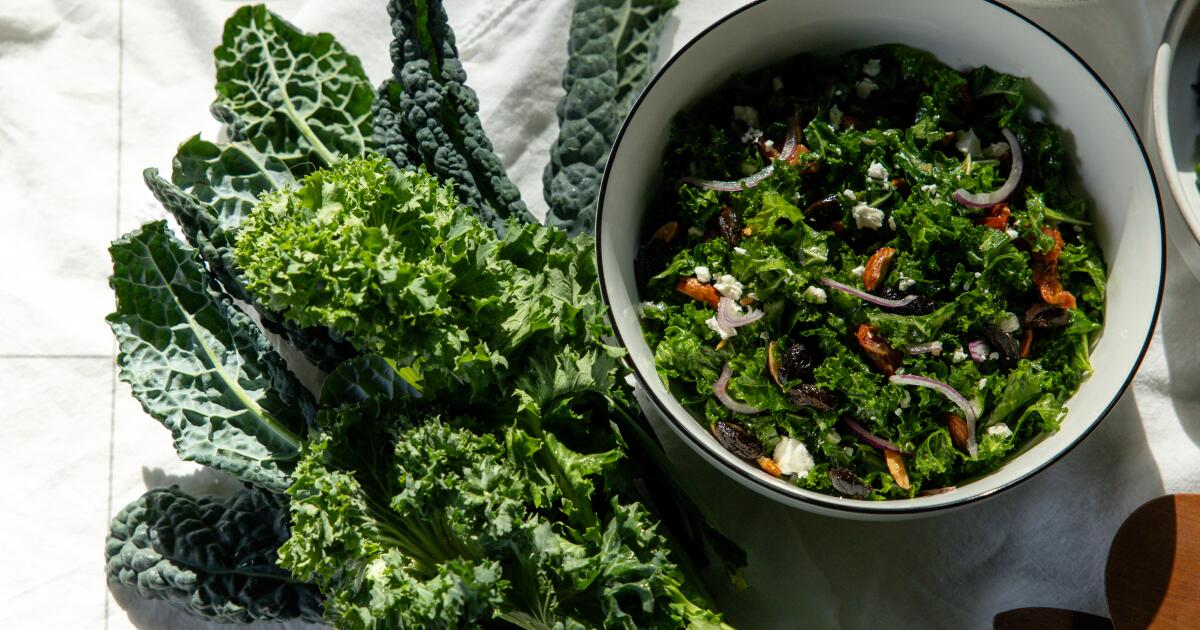
Tuscan kale, curly kale, Swiss chard, escarole — they’re easy to cook with and deserve more love.
(Juliana Yamada/Los Angeles Times)
Like him, I too was once at a loss as to what to do with these greens, until a member of the family behind the famed Chino Farm in Rancho Santa Fe taught me how to make greens, long-cooked in olive oil with onions and garlic until they’re tender and rich with complex, earthy flavors — unexpectedly luxurious.
Leafy greens are delicious and healthy winter vegetables, and they deserve more love.
They take some time and effort to prepare, unlike an heirloom tomato in August, which requires nothing more than slicing and salting. But this isn’t August, and happiness in winter requires that you deal with reality. Besides, they’re worth the washing and trimming. Once that’s done, they practically cook themselves; it’s mostly hands-off cooking time.
They have other things going for them that, say, a Brandywine tomato doesn’t. They’re inexpensive. The price for a bunch of kale, chard, collards or escarole is $2.50 to $3 (a single heirloom tomato can cost you twice that). They’re available year-round with peak flavor in the dead of California “winter.” And they’re healthful, even when cooked.

Kale salad, from left, made with curly green kale; greens soup with chard, kale, broccoli and escarole; and sauteed greens with a fried egg on top.
(Juliana Yamada/Los Angeles Times)
I use the term “greens” loosely, and in fact, the vegetables I’m referring to come from different plant families. Escarole is a chicory, the clan that includes radicchio, endive and frisée. Chard and spinach are in the amaranth family. And kale and collard greens are in the family of cruciferous veggies, cousins of broccoli, cauliflower, Brussels sprouts and cabbage.
Here in L.A., one of the greatest food cities in America, we strike a balance between loving flavor and wanting to feel great. Greens, when cooked for deliciousness, manage to land within that zone.
And yet, they often go overlooked, despite taking up a lot of display space at the store because of their bulk and their leafy nature. When have you heard someone say, “I’m making this wonderful chard dish for dinner?” Or, “Oh, the temperatures are dropping. Can’t wait to get my hands on some kale.” Not often enough!

Sauteed greens with kale, chard, collards and spinach, topped with a fried egg.
(Juliana Yamada/Los Angeles Times)
Although you can find the majority of greens year-round, they’re at their peak in terms of flavor and texture in winter, meaning less bitter, more snap, which is relevant especially when making a kale salad, since the kale is uncooked. At the start of the year, when we’re full of good intentions, nursing a pot of greens on the stove, or tossing a giant kale salad, or stocking up on hearty greens soup, just feels like the nicest thing we can do for ourselves.
I gather bunches of vegetables and make a big pot of sauteed greens and various green soups several times every winter. I like to feel good after I eat. I like to be healthy. So I was relieved to find out that, though some nutrients, such as vitamin B and C, are lost from long-cooking, others, such as vitamins A and K, become more available, and the greens are still packed with minerals (iron and calcium), antioxidants and fiber after being cooked — they’re also easier to digest.
Healthy, economical, seasonal. All these greens have to do is teach weight training to check all the boxes of my New Year’s resolutions.
Get the recipes
Time 2 hours
Yields Serves 6 to 8

“What are those?” asked the cashier at the grocery store checkout. He gingerly added bunches of greens to my shopping bags as if they were long-stemmed roses: curly kale, black (Tuscan) kale, chard (rainbow and white), collard greens, spinach and a head of escarole. “I mean … like … what are you going to do with them?”
“I’m going to cook them,” I said. I kept it vague. He seemed overwhelmed, and the next customer’s groceries were starting to come down the conveyor belt for bagging. “They’re vegetables. I’m making vegetables.”
“Oh. Man. Wow!!!” he said, his mouth hanging open in disbelief.
Tuscan kale, curly kale, Swiss chard, escarole — they’re easy to cook with and deserve more love.
(Juliana Yamada/Los Angeles Times)
Like him, I too was once at a loss as to what to do with these greens, until a member of the family behind the famed Chino Farm in Rancho Santa Fe taught me how to make greens, long-cooked in olive oil with onions and garlic until they’re tender and rich with complex, earthy flavors — unexpectedly luxurious.
Leafy greens are delicious and healthy winter vegetables, and they deserve more love.
They take some time and effort to prepare, unlike an heirloom tomato in August, which requires nothing more than slicing and salting. But this isn’t August, and happiness in winter requires that you deal with reality. Besides, they’re worth the washing and trimming. Once that’s done, they practically cook themselves; it’s mostly hands-off cooking time.
They have other things going for them that, say, a Brandywine tomato doesn’t. They’re inexpensive. The price for a bunch of kale, chard, collards or escarole is $2.50 to $3 (a single heirloom tomato can cost you twice that). They’re available year-round with peak flavor in the dead of California “winter.” And they’re healthful, even when cooked.
Kale salad, from left, made with curly green kale; greens soup with chard, kale, broccoli and escarole; and sauteed greens with a fried egg on top.
(Juliana Yamada/Los Angeles Times)
I use the term “greens” loosely, and in fact, the vegetables I’m referring to come from different plant families. Escarole is a chicory, the clan that includes radicchio, endive and frisée. Chard and spinach are in the amaranth family. And kale and collard greens are in the family of cruciferous veggies, cousins of broccoli, cauliflower, Brussels sprouts and cabbage.
Here in L.A., one of the greatest food cities in America, we strike a balance between loving flavor and wanting to feel great. Greens, when cooked for deliciousness, manage to land within that zone.
And yet, they often go overlooked, despite taking up a lot of display space at the store because of their bulk and their leafy nature. When have you heard someone say, “I’m making this wonderful chard dish for dinner?” Or, “Oh, the temperatures are dropping. Can’t wait to get my hands on some kale.” Not often enough!
Sauteed greens with kale, chard, collards and spinach, topped with a fried egg.
(Juliana Yamada/Los Angeles Times)
Although you can find the majority of greens year-round, they’re at their peak in terms of flavor and texture in winter, meaning less bitter, more snap, which is relevant especially when making a kale salad, since the kale is uncooked. At the start of the year, when we’re full of good intentions, nursing a pot of greens on the stove, or tossing a giant kale salad, or stocking up on hearty greens soup, just feels like the nicest thing we can do for ourselves.
I gather bunches of vegetables and make a big pot of sauteed greens and various green soups several times every winter. I like to feel good after I eat. I like to be healthy. So I was relieved to find out that, though some nutrients, such as vitamin B and C, are lost from long-cooking, others, such as vitamins A and K, become more available, and the greens are still packed with minerals (iron and calcium), antioxidants and fiber after being cooked — they’re also easier to digest.
Healthy, economical, seasonal. All these greens have to do is teach weight training to check all the boxes of my New Year’s resolutions.
Get the recipes
Time 2 hours
Yields Serves 6 to 8

“What are those?” asked the cashier at the grocery store checkout. He gingerly added bunches of greens to my shopping bags as if they were long-stemmed roses: curly kale, black (Tuscan) kale, chard (rainbow and white), collard greens, spinach and a head of escarole. “I mean … like … what are you going to do with them?”
“I’m going to cook them,” I said. I kept it vague. He seemed overwhelmed, and the next customer’s groceries were starting to come down the conveyor belt for bagging. “They’re vegetables. I’m making vegetables.”
“Oh. Man. Wow!!!” he said, his mouth hanging open in disbelief.
Tuscan kale, curly kale, Swiss chard, escarole — they’re easy to cook with and deserve more love.
(Juliana Yamada/Los Angeles Times)
Like him, I too was once at a loss as to what to do with these greens, until a member of the family behind the famed Chino Farm in Rancho Santa Fe taught me how to make greens, long-cooked in olive oil with onions and garlic until they’re tender and rich with complex, earthy flavors — unexpectedly luxurious.
Leafy greens are delicious and healthy winter vegetables, and they deserve more love.
They take some time and effort to prepare, unlike an heirloom tomato in August, which requires nothing more than slicing and salting. But this isn’t August, and happiness in winter requires that you deal with reality. Besides, they’re worth the washing and trimming. Once that’s done, they practically cook themselves; it’s mostly hands-off cooking time.
They have other things going for them that, say, a Brandywine tomato doesn’t. They’re inexpensive. The price for a bunch of kale, chard, collards or escarole is $2.50 to $3 (a single heirloom tomato can cost you twice that). They’re available year-round with peak flavor in the dead of California “winter.” And they’re healthful, even when cooked.
Kale salad, from left, made with curly green kale; greens soup with chard, kale, broccoli and escarole; and sauteed greens with a fried egg on top.
(Juliana Yamada/Los Angeles Times)
I use the term “greens” loosely, and in fact, the vegetables I’m referring to come from different plant families. Escarole is a chicory, the clan that includes radicchio, endive and frisée. Chard and spinach are in the amaranth family. And kale and collard greens are in the family of cruciferous veggies, cousins of broccoli, cauliflower, Brussels sprouts and cabbage.
Here in L.A., one of the greatest food cities in America, we strike a balance between loving flavor and wanting to feel great. Greens, when cooked for deliciousness, manage to land within that zone.
And yet, they often go overlooked, despite taking up a lot of display space at the store because of their bulk and their leafy nature. When have you heard someone say, “I’m making this wonderful chard dish for dinner?” Or, “Oh, the temperatures are dropping. Can’t wait to get my hands on some kale.” Not often enough!
Sauteed greens with kale, chard, collards and spinach, topped with a fried egg.
(Juliana Yamada/Los Angeles Times)
Although you can find the majority of greens year-round, they’re at their peak in terms of flavor and texture in winter, meaning less bitter, more snap, which is relevant especially when making a kale salad, since the kale is uncooked. At the start of the year, when we’re full of good intentions, nursing a pot of greens on the stove, or tossing a giant kale salad, or stocking up on hearty greens soup, just feels like the nicest thing we can do for ourselves.
I gather bunches of vegetables and make a big pot of sauteed greens and various green soups several times every winter. I like to feel good after I eat. I like to be healthy. So I was relieved to find out that, though some nutrients, such as vitamin B and C, are lost from long-cooking, others, such as vitamins A and K, become more available, and the greens are still packed with minerals (iron and calcium), antioxidants and fiber after being cooked — they’re also easier to digest.
Healthy, economical, seasonal. All these greens have to do is teach weight training to check all the boxes of my New Year’s resolutions.
Get the recipes
Time 2 hours
Yields Serves 6 to 8
“What are those?” asked the cashier at the grocery store checkout. He gingerly added bunches of greens to my shopping bags as if they were long-stemmed roses: curly kale, black (Tuscan) kale, chard (rainbow and white), collard greens, spinach and a head of escarole. “I mean … like … what are you going to do with them?”
“I’m going to cook them,” I said. I kept it vague. He seemed overwhelmed, and the next customer’s groceries were starting to come down the conveyor belt for bagging. “They’re vegetables. I’m making vegetables.”
“Oh. Man. Wow!!!” he said, his mouth hanging open in disbelief.
Tuscan kale, curly kale, Swiss chard, escarole — they’re easy to cook with and deserve more love.
(Juliana Yamada/Los Angeles Times)
Like him, I too was once at a loss as to what to do with these greens, until a member of the family behind the famed Chino Farm in Rancho Santa Fe taught me how to make greens, long-cooked in olive oil with onions and garlic until they’re tender and rich with complex, earthy flavors — unexpectedly luxurious.
Leafy greens are delicious and healthy winter vegetables, and they deserve more love.
They take some time and effort to prepare, unlike an heirloom tomato in August, which requires nothing more than slicing and salting. But this isn’t August, and happiness in winter requires that you deal with reality. Besides, they’re worth the washing and trimming. Once that’s done, they practically cook themselves; it’s mostly hands-off cooking time.
They have other things going for them that, say, a Brandywine tomato doesn’t. They’re inexpensive. The price for a bunch of kale, chard, collards or escarole is $2.50 to $3 (a single heirloom tomato can cost you twice that). They’re available year-round with peak flavor in the dead of California “winter.” And they’re healthful, even when cooked.
Kale salad, from left, made with curly green kale; greens soup with chard, kale, broccoli and escarole; and sauteed greens with a fried egg on top.
(Juliana Yamada/Los Angeles Times)
I use the term “greens” loosely, and in fact, the vegetables I’m referring to come from different plant families. Escarole is a chicory, the clan that includes radicchio, endive and frisée. Chard and spinach are in the amaranth family. And kale and collard greens are in the family of cruciferous veggies, cousins of broccoli, cauliflower, Brussels sprouts and cabbage.
Here in L.A., one of the greatest food cities in America, we strike a balance between loving flavor and wanting to feel great. Greens, when cooked for deliciousness, manage to land within that zone.
And yet, they often go overlooked, despite taking up a lot of display space at the store because of their bulk and their leafy nature. When have you heard someone say, “I’m making this wonderful chard dish for dinner?” Or, “Oh, the temperatures are dropping. Can’t wait to get my hands on some kale.” Not often enough!
Sauteed greens with kale, chard, collards and spinach, topped with a fried egg.
(Juliana Yamada/Los Angeles Times)
Although you can find the majority of greens year-round, they’re at their peak in terms of flavor and texture in winter, meaning less bitter, more snap, which is relevant especially when making a kale salad, since the kale is uncooked. At the start of the year, when we’re full of good intentions, nursing a pot of greens on the stove, or tossing a giant kale salad, or stocking up on hearty greens soup, just feels like the nicest thing we can do for ourselves.
I gather bunches of vegetables and make a big pot of sauteed greens and various green soups several times every winter. I like to feel good after I eat. I like to be healthy. So I was relieved to find out that, though some nutrients, such as vitamin B and C, are lost from long-cooking, others, such as vitamins A and K, become more available, and the greens are still packed with minerals (iron and calcium), antioxidants and fiber after being cooked — they’re also easier to digest.
Healthy, economical, seasonal. All these greens have to do is teach weight training to check all the boxes of my New Year’s resolutions.
Get the recipes
Time 2 hours
Yields Serves 6 to 8


