

For most of the year, Lyndon Laveaux is like any other artist in Los Angeles, auditioning for acting gigs, making music and writing projects. He works for Amazon as a delivery driver, which offers him flexibility in his schedule. But each fall, he transforms into the Captain — the undead host of festivities at the Queen Mary’s Dark Harbor, a haunted attraction held in Long Beach during the Halloween season.
“I just love it,” Laveaux says. “It’s like an adult summer camp and I appreciate the fans, I appreciate this community.”
In many ways, it’s the actor’s dream — getting paid to perform for packed and responsive crowds. Laveaux is one of an estimated 400 scare actors employed seasonally at Dark Harbor, run by Thirteenth Floor Entertainment Group, which also produces L.A.’s Haunted Hayride. That popular Griffith Park event hires about 200 performers. Thirteenth Floor hosts attractions all over the nation, employing more than 4,000 seasonal employees.
It’s no secret there’s big business in scaring people: Horror movies are a box office staple, often costing the least to produce and resulting in the biggest profits. According to Forbes, Universal’s Halloween Horror Nights — another spooky season staple — earns more than $575 million annually for the global event, which is estimated to cost around $100 million to stage at theme parks in Florida, California, Japan and Singapore. The Halloween season is actually referred to as “the thirteenth month” by insiders.
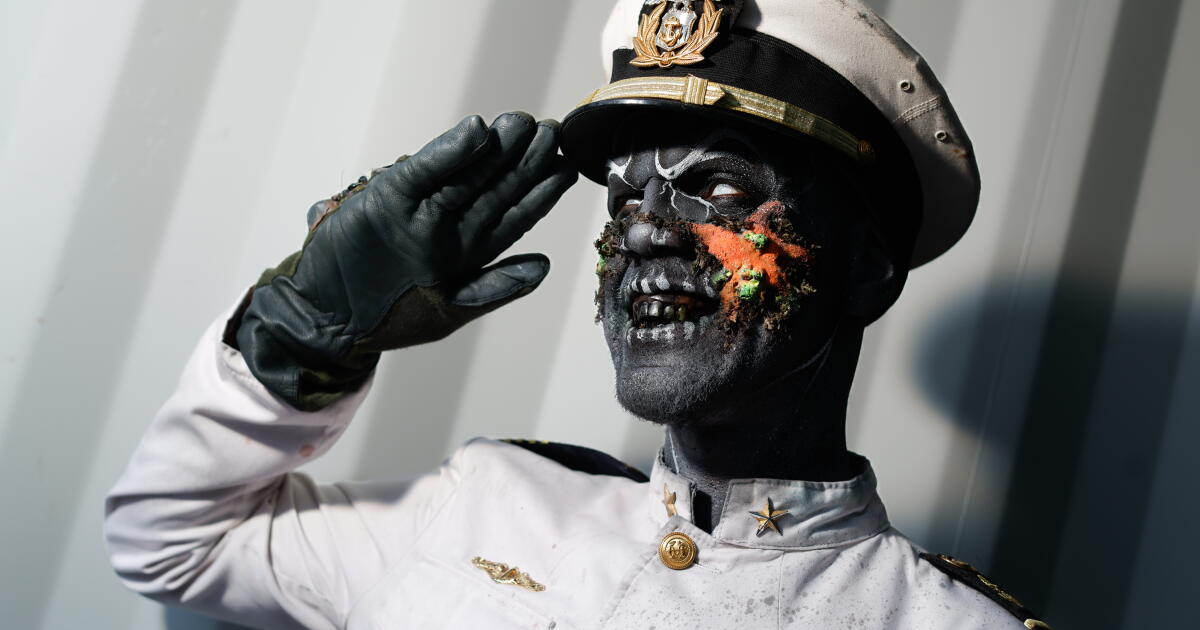
Lyndon Laveaux, 36, who plays the iconic Captain, performs at the Queen Mary’s Dark Harbor. Laveaux looks forward to the seasonal gig each year.
(Carlin Stiehl / For The Times)
And while Thirteenth Floor declined to share financial figures, the city of Long Beach announced in 2024 that it expected to receive more than $1 million in a profit-sharing agreement with the company.
Laveaux began life as a scare actor in 2011 at Universal’s Horror Nights. He soon met Star Romano, a fellow scare actor who moved into a leadership role at Dark Harbor and invited him to join two years ago. Romano is now the general manager of the event.
“She knows it all from the inside, she’s done every step,” Laveaux raves. “And she knows that if you treat your employees well, they will run through a wall for you.”
Romano says anyone can audition to be a scare actor and recommends checking the Thirteenth Floor website for more information. But she cautions, “It takes a lot more than being able to scream loudly. We look for how someone is able to create a character through movement, timing and presence. We also want to see how they respond to direction and stay aware of the people around them.”
Scare actors are required to spend time in cramped mazes, often jumping out at people, and Romano says they train for two weeks, with safety being the priority. Scare actors reportedly make around $18 to $25 an hour, depending on the job. “We have specialty performers — bands, jugglers, fire and chainsaw performers, people who walk on stilts,” Romano says. “People who come in with existing skills we can use.”

Many seasonal scare actors have a diverse skill set, including stilt-walking and fire spinning.
(Carlin Stiehl / For The Times)
As the Captain, Laveaux is what’s known as an “icon” character, someone who interacts with the public and is directly related to a Dark Harbor story line. He hosts various shows, including the nightly Maiden Voyage Launch Party, which welcomes guests at 8:08 p.m. each night.
An icon requires a little more time in the makeup chair. On a recent Sunday, Laveaux arrives at base camp — a tented area near the Queen Mary — before 5 p.m. He appears already sporting a pair of white-out contact lenses to give him the zombified look, noting, “It’s blurry, but I can see.” He sits in a chair and enters what he calls “a zen state” as makeup manager Jeri Jones begins to apply the first of three prosthetic pieces to his face.
Jones works fast. “We have 14 artists working on about 200 actors a day,” she says. “So we average about 12 minutes a monster. Icons take a little longer, usually 30 to 40 minutes.”

Lyndon Laveaux, who plays the Captain, sits to have his makeup applied by Jeri Jones before the Queen Mary’s Dark Harbor opens for the night.
(Carlin Stiehl / For The Times)
Quips Laveaux, “Jeri keeps the Avengers around her. And she’s Nick Fury.”
Designed by Jones and made by Eternal Designs, the prosthetics are glued to Laveaux’s face. One cheek sports a pink starfish while the other is covered with barnacles. The pieces can only be used twice. Once in place, Jones hand-paints the barnacles with glow-in-the-dark paint and adds bits of moss to complete the effect.
Laveaux is mostly used to the makeup but admits to occasional discomfort.
“It can itch as my skin adjusts to the glue or when sweat builds up under it,” he says. “It’s also hard when I want to eat and a piece is too close to my mouth.” But he says it’s better than the alternative — forgetting it’s there and reaching up to scratch or rub his face.
As Jones finishes off Laveaux with a final spray of her air gun and blackens his teeth, other actors are lining up. The holding area begins crawling with costumed characters as clowns, bloody chefs and haunted little girls await their turn in the makeup chair.

Lyndon Laveaux’s facial barnacles are in place.
(Carlin Stiehl / For The Times)
After carefully removing his shirt so as not to disturb the makeup, Laveaux gets into costume. He usually has about 90 minutes before performing, which he uses to put on his headphones and mentally prepare.
“When I go on stage, it’s high energy,” he says. “I want to be my best out there and give 100% as a performer, so there’s nothing lacking when I interact with someone.”
As with any performance, he takes time to get into character. The Captain comes with his lore in place. As in many of the attractions, he’s based on a real person who experienced certain events. “But I also created my own backstory, where I’ve been imprisoned for hundreds of years and brought souls to the Queen Mary,” Laveaux says. “I had siblings, but I was raised as a single child and I’m used to having an active imagination.”
At 8:08 p.m. on the dot, it’s showtime. With all traces of Laveaux gone, the Captain takes the stage and begins introducing acts, including aerialists and fire performers. Because the Captain speaks with a low growl, Laveaux has to go easy on his voice; early on, he lost it after a show. “I have to take care of my instrument,” he notes, adding he relies on cough drops and throat-coat tea.

A scare actor performs at the Queen Mary’s Dark Harbor in Long Beach. Audience reaction figures into how each show goes.
(Carlin Stiehl / For The Times)
Live performance that relies on audience reaction can be unpredictable. Laveaux says he’s been hit before, though never seriously, calling those past incidents “completely unintentional” and born “out of surprise, not malice.”
The most challenging patrons are those who come in inebriated or quickly get drunk. “Fortunately, our security is really on top of it,” Laveaux notes. “You might not see them, but they are always there and a line of force.”
Perhaps most perplexing are the patrons who aggressively flirt with him. “Some people are really into it,” he says with a laugh. “They’ll say, ‘You know you’re hot, right?’ And I’m like, ‘I’ve got moss on my face!’ ”

Scare actors roam the grounds of the Queen Mary’s Dark Harbor spooking guests. The show employs close to 200 performers.
(Carlin Stiehl / For The Times)
Laveaux performs throughout the night, concluding with a dance party called the Final Voyage. After the park closes (at 12:30 a.m. on weeknights and 1 a.m. on weekends), he takes about 10 minutes to remove his makeup and grab a shuttle to the staff parking lot.
The drive home to North Hollywood is considerably shorter than the drive to Long Beach because the freeways are mostly empty at that late hour, and he uses that time to decompress and relax.
While it can be exhausting and Laveaux admits he wouldn’t do it year round, he looks forward to coming back every season. And no matter how successful he becomes, he’ll return as long as they’ll have him.
“I love being a part of this,” he says. “And I believe in it.”

For most of the year, Lyndon Laveaux is like any other artist in Los Angeles, auditioning for acting gigs, making music and writing projects. He works for Amazon as a delivery driver, which offers him flexibility in his schedule. But each fall, he transforms into the Captain — the undead host of festivities at the Queen Mary’s Dark Harbor, a haunted attraction held in Long Beach during the Halloween season.
“I just love it,” Laveaux says. “It’s like an adult summer camp and I appreciate the fans, I appreciate this community.”
In many ways, it’s the actor’s dream — getting paid to perform for packed and responsive crowds. Laveaux is one of an estimated 400 scare actors employed seasonally at Dark Harbor, run by Thirteenth Floor Entertainment Group, which also produces L.A.’s Haunted Hayride. That popular Griffith Park event hires about 200 performers. Thirteenth Floor hosts attractions all over the nation, employing more than 4,000 seasonal employees.
It’s no secret there’s big business in scaring people: Horror movies are a box office staple, often costing the least to produce and resulting in the biggest profits. According to Forbes, Universal’s Halloween Horror Nights — another spooky season staple — earns more than $575 million annually for the global event, which is estimated to cost around $100 million to stage at theme parks in Florida, California, Japan and Singapore. The Halloween season is actually referred to as “the thirteenth month” by insiders.
Lyndon Laveaux, 36, who plays the iconic Captain, performs at the Queen Mary’s Dark Harbor. Laveaux looks forward to the seasonal gig each year.
(Carlin Stiehl / For The Times)
And while Thirteenth Floor declined to share financial figures, the city of Long Beach announced in 2024 that it expected to receive more than $1 million in a profit-sharing agreement with the company.
Laveaux began life as a scare actor in 2011 at Universal’s Horror Nights. He soon met Star Romano, a fellow scare actor who moved into a leadership role at Dark Harbor and invited him to join two years ago. Romano is now the general manager of the event.
“She knows it all from the inside, she’s done every step,” Laveaux raves. “And she knows that if you treat your employees well, they will run through a wall for you.”
Romano says anyone can audition to be a scare actor and recommends checking the Thirteenth Floor website for more information. But she cautions, “It takes a lot more than being able to scream loudly. We look for how someone is able to create a character through movement, timing and presence. We also want to see how they respond to direction and stay aware of the people around them.”
Scare actors are required to spend time in cramped mazes, often jumping out at people, and Romano says they train for two weeks, with safety being the priority. Scare actors reportedly make around $18 to $25 an hour, depending on the job. “We have specialty performers — bands, jugglers, fire and chainsaw performers, people who walk on stilts,” Romano says. “People who come in with existing skills we can use.”
Many seasonal scare actors have a diverse skill set, including stilt-walking and fire spinning.
(Carlin Stiehl / For The Times)
As the Captain, Laveaux is what’s known as an “icon” character, someone who interacts with the public and is directly related to a Dark Harbor story line. He hosts various shows, including the nightly Maiden Voyage Launch Party, which welcomes guests at 8:08 p.m. each night.
An icon requires a little more time in the makeup chair. On a recent Sunday, Laveaux arrives at base camp — a tented area near the Queen Mary — before 5 p.m. He appears already sporting a pair of white-out contact lenses to give him the zombified look, noting, “It’s blurry, but I can see.” He sits in a chair and enters what he calls “a zen state” as makeup manager Jeri Jones begins to apply the first of three prosthetic pieces to his face.
Jones works fast. “We have 14 artists working on about 200 actors a day,” she says. “So we average about 12 minutes a monster. Icons take a little longer, usually 30 to 40 minutes.”
Lyndon Laveaux, who plays the Captain, sits to have his makeup applied by Jeri Jones before the Queen Mary’s Dark Harbor opens for the night.
(Carlin Stiehl / For The Times)
Quips Laveaux, “Jeri keeps the Avengers around her. And she’s Nick Fury.”
Designed by Jones and made by Eternal Designs, the prosthetics are glued to Laveaux’s face. One cheek sports a pink starfish while the other is covered with barnacles. The pieces can only be used twice. Once in place, Jones hand-paints the barnacles with glow-in-the-dark paint and adds bits of moss to complete the effect.
Laveaux is mostly used to the makeup but admits to occasional discomfort.
“It can itch as my skin adjusts to the glue or when sweat builds up under it,” he says. “It’s also hard when I want to eat and a piece is too close to my mouth.” But he says it’s better than the alternative — forgetting it’s there and reaching up to scratch or rub his face.
As Jones finishes off Laveaux with a final spray of her air gun and blackens his teeth, other actors are lining up. The holding area begins crawling with costumed characters as clowns, bloody chefs and haunted little girls await their turn in the makeup chair.
Lyndon Laveaux’s facial barnacles are in place.
(Carlin Stiehl / For The Times)
After carefully removing his shirt so as not to disturb the makeup, Laveaux gets into costume. He usually has about 90 minutes before performing, which he uses to put on his headphones and mentally prepare.
“When I go on stage, it’s high energy,” he says. “I want to be my best out there and give 100% as a performer, so there’s nothing lacking when I interact with someone.”
As with any performance, he takes time to get into character. The Captain comes with his lore in place. As in many of the attractions, he’s based on a real person who experienced certain events. “But I also created my own backstory, where I’ve been imprisoned for hundreds of years and brought souls to the Queen Mary,” Laveaux says. “I had siblings, but I was raised as a single child and I’m used to having an active imagination.”
At 8:08 p.m. on the dot, it’s showtime. With all traces of Laveaux gone, the Captain takes the stage and begins introducing acts, including aerialists and fire performers. Because the Captain speaks with a low growl, Laveaux has to go easy on his voice; early on, he lost it after a show. “I have to take care of my instrument,” he notes, adding he relies on cough drops and throat-coat tea.
A scare actor performs at the Queen Mary’s Dark Harbor in Long Beach. Audience reaction figures into how each show goes.
(Carlin Stiehl / For The Times)
Live performance that relies on audience reaction can be unpredictable. Laveaux says he’s been hit before, though never seriously, calling those past incidents “completely unintentional” and born “out of surprise, not malice.”
The most challenging patrons are those who come in inebriated or quickly get drunk. “Fortunately, our security is really on top of it,” Laveaux notes. “You might not see them, but they are always there and a line of force.”
Perhaps most perplexing are the patrons who aggressively flirt with him. “Some people are really into it,” he says with a laugh. “They’ll say, ‘You know you’re hot, right?’ And I’m like, ‘I’ve got moss on my face!’ ”
Scare actors roam the grounds of the Queen Mary’s Dark Harbor spooking guests. The show employs close to 200 performers.
(Carlin Stiehl / For The Times)
Laveaux performs throughout the night, concluding with a dance party called the Final Voyage. After the park closes (at 12:30 a.m. on weeknights and 1 a.m. on weekends), he takes about 10 minutes to remove his makeup and grab a shuttle to the staff parking lot.
The drive home to North Hollywood is considerably shorter than the drive to Long Beach because the freeways are mostly empty at that late hour, and he uses that time to decompress and relax.
While it can be exhausting and Laveaux admits he wouldn’t do it year round, he looks forward to coming back every season. And no matter how successful he becomes, he’ll return as long as they’ll have him.
“I love being a part of this,” he says. “And I believe in it.”


