Thursday, June 4, 2026
Washington DC
New York
Toronto
Distribution: (800) 510 9863
Press ID
  • Login
RH NEWSROOM National News and Press Releases. Local and Regional Perspectives. Media Advisories.
Yonkers Observer
  • Home
  • World
  • Politics
  • Finance
  • Technology
  • Health
  • Culture
  • Entertainment
  • Trend
No Result
View All Result
  • Home
  • World
  • Politics
  • Finance
  • Technology
  • Health
  • Culture
  • Entertainment
  • Trend
No Result
View All Result
Yonkers Observer
No Result
View All Result
Home Health

Fast-food workers rally as California lawmakers hold controversial franchise liability bill

by Yonkers Observer Report
July 13, 2023
in Health
Share on FacebookShare on Twitter

Scores of Los Angeles fast-food workers spent their Thursday protesting for higher pay and better working conditions, even as labor’s latest legislative pushback against the restaurant industry has stalled.

Wearing bright red shirts and carrying signs, more than 100 local fast-food workers and union organizers crowded on the steps of the downtown Los Angeles building housing the Los Angeles Area Chamber of Commerce in the morning with plans to protest at individual restaurants later in the day.

“We are fighting for ourselves to live,” one worker said as the crowd cheered.

In Sacramento, however, that fight stalled, at least for now. That’s because one facet got stuck in a state Senate committee.

Assembly Bill 1228 aims to hold fast-food corporations responsible for ensuring their franchisees comply with labor laws, and would make franchisee violations of employment laws enforceable against franchiser and franchisee equally. The International Franchise Assn. and others in the restaurant industry have strenuously opposed the measure, saying it would hurt the small-business operators that own franchises of big companies, such as McDonald’s.

It’s highly contentious legislation, introduced this year, that represents the latest iteration of a multiyear battle between organized labor and fast-food businesses over control of workplace standards.

But Senate Judiciary Chair Tom Umberg said in a session Tuesday that the bill had been pulled from the agenda by its proponents.

The decision to pull the bill was made to give opponents more time to speak with the authors, according to Service Employees International Union California, a major proponent of the bill. Umberg said he plans to reintroduce it at a hearing in August or September.

The bill’s author, Assemblymember Chris Holden (D-Pasadena) said the decision to reschedule the bill’s judiciary hearing was “a positive one.”

“I respect the space that is being provided for deeper vetting and look to serve as a resource for clarity, not only as a former franchise owner myself, but also as a Legislator who’s sat down with fast-food workers across our state,” he said in an emailed statement. “We have the opportunity to create a safer and more respectable work environment for these workers while enhancing the industry as a whole, and that is what we are working toward.”

The union said it’s pushing for the bill to go up for a vote sooner — in August — rather than later.

“California’s leaders have listened to fast-food workers, who have been speaking out about the exploitative and abusive conditions in the industry for years,” said David Huerta, president of SEIU California and SEIU United Service Workers West. “We are confident that the Legislature and the Administration are fully committed to bringing greater accountability to this industry.”

Opponents of the bill have derided AB 1228 as “a drastic bill” that would “fundamentally destroy” the franchise model in California by forcing national fast-food companies to exert more control over local franchised restaurants.

It would mean “turning locally owned and operated restaurants into corporate run restaurants and stripping local restaurant owners of their authority as small business owners,” according to a statement by Stop the Attack on Local Restaurants coalition, a group of fast-food corporations and trade groups.

The California Chamber of Commerce has labeled AB 1228 and many other employee-focused bills as “job killers,”

The union organized a series of rallies on Thursday for fast-food workers who are “fed up” with rampant labor law violations in their industry, according to a Thursday news release by SEIU, and don’t have time to wait for a fraught legislative process to play out.

Trey McGuire, 19, who works at a Lancaster location of hot dog fast-food chain Wienerschnitzel, said it’s frustrating and difficult to work 12-hour shifts and still make so little. He’s under pressure to make enough to provide for his 20-month-old child — and another kid on the way, with his partner six months pregnant.

McGuire and his family rolled up to the protest outside the Los Angeles Chamber of Commerce decked out in matching red “FAST FOOD WORKERS UNIDOS” T-shirts distributed by the union.

It definitely doesn’t help workers feel valued, McGuire said, that the owner of the store he works at seems to own two Teslas.

“He drives up to work three days a week always in different cars,” McGuire said. “It makes us want to push harder and fight for what’s ours.”

Scores of Los Angeles fast-food workers spent their Thursday protesting for higher pay and better working conditions, even as labor’s latest legislative pushback against the restaurant industry has stalled.

Wearing bright red shirts and carrying signs, more than 100 local fast-food workers and union organizers crowded on the steps of the downtown Los Angeles building housing the Los Angeles Area Chamber of Commerce in the morning with plans to protest at individual restaurants later in the day.

“We are fighting for ourselves to live,” one worker said as the crowd cheered.

In Sacramento, however, that fight stalled, at least for now. That’s because one facet got stuck in a state Senate committee.

Assembly Bill 1228 aims to hold fast-food corporations responsible for ensuring their franchisees comply with labor laws, and would make franchisee violations of employment laws enforceable against franchiser and franchisee equally. The International Franchise Assn. and others in the restaurant industry have strenuously opposed the measure, saying it would hurt the small-business operators that own franchises of big companies, such as McDonald’s.

It’s highly contentious legislation, introduced this year, that represents the latest iteration of a multiyear battle between organized labor and fast-food businesses over control of workplace standards.

But Senate Judiciary Chair Tom Umberg said in a session Tuesday that the bill had been pulled from the agenda by its proponents.

The decision to pull the bill was made to give opponents more time to speak with the authors, according to Service Employees International Union California, a major proponent of the bill. Umberg said he plans to reintroduce it at a hearing in August or September.

The bill’s author, Assemblymember Chris Holden (D-Pasadena) said the decision to reschedule the bill’s judiciary hearing was “a positive one.”

“I respect the space that is being provided for deeper vetting and look to serve as a resource for clarity, not only as a former franchise owner myself, but also as a Legislator who’s sat down with fast-food workers across our state,” he said in an emailed statement. “We have the opportunity to create a safer and more respectable work environment for these workers while enhancing the industry as a whole, and that is what we are working toward.”

The union said it’s pushing for the bill to go up for a vote sooner — in August — rather than later.

“California’s leaders have listened to fast-food workers, who have been speaking out about the exploitative and abusive conditions in the industry for years,” said David Huerta, president of SEIU California and SEIU United Service Workers West. “We are confident that the Legislature and the Administration are fully committed to bringing greater accountability to this industry.”

Opponents of the bill have derided AB 1228 as “a drastic bill” that would “fundamentally destroy” the franchise model in California by forcing national fast-food companies to exert more control over local franchised restaurants.

It would mean “turning locally owned and operated restaurants into corporate run restaurants and stripping local restaurant owners of their authority as small business owners,” according to a statement by Stop the Attack on Local Restaurants coalition, a group of fast-food corporations and trade groups.

The California Chamber of Commerce has labeled AB 1228 and many other employee-focused bills as “job killers,”

The union organized a series of rallies on Thursday for fast-food workers who are “fed up” with rampant labor law violations in their industry, according to a Thursday news release by SEIU, and don’t have time to wait for a fraught legislative process to play out.

Trey McGuire, 19, who works at a Lancaster location of hot dog fast-food chain Wienerschnitzel, said it’s frustrating and difficult to work 12-hour shifts and still make so little. He’s under pressure to make enough to provide for his 20-month-old child — and another kid on the way, with his partner six months pregnant.

McGuire and his family rolled up to the protest outside the Los Angeles Chamber of Commerce decked out in matching red “FAST FOOD WORKERS UNIDOS” T-shirts distributed by the union.

It definitely doesn’t help workers feel valued, McGuire said, that the owner of the store he works at seems to own two Teslas.

“He drives up to work three days a week always in different cars,” McGuire said. “It makes us want to push harder and fight for what’s ours.”

Scores of Los Angeles fast-food workers spent their Thursday protesting for higher pay and better working conditions, even as labor’s latest legislative pushback against the restaurant industry has stalled.

Wearing bright red shirts and carrying signs, more than 100 local fast-food workers and union organizers crowded on the steps of the downtown Los Angeles building housing the Los Angeles Area Chamber of Commerce in the morning with plans to protest at individual restaurants later in the day.

“We are fighting for ourselves to live,” one worker said as the crowd cheered.

In Sacramento, however, that fight stalled, at least for now. That’s because one facet got stuck in a state Senate committee.

Assembly Bill 1228 aims to hold fast-food corporations responsible for ensuring their franchisees comply with labor laws, and would make franchisee violations of employment laws enforceable against franchiser and franchisee equally. The International Franchise Assn. and others in the restaurant industry have strenuously opposed the measure, saying it would hurt the small-business operators that own franchises of big companies, such as McDonald’s.

It’s highly contentious legislation, introduced this year, that represents the latest iteration of a multiyear battle between organized labor and fast-food businesses over control of workplace standards.

But Senate Judiciary Chair Tom Umberg said in a session Tuesday that the bill had been pulled from the agenda by its proponents.

The decision to pull the bill was made to give opponents more time to speak with the authors, according to Service Employees International Union California, a major proponent of the bill. Umberg said he plans to reintroduce it at a hearing in August or September.

The bill’s author, Assemblymember Chris Holden (D-Pasadena) said the decision to reschedule the bill’s judiciary hearing was “a positive one.”

“I respect the space that is being provided for deeper vetting and look to serve as a resource for clarity, not only as a former franchise owner myself, but also as a Legislator who’s sat down with fast-food workers across our state,” he said in an emailed statement. “We have the opportunity to create a safer and more respectable work environment for these workers while enhancing the industry as a whole, and that is what we are working toward.”

The union said it’s pushing for the bill to go up for a vote sooner — in August — rather than later.

“California’s leaders have listened to fast-food workers, who have been speaking out about the exploitative and abusive conditions in the industry for years,” said David Huerta, president of SEIU California and SEIU United Service Workers West. “We are confident that the Legislature and the Administration are fully committed to bringing greater accountability to this industry.”

Opponents of the bill have derided AB 1228 as “a drastic bill” that would “fundamentally destroy” the franchise model in California by forcing national fast-food companies to exert more control over local franchised restaurants.

It would mean “turning locally owned and operated restaurants into corporate run restaurants and stripping local restaurant owners of their authority as small business owners,” according to a statement by Stop the Attack on Local Restaurants coalition, a group of fast-food corporations and trade groups.

The California Chamber of Commerce has labeled AB 1228 and many other employee-focused bills as “job killers,”

The union organized a series of rallies on Thursday for fast-food workers who are “fed up” with rampant labor law violations in their industry, according to a Thursday news release by SEIU, and don’t have time to wait for a fraught legislative process to play out.

Trey McGuire, 19, who works at a Lancaster location of hot dog fast-food chain Wienerschnitzel, said it’s frustrating and difficult to work 12-hour shifts and still make so little. He’s under pressure to make enough to provide for his 20-month-old child — and another kid on the way, with his partner six months pregnant.

McGuire and his family rolled up to the protest outside the Los Angeles Chamber of Commerce decked out in matching red “FAST FOOD WORKERS UNIDOS” T-shirts distributed by the union.

It definitely doesn’t help workers feel valued, McGuire said, that the owner of the store he works at seems to own two Teslas.

“He drives up to work three days a week always in different cars,” McGuire said. “It makes us want to push harder and fight for what’s ours.”


Scores of Los Angeles fast-food workers spent their Thursday protesting for higher pay and better working conditions, even as labor’s latest legislative pushback against the restaurant industry has stalled.

Wearing bright red shirts and carrying signs, more than 100 local fast-food workers and union organizers crowded on the steps of the downtown Los Angeles building housing the Los Angeles Area Chamber of Commerce in the morning with plans to protest at individual restaurants later in the day.

“We are fighting for ourselves to live,” one worker said as the crowd cheered.

In Sacramento, however, that fight stalled, at least for now. That’s because one facet got stuck in a state Senate committee.

Assembly Bill 1228 aims to hold fast-food corporations responsible for ensuring their franchisees comply with labor laws, and would make franchisee violations of employment laws enforceable against franchiser and franchisee equally. The International Franchise Assn. and others in the restaurant industry have strenuously opposed the measure, saying it would hurt the small-business operators that own franchises of big companies, such as McDonald’s.

It’s highly contentious legislation, introduced this year, that represents the latest iteration of a multiyear battle between organized labor and fast-food businesses over control of workplace standards.

But Senate Judiciary Chair Tom Umberg said in a session Tuesday that the bill had been pulled from the agenda by its proponents.

The decision to pull the bill was made to give opponents more time to speak with the authors, according to Service Employees International Union California, a major proponent of the bill. Umberg said he plans to reintroduce it at a hearing in August or September.

The bill’s author, Assemblymember Chris Holden (D-Pasadena) said the decision to reschedule the bill’s judiciary hearing was “a positive one.”

“I respect the space that is being provided for deeper vetting and look to serve as a resource for clarity, not only as a former franchise owner myself, but also as a Legislator who’s sat down with fast-food workers across our state,” he said in an emailed statement. “We have the opportunity to create a safer and more respectable work environment for these workers while enhancing the industry as a whole, and that is what we are working toward.”

The union said it’s pushing for the bill to go up for a vote sooner — in August — rather than later.

“California’s leaders have listened to fast-food workers, who have been speaking out about the exploitative and abusive conditions in the industry for years,” said David Huerta, president of SEIU California and SEIU United Service Workers West. “We are confident that the Legislature and the Administration are fully committed to bringing greater accountability to this industry.”

Opponents of the bill have derided AB 1228 as “a drastic bill” that would “fundamentally destroy” the franchise model in California by forcing national fast-food companies to exert more control over local franchised restaurants.

It would mean “turning locally owned and operated restaurants into corporate run restaurants and stripping local restaurant owners of their authority as small business owners,” according to a statement by Stop the Attack on Local Restaurants coalition, a group of fast-food corporations and trade groups.

The California Chamber of Commerce has labeled AB 1228 and many other employee-focused bills as “job killers,”

The union organized a series of rallies on Thursday for fast-food workers who are “fed up” with rampant labor law violations in their industry, according to a Thursday news release by SEIU, and don’t have time to wait for a fraught legislative process to play out.

Trey McGuire, 19, who works at a Lancaster location of hot dog fast-food chain Wienerschnitzel, said it’s frustrating and difficult to work 12-hour shifts and still make so little. He’s under pressure to make enough to provide for his 20-month-old child — and another kid on the way, with his partner six months pregnant.

McGuire and his family rolled up to the protest outside the Los Angeles Chamber of Commerce decked out in matching red “FAST FOOD WORKERS UNIDOS” T-shirts distributed by the union.

It definitely doesn’t help workers feel valued, McGuire said, that the owner of the store he works at seems to own two Teslas.

“He drives up to work three days a week always in different cars,” McGuire said. “It makes us want to push harder and fight for what’s ours.”

Scores of Los Angeles fast-food workers spent their Thursday protesting for higher pay and better working conditions, even as labor’s latest legislative pushback against the restaurant industry has stalled.

Wearing bright red shirts and carrying signs, more than 100 local fast-food workers and union organizers crowded on the steps of the downtown Los Angeles building housing the Los Angeles Area Chamber of Commerce in the morning with plans to protest at individual restaurants later in the day.

“We are fighting for ourselves to live,” one worker said as the crowd cheered.

In Sacramento, however, that fight stalled, at least for now. That’s because one facet got stuck in a state Senate committee.

Assembly Bill 1228 aims to hold fast-food corporations responsible for ensuring their franchisees comply with labor laws, and would make franchisee violations of employment laws enforceable against franchiser and franchisee equally. The International Franchise Assn. and others in the restaurant industry have strenuously opposed the measure, saying it would hurt the small-business operators that own franchises of big companies, such as McDonald’s.

It’s highly contentious legislation, introduced this year, that represents the latest iteration of a multiyear battle between organized labor and fast-food businesses over control of workplace standards.

But Senate Judiciary Chair Tom Umberg said in a session Tuesday that the bill had been pulled from the agenda by its proponents.

The decision to pull the bill was made to give opponents more time to speak with the authors, according to Service Employees International Union California, a major proponent of the bill. Umberg said he plans to reintroduce it at a hearing in August or September.

The bill’s author, Assemblymember Chris Holden (D-Pasadena) said the decision to reschedule the bill’s judiciary hearing was “a positive one.”

“I respect the space that is being provided for deeper vetting and look to serve as a resource for clarity, not only as a former franchise owner myself, but also as a Legislator who’s sat down with fast-food workers across our state,” he said in an emailed statement. “We have the opportunity to create a safer and more respectable work environment for these workers while enhancing the industry as a whole, and that is what we are working toward.”

The union said it’s pushing for the bill to go up for a vote sooner — in August — rather than later.

“California’s leaders have listened to fast-food workers, who have been speaking out about the exploitative and abusive conditions in the industry for years,” said David Huerta, president of SEIU California and SEIU United Service Workers West. “We are confident that the Legislature and the Administration are fully committed to bringing greater accountability to this industry.”

Opponents of the bill have derided AB 1228 as “a drastic bill” that would “fundamentally destroy” the franchise model in California by forcing national fast-food companies to exert more control over local franchised restaurants.

It would mean “turning locally owned and operated restaurants into corporate run restaurants and stripping local restaurant owners of their authority as small business owners,” according to a statement by Stop the Attack on Local Restaurants coalition, a group of fast-food corporations and trade groups.

The California Chamber of Commerce has labeled AB 1228 and many other employee-focused bills as “job killers,”

The union organized a series of rallies on Thursday for fast-food workers who are “fed up” with rampant labor law violations in their industry, according to a Thursday news release by SEIU, and don’t have time to wait for a fraught legislative process to play out.

Trey McGuire, 19, who works at a Lancaster location of hot dog fast-food chain Wienerschnitzel, said it’s frustrating and difficult to work 12-hour shifts and still make so little. He’s under pressure to make enough to provide for his 20-month-old child — and another kid on the way, with his partner six months pregnant.

McGuire and his family rolled up to the protest outside the Los Angeles Chamber of Commerce decked out in matching red “FAST FOOD WORKERS UNIDOS” T-shirts distributed by the union.

It definitely doesn’t help workers feel valued, McGuire said, that the owner of the store he works at seems to own two Teslas.

“He drives up to work three days a week always in different cars,” McGuire said. “It makes us want to push harder and fight for what’s ours.”
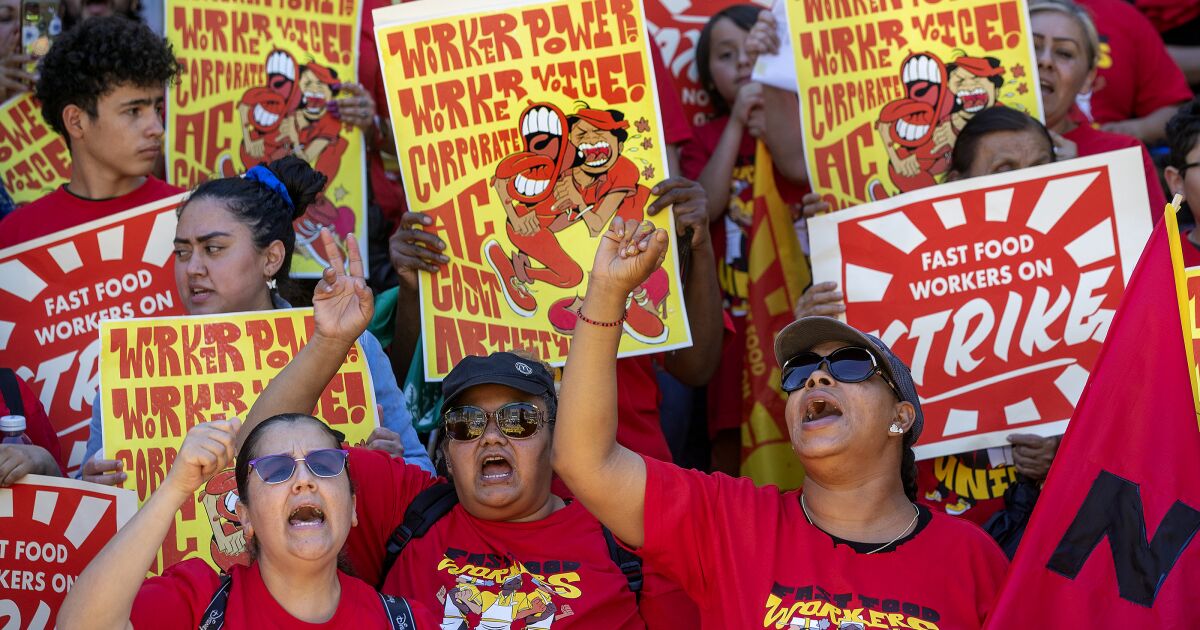
Scores of Los Angeles fast-food workers spent their Thursday protesting for higher pay and better working conditions, even as labor’s latest legislative pushback against the restaurant industry has stalled.

Wearing bright red shirts and carrying signs, more than 100 local fast-food workers and union organizers crowded on the steps of the downtown Los Angeles building housing the Los Angeles Area Chamber of Commerce in the morning with plans to protest at individual restaurants later in the day.

“We are fighting for ourselves to live,” one worker said as the crowd cheered.

In Sacramento, however, that fight stalled, at least for now. That’s because one facet got stuck in a state Senate committee.

Assembly Bill 1228 aims to hold fast-food corporations responsible for ensuring their franchisees comply with labor laws, and would make franchisee violations of employment laws enforceable against franchiser and franchisee equally. The International Franchise Assn. and others in the restaurant industry have strenuously opposed the measure, saying it would hurt the small-business operators that own franchises of big companies, such as McDonald’s.

It’s highly contentious legislation, introduced this year, that represents the latest iteration of a multiyear battle between organized labor and fast-food businesses over control of workplace standards.

But Senate Judiciary Chair Tom Umberg said in a session Tuesday that the bill had been pulled from the agenda by its proponents.

The decision to pull the bill was made to give opponents more time to speak with the authors, according to Service Employees International Union California, a major proponent of the bill. Umberg said he plans to reintroduce it at a hearing in August or September.

The bill’s author, Assemblymember Chris Holden (D-Pasadena) said the decision to reschedule the bill’s judiciary hearing was “a positive one.”

“I respect the space that is being provided for deeper vetting and look to serve as a resource for clarity, not only as a former franchise owner myself, but also as a Legislator who’s sat down with fast-food workers across our state,” he said in an emailed statement. “We have the opportunity to create a safer and more respectable work environment for these workers while enhancing the industry as a whole, and that is what we are working toward.”

The union said it’s pushing for the bill to go up for a vote sooner — in August — rather than later.

“California’s leaders have listened to fast-food workers, who have been speaking out about the exploitative and abusive conditions in the industry for years,” said David Huerta, president of SEIU California and SEIU United Service Workers West. “We are confident that the Legislature and the Administration are fully committed to bringing greater accountability to this industry.”

Opponents of the bill have derided AB 1228 as “a drastic bill” that would “fundamentally destroy” the franchise model in California by forcing national fast-food companies to exert more control over local franchised restaurants.

It would mean “turning locally owned and operated restaurants into corporate run restaurants and stripping local restaurant owners of their authority as small business owners,” according to a statement by Stop the Attack on Local Restaurants coalition, a group of fast-food corporations and trade groups.

The California Chamber of Commerce has labeled AB 1228 and many other employee-focused bills as “job killers,”

The union organized a series of rallies on Thursday for fast-food workers who are “fed up” with rampant labor law violations in their industry, according to a Thursday news release by SEIU, and don’t have time to wait for a fraught legislative process to play out.

Trey McGuire, 19, who works at a Lancaster location of hot dog fast-food chain Wienerschnitzel, said it’s frustrating and difficult to work 12-hour shifts and still make so little. He’s under pressure to make enough to provide for his 20-month-old child — and another kid on the way, with his partner six months pregnant.

McGuire and his family rolled up to the protest outside the Los Angeles Chamber of Commerce decked out in matching red “FAST FOOD WORKERS UNIDOS” T-shirts distributed by the union.

It definitely doesn’t help workers feel valued, McGuire said, that the owner of the store he works at seems to own two Teslas.

“He drives up to work three days a week always in different cars,” McGuire said. “It makes us want to push harder and fight for what’s ours.”

Scores of Los Angeles fast-food workers spent their Thursday protesting for higher pay and better working conditions, even as labor’s latest legislative pushback against the restaurant industry has stalled.

Wearing bright red shirts and carrying signs, more than 100 local fast-food workers and union organizers crowded on the steps of the downtown Los Angeles building housing the Los Angeles Area Chamber of Commerce in the morning with plans to protest at individual restaurants later in the day.

“We are fighting for ourselves to live,” one worker said as the crowd cheered.

In Sacramento, however, that fight stalled, at least for now. That’s because one facet got stuck in a state Senate committee.

Assembly Bill 1228 aims to hold fast-food corporations responsible for ensuring their franchisees comply with labor laws, and would make franchisee violations of employment laws enforceable against franchiser and franchisee equally. The International Franchise Assn. and others in the restaurant industry have strenuously opposed the measure, saying it would hurt the small-business operators that own franchises of big companies, such as McDonald’s.

It’s highly contentious legislation, introduced this year, that represents the latest iteration of a multiyear battle between organized labor and fast-food businesses over control of workplace standards.

But Senate Judiciary Chair Tom Umberg said in a session Tuesday that the bill had been pulled from the agenda by its proponents.

The decision to pull the bill was made to give opponents more time to speak with the authors, according to Service Employees International Union California, a major proponent of the bill. Umberg said he plans to reintroduce it at a hearing in August or September.

The bill’s author, Assemblymember Chris Holden (D-Pasadena) said the decision to reschedule the bill’s judiciary hearing was “a positive one.”

“I respect the space that is being provided for deeper vetting and look to serve as a resource for clarity, not only as a former franchise owner myself, but also as a Legislator who’s sat down with fast-food workers across our state,” he said in an emailed statement. “We have the opportunity to create a safer and more respectable work environment for these workers while enhancing the industry as a whole, and that is what we are working toward.”

The union said it’s pushing for the bill to go up for a vote sooner — in August — rather than later.

“California’s leaders have listened to fast-food workers, who have been speaking out about the exploitative and abusive conditions in the industry for years,” said David Huerta, president of SEIU California and SEIU United Service Workers West. “We are confident that the Legislature and the Administration are fully committed to bringing greater accountability to this industry.”

Opponents of the bill have derided AB 1228 as “a drastic bill” that would “fundamentally destroy” the franchise model in California by forcing national fast-food companies to exert more control over local franchised restaurants.

It would mean “turning locally owned and operated restaurants into corporate run restaurants and stripping local restaurant owners of their authority as small business owners,” according to a statement by Stop the Attack on Local Restaurants coalition, a group of fast-food corporations and trade groups.

The California Chamber of Commerce has labeled AB 1228 and many other employee-focused bills as “job killers,”

The union organized a series of rallies on Thursday for fast-food workers who are “fed up” with rampant labor law violations in their industry, according to a Thursday news release by SEIU, and don’t have time to wait for a fraught legislative process to play out.

Trey McGuire, 19, who works at a Lancaster location of hot dog fast-food chain Wienerschnitzel, said it’s frustrating and difficult to work 12-hour shifts and still make so little. He’s under pressure to make enough to provide for his 20-month-old child — and another kid on the way, with his partner six months pregnant.

McGuire and his family rolled up to the protest outside the Los Angeles Chamber of Commerce decked out in matching red “FAST FOOD WORKERS UNIDOS” T-shirts distributed by the union.

It definitely doesn’t help workers feel valued, McGuire said, that the owner of the store he works at seems to own two Teslas.

“He drives up to work three days a week always in different cars,” McGuire said. “It makes us want to push harder and fight for what’s ours.”

Scores of Los Angeles fast-food workers spent their Thursday protesting for higher pay and better working conditions, even as labor’s latest legislative pushback against the restaurant industry has stalled.

Wearing bright red shirts and carrying signs, more than 100 local fast-food workers and union organizers crowded on the steps of the downtown Los Angeles building housing the Los Angeles Area Chamber of Commerce in the morning with plans to protest at individual restaurants later in the day.

“We are fighting for ourselves to live,” one worker said as the crowd cheered.

In Sacramento, however, that fight stalled, at least for now. That’s because one facet got stuck in a state Senate committee.

Assembly Bill 1228 aims to hold fast-food corporations responsible for ensuring their franchisees comply with labor laws, and would make franchisee violations of employment laws enforceable against franchiser and franchisee equally. The International Franchise Assn. and others in the restaurant industry have strenuously opposed the measure, saying it would hurt the small-business operators that own franchises of big companies, such as McDonald’s.

It’s highly contentious legislation, introduced this year, that represents the latest iteration of a multiyear battle between organized labor and fast-food businesses over control of workplace standards.

But Senate Judiciary Chair Tom Umberg said in a session Tuesday that the bill had been pulled from the agenda by its proponents.

The decision to pull the bill was made to give opponents more time to speak with the authors, according to Service Employees International Union California, a major proponent of the bill. Umberg said he plans to reintroduce it at a hearing in August or September.

The bill’s author, Assemblymember Chris Holden (D-Pasadena) said the decision to reschedule the bill’s judiciary hearing was “a positive one.”

“I respect the space that is being provided for deeper vetting and look to serve as a resource for clarity, not only as a former franchise owner myself, but also as a Legislator who’s sat down with fast-food workers across our state,” he said in an emailed statement. “We have the opportunity to create a safer and more respectable work environment for these workers while enhancing the industry as a whole, and that is what we are working toward.”

The union said it’s pushing for the bill to go up for a vote sooner — in August — rather than later.

“California’s leaders have listened to fast-food workers, who have been speaking out about the exploitative and abusive conditions in the industry for years,” said David Huerta, president of SEIU California and SEIU United Service Workers West. “We are confident that the Legislature and the Administration are fully committed to bringing greater accountability to this industry.”

Opponents of the bill have derided AB 1228 as “a drastic bill” that would “fundamentally destroy” the franchise model in California by forcing national fast-food companies to exert more control over local franchised restaurants.

It would mean “turning locally owned and operated restaurants into corporate run restaurants and stripping local restaurant owners of their authority as small business owners,” according to a statement by Stop the Attack on Local Restaurants coalition, a group of fast-food corporations and trade groups.

The California Chamber of Commerce has labeled AB 1228 and many other employee-focused bills as “job killers,”

The union organized a series of rallies on Thursday for fast-food workers who are “fed up” with rampant labor law violations in their industry, according to a Thursday news release by SEIU, and don’t have time to wait for a fraught legislative process to play out.

Trey McGuire, 19, who works at a Lancaster location of hot dog fast-food chain Wienerschnitzel, said it’s frustrating and difficult to work 12-hour shifts and still make so little. He’s under pressure to make enough to provide for his 20-month-old child — and another kid on the way, with his partner six months pregnant.

McGuire and his family rolled up to the protest outside the Los Angeles Chamber of Commerce decked out in matching red “FAST FOOD WORKERS UNIDOS” T-shirts distributed by the union.

It definitely doesn’t help workers feel valued, McGuire said, that the owner of the store he works at seems to own two Teslas.

“He drives up to work three days a week always in different cars,” McGuire said. “It makes us want to push harder and fight for what’s ours.”

Leave a Reply Cancel reply

Your email address will not be published. Required fields are marked *

Recommended

Hamas Signals No Breakthrough in Talks on Cease-Fire With Israel: Live Updates

2 years ago

Trump Claims Harris’s Rallies Are Smaller. We Counted.

2 years ago

Emma Roberts announces Cody John engagement (before mom can)

2 years ago

AI could take your next drive-through order. What to know

1 year ago
Yonkers Observer

© 2025 Yonkers Observer or its affiliated companies.

Navigate Site

  • About
  • Advertise
  • Terms & Conditions
  • Privacy Policy
  • Disclaimer
  • Contact

Follow Us

No Result
View All Result
  • Home
  • World
  • Politics
  • Finance
  • Technology
  • Health
  • Culture
  • Entertainment
  • Trend

© 2025 Yonkers Observer or its affiliated companies.

Welcome Back!

Login to your account below

Forgotten Password?

Retrieve your password

Please enter your username or email address to reset your password.

Log In