

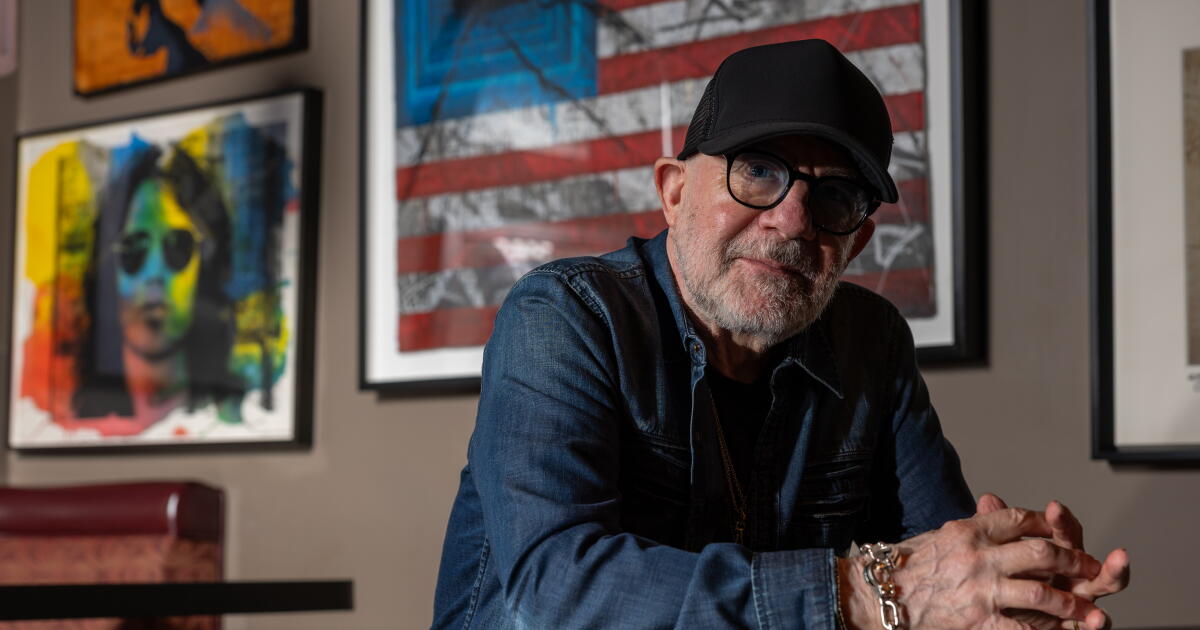

Dressed in a black T-shirt and jeans, ball cap pulled low over his eyes, Bernie Taupin sips a glass of Chardonnay in a corner booth at Craig’s on Melrose Avenue.
The restaurant’s dining room isn’t open for lunch on this recent Tuesday afternoon. But more than half a century after he first came to Los Angeles, Taupin — the 76-year-old English songwriter best known for his long creative partnership with Elton John — still has plenty of friends around town, including Craig himself, who’s agreed to host Taupin and me for a chat about Taupin’s new album, “The Sea Has No Mercy.”
“Hi, honey — you look great,” the restaurateur says as he swings by our table. He turns to me and adds, “You’re talking to the legend.”
Taupin’s first solo LP since the late 1980s, “The Sea Has No Mercy” is also the first record for which he’s written both the words and the music. He calls the album’s sound “atmospheric folk”; the songs ponder faith, nature and mortality and feature guest appearances by Brandi Carlile, Lee Ann Womack and Taupin’s 18-year-old daughter, Georgey.
Yet if the album marks a new way of working for the songwriter, it grew out of the season of reflection that yielded his 2023 memoir as well as a documentary about him set to premiere Jan. 1 on CNN.
“It’s like one-two-three — a trifecta,” says Taupin, who lives these days with his wife, Heather, in the Santa Ynez Valley. “It’s 100% what I want to say at this point in my life.”
You landed in L.A. in 1970 — just a few blocks from where we’re sitting.
To play the Troubadour. We played a week, although everybody thinks it was just one night.
I’d imagine you’ve met thousands of people who say they were there.
If everybody who claims they were there was actually there, we could’ve filled Dodger Stadium five years before we did. That said, I don’t remember it being that star-encrusted, to be honest. I remember Leon Russell and Quincy Jones being there. Obviously Neil Diamond was there — he introduced Elton the first night. A couple of Beach Boys came, and the least important member of Buffalo Springfield: Dewey Martin, who was the drummer.
Do you remember where you sat?
I never sat. In the movie “Rocketman,” Jamie Bell, who plays me, is standing in the balcony, leaning over — that’s exactly where I was.
You were 20 when you left England. What were you leaving behind?
I was leaving a black-and-white world. As a child, I never really felt I belonged in England. I always associated myself musically — not just musically but fictionally and historically — with things that pertained to the United States. And when we went to California, the color was blinding. It really was the thing of you come off the plane and you kiss the ground because you know this is where you belong. Everything I’d ever aspired to I got to experience here straightaway. And obviously the female contingent of L.A. was so radically different than what we had experienced in England.
In what way?
I don’t want use to terms like “free love,” but there was a freedom that didn’t exist in the United Kingdom.
A sexual freedom.
But not just a sexual freedom. England was still so repressed — people acted completely different there than they did here. One of the first things I did on my second trip to California was I rented a Mustang and drove across the United States on my own. And that road trip was the blue touch paper to the “Madman Across the Water” album, starting with “Tiny Dancer” in L.A.
Elton John, right, and Bernie Taupin in London in 1973.
(John Glanvill / Associated Press)
“Tiny Dancer” wasn’t particularly big when it came out — didn’t even crack the Top 40. Would you have predicted it would endure the way it has?
I never thought in those terms — I never paid attention to sales figures or chart positions. Elton in those days — and still to these days — he’s obsessed with statistics. He’d get Billboard and go to Tower Records: “Gotta get that one, gotta get that one.” But the thing is: We never set out to write hit singles.
You have to have recognized by 1974 that you were on an insane run.
But I didn’t even know what a hit was.
In 1974? I think it was a song by Elton John and Bernie Taupin.
No, because we were writing all different kinds of things. I swear on my life: I never set out to write something I thought was a hit because I didn’t know how to do it. Originality was my way of writing hits — to find something straightforward, but then throw in a curveball.
What’s the curveball in “Tiny Dancer?”
The sexual ambiguity of it: “Rolling like thunder under the covers …” Oh, that’s not even “Tiny Dancer,” is it?
This is the problem when you have too many hits.
I’m terrible at remembering my own lyrics. OK, a good example is “Bennie and the Jets” — very weird song that for some unbeknownst reason got picked up in Detroit by Black radio. There was a promotions guy at MCA Universal called Pat Pipolo.
Great name.
All those guys were great in their polyester suits and their wide-lapel shirts. They don’t exist anymore, which is sad. But he said to Elton and I that this record was breaking out in Detroit and we should consider putting it out as a single. We said, “You’re insane.” He said, “I’m telling you it’ll be a monster hit.” Luckily, we caved — end of story.
What was it like to be the relatively un-famous partner of a hugely famous pop star?
I never wanted to be up front and center. And I had all the recognition I could possibly want. When Elton did interviews, he always said, “This is our new album” — never “This is my new album.”
That was gratifying to you.
Extremely gratifying — kept me quite content. On top of that, every record we made from “Empty Sky” to “Blue Moves,” my picture was all over the album jacket.
With an excellent mullet.
I went through phases. But I could never, ever have been in the public eye the way Elton is. It’s ridiculous with him — he can’t go anywhere.
Figure there’s — what? — 10 musicians in the world as recognizable as he is?
I don’t even know if there’s 10. I’ve had the pleasure of knowing some of them — knew all the Beatles, knew all the Stones. I saw Paul not long ago in Santa Barbara. We had a picture taken together, and it’s like, this is Paul f—ing McCartney! It doesn’t get lost on you. The only other person that magnetic to me was Leonard Cohen — he could buy me and sell me in a second. This album I just made has his fingerprints all over it.
In the writing? The singing? Both?
In everything. My vocal timbre on something like “The Favor,” I wanted it to be like Leonard. The song is so Leonard too — the chord structure and the simplicity of it. He could write the most extraordinary songs on so few chords.
You made this album in Nashville, but you’ve said it’s not a country record.
Does it sound like a country record to you?
You say that like it’s a bad word.
No, no, no — I don’t think it’s a bad word. But country music isn’t country music anymore, is it? I didn’t think what I had to say fitted into the genre. It fitted into folk and Leonard Cohen and late-life Bob Dylan. I don’t mean early Dylan — I’m talking “Time After Mind” and “Rough and Rowdy Ways,” which was inspirational, no doubt.
What do you find inspiring about “Rough and Rowdy Ways”?
I can tell you exactly: He’s still vibrant — he’s still writing about things that are interesting. I mean, he doesn’t always write things that I love. Sometimes I think Dylan is sloppy. The one track I didn’t care for — I thought it was overly hyped — was the Kennedy thing.
“Murder Most Foul,” about JFK. Very long.
Well, and I didn’t think it was very good. You’re gonna make the most of this, but any really good lyricist could have written a song equally as good.
I don’t know, man: “Play ‘Please Don’t Let Me Be Misunderstood’ / Play it for the First Lady — she ain’t feeling any good.”
Then he’s talking about Henley and Frey and Fleetwood Mac. What? Not that I disrespect them, but it was just rambling. I think Mick Jagger could have done a counter version of it. There’s nobody that writes like him. “I was a butcher cutting up meat” — who’s gonna write that?
Have you heard this latest Stones record?
I don’t like it as much as the last one.
I’m the opposite.
Really?
Tell me about your Brandi Carlile duet, “Come On California.” You guys seem to have become good pals.
She’s part of our life now. I go back to the day she sent me a letter saying, “My name’s Brandi Carlile, and I just made a record. You probably have no idea who I am,” and I didn’t. But slowly she progressed into what Brandi is now: one of the best writers, recording artists and certainly live performers out there. She’s what Elvis would’ve been as a woman.
When I saw that she was on the record —
I was gonna ask Joni Mitchell to do it, and I chickened out.
I was expecting Brandi to do her Brandi thing, where she steps in and takes a song to a higher emotional plane. She’s way more reserved.
If you notice on the record, it says “featuring” — it doesn’t say it’s a duet. It wouldn’t have made sense if it had been a duet because the song is so personal. It’s a metaphor for California and my relationship with my wife — how I found her through California.

Why’d you move to Santa Ynez?
Because I got tired of L.A. In the early ’90s, I wanted to race horses or cowboy or get into some sort of competition horse-wise, and I ended up buying a cutting ranch. I immersed myself in cowboy culture because you can’t bulls— these guys. If you’re gonna be a cowboy — a real cowboy — you can’t be a weekend warrior. So I backed out of everything for a while and spent 10 years on the road going to every rat-ass place you could imagine.
Do you look back fondly on that time?
I do. It changed my whole perception of living in this country. Rodeo was a huge part of my life — it kind of still is. Cutting is physically taxing, and I just blew my shoulder out. But then I got married to my Heather and we had our first kid, Charley, and this kid was riding before she could walk. Now she’s a big-time barrel racer in Texas. I watch her ride and it’s one of the things I’m proudest of in my life.
Couple more quick ones. You once wrote a song with Courtney Love.
I don’t remember anything about that — don’t even remember what the song was.
But somehow it happened.
I have no idea how. I did a podcast recently, and the guy said, “Oh, you’ve written with all these people — you’ve written with Lady Gaga.” I went, “I don’t remember writing with Lady Gaga.” The guy looks at his clipboard, and he goes, “There’s an Elton John song called ‘Hello Hello,’ and she sang on it.” Well, it was from an animated movie about gnomes. I have no recollection of that whatsoever.
I talked with Ann and Nancy Wilson recently about how you and Martin Page wrote “These Dreams” for Stevie Nicks before Heart ended up recording it.
That’s right — I’d forgotten that Stevie turned it down. I was put together with Martin by one of our publishers, and the first two things we did, believe it or not, were “These Dreams” and “We Built This City.” “We Built This City” was extraordinarily different than how it ended up — very dark. The thing that sticks in my craw is that the guys in Jefferson Starship had no problem with the song at the time. Then, years later, Grace Slick ragged on it continually: “It was a piece of s— that didn’t make any sense.” I’m thinking: This is somebody who spent her life writing about white rabbits and painting pictures of them. It’s a little hypocritical, but whatever — God bless you, darling.
What do you think of the records Elton made without you after “Blue Moves”?
“Victim of Love,” I don’t even think Elton would call that decent. He did “A Single Man,” but I’ll be honest with you — I think I probably listened to it once.
Do you and Elton have another album in you?
It’s difficult for him now with his eyesight. He’s been messing around in the studio with Andrew Watt, and I’ve contributed a few things. There’s stuff that will be coming out but probably not till later next year.
What song of yours would you want mentioned in the first paragraph of your obit?
[Thinks.]
One tune to sum it all up.
Well, at that point I’m not still standing, am I?

Dressed in a black T-shirt and jeans, ball cap pulled low over his eyes, Bernie Taupin sips a glass of Chardonnay in a corner booth at Craig’s on Melrose Avenue.
The restaurant’s dining room isn’t open for lunch on this recent Tuesday afternoon. But more than half a century after he first came to Los Angeles, Taupin — the 76-year-old English songwriter best known for his long creative partnership with Elton John — still has plenty of friends around town, including Craig himself, who’s agreed to host Taupin and me for a chat about Taupin’s new album, “The Sea Has No Mercy.”
“Hi, honey — you look great,” the restaurateur says as he swings by our table. He turns to me and adds, “You’re talking to the legend.”
Taupin’s first solo LP since the late 1980s, “The Sea Has No Mercy” is also the first record for which he’s written both the words and the music. He calls the album’s sound “atmospheric folk”; the songs ponder faith, nature and mortality and feature guest appearances by Brandi Carlile, Lee Ann Womack and Taupin’s 18-year-old daughter, Georgey.
Yet if the album marks a new way of working for the songwriter, it grew out of the season of reflection that yielded his 2023 memoir as well as a documentary about him set to premiere Jan. 1 on CNN.
“It’s like one-two-three — a trifecta,” says Taupin, who lives these days with his wife, Heather, in the Santa Ynez Valley. “It’s 100% what I want to say at this point in my life.”
You landed in L.A. in 1970 — just a few blocks from where we’re sitting.
To play the Troubadour. We played a week, although everybody thinks it was just one night.
I’d imagine you’ve met thousands of people who say they were there.
If everybody who claims they were there was actually there, we could’ve filled Dodger Stadium five years before we did. That said, I don’t remember it being that star-encrusted, to be honest. I remember Leon Russell and Quincy Jones being there. Obviously Neil Diamond was there — he introduced Elton the first night. A couple of Beach Boys came, and the least important member of Buffalo Springfield: Dewey Martin, who was the drummer.
Do you remember where you sat?
I never sat. In the movie “Rocketman,” Jamie Bell, who plays me, is standing in the balcony, leaning over — that’s exactly where I was.
You were 20 when you left England. What were you leaving behind?
I was leaving a black-and-white world. As a child, I never really felt I belonged in England. I always associated myself musically — not just musically but fictionally and historically — with things that pertained to the United States. And when we went to California, the color was blinding. It really was the thing of you come off the plane and you kiss the ground because you know this is where you belong. Everything I’d ever aspired to I got to experience here straightaway. And obviously the female contingent of L.A. was so radically different than what we had experienced in England.
In what way?
I don’t want use to terms like “free love,” but there was a freedom that didn’t exist in the United Kingdom.
A sexual freedom.
But not just a sexual freedom. England was still so repressed — people acted completely different there than they did here. One of the first things I did on my second trip to California was I rented a Mustang and drove across the United States on my own. And that road trip was the blue touch paper to the “Madman Across the Water” album, starting with “Tiny Dancer” in L.A.
Elton John, right, and Bernie Taupin in London in 1973.
(John Glanvill / Associated Press)
“Tiny Dancer” wasn’t particularly big when it came out — didn’t even crack the Top 40. Would you have predicted it would endure the way it has?
I never thought in those terms — I never paid attention to sales figures or chart positions. Elton in those days — and still to these days — he’s obsessed with statistics. He’d get Billboard and go to Tower Records: “Gotta get that one, gotta get that one.” But the thing is: We never set out to write hit singles.
You have to have recognized by 1974 that you were on an insane run.
But I didn’t even know what a hit was.
In 1974? I think it was a song by Elton John and Bernie Taupin.
No, because we were writing all different kinds of things. I swear on my life: I never set out to write something I thought was a hit because I didn’t know how to do it. Originality was my way of writing hits — to find something straightforward, but then throw in a curveball.
What’s the curveball in “Tiny Dancer?”
The sexual ambiguity of it: “Rolling like thunder under the covers …” Oh, that’s not even “Tiny Dancer,” is it?
This is the problem when you have too many hits.
I’m terrible at remembering my own lyrics. OK, a good example is “Bennie and the Jets” — very weird song that for some unbeknownst reason got picked up in Detroit by Black radio. There was a promotions guy at MCA Universal called Pat Pipolo.
Great name.
All those guys were great in their polyester suits and their wide-lapel shirts. They don’t exist anymore, which is sad. But he said to Elton and I that this record was breaking out in Detroit and we should consider putting it out as a single. We said, “You’re insane.” He said, “I’m telling you it’ll be a monster hit.” Luckily, we caved — end of story.
What was it like to be the relatively un-famous partner of a hugely famous pop star?
I never wanted to be up front and center. And I had all the recognition I could possibly want. When Elton did interviews, he always said, “This is our new album” — never “This is my new album.”
That was gratifying to you.
Extremely gratifying — kept me quite content. On top of that, every record we made from “Empty Sky” to “Blue Moves,” my picture was all over the album jacket.
With an excellent mullet.
I went through phases. But I could never, ever have been in the public eye the way Elton is. It’s ridiculous with him — he can’t go anywhere.
Figure there’s — what? — 10 musicians in the world as recognizable as he is?
I don’t even know if there’s 10. I’ve had the pleasure of knowing some of them — knew all the Beatles, knew all the Stones. I saw Paul not long ago in Santa Barbara. We had a picture taken together, and it’s like, this is Paul f—ing McCartney! It doesn’t get lost on you. The only other person that magnetic to me was Leonard Cohen — he could buy me and sell me in a second. This album I just made has his fingerprints all over it.
In the writing? The singing? Both?
In everything. My vocal timbre on something like “The Favor,” I wanted it to be like Leonard. The song is so Leonard too — the chord structure and the simplicity of it. He could write the most extraordinary songs on so few chords.
You made this album in Nashville, but you’ve said it’s not a country record.
Does it sound like a country record to you?
You say that like it’s a bad word.
No, no, no — I don’t think it’s a bad word. But country music isn’t country music anymore, is it? I didn’t think what I had to say fitted into the genre. It fitted into folk and Leonard Cohen and late-life Bob Dylan. I don’t mean early Dylan — I’m talking “Time After Mind” and “Rough and Rowdy Ways,” which was inspirational, no doubt.
What do you find inspiring about “Rough and Rowdy Ways”?
I can tell you exactly: He’s still vibrant — he’s still writing about things that are interesting. I mean, he doesn’t always write things that I love. Sometimes I think Dylan is sloppy. The one track I didn’t care for — I thought it was overly hyped — was the Kennedy thing.
“Murder Most Foul,” about JFK. Very long.
Well, and I didn’t think it was very good. You’re gonna make the most of this, but any really good lyricist could have written a song equally as good.
I don’t know, man: “Play ‘Please Don’t Let Me Be Misunderstood’ / Play it for the First Lady — she ain’t feeling any good.”
Then he’s talking about Henley and Frey and Fleetwood Mac. What? Not that I disrespect them, but it was just rambling. I think Mick Jagger could have done a counter version of it. There’s nobody that writes like him. “I was a butcher cutting up meat” — who’s gonna write that?
Have you heard this latest Stones record?
I don’t like it as much as the last one.
I’m the opposite.
Really?
Tell me about your Brandi Carlile duet, “Come On California.” You guys seem to have become good pals.
She’s part of our life now. I go back to the day she sent me a letter saying, “My name’s Brandi Carlile, and I just made a record. You probably have no idea who I am,” and I didn’t. But slowly she progressed into what Brandi is now: one of the best writers, recording artists and certainly live performers out there. She’s what Elvis would’ve been as a woman.
When I saw that she was on the record —
I was gonna ask Joni Mitchell to do it, and I chickened out.
I was expecting Brandi to do her Brandi thing, where she steps in and takes a song to a higher emotional plane. She’s way more reserved.
If you notice on the record, it says “featuring” — it doesn’t say it’s a duet. It wouldn’t have made sense if it had been a duet because the song is so personal. It’s a metaphor for California and my relationship with my wife — how I found her through California.
Why’d you move to Santa Ynez?
Because I got tired of L.A. In the early ’90s, I wanted to race horses or cowboy or get into some sort of competition horse-wise, and I ended up buying a cutting ranch. I immersed myself in cowboy culture because you can’t bulls— these guys. If you’re gonna be a cowboy — a real cowboy — you can’t be a weekend warrior. So I backed out of everything for a while and spent 10 years on the road going to every rat-ass place you could imagine.
Do you look back fondly on that time?
I do. It changed my whole perception of living in this country. Rodeo was a huge part of my life — it kind of still is. Cutting is physically taxing, and I just blew my shoulder out. But then I got married to my Heather and we had our first kid, Charley, and this kid was riding before she could walk. Now she’s a big-time barrel racer in Texas. I watch her ride and it’s one of the things I’m proudest of in my life.
Couple more quick ones. You once wrote a song with Courtney Love.
I don’t remember anything about that — don’t even remember what the song was.
But somehow it happened.
I have no idea how. I did a podcast recently, and the guy said, “Oh, you’ve written with all these people — you’ve written with Lady Gaga.” I went, “I don’t remember writing with Lady Gaga.” The guy looks at his clipboard, and he goes, “There’s an Elton John song called ‘Hello Hello,’ and she sang on it.” Well, it was from an animated movie about gnomes. I have no recollection of that whatsoever.
I talked with Ann and Nancy Wilson recently about how you and Martin Page wrote “These Dreams” for Stevie Nicks before Heart ended up recording it.
That’s right — I’d forgotten that Stevie turned it down. I was put together with Martin by one of our publishers, and the first two things we did, believe it or not, were “These Dreams” and “We Built This City.” “We Built This City” was extraordinarily different than how it ended up — very dark. The thing that sticks in my craw is that the guys in Jefferson Starship had no problem with the song at the time. Then, years later, Grace Slick ragged on it continually: “It was a piece of s— that didn’t make any sense.” I’m thinking: This is somebody who spent her life writing about white rabbits and painting pictures of them. It’s a little hypocritical, but whatever — God bless you, darling.
What do you think of the records Elton made without you after “Blue Moves”?
“Victim of Love,” I don’t even think Elton would call that decent. He did “A Single Man,” but I’ll be honest with you — I think I probably listened to it once.
Do you and Elton have another album in you?
It’s difficult for him now with his eyesight. He’s been messing around in the studio with Andrew Watt, and I’ve contributed a few things. There’s stuff that will be coming out but probably not till later next year.
What song of yours would you want mentioned in the first paragraph of your obit?
[Thinks.]
One tune to sum it all up.
Well, at that point I’m not still standing, am I?


