
Things may be broken right now in your life, in your home, in your heart. They have been in mine, where a family member’s declining health has shattered my peace for some time.
That’s what I was thinking as I slammed a hammer onto a ceramic dish at an arts workshop recently, leaving it splintered into pieces.
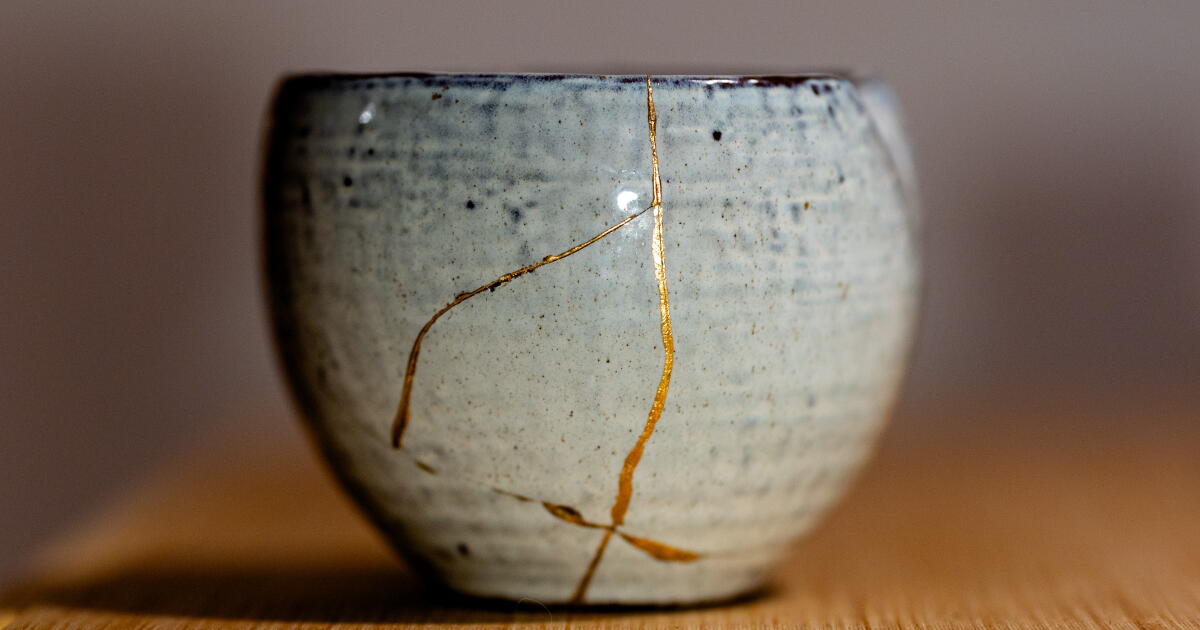
I was at the Magic Brush Room, an arts and crafts studio in Eagle Rock. Founder Rebecca Roy was giving me a lesson in kintsugi, which is the centuries-old Japanese art of repairing broken ceramics with lacquer mixed with powdered metal, such as gold, silver or brass.
The slow, meditative act of repairing the stoneware dish in this kintsugi class would turn out to be more emotional than I could have imagined (leaving the instructor in tears multiple times). It sparked a conversation about pain and resilience, as well as a sense of gratitude for the mess that life brings.

“Kintsugi asks us to reconsider what’s valuable to us,” Roy said. “And it questions equating perfection with beauty.”
After shattering our dishes, we sat at a small wooden table and embarked on the detailed process of repair, which was so tactile and focused on the minutia that it brought on an overwhelming calm. (“You’re in flow state,” Roy said. “It’s super relaxing.”) We gently, lovingly cleaned each ceramic remnant with a cotton ball and rubbing alcohol. Then we assembled the broken pieces into pairings and “rehearsed” how they would fit together, adjusting the jagged ceramic shapes in our hands until they “clicked together” seamlessly. We mixed epoxy with mica-based gold powder, painting the seam with the viscous solution and securing the pieces back together.
As we held them still for five minutes, waiting for the adhesive to set, Roy explained that we would not be covering up the cracks in the reassembled dish, but highlighting them. We smeared the visible fractures with gold liquid, leaving gloopy shimmering zig-zags across the dish surface. Then we shaped those gold lines, refining them with a fine-tipped bamboo stick wrapped in cotton and dipped in acetone, or with a razor blade.
“When you’re emphasizing the breaks in kintsugi, you’re also emphasizing the repair and the care,” Roy said. “The value that you’ve put in this piece, there’s resilience in that — gratitude.”


1. A bowl of gold mica powder. 2. Rebecca Roy paints the edges of a ceramic remnant. 3. The Kintsugi workshop underway. 4. “Kintsugi asks us to reconsider what’s valuable to us,” Rebecca Roy says. 5. A razor blade is used to refine gold-rimmed cracks. (Ronaldo Bolanos/Los Angeles Times)
Roy, originally from western Massachusetts, studied traditional kintsugi while living in Tokyo for a year around 2002. She was drawn to the artform’s aesthetic and inherent ideals — the sustainability aspect — and found the process meditative. But what started as a crafty hobby became a regular gratitude practice. Which can be transformative, says Jeremy Adam Smith, editor of Greater Good Magazine at the UC Berkeley Greater Good Science Center.
“Over the past 20 years we’ve seen this flourishing of gratitude research and we’ve really started to understand the social, psychological and cultural functions of gratitude in a way we never have before,” Smith says. “There are very strong links between gratitude and physical and mental health. There’s good reason to believe that practicing gratitude can actually lengthen your life and can definitely make you feel a lot better physically and emotionally, day to day.”
The metaphor of kintsugi — broken objects repurposed and made beautiful again (resilience) and the appreciation of inevitable imperfections (acceptance, gratitude) — is admittedly on-the-nose. But, Smith adds, “it’s very valuable as a mental exercise. You can’t go through life without seeing things break — you yourself will break from time to time — and kintsugi teaches us that things will break, things can be repaired, and the important thing is that we find ways to focus on that positive rebuilding and renewing dimension of life.”
Roy’s passion for the craft of kintsugi, and her vulnerability while teaching it, imbued the workshop with a surprising sense of intimacy and emotion — it became more of a journey, an exploration of our internal landscapes, as opposed to just crafting with our hands. In past classes, participants have cried, others have shared never-before-told stories. One woman, during a private kintsugi workshop that was her birthday celebration, gave a heartfelt speech to her friends about how they’d “kintsugi’d her life back together.”
Suddenly, Roy’s own eyes filled with tears.
“What we’re going through right now — we suffered so many blows as a society — and we are deeply fractured,” she said. “There was COVID and Trump got elected, it’s been really volatile. And how do we move forward, do we throw this all away? No. There’s this opportunity for repairing and re-bonding ourselves.”

Kintsugi instructor Rebecca Roy at home. She typically holds workshops in her open-air home studio or at the Brewery, in downtown L.A.
(Ronaldo Bolaños / Los Angeles Times)
The web of highlighted cracks in a kintsugi piece, she explained — the breakage — is a map of sorts to the object’s history. And as a society right now “we don’t want to hide what happened, we don’t want to cover it up,” she said. “Let’s really look at this break, let’s emphasize it, and use it to make something that’s even better than before.”
As we wrapped up the workshop, Roy relayed one last tidbit about kintsugi. The finished artwork — the pieced-together dish or bowl or vase, with its abstract splay of metallic lines — is structurally stronger than the original. Because the adhesive that binds it together is stronger than the stoneware itself.
It’s another on-the-nose, but still moving, metaphor: that which does break us — if we embrace it with gratitude — makes us stronger.

Things may be broken right now in your life, in your home, in your heart. They have been in mine, where a family member’s declining health has shattered my peace for some time.
That’s what I was thinking as I slammed a hammer onto a ceramic dish at an arts workshop recently, leaving it splintered into pieces.
I was at the Magic Brush Room, an arts and crafts studio in Eagle Rock. Founder Rebecca Roy was giving me a lesson in kintsugi, which is the centuries-old Japanese art of repairing broken ceramics with lacquer mixed with powdered metal, such as gold, silver or brass.
The slow, meditative act of repairing the stoneware dish in this kintsugi class would turn out to be more emotional than I could have imagined (leaving the instructor in tears multiple times). It sparked a conversation about pain and resilience, as well as a sense of gratitude for the mess that life brings.
“Kintsugi asks us to reconsider what’s valuable to us,” Roy said. “And it questions equating perfection with beauty.”
After shattering our dishes, we sat at a small wooden table and embarked on the detailed process of repair, which was so tactile and focused on the minutia that it brought on an overwhelming calm. (“You’re in flow state,” Roy said. “It’s super relaxing.”) We gently, lovingly cleaned each ceramic remnant with a cotton ball and rubbing alcohol. Then we assembled the broken pieces into pairings and “rehearsed” how they would fit together, adjusting the jagged ceramic shapes in our hands until they “clicked together” seamlessly. We mixed epoxy with mica-based gold powder, painting the seam with the viscous solution and securing the pieces back together.
As we held them still for five minutes, waiting for the adhesive to set, Roy explained that we would not be covering up the cracks in the reassembled dish, but highlighting them. We smeared the visible fractures with gold liquid, leaving gloopy shimmering zig-zags across the dish surface. Then we shaped those gold lines, refining them with a fine-tipped bamboo stick wrapped in cotton and dipped in acetone, or with a razor blade.
“When you’re emphasizing the breaks in kintsugi, you’re also emphasizing the repair and the care,” Roy said. “The value that you’ve put in this piece, there’s resilience in that — gratitude.”
1. A bowl of gold mica powder. 2. Rebecca Roy paints the edges of a ceramic remnant. 3. The Kintsugi workshop underway. 4. “Kintsugi asks us to reconsider what’s valuable to us,” Rebecca Roy says. 5. A razor blade is used to refine gold-rimmed cracks. (Ronaldo Bolanos/Los Angeles Times)
Roy, originally from western Massachusetts, studied traditional kintsugi while living in Tokyo for a year around 2002. She was drawn to the artform’s aesthetic and inherent ideals — the sustainability aspect — and found the process meditative. But what started as a crafty hobby became a regular gratitude practice. Which can be transformative, says Jeremy Adam Smith, editor of Greater Good Magazine at the UC Berkeley Greater Good Science Center.
“Over the past 20 years we’ve seen this flourishing of gratitude research and we’ve really started to understand the social, psychological and cultural functions of gratitude in a way we never have before,” Smith says. “There are very strong links between gratitude and physical and mental health. There’s good reason to believe that practicing gratitude can actually lengthen your life and can definitely make you feel a lot better physically and emotionally, day to day.”
The metaphor of kintsugi — broken objects repurposed and made beautiful again (resilience) and the appreciation of inevitable imperfections (acceptance, gratitude) — is admittedly on-the-nose. But, Smith adds, “it’s very valuable as a mental exercise. You can’t go through life without seeing things break — you yourself will break from time to time — and kintsugi teaches us that things will break, things can be repaired, and the important thing is that we find ways to focus on that positive rebuilding and renewing dimension of life.”
Roy’s passion for the craft of kintsugi, and her vulnerability while teaching it, imbued the workshop with a surprising sense of intimacy and emotion — it became more of a journey, an exploration of our internal landscapes, as opposed to just crafting with our hands. In past classes, participants have cried, others have shared never-before-told stories. One woman, during a private kintsugi workshop that was her birthday celebration, gave a heartfelt speech to her friends about how they’d “kintsugi’d her life back together.”
Suddenly, Roy’s own eyes filled with tears.
“What we’re going through right now — we suffered so many blows as a society — and we are deeply fractured,” she said. “There was COVID and Trump got elected, it’s been really volatile. And how do we move forward, do we throw this all away? No. There’s this opportunity for repairing and re-bonding ourselves.”
Kintsugi instructor Rebecca Roy at home. She typically holds workshops in her open-air home studio or at the Brewery, in downtown L.A.
(Ronaldo Bolaños / Los Angeles Times)
The web of highlighted cracks in a kintsugi piece, she explained — the breakage — is a map of sorts to the object’s history. And as a society right now “we don’t want to hide what happened, we don’t want to cover it up,” she said. “Let’s really look at this break, let’s emphasize it, and use it to make something that’s even better than before.”
As we wrapped up the workshop, Roy relayed one last tidbit about kintsugi. The finished artwork — the pieced-together dish or bowl or vase, with its abstract splay of metallic lines — is structurally stronger than the original. Because the adhesive that binds it together is stronger than the stoneware itself.
It’s another on-the-nose, but still moving, metaphor: that which does break us — if we embrace it with gratitude — makes us stronger.