


We’re past due for dystopian storytelling to train its lens on a creature in the here and now, one whose very survival speaks to consequential global change. Take the ice-dependent polar bear, rapidly losing its food-sustaining habitat and having to perilously adapt by nudging further and further into human spaces. And yet, as the moody, starkly beautiful documentary “Nuisance Bear” reveals, following just one wandering ursus maritimus in search of food will still ultimately tell you as much about the two-legged mammals who created its plight.
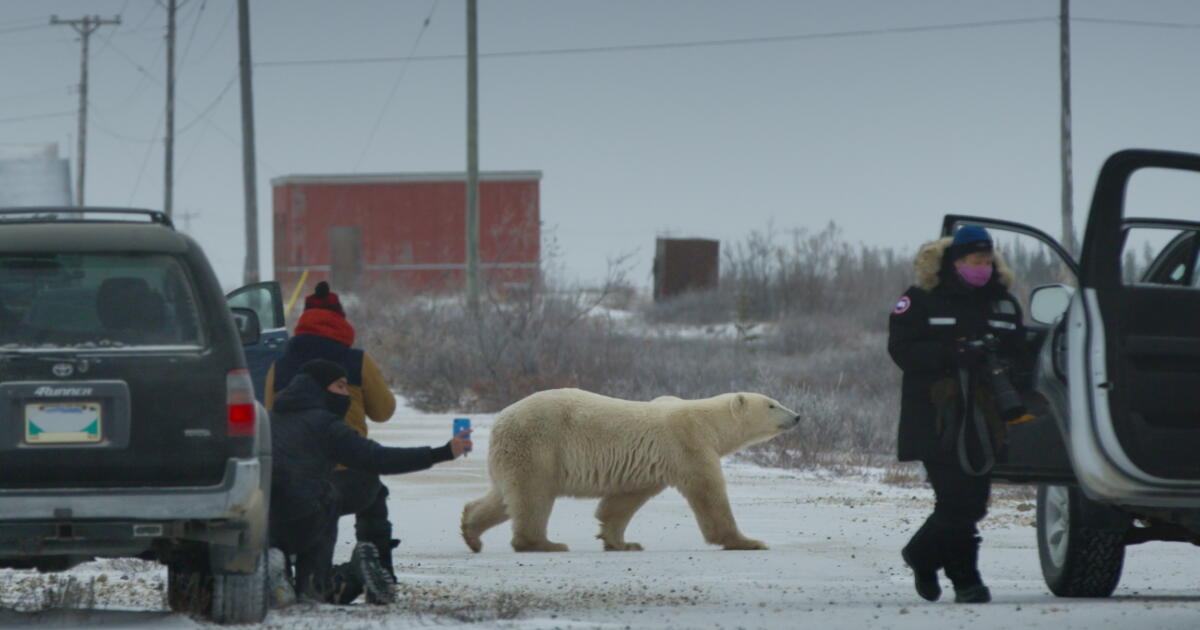
Broadening and deepening their acclaimed, same-titled short from 2022, directors Jack Weisman and Gabriela Osio Vanden have made a nature film turned on its head. They camped out in Churchill, Manitoba, along the Hudson Bay, where hundreds of polar bears migrate each winter, to capture their increasing encroachment into human communities. There’s an ironic disconnect when a town calls itself “Polar Bear Capital of the World” — it’s not like these creatures, who existed long before us, get to be in charge of anything. Their food source becomes town dumps, plus, in the interests of “conservation,” they get treated either like a roaming photo-op for tourists or, if too aggressive and needing to be reminded of their place, like a drunk vagrant consigned to a night in the clink. (There’s a holding facility for polar bears before they’re let loose again.)
Weisman and Vanden oversaw a crew of six cinematographers (including themselves) and built their visuals primarily around the perspective of one isolated, scavenging bear as it endures busloads of sightseeing visitors, brief incarceration from a patrol operation and, after an airlift, an even more conflict-ridden journey north toward the Inuit town Arviat, just in time for that hamlet’s annual hunt. With attacks on the rise, the people of Arviat harbor no delusion that polar bears are endangered.
Their experience with avinnaarjuk, an Inuit term for roaming bears without fear of humans, is the movie’s other carefully considered viewpoint, since the Inuit, too, have suffered under a system of control. Colonialism herded these Indigenous communities directly in the path of the bears’ ancient migration, and now hunting regulations hamper their ability to manage the population. “Nuisance Bear” is partly narrated by one such affected elder, Mike Tunalaaq Gibbons. His weary voice, describing with sympathy what this solitary, hungry rover is going through, details a broken relationship between human and beast, but more keenly and traumatically, between humans and humans. It’s as if we’re privy not only to hard-earned wisdom but something poignant and therapeutic about loss and change.
The bear, meanwhile, gets our empathy, as any creature would. Whether gazed upon in close-up (an intimacy made possible when it’s dosed with tranquilizers) or viewed from a distance as it’s chased across a landscape increasingly marked by human settlement — trash, fences, machinery, buildings — our ursine antihero is like some lost spirit, scrambling for purchase where claws no longer reliably grip. The steady, gliding images, part surveillance, part concern, suggest a de-evolution. When Cristóbal Tapia de Veer’s ethereal score is playing, “Nuisance Bear” evokes a sacred domain where the cosmic hymn that’s always undergirded it has begun to lose its melody.
‘Nuisance Bear’
In Inuktitut and English, with subtitles
Not rated
Running time: 1 hour, 29 minutes
Playing: Opens Friday, Nov. 6 at Laemmle Glendale


