

Few of us living in Southern California fully grasp the pivotal role the area has played in the history of flight and space travel. It boasted about two-thirds of the nation’s aircraft companies by the end of World War II and later birthed moon-bound Apollo spacecraft and the Columbia, Challenger, Discovery, Atlantis and Endeavour space shuttles. NASA’s Jet Propulsion Laboratory in La Cañada Flintridge is still where many of NASA’s robotic space missions are built and operated, and SpaceX has forged most of its rockets and spacecraft in Hawthorne.
Our region specializes in another kind of escape too: entertainment. At the new Samuel Oschin Air and Space Center, the $450-million, 200,000-square-foot expansion of the California Science Center, which opens to the public on Nov. 13, our expertise in cosmonautics and creativity converge to produce a blockbuster — a people-pleasing, action-packed popcorn flick that’s a foil to the city’s newest museums such as LACMA’s indie art house and Lucas’ sci-fi saga.
The Samuel Oschin Air and Space Center. The cone-like top houses the Endeavour space shuttle in launch position.
(Allen J. Schaben / Los Angeles Times)
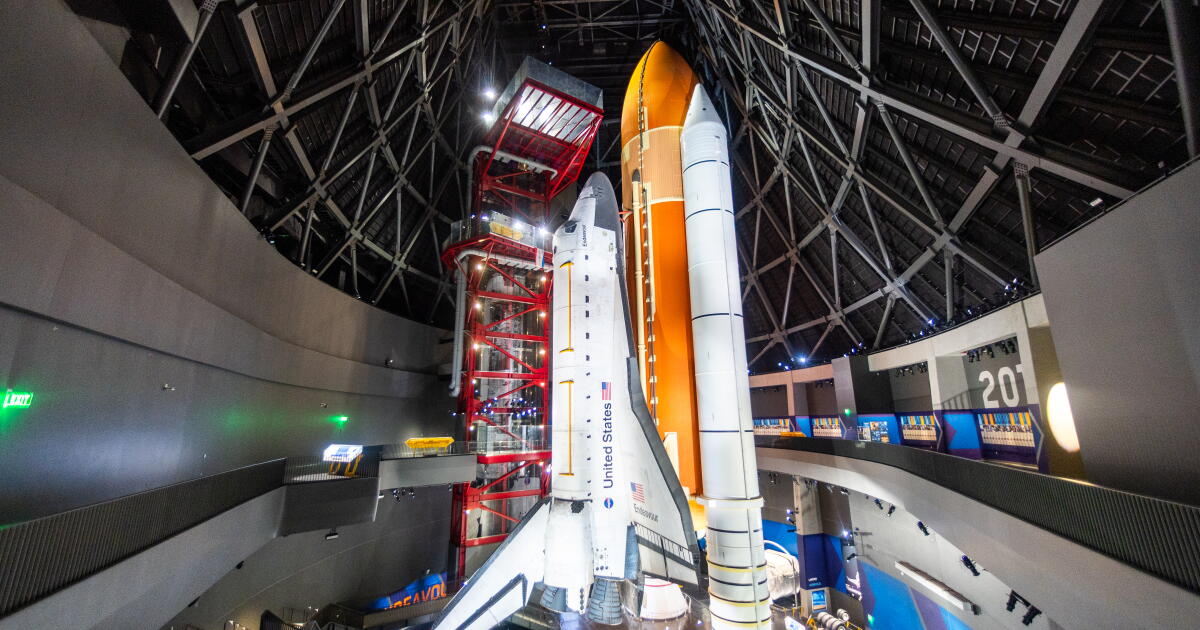
The center, with its galleries dedicated to aviation, space exploration and the shuttle program, turns the miracle of flight into theater, building to a dazzling denouement: the space shuttle Endeavour, with its solid rocket boosters and enormous external tank displayed in launch-ready position for the first time.
The drama begins in a darkened room, where a film created by J.J. Abrams’ production company, Bad Robot, transports you into the rousing, aggressively optimistic world of space travel, with its grainy footage, scratchy voices and real-life heroes. Then the shuttle appears on screen, the music swells and the room shakes with the tearing, rumbling force of a launch. The music resolves and smoke rolls into the gallery before the screen opens up and the real Endeavour gleams in the distance, spotlighted like a mirage in the dark.
It’s all a bit much. But I defy you to experience this reveal without getting goosebumps, or even (like a few people I know) shedding a tear.

Former NASA astronaut John “Danny” Olivas watches a J.J. Abrams-produced film about the space shuttle program before entering the shuttle display area at the Samuel Oschin Air and Space Center.
(Allen J. Schaben / Los Angeles Times)
You may think you experienced the shuttle a few years ago, parked in a hangar-like building at the west edge of the Science Center. But witnessing the shuttle upright — an idea that emerged out of a Science Center master plan over 30 years ago — is an entirely different thing. The 20-story-tall Endeavour stack is, simply put, one of the greatest artifacts ever installed in a museum. Anchored, via just eight bolts, to a concrete pad a floor below the ground, it’s a mesmerizing monument that feels as if it’s emerging from the earth to burst into space.
Space is the key word. To its credit, Oschin architect ZGF has done its best to keep the shuttle gallery’s dark, cavernous architecture in the background; focusing attention on the Endeavour while transporting visitors to another realm. Above its three-story concrete lower walls the gallery’s structure becomes a lean, self-supporting steel diagrid (think of a giant Erector Set) that wraps around the orbiter without interior walls or columns. Its web of steel connectors reads like a constellation. Its cone-shaped surface consists of thousands of panels, merging support and weather protection, and serving, via steel clips, as a frame for the building’s outer stainless-steel tiles. Each panel is different, their subtly shifting shapes recalling those of the shuttle’s heat-shield tiles.

From the upper deck, visitors can get a close-up view of the cockpit of space shuttle Endeavour inside the Samuel Oschin Shuttle Gallery at the California Science Center in Exposition Park.
(Allen J. Schaben / Los Angeles Times)
The building choreographs a series of changing paths and perspectives within this vast armature. From wrapping overlooks, anchored by a central stepped terrace, you can take in the Endeavour’s full presence, set against the ethereal diagrid, from all sides. Walk to the far end to get closer to the shuttle: Its open cargo bay, which shows off its 50-foot-long mechanical arm designed to launch satellites and snag spacecraft, looks enormous compared with the tiny cockpit and living quarters where floating astronauts somehow squeezed in together, literally sleeping against walls and ceilings.
You can descend stairs from here, or opt for a (very) fast ride down one of the gallery’s 115-foot-long tubular metal slides, which dive through the floor and curve, as if hurtling through the atmosphere, to the base of the shuttle. Looking up from the ground floor gives you a true sense of the scale of the behemoth orbiter, boosters and tank, which shoot up like skyscrapers.

The super-fast 115-foot-long Shuttle Descent Slides inside the Samuel Oschin Shuttle Gallery.
(Allen J. Schaben / Los Angeles Times)
The “Launch Tower,” a 16-story-tall re-creation of the shuttle launchpad’s gantry, gets you even closer to the stack. You ascend quickly via its glass elevator, and the Endeavour and its components shift in size and sensation as you climb. Viewing decks at multiple levels help you get even closer. At one moment the orbiter looks alive — with its black, doglike cone nose and deep nostrils. Then it resembles an alien probe, filled with weird nozzles and mysterious hatches. It may dawn on you that this heroic artifact is a vulnerable, handmade thing. Ceramic tiles closer to the front are darker, stained with the unreal heat of piercing the atmosphere. Some of the shielding consists of white, quilted silica fabric; literally handwoven.
At the top level, 140 feet up, you walk out onto a structural glass-floor ledge and stare down into the shuttle’s cockpit, through your feet. You, the tiny David, have eclipsed the Goliath and conquered space! Or you peer over a railing to study the external tank — literally the last of its kind — tracked down for this exhibit at NASA’s Michoud Assembly Facility in Louisiana. It’s fluted in places, like a colossal, Space Age column. Elsewhere it’s mottled and reddish, as if made of clay.
The experience is profound for reasons other than pure spatial and tactical wonder. The shuttle is a machine for nostalgia, embodying a space program that brought us miraculously closer to the heavens and distilled the promise — deeply American, for better or worse — that ingenuity and persistence could take us beyond what seemed possible. Visiting it brings back childhood memories of watching a launch in awe. It transports us to a simpler time when spaceflight felt like a shared public undertaking, led by NASA in pursuit of knowledge, not by billionaires in pursuit of ego.
Part science exhibit, part thrill ride, the shuttle gallery teaches most effectively via emotion. While it’s hard to pull your attention from the shuttle, the area is layered with dozens of more evocative exhibits and artifacts, including a replica of the shuttle’s flight deck — housing more than 1,000 densely packed switches, dials and displays — and a simulator that allows you to move, weightlessly, through the International Space Station. A line of graphics along one wall outlines the details of each shuttle mission — 135 in all — as vertical stripes of information.
The Oschin’s Aviation and Space galleries, bridging the shuttle gallery and the Science Center’s towering lobby, share the same broad idea: let extraordinary artifacts lead, and use architecture to shape the views and journeys around them. They’re excellently executed, but they feel familiar — planes and spacecraft spread across several levels accompanied by oversize graphics and hands-on displays. They rarely reach the singular intensity of the shuttle gallery.

Several planes and jets, including an inverted Grumman F11F-1 Tiger, are on display inside the Korean Air Aviation Gallery at the Samuel Oschin Air and Space Center.
(Allen J. Schaben / Los Angeles Times)
The three-story aviation hall makes room for almost two dozen aircraft — including a replica Wright Brothers glider, a Grumman F11F-1 Tiger, inverted as if a Navy Blue Angel were still steering, and a Joby S4 Air Taxi — suspended via steel wires from extra-thick concrete beams. Large openings cut through each level’s floor plates help accommodate the impressive craft while providing perspectives from all angles, even above. Exposed structure and lighting give the area the spare feeling of a hangar, with upper-level clerestory windows and skylights providing natural light. The “Concourse,” a central bank of bleacher seating linking the first and second floors, provides a place to take it all in, or to watch occasional presentations and shows.
Dozens of exhibits, which don’t have to compete with a looming space shuttle, will make it hard for you to get your children to leave. You can explore the interior of a 747, embarking on a simulated flight to South Korea, learn the mechanics of flight through several manually controlled displays, or send drones on missions above a miniature model of Los Angeles.
The space galleries capture more of the shuttle exhibit’s sense of otherworldly drama: dark, amorphous, windowless spaces with graphics of glittering stars and planets on the walls and spotlights lending pop to each surreal artifact. You can gape at gargantuan rocket components and space vehicles — the Rocket Lab Electron Rocket, for instance, juts through multiple floors — or ogle space suits, shuttle thrusters and moon rocks. There’s the diminutive Mercury-Redstone 2 capsule, which carried a chimpanzee on a suborbital spaceflight; the scruffy Apollo-ASTP Command Module, which orbited the Earth; and a model of Mariner IV, the probe that took the first close-up pictures of Mars. The best interactive exhibits turn curiosity and fun into stealth learning, like a chance to control a Mars rover or practice repairing the Hubble Space Telescope.

A section of a Boeing 747 is displayed inside the Korean Air Aviation Gallery at the Samuel Oschin Air and Space Center. Guests can take a simulated flight to Seoul.
(Allen J. Schaben / Los Angeles Times)
Outside, the addition has its strengths, but it makes an uneven case architecturally. I don’t mind that it doesn’t rhyme with the rest of the center: Oschin is one of a kind, especially its shuttle gallery. Besides, I’ve never been a big fan of the main building’s postmodern agglomeration. The new wing’s irregular, mysterious form and overlapping stainless-steel panels catch unique swathes of glowing sunlight. Its tight curves and angled seams recall aeronautic skins, giving the surface a sense of buzzing movement — an appropriate preview for what’s inside. When the building wraps around the shuttle itself it reads as a gleaming, cone-shaped beacon, visible from far away; tracing the shuttle’s dimensions and anchoring the museum in Expo Park. But the remainder feels leftover — formless and aimless — like tinfoil stretched around a clunky, conventional mass. It’s an outgrowth of merging an entirely new kind of exhibit with a more traditional one.
Oschin’s scalelike steel panels, albeit part of a smart, efficient structural solution, inevitably read as a watered-down redux of Frank Gehry’s Bilbao-era work. The echo is especially ironic given the presence, just a few feet away, of Gehry’s 1984 Science Center Air and Space Gallery (which closed in 2011), now empty and deteriorating. That canted, seven-sided building boldly incorporated a Lockheed F-104 Starfighter jet into its sheet metal and stucco-clad architecture. Its neglected husk is a missed opportunity: Why echo Gehry from across the street when you could engage the work already there? Science Center President and Chief Executive Jeffrey N. Rudolph says there is hope to someday bring the building back into service, but that its small spaces, awkward circulation and constant leaking have made that difficult.

A drone view at sunset of the Samuel Oschin Air and Space Center.
(Allen J. Schaben / Los Angeles Times)
The larger missed opportunity is Expo Park itself. With the recent additions of Oschin, the Lucas Museum and BMO Stadium, two expansions to the Natural History Museum and the renovation of the California African American Museum, the area now arguably contains Los Angeles’ most impressive collection of cultural institutions. But despite decades of visioning, the buildings are still not connected in a meaningful, humane way. State Drive, an ugly black roadway, separates the Science Center and its new addition from the park’s Rose Garden, and serves as a sad connector to the rest of the park.
Expo’s most recent master plan, approved in 2020, called for, among many other unexecuted improvements, replacing State Drive with a soft, shaded pedestrian route called Museum Walk. Plans for such a connector date back as far as the 1984 Olympics. “If there was funding (and significant effort toward its delivery) we would indeed explore creating a green promenade,” Andrea Ambriz, general manager of the state-run Office of Exposition Park Management, wrote in an email. “We’d love to see it developed,” echoed Rudolph.
The state contributed $80 million to the Oschin Center’s creation, and it is spending another $450 million on Expo’s deferred maintenance, accessibility and a new park along the complex’s south edge. Why not a few million more to better connect its facilities? And why can’t the institutions themselves chip in? The park’s museums should no longer be treated as isolated islands — the spaces between them urban leftovers.
Ironically, while Expo Park desperately needs to connect, Oschin’s galleries succeed most when they disengage from the world. And that’s OK. Their darkness and surreality narrow your attention and enhance your connection to their stunning, futuristic artifacts, turning a familiar experience into a thrilling journey. These spaces are about wonder, perfect for a museum that, at its core, is about teaching and inspiring children.
Los Angeles has long known how to produce this kind of wonder, in its aerospace workshops, soundstages and sometimes, its architecture. Oschin reveals the power of uniting these strengths. But the reality outside shows how much work remains to bridge the gap between the remarkable things this city builds and the often neglected spaces between.

Few of us living in Southern California fully grasp the pivotal role the area has played in the history of flight and space travel. It boasted about two-thirds of the nation’s aircraft companies by the end of World War II and later birthed moon-bound Apollo spacecraft and the Columbia, Challenger, Discovery, Atlantis and Endeavour space shuttles. NASA’s Jet Propulsion Laboratory in La Cañada Flintridge is still where many of NASA’s robotic space missions are built and operated, and SpaceX has forged most of its rockets and spacecraft in Hawthorne.
Our region specializes in another kind of escape too: entertainment. At the new Samuel Oschin Air and Space Center, the $450-million, 200,000-square-foot expansion of the California Science Center, which opens to the public on Nov. 13, our expertise in cosmonautics and creativity converge to produce a blockbuster — a people-pleasing, action-packed popcorn flick that’s a foil to the city’s newest museums such as LACMA’s indie art house and Lucas’ sci-fi saga.
The Samuel Oschin Air and Space Center. The cone-like top houses the Endeavour space shuttle in launch position.
(Allen J. Schaben / Los Angeles Times)
The center, with its galleries dedicated to aviation, space exploration and the shuttle program, turns the miracle of flight into theater, building to a dazzling denouement: the space shuttle Endeavour, with its solid rocket boosters and enormous external tank displayed in launch-ready position for the first time.
The drama begins in a darkened room, where a film created by J.J. Abrams’ production company, Bad Robot, transports you into the rousing, aggressively optimistic world of space travel, with its grainy footage, scratchy voices and real-life heroes. Then the shuttle appears on screen, the music swells and the room shakes with the tearing, rumbling force of a launch. The music resolves and smoke rolls into the gallery before the screen opens up and the real Endeavour gleams in the distance, spotlighted like a mirage in the dark.
It’s all a bit much. But I defy you to experience this reveal without getting goosebumps, or even (like a few people I know) shedding a tear.
Former NASA astronaut John “Danny” Olivas watches a J.J. Abrams-produced film about the space shuttle program before entering the shuttle display area at the Samuel Oschin Air and Space Center.
(Allen J. Schaben / Los Angeles Times)
You may think you experienced the shuttle a few years ago, parked in a hangar-like building at the west edge of the Science Center. But witnessing the shuttle upright — an idea that emerged out of a Science Center master plan over 30 years ago — is an entirely different thing. The 20-story-tall Endeavour stack is, simply put, one of the greatest artifacts ever installed in a museum. Anchored, via just eight bolts, to a concrete pad a floor below the ground, it’s a mesmerizing monument that feels as if it’s emerging from the earth to burst into space.
Space is the key word. To its credit, Oschin architect ZGF has done its best to keep the shuttle gallery’s dark, cavernous architecture in the background; focusing attention on the Endeavour while transporting visitors to another realm. Above its three-story concrete lower walls the gallery’s structure becomes a lean, self-supporting steel diagrid (think of a giant Erector Set) that wraps around the orbiter without interior walls or columns. Its web of steel connectors reads like a constellation. Its cone-shaped surface consists of thousands of panels, merging support and weather protection, and serving, via steel clips, as a frame for the building’s outer stainless-steel tiles. Each panel is different, their subtly shifting shapes recalling those of the shuttle’s heat-shield tiles.
From the upper deck, visitors can get a close-up view of the cockpit of space shuttle Endeavour inside the Samuel Oschin Shuttle Gallery at the California Science Center in Exposition Park.
(Allen J. Schaben / Los Angeles Times)
The building choreographs a series of changing paths and perspectives within this vast armature. From wrapping overlooks, anchored by a central stepped terrace, you can take in the Endeavour’s full presence, set against the ethereal diagrid, from all sides. Walk to the far end to get closer to the shuttle: Its open cargo bay, which shows off its 50-foot-long mechanical arm designed to launch satellites and snag spacecraft, looks enormous compared with the tiny cockpit and living quarters where floating astronauts somehow squeezed in together, literally sleeping against walls and ceilings.
You can descend stairs from here, or opt for a (very) fast ride down one of the gallery’s 115-foot-long tubular metal slides, which dive through the floor and curve, as if hurtling through the atmosphere, to the base of the shuttle. Looking up from the ground floor gives you a true sense of the scale of the behemoth orbiter, boosters and tank, which shoot up like skyscrapers.
The super-fast 115-foot-long Shuttle Descent Slides inside the Samuel Oschin Shuttle Gallery.
(Allen J. Schaben / Los Angeles Times)
The “Launch Tower,” a 16-story-tall re-creation of the shuttle launchpad’s gantry, gets you even closer to the stack. You ascend quickly via its glass elevator, and the Endeavour and its components shift in size and sensation as you climb. Viewing decks at multiple levels help you get even closer. At one moment the orbiter looks alive — with its black, doglike cone nose and deep nostrils. Then it resembles an alien probe, filled with weird nozzles and mysterious hatches. It may dawn on you that this heroic artifact is a vulnerable, handmade thing. Ceramic tiles closer to the front are darker, stained with the unreal heat of piercing the atmosphere. Some of the shielding consists of white, quilted silica fabric; literally handwoven.
At the top level, 140 feet up, you walk out onto a structural glass-floor ledge and stare down into the shuttle’s cockpit, through your feet. You, the tiny David, have eclipsed the Goliath and conquered space! Or you peer over a railing to study the external tank — literally the last of its kind — tracked down for this exhibit at NASA’s Michoud Assembly Facility in Louisiana. It’s fluted in places, like a colossal, Space Age column. Elsewhere it’s mottled and reddish, as if made of clay.
The experience is profound for reasons other than pure spatial and tactical wonder. The shuttle is a machine for nostalgia, embodying a space program that brought us miraculously closer to the heavens and distilled the promise — deeply American, for better or worse — that ingenuity and persistence could take us beyond what seemed possible. Visiting it brings back childhood memories of watching a launch in awe. It transports us to a simpler time when spaceflight felt like a shared public undertaking, led by NASA in pursuit of knowledge, not by billionaires in pursuit of ego.
Part science exhibit, part thrill ride, the shuttle gallery teaches most effectively via emotion. While it’s hard to pull your attention from the shuttle, the area is layered with dozens of more evocative exhibits and artifacts, including a replica of the shuttle’s flight deck — housing more than 1,000 densely packed switches, dials and displays — and a simulator that allows you to move, weightlessly, through the International Space Station. A line of graphics along one wall outlines the details of each shuttle mission — 135 in all — as vertical stripes of information.
The Oschin’s Aviation and Space galleries, bridging the shuttle gallery and the Science Center’s towering lobby, share the same broad idea: let extraordinary artifacts lead, and use architecture to shape the views and journeys around them. They’re excellently executed, but they feel familiar — planes and spacecraft spread across several levels accompanied by oversize graphics and hands-on displays. They rarely reach the singular intensity of the shuttle gallery.
Several planes and jets, including an inverted Grumman F11F-1 Tiger, are on display inside the Korean Air Aviation Gallery at the Samuel Oschin Air and Space Center.
(Allen J. Schaben / Los Angeles Times)
The three-story aviation hall makes room for almost two dozen aircraft — including a replica Wright Brothers glider, a Grumman F11F-1 Tiger, inverted as if a Navy Blue Angel were still steering, and a Joby S4 Air Taxi — suspended via steel wires from extra-thick concrete beams. Large openings cut through each level’s floor plates help accommodate the impressive craft while providing perspectives from all angles, even above. Exposed structure and lighting give the area the spare feeling of a hangar, with upper-level clerestory windows and skylights providing natural light. The “Concourse,” a central bank of bleacher seating linking the first and second floors, provides a place to take it all in, or to watch occasional presentations and shows.
Dozens of exhibits, which don’t have to compete with a looming space shuttle, will make it hard for you to get your children to leave. You can explore the interior of a 747, embarking on a simulated flight to South Korea, learn the mechanics of flight through several manually controlled displays, or send drones on missions above a miniature model of Los Angeles.
The space galleries capture more of the shuttle exhibit’s sense of otherworldly drama: dark, amorphous, windowless spaces with graphics of glittering stars and planets on the walls and spotlights lending pop to each surreal artifact. You can gape at gargantuan rocket components and space vehicles — the Rocket Lab Electron Rocket, for instance, juts through multiple floors — or ogle space suits, shuttle thrusters and moon rocks. There’s the diminutive Mercury-Redstone 2 capsule, which carried a chimpanzee on a suborbital spaceflight; the scruffy Apollo-ASTP Command Module, which orbited the Earth; and a model of Mariner IV, the probe that took the first close-up pictures of Mars. The best interactive exhibits turn curiosity and fun into stealth learning, like a chance to control a Mars rover or practice repairing the Hubble Space Telescope.
A section of a Boeing 747 is displayed inside the Korean Air Aviation Gallery at the Samuel Oschin Air and Space Center. Guests can take a simulated flight to Seoul.
(Allen J. Schaben / Los Angeles Times)
Outside, the addition has its strengths, but it makes an uneven case architecturally. I don’t mind that it doesn’t rhyme with the rest of the center: Oschin is one of a kind, especially its shuttle gallery. Besides, I’ve never been a big fan of the main building’s postmodern agglomeration. The new wing’s irregular, mysterious form and overlapping stainless-steel panels catch unique swathes of glowing sunlight. Its tight curves and angled seams recall aeronautic skins, giving the surface a sense of buzzing movement — an appropriate preview for what’s inside. When the building wraps around the shuttle itself it reads as a gleaming, cone-shaped beacon, visible from far away; tracing the shuttle’s dimensions and anchoring the museum in Expo Park. But the remainder feels leftover — formless and aimless — like tinfoil stretched around a clunky, conventional mass. It’s an outgrowth of merging an entirely new kind of exhibit with a more traditional one.
Oschin’s scalelike steel panels, albeit part of a smart, efficient structural solution, inevitably read as a watered-down redux of Frank Gehry’s Bilbao-era work. The echo is especially ironic given the presence, just a few feet away, of Gehry’s 1984 Science Center Air and Space Gallery (which closed in 2011), now empty and deteriorating. That canted, seven-sided building boldly incorporated a Lockheed F-104 Starfighter jet into its sheet metal and stucco-clad architecture. Its neglected husk is a missed opportunity: Why echo Gehry from across the street when you could engage the work already there? Science Center President and Chief Executive Jeffrey N. Rudolph says there is hope to someday bring the building back into service, but that its small spaces, awkward circulation and constant leaking have made that difficult.
A drone view at sunset of the Samuel Oschin Air and Space Center.
(Allen J. Schaben / Los Angeles Times)
The larger missed opportunity is Expo Park itself. With the recent additions of Oschin, the Lucas Museum and BMO Stadium, two expansions to the Natural History Museum and the renovation of the California African American Museum, the area now arguably contains Los Angeles’ most impressive collection of cultural institutions. But despite decades of visioning, the buildings are still not connected in a meaningful, humane way. State Drive, an ugly black roadway, separates the Science Center and its new addition from the park’s Rose Garden, and serves as a sad connector to the rest of the park.
Expo’s most recent master plan, approved in 2020, called for, among many other unexecuted improvements, replacing State Drive with a soft, shaded pedestrian route called Museum Walk. Plans for such a connector date back as far as the 1984 Olympics. “If there was funding (and significant effort toward its delivery) we would indeed explore creating a green promenade,” Andrea Ambriz, general manager of the state-run Office of Exposition Park Management, wrote in an email. “We’d love to see it developed,” echoed Rudolph.
The state contributed $80 million to the Oschin Center’s creation, and it is spending another $450 million on Expo’s deferred maintenance, accessibility and a new park along the complex’s south edge. Why not a few million more to better connect its facilities? And why can’t the institutions themselves chip in? The park’s museums should no longer be treated as isolated islands — the spaces between them urban leftovers.
Ironically, while Expo Park desperately needs to connect, Oschin’s galleries succeed most when they disengage from the world. And that’s OK. Their darkness and surreality narrow your attention and enhance your connection to their stunning, futuristic artifacts, turning a familiar experience into a thrilling journey. These spaces are about wonder, perfect for a museum that, at its core, is about teaching and inspiring children.
Los Angeles has long known how to produce this kind of wonder, in its aerospace workshops, soundstages and sometimes, its architecture. Oschin reveals the power of uniting these strengths. But the reality outside shows how much work remains to bridge the gap between the remarkable things this city builds and the often neglected spaces between.


