When the curtain rises on L.A. Opera’s new season at Dorothy Chandler Pavilion later this month, it won’t feature the usual starburst pattern that has greeted fans for the last 63 years. That curtain has been swapped out for something entirely new: a design titled “The Things We Know,” featuring a pensive-looking boy and girl beneath a halo of light. The boy holds a caged bird; the girl, a fish tank. Both are outlined in black on an off-white background.
The 70-foot-wide curtain painstakingly created by L.A. artist Enrique Martínez Celaya is a surprising choice for a major opera house where one would expect a pattern or imagery related to storytelling. A bold and offbeat move, it draws upon notions of art and its place in the human psyche.
“I wanted an image that would not be related to any opera,” Martínez Celaya said during a preview of the curtain when it was still a work in progress. “I’m interested in both the coming-of-age aspect of these children and also the containment of these birds and these fish, and the children in relation to that containment.”
Martínez Celaya added that he is particularly intrigued with the gray zone where “childhood ceases to be, and adulthood hasn’t come yet.”
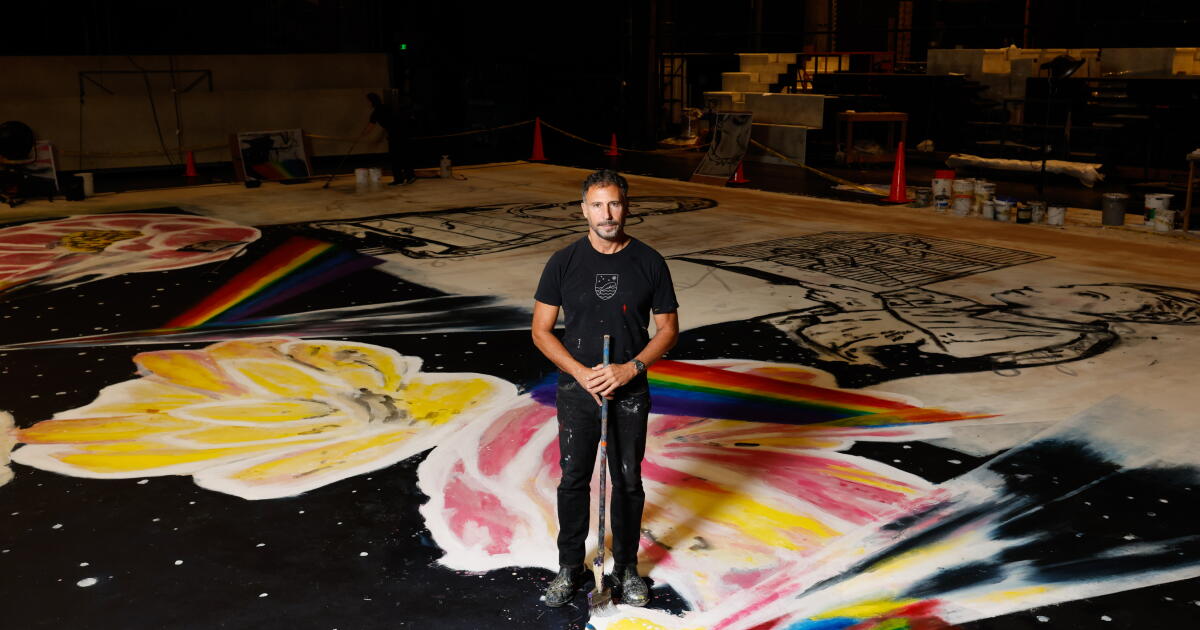
Another world is depicted beneath the children — one that won’t be seen until four minutes before conductor Domingo Hindoyan raises his baton and the curtain begins to rise. Its unfurling will reveal an image of the cosmos overlain with blooming flowers and splintered prisms emanating rainbows.
Artist Enrique Martínez Celaya was commissioned to create a unique piece of art as the new curtain for the L.A. Opera at the Dorothy Chandler Pavilion.
(Carlin Stiehl / For The Times)
“It’s this containment here that then just breaks apart and opens up,” said Martínez Celaya. “What you’re going to have here is actually a performative aspect to the work. But as it moves up, you try to hold on to that which is disappearing, and you cannot have both of these things at once. So that trade-off makes the movement of the curtain fundamental to the experience.”
A discussion about collaborating on a project between Martínez Celaya and L.A. Opera Chief Executive Christopher Koelsch began about 10 years ago, after Koelsch first encountered Martínez Celaya’s work at an L.A. Louver fundraiser.
“It was very clear from that conversation that this was someone who had thought pretty deeply about music, but also about how to translate that through art in public spaces,” Koelsch said of their early conversations.
On a longtime quest to democratize opera, Koelsch invited Martínez Celaya to the Chandler for a walk-through. “The idea of a really big public art project, and using the theater itself as the gallery/canvas, has been one that I’ve had forever,” Koelsch said. “I’ve been trying for many years to figure out a way to triangulate the commercial interests of the for-profit world and the nonprofit world by inviting artists into a regular dialogue with the company.”
Koelsch provided no real parameters for Martínez Celaya, stipulating only that he wanted a “radically large-scale painting.” The point was to come up with something that was emblematic of the city, a piece that would reflect L.A.’s wellspring of creativity in the contemporary art world.
“All we wanted is that it wasn’t tied to any opera, to any imagery for any opera, but would just be an artwork that will stand by itself,” Martínez Celaya said. “And other than that, [L.A. Opera was] incredibly generous and open.”
The top half of the composition, which is related to Martínez Celaya’s family history, has been shown in small scale at the National Museum of Fine Arts in his native Cuba. The image speaks to a period when his family was headed from Havana to exile in Spain. The girl is his daughter Natalia, and the birds reference his grandfather who kept a collection as pets in cages.

A detail of Martínez Celaya’s new curtain for the L.A. Opera. The little boy is based on his grandfather.
(Carlin Stiehl / For The Times)
At age 12, Martínez Celaya entered into an apprenticeship with a painter — the start of his formal artistic training — and around the same time he began cultivating an interest in writing and philosophy. He earned a degree in applied physics with a minor in electrical engineering from Cornell University, followed by a master’s degree in quantum electronics from UC Berkeley. On his way to a PhD, he changed course and turned to art, completing a master of fine arts degree at UC Santa Barbara. Today he serves as provost professor of humanities and arts at USC.
Rather than print the image on the curtain, Martínez Celaya and his team spent the past few weeks hand-painting it on canvaslike fabric on the floor of the stage. The original studio canvas was painted in oil, but the curtain is painted in acrylic and water-based paint. Variations from one medium to the other is a part of the process, and Martínez Celaya said he finds both thrilling and challenging.
The new curtain is not the artist’s first brush with classical music. In 2004, he created a sculptural installation for the Berlin Philharmonic called “Schneebett” (Snow Bed), a somber, multilayered environment inspired by the final days of Ludwig van Beethoven in Vienna in 1827. A metal bed with a refrigeration system that maintained a continuous layer of frost over its surface was placed at its center. It also included writings and a large painting of a forest made with tar, oil and feathers. The piece is now in the collection of Pérez Art Museum Miami.
“The opportunity of having dozens of people trapped in a room, having to engage with something, is a very different experience than people walking by it in a museum for seven seconds,” Martínez Celaya said, explaining the genesis of the new curtain. “Most people come there not for the curtain but for what’s behind it. So how do you create a situation where this becomes an end in itself?”

A view of the stage at Dorothy Chandler Pavilion while artist Enrique Martínez Celaya works on painting a new curtain he is creating for the L.A. Opera.
(Carlin Stiehl / For The Times)
Martínez Celaya began the process simply enough: He put pen to paper in order to organize his thoughts, and began asking broad questions like what is a stage, what are people doing here, what is Los Angeles, and what do people anticipate, are they bored, are they talking?
“All these kinds of things were in my head before I started working. For me, this had to be an investigation,” he said, noting that it was at least six weeks before he even began to draw. Initial images included a silhouetted figure overseeing scattered human limbs, with the bottom portion of the composition awash in sea foam. The next iteration replaced the sea foam with prismatic and floral elements.
L.A. Opera originally planned to carefully cut the curtain into pieces at the end of the season and sell off sections in order to raise funds, but that idea is in flux.
“I do want to figure out a way to preserve legible chunks of it in some form or other,” said Koelsch, who hopes to commission a new curtain for the 2027-28 season. “Frankly, after all of that labor and investment, I do think that we are incentivized to try to preserve portions of it. The fact that it has happened will open new opportunities for this to happen again in the future.”

When the curtain rises on L.A. Opera’s new season at Dorothy Chandler Pavilion later this month, it won’t feature the usual starburst pattern that has greeted fans for the last 63 years. That curtain has been swapped out for something entirely new: a design titled “The Things We Know,” featuring a pensive-looking boy and girl beneath a halo of light. The boy holds a caged bird; the girl, a fish tank. Both are outlined in black on an off-white background.
The 70-foot-wide curtain painstakingly created by L.A. artist Enrique Martínez Celaya is a surprising choice for a major opera house where one would expect a pattern or imagery related to storytelling. A bold and offbeat move, it draws upon notions of art and its place in the human psyche.
“I wanted an image that would not be related to any opera,” Martínez Celaya said during a preview of the curtain when it was still a work in progress. “I’m interested in both the coming-of-age aspect of these children and also the containment of these birds and these fish, and the children in relation to that containment.”
Martínez Celaya added that he is particularly intrigued with the gray zone where “childhood ceases to be, and adulthood hasn’t come yet.”
Another world is depicted beneath the children — one that won’t be seen until four minutes before conductor Domingo Hindoyan raises his baton and the curtain begins to rise. Its unfurling will reveal an image of the cosmos overlain with blooming flowers and splintered prisms emanating rainbows.
Artist Enrique Martínez Celaya was commissioned to create a unique piece of art as the new curtain for the L.A. Opera at the Dorothy Chandler Pavilion.
(Carlin Stiehl / For The Times)
“It’s this containment here that then just breaks apart and opens up,” said Martínez Celaya. “What you’re going to have here is actually a performative aspect to the work. But as it moves up, you try to hold on to that which is disappearing, and you cannot have both of these things at once. So that trade-off makes the movement of the curtain fundamental to the experience.”
A discussion about collaborating on a project between Martínez Celaya and L.A. Opera Chief Executive Christopher Koelsch began about 10 years ago, after Koelsch first encountered Martínez Celaya’s work at an L.A. Louver fundraiser.
“It was very clear from that conversation that this was someone who had thought pretty deeply about music, but also about how to translate that through art in public spaces,” Koelsch said of their early conversations.
On a longtime quest to democratize opera, Koelsch invited Martínez Celaya to the Chandler for a walk-through. “The idea of a really big public art project, and using the theater itself as the gallery/canvas, has been one that I’ve had forever,” Koelsch said. “I’ve been trying for many years to figure out a way to triangulate the commercial interests of the for-profit world and the nonprofit world by inviting artists into a regular dialogue with the company.”
Koelsch provided no real parameters for Martínez Celaya, stipulating only that he wanted a “radically large-scale painting.” The point was to come up with something that was emblematic of the city, a piece that would reflect L.A.’s wellspring of creativity in the contemporary art world.
“All we wanted is that it wasn’t tied to any opera, to any imagery for any opera, but would just be an artwork that will stand by itself,” Martínez Celaya said. “And other than that, [L.A. Opera was] incredibly generous and open.”
The top half of the composition, which is related to Martínez Celaya’s family history, has been shown in small scale at the National Museum of Fine Arts in his native Cuba. The image speaks to a period when his family was headed from Havana to exile in Spain. The girl is his daughter Natalia, and the birds reference his grandfather who kept a collection as pets in cages.
A detail of Martínez Celaya’s new curtain for the L.A. Opera. The little boy is based on his grandfather.
(Carlin Stiehl / For The Times)
At age 12, Martínez Celaya entered into an apprenticeship with a painter — the start of his formal artistic training — and around the same time he began cultivating an interest in writing and philosophy. He earned a degree in applied physics with a minor in electrical engineering from Cornell University, followed by a master’s degree in quantum electronics from UC Berkeley. On his way to a PhD, he changed course and turned to art, completing a master of fine arts degree at UC Santa Barbara. Today he serves as provost professor of humanities and arts at USC.
Rather than print the image on the curtain, Martínez Celaya and his team spent the past few weeks hand-painting it on canvaslike fabric on the floor of the stage. The original studio canvas was painted in oil, but the curtain is painted in acrylic and water-based paint. Variations from one medium to the other is a part of the process, and Martínez Celaya said he finds both thrilling and challenging.
The new curtain is not the artist’s first brush with classical music. In 2004, he created a sculptural installation for the Berlin Philharmonic called “Schneebett” (Snow Bed), a somber, multilayered environment inspired by the final days of Ludwig van Beethoven in Vienna in 1827. A metal bed with a refrigeration system that maintained a continuous layer of frost over its surface was placed at its center. It also included writings and a large painting of a forest made with tar, oil and feathers. The piece is now in the collection of Pérez Art Museum Miami.
“The opportunity of having dozens of people trapped in a room, having to engage with something, is a very different experience than people walking by it in a museum for seven seconds,” Martínez Celaya said, explaining the genesis of the new curtain. “Most people come there not for the curtain but for what’s behind it. So how do you create a situation where this becomes an end in itself?”
A view of the stage at Dorothy Chandler Pavilion while artist Enrique Martínez Celaya works on painting a new curtain he is creating for the L.A. Opera.
(Carlin Stiehl / For The Times)
Martínez Celaya began the process simply enough: He put pen to paper in order to organize his thoughts, and began asking broad questions like what is a stage, what are people doing here, what is Los Angeles, and what do people anticipate, are they bored, are they talking?
“All these kinds of things were in my head before I started working. For me, this had to be an investigation,” he said, noting that it was at least six weeks before he even began to draw. Initial images included a silhouetted figure overseeing scattered human limbs, with the bottom portion of the composition awash in sea foam. The next iteration replaced the sea foam with prismatic and floral elements.
L.A. Opera originally planned to carefully cut the curtain into pieces at the end of the season and sell off sections in order to raise funds, but that idea is in flux.
“I do want to figure out a way to preserve legible chunks of it in some form or other,” said Koelsch, who hopes to commission a new curtain for the 2027-28 season. “Frankly, after all of that labor and investment, I do think that we are incentivized to try to preserve portions of it. The fact that it has happened will open new opportunities for this to happen again in the future.”

When the curtain rises on L.A. Opera’s new season at Dorothy Chandler Pavilion later this month, it won’t feature the usual starburst pattern that has greeted fans for the last 63 years. That curtain has been swapped out for something entirely new: a design titled “The Things We Know,” featuring a pensive-looking boy and girl beneath a halo of light. The boy holds a caged bird; the girl, a fish tank. Both are outlined in black on an off-white background.
The 70-foot-wide curtain painstakingly created by L.A. artist Enrique Martínez Celaya is a surprising choice for a major opera house where one would expect a pattern or imagery related to storytelling. A bold and offbeat move, it draws upon notions of art and its place in the human psyche.
“I wanted an image that would not be related to any opera,” Martínez Celaya said during a preview of the curtain when it was still a work in progress. “I’m interested in both the coming-of-age aspect of these children and also the containment of these birds and these fish, and the children in relation to that containment.”
Martínez Celaya added that he is particularly intrigued with the gray zone where “childhood ceases to be, and adulthood hasn’t come yet.”
Another world is depicted beneath the children — one that won’t be seen until four minutes before conductor Domingo Hindoyan raises his baton and the curtain begins to rise. Its unfurling will reveal an image of the cosmos overlain with blooming flowers and splintered prisms emanating rainbows.
Artist Enrique Martínez Celaya was commissioned to create a unique piece of art as the new curtain for the L.A. Opera at the Dorothy Chandler Pavilion.
(Carlin Stiehl / For The Times)
“It’s this containment here that then just breaks apart and opens up,” said Martínez Celaya. “What you’re going to have here is actually a performative aspect to the work. But as it moves up, you try to hold on to that which is disappearing, and you cannot have both of these things at once. So that trade-off makes the movement of the curtain fundamental to the experience.”
A discussion about collaborating on a project between Martínez Celaya and L.A. Opera Chief Executive Christopher Koelsch began about 10 years ago, after Koelsch first encountered Martínez Celaya’s work at an L.A. Louver fundraiser.
“It was very clear from that conversation that this was someone who had thought pretty deeply about music, but also about how to translate that through art in public spaces,” Koelsch said of their early conversations.
On a longtime quest to democratize opera, Koelsch invited Martínez Celaya to the Chandler for a walk-through. “The idea of a really big public art project, and using the theater itself as the gallery/canvas, has been one that I’ve had forever,” Koelsch said. “I’ve been trying for many years to figure out a way to triangulate the commercial interests of the for-profit world and the nonprofit world by inviting artists into a regular dialogue with the company.”
Koelsch provided no real parameters for Martínez Celaya, stipulating only that he wanted a “radically large-scale painting.” The point was to come up with something that was emblematic of the city, a piece that would reflect L.A.’s wellspring of creativity in the contemporary art world.
“All we wanted is that it wasn’t tied to any opera, to any imagery for any opera, but would just be an artwork that will stand by itself,” Martínez Celaya said. “And other than that, [L.A. Opera was] incredibly generous and open.”
The top half of the composition, which is related to Martínez Celaya’s family history, has been shown in small scale at the National Museum of Fine Arts in his native Cuba. The image speaks to a period when his family was headed from Havana to exile in Spain. The girl is his daughter Natalia, and the birds reference his grandfather who kept a collection as pets in cages.
A detail of Martínez Celaya’s new curtain for the L.A. Opera. The little boy is based on his grandfather.
(Carlin Stiehl / For The Times)
At age 12, Martínez Celaya entered into an apprenticeship with a painter — the start of his formal artistic training — and around the same time he began cultivating an interest in writing and philosophy. He earned a degree in applied physics with a minor in electrical engineering from Cornell University, followed by a master’s degree in quantum electronics from UC Berkeley. On his way to a PhD, he changed course and turned to art, completing a master of fine arts degree at UC Santa Barbara. Today he serves as provost professor of humanities and arts at USC.
Rather than print the image on the curtain, Martínez Celaya and his team spent the past few weeks hand-painting it on canvaslike fabric on the floor of the stage. The original studio canvas was painted in oil, but the curtain is painted in acrylic and water-based paint. Variations from one medium to the other is a part of the process, and Martínez Celaya said he finds both thrilling and challenging.
The new curtain is not the artist’s first brush with classical music. In 2004, he created a sculptural installation for the Berlin Philharmonic called “Schneebett” (Snow Bed), a somber, multilayered environment inspired by the final days of Ludwig van Beethoven in Vienna in 1827. A metal bed with a refrigeration system that maintained a continuous layer of frost over its surface was placed at its center. It also included writings and a large painting of a forest made with tar, oil and feathers. The piece is now in the collection of Pérez Art Museum Miami.
“The opportunity of having dozens of people trapped in a room, having to engage with something, is a very different experience than people walking by it in a museum for seven seconds,” Martínez Celaya said, explaining the genesis of the new curtain. “Most people come there not for the curtain but for what’s behind it. So how do you create a situation where this becomes an end in itself?”
A view of the stage at Dorothy Chandler Pavilion while artist Enrique Martínez Celaya works on painting a new curtain he is creating for the L.A. Opera.
(Carlin Stiehl / For The Times)
Martínez Celaya began the process simply enough: He put pen to paper in order to organize his thoughts, and began asking broad questions like what is a stage, what are people doing here, what is Los Angeles, and what do people anticipate, are they bored, are they talking?
“All these kinds of things were in my head before I started working. For me, this had to be an investigation,” he said, noting that it was at least six weeks before he even began to draw. Initial images included a silhouetted figure overseeing scattered human limbs, with the bottom portion of the composition awash in sea foam. The next iteration replaced the sea foam with prismatic and floral elements.
L.A. Opera originally planned to carefully cut the curtain into pieces at the end of the season and sell off sections in order to raise funds, but that idea is in flux.
“I do want to figure out a way to preserve legible chunks of it in some form or other,” said Koelsch, who hopes to commission a new curtain for the 2027-28 season. “Frankly, after all of that labor and investment, I do think that we are incentivized to try to preserve portions of it. The fact that it has happened will open new opportunities for this to happen again in the future.”
When the curtain rises on L.A. Opera’s new season at Dorothy Chandler Pavilion later this month, it won’t feature the usual starburst pattern that has greeted fans for the last 63 years. That curtain has been swapped out for something entirely new: a design titled “The Things We Know,” featuring a pensive-looking boy and girl beneath a halo of light. The boy holds a caged bird; the girl, a fish tank. Both are outlined in black on an off-white background.
The 70-foot-wide curtain painstakingly created by L.A. artist Enrique Martínez Celaya is a surprising choice for a major opera house where one would expect a pattern or imagery related to storytelling. A bold and offbeat move, it draws upon notions of art and its place in the human psyche.
“I wanted an image that would not be related to any opera,” Martínez Celaya said during a preview of the curtain when it was still a work in progress. “I’m interested in both the coming-of-age aspect of these children and also the containment of these birds and these fish, and the children in relation to that containment.”
Martínez Celaya added that he is particularly intrigued with the gray zone where “childhood ceases to be, and adulthood hasn’t come yet.”
Another world is depicted beneath the children — one that won’t be seen until four minutes before conductor Domingo Hindoyan raises his baton and the curtain begins to rise. Its unfurling will reveal an image of the cosmos overlain with blooming flowers and splintered prisms emanating rainbows.
Artist Enrique Martínez Celaya was commissioned to create a unique piece of art as the new curtain for the L.A. Opera at the Dorothy Chandler Pavilion.
(Carlin Stiehl / For The Times)
“It’s this containment here that then just breaks apart and opens up,” said Martínez Celaya. “What you’re going to have here is actually a performative aspect to the work. But as it moves up, you try to hold on to that which is disappearing, and you cannot have both of these things at once. So that trade-off makes the movement of the curtain fundamental to the experience.”
A discussion about collaborating on a project between Martínez Celaya and L.A. Opera Chief Executive Christopher Koelsch began about 10 years ago, after Koelsch first encountered Martínez Celaya’s work at an L.A. Louver fundraiser.
“It was very clear from that conversation that this was someone who had thought pretty deeply about music, but also about how to translate that through art in public spaces,” Koelsch said of their early conversations.
On a longtime quest to democratize opera, Koelsch invited Martínez Celaya to the Chandler for a walk-through. “The idea of a really big public art project, and using the theater itself as the gallery/canvas, has been one that I’ve had forever,” Koelsch said. “I’ve been trying for many years to figure out a way to triangulate the commercial interests of the for-profit world and the nonprofit world by inviting artists into a regular dialogue with the company.”
Koelsch provided no real parameters for Martínez Celaya, stipulating only that he wanted a “radically large-scale painting.” The point was to come up with something that was emblematic of the city, a piece that would reflect L.A.’s wellspring of creativity in the contemporary art world.
“All we wanted is that it wasn’t tied to any opera, to any imagery for any opera, but would just be an artwork that will stand by itself,” Martínez Celaya said. “And other than that, [L.A. Opera was] incredibly generous and open.”
The top half of the composition, which is related to Martínez Celaya’s family history, has been shown in small scale at the National Museum of Fine Arts in his native Cuba. The image speaks to a period when his family was headed from Havana to exile in Spain. The girl is his daughter Natalia, and the birds reference his grandfather who kept a collection as pets in cages.
A detail of Martínez Celaya’s new curtain for the L.A. Opera. The little boy is based on his grandfather.
(Carlin Stiehl / For The Times)
At age 12, Martínez Celaya entered into an apprenticeship with a painter — the start of his formal artistic training — and around the same time he began cultivating an interest in writing and philosophy. He earned a degree in applied physics with a minor in electrical engineering from Cornell University, followed by a master’s degree in quantum electronics from UC Berkeley. On his way to a PhD, he changed course and turned to art, completing a master of fine arts degree at UC Santa Barbara. Today he serves as provost professor of humanities and arts at USC.
Rather than print the image on the curtain, Martínez Celaya and his team spent the past few weeks hand-painting it on canvaslike fabric on the floor of the stage. The original studio canvas was painted in oil, but the curtain is painted in acrylic and water-based paint. Variations from one medium to the other is a part of the process, and Martínez Celaya said he finds both thrilling and challenging.
The new curtain is not the artist’s first brush with classical music. In 2004, he created a sculptural installation for the Berlin Philharmonic called “Schneebett” (Snow Bed), a somber, multilayered environment inspired by the final days of Ludwig van Beethoven in Vienna in 1827. A metal bed with a refrigeration system that maintained a continuous layer of frost over its surface was placed at its center. It also included writings and a large painting of a forest made with tar, oil and feathers. The piece is now in the collection of Pérez Art Museum Miami.
“The opportunity of having dozens of people trapped in a room, having to engage with something, is a very different experience than people walking by it in a museum for seven seconds,” Martínez Celaya said, explaining the genesis of the new curtain. “Most people come there not for the curtain but for what’s behind it. So how do you create a situation where this becomes an end in itself?”
A view of the stage at Dorothy Chandler Pavilion while artist Enrique Martínez Celaya works on painting a new curtain he is creating for the L.A. Opera.
(Carlin Stiehl / For The Times)
Martínez Celaya began the process simply enough: He put pen to paper in order to organize his thoughts, and began asking broad questions like what is a stage, what are people doing here, what is Los Angeles, and what do people anticipate, are they bored, are they talking?
“All these kinds of things were in my head before I started working. For me, this had to be an investigation,” he said, noting that it was at least six weeks before he even began to draw. Initial images included a silhouetted figure overseeing scattered human limbs, with the bottom portion of the composition awash in sea foam. The next iteration replaced the sea foam with prismatic and floral elements.
L.A. Opera originally planned to carefully cut the curtain into pieces at the end of the season and sell off sections in order to raise funds, but that idea is in flux.
“I do want to figure out a way to preserve legible chunks of it in some form or other,” said Koelsch, who hopes to commission a new curtain for the 2027-28 season. “Frankly, after all of that labor and investment, I do think that we are incentivized to try to preserve portions of it. The fact that it has happened will open new opportunities for this to happen again in the future.”

When the curtain rises on L.A. Opera’s new season at Dorothy Chandler Pavilion later this month, it won’t feature the usual starburst pattern that has greeted fans for the last 63 years. That curtain has been swapped out for something entirely new: a design titled “The Things We Know,” featuring a pensive-looking boy and girl beneath a halo of light. The boy holds a caged bird; the girl, a fish tank. Both are outlined in black on an off-white background.
The 70-foot-wide curtain painstakingly created by L.A. artist Enrique Martínez Celaya is a surprising choice for a major opera house where one would expect a pattern or imagery related to storytelling. A bold and offbeat move, it draws upon notions of art and its place in the human psyche.
“I wanted an image that would not be related to any opera,” Martínez Celaya said during a preview of the curtain when it was still a work in progress. “I’m interested in both the coming-of-age aspect of these children and also the containment of these birds and these fish, and the children in relation to that containment.”
Martínez Celaya added that he is particularly intrigued with the gray zone where “childhood ceases to be, and adulthood hasn’t come yet.”
Another world is depicted beneath the children — one that won’t be seen until four minutes before conductor Domingo Hindoyan raises his baton and the curtain begins to rise. Its unfurling will reveal an image of the cosmos overlain with blooming flowers and splintered prisms emanating rainbows.
Artist Enrique Martínez Celaya was commissioned to create a unique piece of art as the new curtain for the L.A. Opera at the Dorothy Chandler Pavilion.
(Carlin Stiehl / For The Times)
“It’s this containment here that then just breaks apart and opens up,” said Martínez Celaya. “What you’re going to have here is actually a performative aspect to the work. But as it moves up, you try to hold on to that which is disappearing, and you cannot have both of these things at once. So that trade-off makes the movement of the curtain fundamental to the experience.”
A discussion about collaborating on a project between Martínez Celaya and L.A. Opera Chief Executive Christopher Koelsch began about 10 years ago, after Koelsch first encountered Martínez Celaya’s work at an L.A. Louver fundraiser.
“It was very clear from that conversation that this was someone who had thought pretty deeply about music, but also about how to translate that through art in public spaces,” Koelsch said of their early conversations.
On a longtime quest to democratize opera, Koelsch invited Martínez Celaya to the Chandler for a walk-through. “The idea of a really big public art project, and using the theater itself as the gallery/canvas, has been one that I’ve had forever,” Koelsch said. “I’ve been trying for many years to figure out a way to triangulate the commercial interests of the for-profit world and the nonprofit world by inviting artists into a regular dialogue with the company.”
Koelsch provided no real parameters for Martínez Celaya, stipulating only that he wanted a “radically large-scale painting.” The point was to come up with something that was emblematic of the city, a piece that would reflect L.A.’s wellspring of creativity in the contemporary art world.
“All we wanted is that it wasn’t tied to any opera, to any imagery for any opera, but would just be an artwork that will stand by itself,” Martínez Celaya said. “And other than that, [L.A. Opera was] incredibly generous and open.”
The top half of the composition, which is related to Martínez Celaya’s family history, has been shown in small scale at the National Museum of Fine Arts in his native Cuba. The image speaks to a period when his family was headed from Havana to exile in Spain. The girl is his daughter Natalia, and the birds reference his grandfather who kept a collection as pets in cages.
A detail of Martínez Celaya’s new curtain for the L.A. Opera. The little boy is based on his grandfather.
(Carlin Stiehl / For The Times)
At age 12, Martínez Celaya entered into an apprenticeship with a painter — the start of his formal artistic training — and around the same time he began cultivating an interest in writing and philosophy. He earned a degree in applied physics with a minor in electrical engineering from Cornell University, followed by a master’s degree in quantum electronics from UC Berkeley. On his way to a PhD, he changed course and turned to art, completing a master of fine arts degree at UC Santa Barbara. Today he serves as provost professor of humanities and arts at USC.
Rather than print the image on the curtain, Martínez Celaya and his team spent the past few weeks hand-painting it on canvaslike fabric on the floor of the stage. The original studio canvas was painted in oil, but the curtain is painted in acrylic and water-based paint. Variations from one medium to the other is a part of the process, and Martínez Celaya said he finds both thrilling and challenging.
The new curtain is not the artist’s first brush with classical music. In 2004, he created a sculptural installation for the Berlin Philharmonic called “Schneebett” (Snow Bed), a somber, multilayered environment inspired by the final days of Ludwig van Beethoven in Vienna in 1827. A metal bed with a refrigeration system that maintained a continuous layer of frost over its surface was placed at its center. It also included writings and a large painting of a forest made with tar, oil and feathers. The piece is now in the collection of Pérez Art Museum Miami.
“The opportunity of having dozens of people trapped in a room, having to engage with something, is a very different experience than people walking by it in a museum for seven seconds,” Martínez Celaya said, explaining the genesis of the new curtain. “Most people come there not for the curtain but for what’s behind it. So how do you create a situation where this becomes an end in itself?”
A view of the stage at Dorothy Chandler Pavilion while artist Enrique Martínez Celaya works on painting a new curtain he is creating for the L.A. Opera.
(Carlin Stiehl / For The Times)
Martínez Celaya began the process simply enough: He put pen to paper in order to organize his thoughts, and began asking broad questions like what is a stage, what are people doing here, what is Los Angeles, and what do people anticipate, are they bored, are they talking?
“All these kinds of things were in my head before I started working. For me, this had to be an investigation,” he said, noting that it was at least six weeks before he even began to draw. Initial images included a silhouetted figure overseeing scattered human limbs, with the bottom portion of the composition awash in sea foam. The next iteration replaced the sea foam with prismatic and floral elements.
L.A. Opera originally planned to carefully cut the curtain into pieces at the end of the season and sell off sections in order to raise funds, but that idea is in flux.
“I do want to figure out a way to preserve legible chunks of it in some form or other,” said Koelsch, who hopes to commission a new curtain for the 2027-28 season. “Frankly, after all of that labor and investment, I do think that we are incentivized to try to preserve portions of it. The fact that it has happened will open new opportunities for this to happen again in the future.”
When the curtain rises on L.A. Opera’s new season at Dorothy Chandler Pavilion later this month, it won’t feature the usual starburst pattern that has greeted fans for the last 63 years. That curtain has been swapped out for something entirely new: a design titled “The Things We Know,” featuring a pensive-looking boy and girl beneath a halo of light. The boy holds a caged bird; the girl, a fish tank. Both are outlined in black on an off-white background.
The 70-foot-wide curtain painstakingly created by L.A. artist Enrique Martínez Celaya is a surprising choice for a major opera house where one would expect a pattern or imagery related to storytelling. A bold and offbeat move, it draws upon notions of art and its place in the human psyche.
“I wanted an image that would not be related to any opera,” Martínez Celaya said during a preview of the curtain when it was still a work in progress. “I’m interested in both the coming-of-age aspect of these children and also the containment of these birds and these fish, and the children in relation to that containment.”
Martínez Celaya added that he is particularly intrigued with the gray zone where “childhood ceases to be, and adulthood hasn’t come yet.”
Another world is depicted beneath the children — one that won’t be seen until four minutes before conductor Domingo Hindoyan raises his baton and the curtain begins to rise. Its unfurling will reveal an image of the cosmos overlain with blooming flowers and splintered prisms emanating rainbows.
Artist Enrique Martínez Celaya was commissioned to create a unique piece of art as the new curtain for the L.A. Opera at the Dorothy Chandler Pavilion.
(Carlin Stiehl / For The Times)
“It’s this containment here that then just breaks apart and opens up,” said Martínez Celaya. “What you’re going to have here is actually a performative aspect to the work. But as it moves up, you try to hold on to that which is disappearing, and you cannot have both of these things at once. So that trade-off makes the movement of the curtain fundamental to the experience.”
A discussion about collaborating on a project between Martínez Celaya and L.A. Opera Chief Executive Christopher Koelsch began about 10 years ago, after Koelsch first encountered Martínez Celaya’s work at an L.A. Louver fundraiser.
“It was very clear from that conversation that this was someone who had thought pretty deeply about music, but also about how to translate that through art in public spaces,” Koelsch said of their early conversations.
On a longtime quest to democratize opera, Koelsch invited Martínez Celaya to the Chandler for a walk-through. “The idea of a really big public art project, and using the theater itself as the gallery/canvas, has been one that I’ve had forever,” Koelsch said. “I’ve been trying for many years to figure out a way to triangulate the commercial interests of the for-profit world and the nonprofit world by inviting artists into a regular dialogue with the company.”
Koelsch provided no real parameters for Martínez Celaya, stipulating only that he wanted a “radically large-scale painting.” The point was to come up with something that was emblematic of the city, a piece that would reflect L.A.’s wellspring of creativity in the contemporary art world.
“All we wanted is that it wasn’t tied to any opera, to any imagery for any opera, but would just be an artwork that will stand by itself,” Martínez Celaya said. “And other than that, [L.A. Opera was] incredibly generous and open.”
The top half of the composition, which is related to Martínez Celaya’s family history, has been shown in small scale at the National Museum of Fine Arts in his native Cuba. The image speaks to a period when his family was headed from Havana to exile in Spain. The girl is his daughter Natalia, and the birds reference his grandfather who kept a collection as pets in cages.
A detail of Martínez Celaya’s new curtain for the L.A. Opera. The little boy is based on his grandfather.
(Carlin Stiehl / For The Times)
At age 12, Martínez Celaya entered into an apprenticeship with a painter — the start of his formal artistic training — and around the same time he began cultivating an interest in writing and philosophy. He earned a degree in applied physics with a minor in electrical engineering from Cornell University, followed by a master’s degree in quantum electronics from UC Berkeley. On his way to a PhD, he changed course and turned to art, completing a master of fine arts degree at UC Santa Barbara. Today he serves as provost professor of humanities and arts at USC.
Rather than print the image on the curtain, Martínez Celaya and his team spent the past few weeks hand-painting it on canvaslike fabric on the floor of the stage. The original studio canvas was painted in oil, but the curtain is painted in acrylic and water-based paint. Variations from one medium to the other is a part of the process, and Martínez Celaya said he finds both thrilling and challenging.
The new curtain is not the artist’s first brush with classical music. In 2004, he created a sculptural installation for the Berlin Philharmonic called “Schneebett” (Snow Bed), a somber, multilayered environment inspired by the final days of Ludwig van Beethoven in Vienna in 1827. A metal bed with a refrigeration system that maintained a continuous layer of frost over its surface was placed at its center. It also included writings and a large painting of a forest made with tar, oil and feathers. The piece is now in the collection of Pérez Art Museum Miami.
“The opportunity of having dozens of people trapped in a room, having to engage with something, is a very different experience than people walking by it in a museum for seven seconds,” Martínez Celaya said, explaining the genesis of the new curtain. “Most people come there not for the curtain but for what’s behind it. So how do you create a situation where this becomes an end in itself?”
A view of the stage at Dorothy Chandler Pavilion while artist Enrique Martínez Celaya works on painting a new curtain he is creating for the L.A. Opera.
(Carlin Stiehl / For The Times)
Martínez Celaya began the process simply enough: He put pen to paper in order to organize his thoughts, and began asking broad questions like what is a stage, what are people doing here, what is Los Angeles, and what do people anticipate, are they bored, are they talking?
“All these kinds of things were in my head before I started working. For me, this had to be an investigation,” he said, noting that it was at least six weeks before he even began to draw. Initial images included a silhouetted figure overseeing scattered human limbs, with the bottom portion of the composition awash in sea foam. The next iteration replaced the sea foam with prismatic and floral elements.
L.A. Opera originally planned to carefully cut the curtain into pieces at the end of the season and sell off sections in order to raise funds, but that idea is in flux.
“I do want to figure out a way to preserve legible chunks of it in some form or other,” said Koelsch, who hopes to commission a new curtain for the 2027-28 season. “Frankly, after all of that labor and investment, I do think that we are incentivized to try to preserve portions of it. The fact that it has happened will open new opportunities for this to happen again in the future.”
When the curtain rises on L.A. Opera’s new season at Dorothy Chandler Pavilion later this month, it won’t feature the usual starburst pattern that has greeted fans for the last 63 years. That curtain has been swapped out for something entirely new: a design titled “The Things We Know,” featuring a pensive-looking boy and girl beneath a halo of light. The boy holds a caged bird; the girl, a fish tank. Both are outlined in black on an off-white background.
The 70-foot-wide curtain painstakingly created by L.A. artist Enrique Martínez Celaya is a surprising choice for a major opera house where one would expect a pattern or imagery related to storytelling. A bold and offbeat move, it draws upon notions of art and its place in the human psyche.
“I wanted an image that would not be related to any opera,” Martínez Celaya said during a preview of the curtain when it was still a work in progress. “I’m interested in both the coming-of-age aspect of these children and also the containment of these birds and these fish, and the children in relation to that containment.”
Martínez Celaya added that he is particularly intrigued with the gray zone where “childhood ceases to be, and adulthood hasn’t come yet.”
Another world is depicted beneath the children — one that won’t be seen until four minutes before conductor Domingo Hindoyan raises his baton and the curtain begins to rise. Its unfurling will reveal an image of the cosmos overlain with blooming flowers and splintered prisms emanating rainbows.
Artist Enrique Martínez Celaya was commissioned to create a unique piece of art as the new curtain for the L.A. Opera at the Dorothy Chandler Pavilion.
(Carlin Stiehl / For The Times)
“It’s this containment here that then just breaks apart and opens up,” said Martínez Celaya. “What you’re going to have here is actually a performative aspect to the work. But as it moves up, you try to hold on to that which is disappearing, and you cannot have both of these things at once. So that trade-off makes the movement of the curtain fundamental to the experience.”
A discussion about collaborating on a project between Martínez Celaya and L.A. Opera Chief Executive Christopher Koelsch began about 10 years ago, after Koelsch first encountered Martínez Celaya’s work at an L.A. Louver fundraiser.
“It was very clear from that conversation that this was someone who had thought pretty deeply about music, but also about how to translate that through art in public spaces,” Koelsch said of their early conversations.
On a longtime quest to democratize opera, Koelsch invited Martínez Celaya to the Chandler for a walk-through. “The idea of a really big public art project, and using the theater itself as the gallery/canvas, has been one that I’ve had forever,” Koelsch said. “I’ve been trying for many years to figure out a way to triangulate the commercial interests of the for-profit world and the nonprofit world by inviting artists into a regular dialogue with the company.”
Koelsch provided no real parameters for Martínez Celaya, stipulating only that he wanted a “radically large-scale painting.” The point was to come up with something that was emblematic of the city, a piece that would reflect L.A.’s wellspring of creativity in the contemporary art world.
“All we wanted is that it wasn’t tied to any opera, to any imagery for any opera, but would just be an artwork that will stand by itself,” Martínez Celaya said. “And other than that, [L.A. Opera was] incredibly generous and open.”
The top half of the composition, which is related to Martínez Celaya’s family history, has been shown in small scale at the National Museum of Fine Arts in his native Cuba. The image speaks to a period when his family was headed from Havana to exile in Spain. The girl is his daughter Natalia, and the birds reference his grandfather who kept a collection as pets in cages.
A detail of Martínez Celaya’s new curtain for the L.A. Opera. The little boy is based on his grandfather.
(Carlin Stiehl / For The Times)
At age 12, Martínez Celaya entered into an apprenticeship with a painter — the start of his formal artistic training — and around the same time he began cultivating an interest in writing and philosophy. He earned a degree in applied physics with a minor in electrical engineering from Cornell University, followed by a master’s degree in quantum electronics from UC Berkeley. On his way to a PhD, he changed course and turned to art, completing a master of fine arts degree at UC Santa Barbara. Today he serves as provost professor of humanities and arts at USC.
Rather than print the image on the curtain, Martínez Celaya and his team spent the past few weeks hand-painting it on canvaslike fabric on the floor of the stage. The original studio canvas was painted in oil, but the curtain is painted in acrylic and water-based paint. Variations from one medium to the other is a part of the process, and Martínez Celaya said he finds both thrilling and challenging.
The new curtain is not the artist’s first brush with classical music. In 2004, he created a sculptural installation for the Berlin Philharmonic called “Schneebett” (Snow Bed), a somber, multilayered environment inspired by the final days of Ludwig van Beethoven in Vienna in 1827. A metal bed with a refrigeration system that maintained a continuous layer of frost over its surface was placed at its center. It also included writings and a large painting of a forest made with tar, oil and feathers. The piece is now in the collection of Pérez Art Museum Miami.
“The opportunity of having dozens of people trapped in a room, having to engage with something, is a very different experience than people walking by it in a museum for seven seconds,” Martínez Celaya said, explaining the genesis of the new curtain. “Most people come there not for the curtain but for what’s behind it. So how do you create a situation where this becomes an end in itself?”
A view of the stage at Dorothy Chandler Pavilion while artist Enrique Martínez Celaya works on painting a new curtain he is creating for the L.A. Opera.
(Carlin Stiehl / For The Times)
Martínez Celaya began the process simply enough: He put pen to paper in order to organize his thoughts, and began asking broad questions like what is a stage, what are people doing here, what is Los Angeles, and what do people anticipate, are they bored, are they talking?
“All these kinds of things were in my head before I started working. For me, this had to be an investigation,” he said, noting that it was at least six weeks before he even began to draw. Initial images included a silhouetted figure overseeing scattered human limbs, with the bottom portion of the composition awash in sea foam. The next iteration replaced the sea foam with prismatic and floral elements.
L.A. Opera originally planned to carefully cut the curtain into pieces at the end of the season and sell off sections in order to raise funds, but that idea is in flux.
“I do want to figure out a way to preserve legible chunks of it in some form or other,” said Koelsch, who hopes to commission a new curtain for the 2027-28 season. “Frankly, after all of that labor and investment, I do think that we are incentivized to try to preserve portions of it. The fact that it has happened will open new opportunities for this to happen again in the future.”
When the curtain rises on L.A. Opera’s new season at Dorothy Chandler Pavilion later this month, it won’t feature the usual starburst pattern that has greeted fans for the last 63 years. That curtain has been swapped out for something entirely new: a design titled “The Things We Know,” featuring a pensive-looking boy and girl beneath a halo of light. The boy holds a caged bird; the girl, a fish tank. Both are outlined in black on an off-white background.
The 70-foot-wide curtain painstakingly created by L.A. artist Enrique Martínez Celaya is a surprising choice for a major opera house where one would expect a pattern or imagery related to storytelling. A bold and offbeat move, it draws upon notions of art and its place in the human psyche.
“I wanted an image that would not be related to any opera,” Martínez Celaya said during a preview of the curtain when it was still a work in progress. “I’m interested in both the coming-of-age aspect of these children and also the containment of these birds and these fish, and the children in relation to that containment.”
Martínez Celaya added that he is particularly intrigued with the gray zone where “childhood ceases to be, and adulthood hasn’t come yet.”
Another world is depicted beneath the children — one that won’t be seen until four minutes before conductor Domingo Hindoyan raises his baton and the curtain begins to rise. Its unfurling will reveal an image of the cosmos overlain with blooming flowers and splintered prisms emanating rainbows.
Artist Enrique Martínez Celaya was commissioned to create a unique piece of art as the new curtain for the L.A. Opera at the Dorothy Chandler Pavilion.
(Carlin Stiehl / For The Times)
“It’s this containment here that then just breaks apart and opens up,” said Martínez Celaya. “What you’re going to have here is actually a performative aspect to the work. But as it moves up, you try to hold on to that which is disappearing, and you cannot have both of these things at once. So that trade-off makes the movement of the curtain fundamental to the experience.”
A discussion about collaborating on a project between Martínez Celaya and L.A. Opera Chief Executive Christopher Koelsch began about 10 years ago, after Koelsch first encountered Martínez Celaya’s work at an L.A. Louver fundraiser.
“It was very clear from that conversation that this was someone who had thought pretty deeply about music, but also about how to translate that through art in public spaces,” Koelsch said of their early conversations.
On a longtime quest to democratize opera, Koelsch invited Martínez Celaya to the Chandler for a walk-through. “The idea of a really big public art project, and using the theater itself as the gallery/canvas, has been one that I’ve had forever,” Koelsch said. “I’ve been trying for many years to figure out a way to triangulate the commercial interests of the for-profit world and the nonprofit world by inviting artists into a regular dialogue with the company.”
Koelsch provided no real parameters for Martínez Celaya, stipulating only that he wanted a “radically large-scale painting.” The point was to come up with something that was emblematic of the city, a piece that would reflect L.A.’s wellspring of creativity in the contemporary art world.
“All we wanted is that it wasn’t tied to any opera, to any imagery for any opera, but would just be an artwork that will stand by itself,” Martínez Celaya said. “And other than that, [L.A. Opera was] incredibly generous and open.”
The top half of the composition, which is related to Martínez Celaya’s family history, has been shown in small scale at the National Museum of Fine Arts in his native Cuba. The image speaks to a period when his family was headed from Havana to exile in Spain. The girl is his daughter Natalia, and the birds reference his grandfather who kept a collection as pets in cages.
A detail of Martínez Celaya’s new curtain for the L.A. Opera. The little boy is based on his grandfather.
(Carlin Stiehl / For The Times)
At age 12, Martínez Celaya entered into an apprenticeship with a painter — the start of his formal artistic training — and around the same time he began cultivating an interest in writing and philosophy. He earned a degree in applied physics with a minor in electrical engineering from Cornell University, followed by a master’s degree in quantum electronics from UC Berkeley. On his way to a PhD, he changed course and turned to art, completing a master of fine arts degree at UC Santa Barbara. Today he serves as provost professor of humanities and arts at USC.
Rather than print the image on the curtain, Martínez Celaya and his team spent the past few weeks hand-painting it on canvaslike fabric on the floor of the stage. The original studio canvas was painted in oil, but the curtain is painted in acrylic and water-based paint. Variations from one medium to the other is a part of the process, and Martínez Celaya said he finds both thrilling and challenging.
The new curtain is not the artist’s first brush with classical music. In 2004, he created a sculptural installation for the Berlin Philharmonic called “Schneebett” (Snow Bed), a somber, multilayered environment inspired by the final days of Ludwig van Beethoven in Vienna in 1827. A metal bed with a refrigeration system that maintained a continuous layer of frost over its surface was placed at its center. It also included writings and a large painting of a forest made with tar, oil and feathers. The piece is now in the collection of Pérez Art Museum Miami.
“The opportunity of having dozens of people trapped in a room, having to engage with something, is a very different experience than people walking by it in a museum for seven seconds,” Martínez Celaya said, explaining the genesis of the new curtain. “Most people come there not for the curtain but for what’s behind it. So how do you create a situation where this becomes an end in itself?”
A view of the stage at Dorothy Chandler Pavilion while artist Enrique Martínez Celaya works on painting a new curtain he is creating for the L.A. Opera.
(Carlin Stiehl / For The Times)
Martínez Celaya began the process simply enough: He put pen to paper in order to organize his thoughts, and began asking broad questions like what is a stage, what are people doing here, what is Los Angeles, and what do people anticipate, are they bored, are they talking?
“All these kinds of things were in my head before I started working. For me, this had to be an investigation,” he said, noting that it was at least six weeks before he even began to draw. Initial images included a silhouetted figure overseeing scattered human limbs, with the bottom portion of the composition awash in sea foam. The next iteration replaced the sea foam with prismatic and floral elements.
L.A. Opera originally planned to carefully cut the curtain into pieces at the end of the season and sell off sections in order to raise funds, but that idea is in flux.
“I do want to figure out a way to preserve legible chunks of it in some form or other,” said Koelsch, who hopes to commission a new curtain for the 2027-28 season. “Frankly, after all of that labor and investment, I do think that we are incentivized to try to preserve portions of it. The fact that it has happened will open new opportunities for this to happen again in the future.”