


“The Hawk,” a 10-episode series premiering Thursday on Netflix, is a golf comedy, a Will Ferrell comedy and, most to the point, a Will Ferrell golf comedy, following in the line of such sports-themed Ferrell films as “Blades of Glory,” “Talladega Nights: The Ballad of Ricky Bobby” and “Semi-Pro,” and, at a stretch, “Eurovision Song Contest: The Story of Fire Saga.” It has the advantage of concerning a sport the actor loves and plays, making it feel affectionate and informed, even as it creates its own silly world.
Ferrell plays Lonnie “The Hawk” Hawkins, whose career cratered in 2010 after he choked on the 18th hole at Pebble Beach, missing a three-foot putt “on the verge of a career Grand Slam.” Now, as his son Lance (Jimmy Tatro) is making a name for himself on the PGA circuit, Lonnie is working on the minor league Korn Ferry Tour, putting on a show with his longtime caddy and friend, Old Henry, played by Keith David, whose departure from the series after only eight minutes is a disappointment to me, as a card-carrying David fan, whenever I get around to printing those cards.
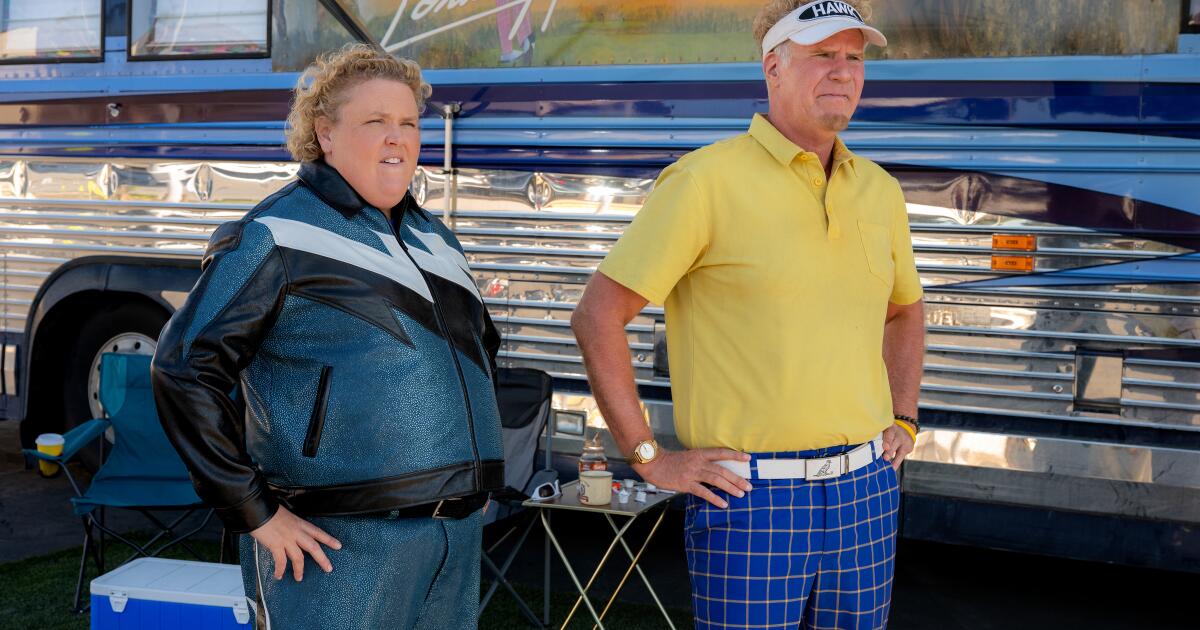
But it clears the way for Fortune Feimster’s Sam, who just happens to be fixing her car in a Walmart parking lot where Lonnie has parked his tour bus, to become Lonnie’s caddy. She knows nothing about golf, and can’t catch a golf club on the fly — one of Old Henry’s tricks — but she has the proper sense of fun and some good ideas.
Lonnie’s dream is to get back on the PGA tour and claim that elusive grand slam. (“You are a ball. I am a man,” he says to a golf ball he’s about to tee up. “Classic redemption story.”) It’s no spoiler to say he’ll make it back to the PGA, because there’s no show without it. Besides Lance, his rival there is the player he lost to in 2010, Golden Fisk, played by Luke Wilson, whose brother Owen starred in last year’s golf comedy, “Stick.” (Ferrell sometimes sounds like Owen here, oddly.)
Lance is engaged to Natalie (Katelyn Tarver), an aspiring wellness influencer, who polices his eating and drinking and conducts him in his “manifestations,” but happily they don’t play her as too much of a caricature. If this were a romantic comedy, she’d be the expendable Ralph Bellamy character, but all Lance really cares about is golf — unlike Lonnie, who mostly cares about golf, but spends the whole series trying to get closer to his son. He’s excited about the chance of their playing together. “We both can be great,” says Lonnie, comparing them to LeBron and Bronny James. “We’re not on the same team,” Lance, less excited, points out.
David Hornsby as Radford and Molly Shannon as Stacy, Lonnie’s not quite ex-wife.
(Colleen E. Hayes / Netflix)
Molly Shannon, Ferrell’s old “Saturday Night Live” castmate and “Superstar” co-star, plays Stacy, Lance’s overly doting mother and Lonnie’s not quite ex-wife. (He’s dragging his feet on the divorce; he’s still into her.) She’s looking for a company to distribute an alcoholic ice tea she calls Teed Off and is in a vaguely defined relationship with “traveling companion” Radford (David Hornsby), a genial, gentlemanly sort often seen reading a book (André Gide’s “The Immoralist,” E.M. Forster’s “Maurice”) meant to suggest he’s gay. (Not every viewer pays attention to book covers, but you’ll get the idea, anyway.) As with Natalie, or Golden, despite the name, he isn’t the caricature another series might make him. In fact, apart from Chris Parnell’s snobby board member, Anton, who hates Lonnie and his fans, whom he describes as “low-class, T-shirt wearing, beer-drinking idiots in their cut-off jeans and flip flops,” most every character is exhibits at least a suggestion of human decency.
A big galoot (though with good golf form), Ferrell again plays a sort of overgrown child. (“Elf” is his defining role). He executes some inspired business with a hand stuck in a pickle jar, and then mangled in a car door, a wound he dresses himself with Paw Patrol band-aids, electrical tape and newspaper. Lonnie’s narcissism is so jolly and inclusive — he assumes he’s a party everyone wants to attend — that it reads like a kind of innocence. (A scene in which he gives money to a poor family seems to exist only to demonstrate his generosity.)
Shannon, who is given a bounty of graphic dialogue detailing the violence she’ll wreak if someone does or does not do something, is a hurricane. And Feimster, whose journey this is as much as anyone’s, gets a part with lots of shades to play; she and Ferrell are the heart of the show; the health of their relationship matters more than who wins a golf game — a theme, certainly, of many a sports story.
It isn’t perfect. There are occasional problems with the mechanics of the plot; threads that trail off into nothing after coming from nowhere. Some scenes seem to contradict what we we’ve seen before, especially when it comes to Lance, who has a gambling problem that comes and goes depending on what the writers need him to do. Not everything aligns perfectly, and I found the climax wanting, even off-putting in some respects. Unlike an actual sporting event, of course, the outcome is engineered, which doesn’t make the golf scenes less suspenseful or exciting for the viewer.
Created by Ferrell with Harper Steele (who wrote at “SNL” when Ferrell acted there and is his co-star in the 2024 documentary “Will & Harper”) and frequent Ferrell collaborator Chris Henchy, “The Hawk” is sentimental and juvenile — that isn’t a criticism — its pee and poo and erection jokes delivered with great vigor. There are, of course, the sort of improvised passages that have left their mark on a quarter-century of film comedy, so that now and again a scene spins into irrelevance, as if life were just a series of skits — and maybe it is — but this does tend to be funny and what we come for, after all.

“The Hawk,” a 10-episode series premiering Thursday on Netflix, is a golf comedy, a Will Ferrell comedy and, most to the point, a Will Ferrell golf comedy, following in the line of such sports-themed Ferrell films as “Blades of Glory,” “Talladega Nights: The Ballad of Ricky Bobby” and “Semi-Pro,” and, at a stretch, “Eurovision Song Contest: The Story of Fire Saga.” It has the advantage of concerning a sport the actor loves and plays, making it feel affectionate and informed, even as it creates its own silly world.
Ferrell plays Lonnie “The Hawk” Hawkins, whose career cratered in 2010 after he choked on the 18th hole at Pebble Beach, missing a three-foot putt “on the verge of a career Grand Slam.” Now, as his son Lance (Jimmy Tatro) is making a name for himself on the PGA circuit, Lonnie is working on the minor league Korn Ferry Tour, putting on a show with his longtime caddy and friend, Old Henry, played by Keith David, whose departure from the series after only eight minutes is a disappointment to me, as a card-carrying David fan, whenever I get around to printing those cards.
But it clears the way for Fortune Feimster’s Sam, who just happens to be fixing her car in a Walmart parking lot where Lonnie has parked his tour bus, to become Lonnie’s caddy. She knows nothing about golf, and can’t catch a golf club on the fly — one of Old Henry’s tricks — but she has the proper sense of fun and some good ideas.
Lonnie’s dream is to get back on the PGA tour and claim that elusive grand slam. (“You are a ball. I am a man,” he says to a golf ball he’s about to tee up. “Classic redemption story.”) It’s no spoiler to say he’ll make it back to the PGA, because there’s no show without it. Besides Lance, his rival there is the player he lost to in 2010, Golden Fisk, played by Luke Wilson, whose brother Owen starred in last year’s golf comedy, “Stick.” (Ferrell sometimes sounds like Owen here, oddly.)
Lance is engaged to Natalie (Katelyn Tarver), an aspiring wellness influencer, who polices his eating and drinking and conducts him in his “manifestations,” but happily they don’t play her as too much of a caricature. If this were a romantic comedy, she’d be the expendable Ralph Bellamy character, but all Lance really cares about is golf — unlike Lonnie, who mostly cares about golf, but spends the whole series trying to get closer to his son. He’s excited about the chance of their playing together. “We both can be great,” says Lonnie, comparing them to LeBron and Bronny James. “We’re not on the same team,” Lance, less excited, points out.
David Hornsby as Radford and Molly Shannon as Stacy, Lonnie’s not quite ex-wife.
(Colleen E. Hayes / Netflix)
Molly Shannon, Ferrell’s old “Saturday Night Live” castmate and “Superstar” co-star, plays Stacy, Lance’s overly doting mother and Lonnie’s not quite ex-wife. (He’s dragging his feet on the divorce; he’s still into her.) She’s looking for a company to distribute an alcoholic ice tea she calls Teed Off and is in a vaguely defined relationship with “traveling companion” Radford (David Hornsby), a genial, gentlemanly sort often seen reading a book (André Gide’s “The Immoralist,” E.M. Forster’s “Maurice”) meant to suggest he’s gay. (Not every viewer pays attention to book covers, but you’ll get the idea, anyway.) As with Natalie, or Golden, despite the name, he isn’t the caricature another series might make him. In fact, apart from Chris Parnell’s snobby board member, Anton, who hates Lonnie and his fans, whom he describes as “low-class, T-shirt wearing, beer-drinking idiots in their cut-off jeans and flip flops,” most every character is exhibits at least a suggestion of human decency.
A big galoot (though with good golf form), Ferrell again plays a sort of overgrown child. (“Elf” is his defining role). He executes some inspired business with a hand stuck in a pickle jar, and then mangled in a car door, a wound he dresses himself with Paw Patrol band-aids, electrical tape and newspaper. Lonnie’s narcissism is so jolly and inclusive — he assumes he’s a party everyone wants to attend — that it reads like a kind of innocence. (A scene in which he gives money to a poor family seems to exist only to demonstrate his generosity.)
Shannon, who is given a bounty of graphic dialogue detailing the violence she’ll wreak if someone does or does not do something, is a hurricane. And Feimster, whose journey this is as much as anyone’s, gets a part with lots of shades to play; she and Ferrell are the heart of the show; the health of their relationship matters more than who wins a golf game — a theme, certainly, of many a sports story.
It isn’t perfect. There are occasional problems with the mechanics of the plot; threads that trail off into nothing after coming from nowhere. Some scenes seem to contradict what we we’ve seen before, especially when it comes to Lance, who has a gambling problem that comes and goes depending on what the writers need him to do. Not everything aligns perfectly, and I found the climax wanting, even off-putting in some respects. Unlike an actual sporting event, of course, the outcome is engineered, which doesn’t make the golf scenes less suspenseful or exciting for the viewer.
Created by Ferrell with Harper Steele (who wrote at “SNL” when Ferrell acted there and is his co-star in the 2024 documentary “Will & Harper”) and frequent Ferrell collaborator Chris Henchy, “The Hawk” is sentimental and juvenile — that isn’t a criticism — its pee and poo and erection jokes delivered with great vigor. There are, of course, the sort of improvised passages that have left their mark on a quarter-century of film comedy, so that now and again a scene spins into irrelevance, as if life were just a series of skits — and maybe it is — but this does tend to be funny and what we come for, after all.

“The Hawk,” a 10-episode series premiering Thursday on Netflix, is a golf comedy, a Will Ferrell comedy and, most to the point, a Will Ferrell golf comedy, following in the line of such sports-themed Ferrell films as “Blades of Glory,” “Talladega Nights: The Ballad of Ricky Bobby” and “Semi-Pro,” and, at a stretch, “Eurovision Song Contest: The Story of Fire Saga.” It has the advantage of concerning a sport the actor loves and plays, making it feel affectionate and informed, even as it creates its own silly world.
Ferrell plays Lonnie “The Hawk” Hawkins, whose career cratered in 2010 after he choked on the 18th hole at Pebble Beach, missing a three-foot putt “on the verge of a career Grand Slam.” Now, as his son Lance (Jimmy Tatro) is making a name for himself on the PGA circuit, Lonnie is working on the minor league Korn Ferry Tour, putting on a show with his longtime caddy and friend, Old Henry, played by Keith David, whose departure from the series after only eight minutes is a disappointment to me, as a card-carrying David fan, whenever I get around to printing those cards.
But it clears the way for Fortune Feimster’s Sam, who just happens to be fixing her car in a Walmart parking lot where Lonnie has parked his tour bus, to become Lonnie’s caddy. She knows nothing about golf, and can’t catch a golf club on the fly — one of Old Henry’s tricks — but she has the proper sense of fun and some good ideas.
Lonnie’s dream is to get back on the PGA tour and claim that elusive grand slam. (“You are a ball. I am a man,” he says to a golf ball he’s about to tee up. “Classic redemption story.”) It’s no spoiler to say he’ll make it back to the PGA, because there’s no show without it. Besides Lance, his rival there is the player he lost to in 2010, Golden Fisk, played by Luke Wilson, whose brother Owen starred in last year’s golf comedy, “Stick.” (Ferrell sometimes sounds like Owen here, oddly.)
Lance is engaged to Natalie (Katelyn Tarver), an aspiring wellness influencer, who polices his eating and drinking and conducts him in his “manifestations,” but happily they don’t play her as too much of a caricature. If this were a romantic comedy, she’d be the expendable Ralph Bellamy character, but all Lance really cares about is golf — unlike Lonnie, who mostly cares about golf, but spends the whole series trying to get closer to his son. He’s excited about the chance of their playing together. “We both can be great,” says Lonnie, comparing them to LeBron and Bronny James. “We’re not on the same team,” Lance, less excited, points out.
David Hornsby as Radford and Molly Shannon as Stacy, Lonnie’s not quite ex-wife.
(Colleen E. Hayes / Netflix)
Molly Shannon, Ferrell’s old “Saturday Night Live” castmate and “Superstar” co-star, plays Stacy, Lance’s overly doting mother and Lonnie’s not quite ex-wife. (He’s dragging his feet on the divorce; he’s still into her.) She’s looking for a company to distribute an alcoholic ice tea she calls Teed Off and is in a vaguely defined relationship with “traveling companion” Radford (David Hornsby), a genial, gentlemanly sort often seen reading a book (André Gide’s “The Immoralist,” E.M. Forster’s “Maurice”) meant to suggest he’s gay. (Not every viewer pays attention to book covers, but you’ll get the idea, anyway.) As with Natalie, or Golden, despite the name, he isn’t the caricature another series might make him. In fact, apart from Chris Parnell’s snobby board member, Anton, who hates Lonnie and his fans, whom he describes as “low-class, T-shirt wearing, beer-drinking idiots in their cut-off jeans and flip flops,” most every character is exhibits at least a suggestion of human decency.
A big galoot (though with good golf form), Ferrell again plays a sort of overgrown child. (“Elf” is his defining role). He executes some inspired business with a hand stuck in a pickle jar, and then mangled in a car door, a wound he dresses himself with Paw Patrol band-aids, electrical tape and newspaper. Lonnie’s narcissism is so jolly and inclusive — he assumes he’s a party everyone wants to attend — that it reads like a kind of innocence. (A scene in which he gives money to a poor family seems to exist only to demonstrate his generosity.)
Shannon, who is given a bounty of graphic dialogue detailing the violence she’ll wreak if someone does or does not do something, is a hurricane. And Feimster, whose journey this is as much as anyone’s, gets a part with lots of shades to play; she and Ferrell are the heart of the show; the health of their relationship matters more than who wins a golf game — a theme, certainly, of many a sports story.
It isn’t perfect. There are occasional problems with the mechanics of the plot; threads that trail off into nothing after coming from nowhere. Some scenes seem to contradict what we we’ve seen before, especially when it comes to Lance, who has a gambling problem that comes and goes depending on what the writers need him to do. Not everything aligns perfectly, and I found the climax wanting, even off-putting in some respects. Unlike an actual sporting event, of course, the outcome is engineered, which doesn’t make the golf scenes less suspenseful or exciting for the viewer.
Created by Ferrell with Harper Steele (who wrote at “SNL” when Ferrell acted there and is his co-star in the 2024 documentary “Will & Harper”) and frequent Ferrell collaborator Chris Henchy, “The Hawk” is sentimental and juvenile — that isn’t a criticism — its pee and poo and erection jokes delivered with great vigor. There are, of course, the sort of improvised passages that have left their mark on a quarter-century of film comedy, so that now and again a scene spins into irrelevance, as if life were just a series of skits — and maybe it is — but this does tend to be funny and what we come for, after all.
“The Hawk,” a 10-episode series premiering Thursday on Netflix, is a golf comedy, a Will Ferrell comedy and, most to the point, a Will Ferrell golf comedy, following in the line of such sports-themed Ferrell films as “Blades of Glory,” “Talladega Nights: The Ballad of Ricky Bobby” and “Semi-Pro,” and, at a stretch, “Eurovision Song Contest: The Story of Fire Saga.” It has the advantage of concerning a sport the actor loves and plays, making it feel affectionate and informed, even as it creates its own silly world.
Ferrell plays Lonnie “The Hawk” Hawkins, whose career cratered in 2010 after he choked on the 18th hole at Pebble Beach, missing a three-foot putt “on the verge of a career Grand Slam.” Now, as his son Lance (Jimmy Tatro) is making a name for himself on the PGA circuit, Lonnie is working on the minor league Korn Ferry Tour, putting on a show with his longtime caddy and friend, Old Henry, played by Keith David, whose departure from the series after only eight minutes is a disappointment to me, as a card-carrying David fan, whenever I get around to printing those cards.
But it clears the way for Fortune Feimster’s Sam, who just happens to be fixing her car in a Walmart parking lot where Lonnie has parked his tour bus, to become Lonnie’s caddy. She knows nothing about golf, and can’t catch a golf club on the fly — one of Old Henry’s tricks — but she has the proper sense of fun and some good ideas.
Lonnie’s dream is to get back on the PGA tour and claim that elusive grand slam. (“You are a ball. I am a man,” he says to a golf ball he’s about to tee up. “Classic redemption story.”) It’s no spoiler to say he’ll make it back to the PGA, because there’s no show without it. Besides Lance, his rival there is the player he lost to in 2010, Golden Fisk, played by Luke Wilson, whose brother Owen starred in last year’s golf comedy, “Stick.” (Ferrell sometimes sounds like Owen here, oddly.)
Lance is engaged to Natalie (Katelyn Tarver), an aspiring wellness influencer, who polices his eating and drinking and conducts him in his “manifestations,” but happily they don’t play her as too much of a caricature. If this were a romantic comedy, she’d be the expendable Ralph Bellamy character, but all Lance really cares about is golf — unlike Lonnie, who mostly cares about golf, but spends the whole series trying to get closer to his son. He’s excited about the chance of their playing together. “We both can be great,” says Lonnie, comparing them to LeBron and Bronny James. “We’re not on the same team,” Lance, less excited, points out.
David Hornsby as Radford and Molly Shannon as Stacy, Lonnie’s not quite ex-wife.
(Colleen E. Hayes / Netflix)
Molly Shannon, Ferrell’s old “Saturday Night Live” castmate and “Superstar” co-star, plays Stacy, Lance’s overly doting mother and Lonnie’s not quite ex-wife. (He’s dragging his feet on the divorce; he’s still into her.) She’s looking for a company to distribute an alcoholic ice tea she calls Teed Off and is in a vaguely defined relationship with “traveling companion” Radford (David Hornsby), a genial, gentlemanly sort often seen reading a book (André Gide’s “The Immoralist,” E.M. Forster’s “Maurice”) meant to suggest he’s gay. (Not every viewer pays attention to book covers, but you’ll get the idea, anyway.) As with Natalie, or Golden, despite the name, he isn’t the caricature another series might make him. In fact, apart from Chris Parnell’s snobby board member, Anton, who hates Lonnie and his fans, whom he describes as “low-class, T-shirt wearing, beer-drinking idiots in their cut-off jeans and flip flops,” most every character is exhibits at least a suggestion of human decency.
A big galoot (though with good golf form), Ferrell again plays a sort of overgrown child. (“Elf” is his defining role). He executes some inspired business with a hand stuck in a pickle jar, and then mangled in a car door, a wound he dresses himself with Paw Patrol band-aids, electrical tape and newspaper. Lonnie’s narcissism is so jolly and inclusive — he assumes he’s a party everyone wants to attend — that it reads like a kind of innocence. (A scene in which he gives money to a poor family seems to exist only to demonstrate his generosity.)
Shannon, who is given a bounty of graphic dialogue detailing the violence she’ll wreak if someone does or does not do something, is a hurricane. And Feimster, whose journey this is as much as anyone’s, gets a part with lots of shades to play; she and Ferrell are the heart of the show; the health of their relationship matters more than who wins a golf game — a theme, certainly, of many a sports story.
It isn’t perfect. There are occasional problems with the mechanics of the plot; threads that trail off into nothing after coming from nowhere. Some scenes seem to contradict what we we’ve seen before, especially when it comes to Lance, who has a gambling problem that comes and goes depending on what the writers need him to do. Not everything aligns perfectly, and I found the climax wanting, even off-putting in some respects. Unlike an actual sporting event, of course, the outcome is engineered, which doesn’t make the golf scenes less suspenseful or exciting for the viewer.
Created by Ferrell with Harper Steele (who wrote at “SNL” when Ferrell acted there and is his co-star in the 2024 documentary “Will & Harper”) and frequent Ferrell collaborator Chris Henchy, “The Hawk” is sentimental and juvenile — that isn’t a criticism — its pee and poo and erection jokes delivered with great vigor. There are, of course, the sort of improvised passages that have left their mark on a quarter-century of film comedy, so that now and again a scene spins into irrelevance, as if life were just a series of skits — and maybe it is — but this does tend to be funny and what we come for, after all.


