
If you were a TV show, nothing would be more certain to gain my attention than to be a French-made, French-language series about Zorro, the masked vigilante swordsman of old Los Angeles. Sword fighting plus cape plus Francophilia plus hometown pride equals yes, please.
Introduced in Johnston McCulley’s 1919 serialized novel, “The Curse of Capistrano” (with some 60 stories to follow), a kid of Californio Robin Hood cum Scarlet Pimpernel, the character jumped quickly to the screen in the 1920 “The Mark of Zorro,” with Douglas Fairbanks demonstrating his remarkable facility for parkour before anyone thought to call it that.
It was remade in 1940 with Tyrone Power; later, comic-book canon made it the film the family was leaving the night Bruce Wayne’s family was killed; in any case, there’s a whole lot of Zorro in Batman). Antonio Banderas played the character twice, in “The Mask of Zorro” (1998) and “The Legend of Zorro” (2005).
Most significant, in the late 1950s, it became the basis of a Disney-produced TV series, starring Guy Williams, who is Zorro, I’d imagine, to most people, here and abroad. It has had a long, international afterlife; you can watch it now on Disney+. (France has local history with the character, Alain Delon having played him in the 1975 “Zorro.”) It might not have been the most consistently exploited IP over the last century, but who doesn’t know Zorro? Hands? Just as I thought.
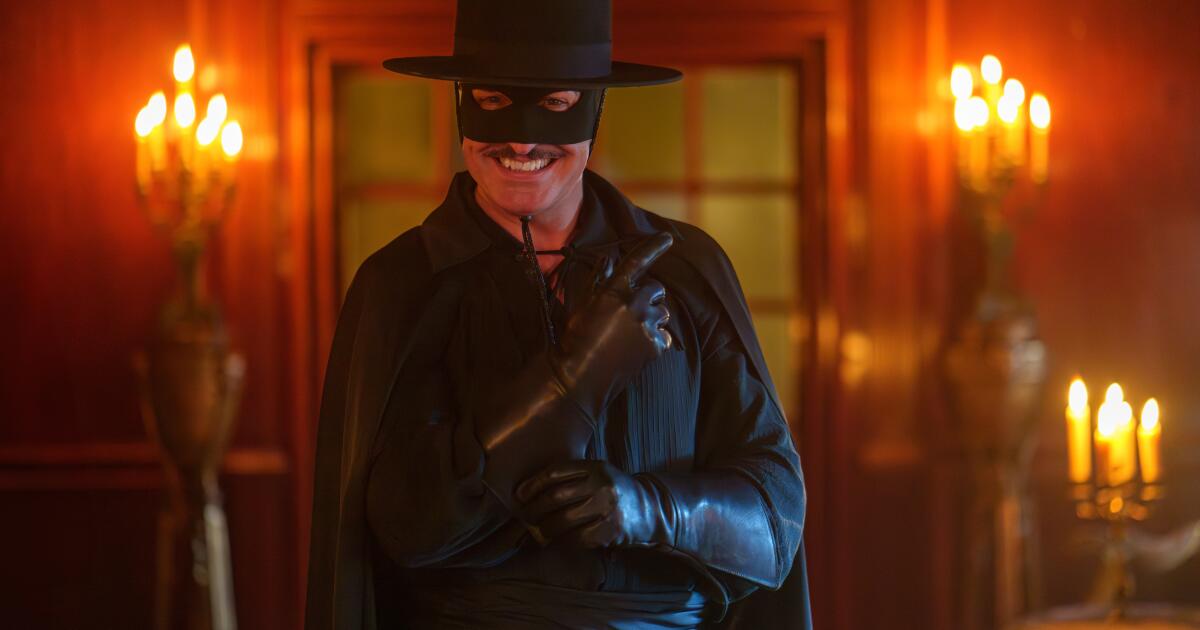
The new “Zorro,” arriving here Tuesday on MHz Choice, some two years after its European debut, is a thoroughly original and quite wonderful take on the material; it’s one of my favorite new shows this year, possibly the one that made me happiest. Starring Jean Dujardin, whom American audiences will know as the star of the 2011 silent film “The Artist,” which won him an Oscar for lead actor, it’s thoroughly a comedy without being a spoof — it isn’t “Zorro, the Gay Blade.” (Though, to be fair, most Zorro films, going back to Fairbanks, have comedy in them.)
It’s 1821 in Alta California, in the twilight of Spanish rule. Don Diego de la Vega (Dujardin), known as Zorro only to his trusted mute manservant, Bernardo (Salvatore Ficarra) — a servant only in the sense that Batman’s Alfred is a butler — has been out of the hero game for 20 years. It’s not exactly clear why he took off the mask and put down the rapier, but he’s espousing a more reasonable approach to conflict resolution, which, as an opening scene demonstrates, works less well than it might.
He’s gotten married, to Gabriella (Audrey Dana), and has been working for his flamboyant father, Don Alejandro (André Dussollier), who is retiring as mayor of El Pueblo de la Reina de Los Angeles (as we learned to say it in elementary school) after 48 years — which is to say, before the town, founded 1781, even existed. (The show is a fantasy.) In the midst of handing the job over to his son, even as Diego is making a speech about water supplies, hygiene and education, Don Alejandro snatches it back to cheers, clutches his heart and dies. But he’ll return, as a ghost, to criticize his son, who, admittedly, has grown staid and stale in his life, his marriage and his work, whatever that’s been.
Indeed, he seems to know little about the actual operation of the town, and it comes to a particular surprise to him to learn that, owing to his father’s profligacy, it’s heavily in debt to Don Emmanuel (Éric Elmosnino), a local businessman who has more than a finger in every pie — he owns all the pie plates as well. Now he’s about to build a casino — destroying a neighborhood, paying workers in alcohol — which drives Diego back into costume and onto the saddle of the son of his old trusty steed, Tornado, also called Tornado.
His other antagonist is the corpulent, comical sergeant (Grégory Gadebois) who, upon Zorro’s return, reads a letter he has been keeping for the occasion (“I want you to know that the way you made fun of me on numerous occasions 20 years ago had serious consequences for my self-esteem”). Now he is set on unmasking the caped crusader.
It’s a romance, a swashbuckler, a melodrama, a relatively light-handed critique of capitalism, demagoguery and the malleability of the crowd. It’s a farce — a French farce, literally, and stylistically, a la Feydeau, with characters appearing and disappearing, changing costumes and identities. It’s occasionally a sex farce. The dialogue (as subtitled) is witty. The action, which is not bloody or at all deadly, has the fizzy charm and slapstick charge of prime Jackie Chan. At the heart of the series is a not unprecedented love triangle between Gabriella and Diego, as himself and Zorro, though it’s unusually well developed and sort of … deep. The emotional stakes — which also involve a thieving street urchin (Baltasar Espinach) the De la Vegas adopt — are real.
The entire cast is first-rate. Ficarra is a brilliant clown — his part is all miming — and also the most level-headed of these characters. Dana, falling in love with Zorro and out of love with Diego, and being deceived by both, is sublimely affecting. Elmosnino is an amusing villain, making his most self-serving machinations sound reasonable. Dujardin, who had spoken of his desire to play Zorro as early as 2010 (“He wears all black, he has a mask, and I could do fencing and horseback riding — I think it’s my last childhood desire”), makes the strongest impression in the trickiest role. He somehow makes Diego and Zorro at once psychologically distinct and convincingly whole, even as their, which is to say his, identities grow cloudy.
MHz Choice, which imports series from around the world, may not be high on your list of must-have streamers — chances are it isn’t. But how else are you going to watch this good thing?

If you were a TV show, nothing would be more certain to gain my attention than to be a French-made, French-language series about Zorro, the masked vigilante swordsman of old Los Angeles. Sword fighting plus cape plus Francophilia plus hometown pride equals yes, please.
Introduced in Johnston McCulley’s 1919 serialized novel, “The Curse of Capistrano” (with some 60 stories to follow), a kid of Californio Robin Hood cum Scarlet Pimpernel, the character jumped quickly to the screen in the 1920 “The Mark of Zorro,” with Douglas Fairbanks demonstrating his remarkable facility for parkour before anyone thought to call it that.
It was remade in 1940 with Tyrone Power; later, comic-book canon made it the film the family was leaving the night Bruce Wayne’s family was killed; in any case, there’s a whole lot of Zorro in Batman). Antonio Banderas played the character twice, in “The Mask of Zorro” (1998) and “The Legend of Zorro” (2005).
Most significant, in the late 1950s, it became the basis of a Disney-produced TV series, starring Guy Williams, who is Zorro, I’d imagine, to most people, here and abroad. It has had a long, international afterlife; you can watch it now on Disney+. (France has local history with the character, Alain Delon having played him in the 1975 “Zorro.”) It might not have been the most consistently exploited IP over the last century, but who doesn’t know Zorro? Hands? Just as I thought.
The new “Zorro,” arriving here Tuesday on MHz Choice, some two years after its European debut, is a thoroughly original and quite wonderful take on the material; it’s one of my favorite new shows this year, possibly the one that made me happiest. Starring Jean Dujardin, whom American audiences will know as the star of the 2011 silent film “The Artist,” which won him an Oscar for lead actor, it’s thoroughly a comedy without being a spoof — it isn’t “Zorro, the Gay Blade.” (Though, to be fair, most Zorro films, going back to Fairbanks, have comedy in them.)
It’s 1821 in Alta California, in the twilight of Spanish rule. Don Diego de la Vega (Dujardin), known as Zorro only to his trusted mute manservant, Bernardo (Salvatore Ficarra) — a servant only in the sense that Batman’s Alfred is a butler — has been out of the hero game for 20 years. It’s not exactly clear why he took off the mask and put down the rapier, but he’s espousing a more reasonable approach to conflict resolution, which, as an opening scene demonstrates, works less well than it might.
He’s gotten married, to Gabriella (Audrey Dana), and has been working for his flamboyant father, Don Alejandro (André Dussollier), who is retiring as mayor of El Pueblo de la Reina de Los Angeles (as we learned to say it in elementary school) after 48 years — which is to say, before the town, founded 1781, even existed. (The show is a fantasy.) In the midst of handing the job over to his son, even as Diego is making a speech about water supplies, hygiene and education, Don Alejandro snatches it back to cheers, clutches his heart and dies. But he’ll return, as a ghost, to criticize his son, who, admittedly, has grown staid and stale in his life, his marriage and his work, whatever that’s been.
Indeed, he seems to know little about the actual operation of the town, and it comes to a particular surprise to him to learn that, owing to his father’s profligacy, it’s heavily in debt to Don Emmanuel (Éric Elmosnino), a local businessman who has more than a finger in every pie — he owns all the pie plates as well. Now he’s about to build a casino — destroying a neighborhood, paying workers in alcohol — which drives Diego back into costume and onto the saddle of the son of his old trusty steed, Tornado, also called Tornado.
His other antagonist is the corpulent, comical sergeant (Grégory Gadebois) who, upon Zorro’s return, reads a letter he has been keeping for the occasion (“I want you to know that the way you made fun of me on numerous occasions 20 years ago had serious consequences for my self-esteem”). Now he is set on unmasking the caped crusader.
It’s a romance, a swashbuckler, a melodrama, a relatively light-handed critique of capitalism, demagoguery and the malleability of the crowd. It’s a farce — a French farce, literally, and stylistically, a la Feydeau, with characters appearing and disappearing, changing costumes and identities. It’s occasionally a sex farce. The dialogue (as subtitled) is witty. The action, which is not bloody or at all deadly, has the fizzy charm and slapstick charge of prime Jackie Chan. At the heart of the series is a not unprecedented love triangle between Gabriella and Diego, as himself and Zorro, though it’s unusually well developed and sort of … deep. The emotional stakes — which also involve a thieving street urchin (Baltasar Espinach) the De la Vegas adopt — are real.
The entire cast is first-rate. Ficarra is a brilliant clown — his part is all miming — and also the most level-headed of these characters. Dana, falling in love with Zorro and out of love with Diego, and being deceived by both, is sublimely affecting. Elmosnino is an amusing villain, making his most self-serving machinations sound reasonable. Dujardin, who had spoken of his desire to play Zorro as early as 2010 (“He wears all black, he has a mask, and I could do fencing and horseback riding — I think it’s my last childhood desire”), makes the strongest impression in the trickiest role. He somehow makes Diego and Zorro at once psychologically distinct and convincingly whole, even as their, which is to say his, identities grow cloudy.
MHz Choice, which imports series from around the world, may not be high on your list of must-have streamers — chances are it isn’t. But how else are you going to watch this good thing?

If you were a TV show, nothing would be more certain to gain my attention than to be a French-made, French-language series about Zorro, the masked vigilante swordsman of old Los Angeles. Sword fighting plus cape plus Francophilia plus hometown pride equals yes, please.
Introduced in Johnston McCulley’s 1919 serialized novel, “The Curse of Capistrano” (with some 60 stories to follow), a kid of Californio Robin Hood cum Scarlet Pimpernel, the character jumped quickly to the screen in the 1920 “The Mark of Zorro,” with Douglas Fairbanks demonstrating his remarkable facility for parkour before anyone thought to call it that.
It was remade in 1940 with Tyrone Power; later, comic-book canon made it the film the family was leaving the night Bruce Wayne’s family was killed; in any case, there’s a whole lot of Zorro in Batman). Antonio Banderas played the character twice, in “The Mask of Zorro” (1998) and “The Legend of Zorro” (2005).
Most significant, in the late 1950s, it became the basis of a Disney-produced TV series, starring Guy Williams, who is Zorro, I’d imagine, to most people, here and abroad. It has had a long, international afterlife; you can watch it now on Disney+. (France has local history with the character, Alain Delon having played him in the 1975 “Zorro.”) It might not have been the most consistently exploited IP over the last century, but who doesn’t know Zorro? Hands? Just as I thought.
The new “Zorro,” arriving here Tuesday on MHz Choice, some two years after its European debut, is a thoroughly original and quite wonderful take on the material; it’s one of my favorite new shows this year, possibly the one that made me happiest. Starring Jean Dujardin, whom American audiences will know as the star of the 2011 silent film “The Artist,” which won him an Oscar for lead actor, it’s thoroughly a comedy without being a spoof — it isn’t “Zorro, the Gay Blade.” (Though, to be fair, most Zorro films, going back to Fairbanks, have comedy in them.)
It’s 1821 in Alta California, in the twilight of Spanish rule. Don Diego de la Vega (Dujardin), known as Zorro only to his trusted mute manservant, Bernardo (Salvatore Ficarra) — a servant only in the sense that Batman’s Alfred is a butler — has been out of the hero game for 20 years. It’s not exactly clear why he took off the mask and put down the rapier, but he’s espousing a more reasonable approach to conflict resolution, which, as an opening scene demonstrates, works less well than it might.
He’s gotten married, to Gabriella (Audrey Dana), and has been working for his flamboyant father, Don Alejandro (André Dussollier), who is retiring as mayor of El Pueblo de la Reina de Los Angeles (as we learned to say it in elementary school) after 48 years — which is to say, before the town, founded 1781, even existed. (The show is a fantasy.) In the midst of handing the job over to his son, even as Diego is making a speech about water supplies, hygiene and education, Don Alejandro snatches it back to cheers, clutches his heart and dies. But he’ll return, as a ghost, to criticize his son, who, admittedly, has grown staid and stale in his life, his marriage and his work, whatever that’s been.
Indeed, he seems to know little about the actual operation of the town, and it comes to a particular surprise to him to learn that, owing to his father’s profligacy, it’s heavily in debt to Don Emmanuel (Éric Elmosnino), a local businessman who has more than a finger in every pie — he owns all the pie plates as well. Now he’s about to build a casino — destroying a neighborhood, paying workers in alcohol — which drives Diego back into costume and onto the saddle of the son of his old trusty steed, Tornado, also called Tornado.
His other antagonist is the corpulent, comical sergeant (Grégory Gadebois) who, upon Zorro’s return, reads a letter he has been keeping for the occasion (“I want you to know that the way you made fun of me on numerous occasions 20 years ago had serious consequences for my self-esteem”). Now he is set on unmasking the caped crusader.
It’s a romance, a swashbuckler, a melodrama, a relatively light-handed critique of capitalism, demagoguery and the malleability of the crowd. It’s a farce — a French farce, literally, and stylistically, a la Feydeau, with characters appearing and disappearing, changing costumes and identities. It’s occasionally a sex farce. The dialogue (as subtitled) is witty. The action, which is not bloody or at all deadly, has the fizzy charm and slapstick charge of prime Jackie Chan. At the heart of the series is a not unprecedented love triangle between Gabriella and Diego, as himself and Zorro, though it’s unusually well developed and sort of … deep. The emotional stakes — which also involve a thieving street urchin (Baltasar Espinach) the De la Vegas adopt — are real.
The entire cast is first-rate. Ficarra is a brilliant clown — his part is all miming — and also the most level-headed of these characters. Dana, falling in love with Zorro and out of love with Diego, and being deceived by both, is sublimely affecting. Elmosnino is an amusing villain, making his most self-serving machinations sound reasonable. Dujardin, who had spoken of his desire to play Zorro as early as 2010 (“He wears all black, he has a mask, and I could do fencing and horseback riding — I think it’s my last childhood desire”), makes the strongest impression in the trickiest role. He somehow makes Diego and Zorro at once psychologically distinct and convincingly whole, even as their, which is to say his, identities grow cloudy.
MHz Choice, which imports series from around the world, may not be high on your list of must-have streamers — chances are it isn’t. But how else are you going to watch this good thing?
If you were a TV show, nothing would be more certain to gain my attention than to be a French-made, French-language series about Zorro, the masked vigilante swordsman of old Los Angeles. Sword fighting plus cape plus Francophilia plus hometown pride equals yes, please.
Introduced in Johnston McCulley’s 1919 serialized novel, “The Curse of Capistrano” (with some 60 stories to follow), a kid of Californio Robin Hood cum Scarlet Pimpernel, the character jumped quickly to the screen in the 1920 “The Mark of Zorro,” with Douglas Fairbanks demonstrating his remarkable facility for parkour before anyone thought to call it that.
It was remade in 1940 with Tyrone Power; later, comic-book canon made it the film the family was leaving the night Bruce Wayne’s family was killed; in any case, there’s a whole lot of Zorro in Batman). Antonio Banderas played the character twice, in “The Mask of Zorro” (1998) and “The Legend of Zorro” (2005).
Most significant, in the late 1950s, it became the basis of a Disney-produced TV series, starring Guy Williams, who is Zorro, I’d imagine, to most people, here and abroad. It has had a long, international afterlife; you can watch it now on Disney+. (France has local history with the character, Alain Delon having played him in the 1975 “Zorro.”) It might not have been the most consistently exploited IP over the last century, but who doesn’t know Zorro? Hands? Just as I thought.
The new “Zorro,” arriving here Tuesday on MHz Choice, some two years after its European debut, is a thoroughly original and quite wonderful take on the material; it’s one of my favorite new shows this year, possibly the one that made me happiest. Starring Jean Dujardin, whom American audiences will know as the star of the 2011 silent film “The Artist,” which won him an Oscar for lead actor, it’s thoroughly a comedy without being a spoof — it isn’t “Zorro, the Gay Blade.” (Though, to be fair, most Zorro films, going back to Fairbanks, have comedy in them.)
It’s 1821 in Alta California, in the twilight of Spanish rule. Don Diego de la Vega (Dujardin), known as Zorro only to his trusted mute manservant, Bernardo (Salvatore Ficarra) — a servant only in the sense that Batman’s Alfred is a butler — has been out of the hero game for 20 years. It’s not exactly clear why he took off the mask and put down the rapier, but he’s espousing a more reasonable approach to conflict resolution, which, as an opening scene demonstrates, works less well than it might.
He’s gotten married, to Gabriella (Audrey Dana), and has been working for his flamboyant father, Don Alejandro (André Dussollier), who is retiring as mayor of El Pueblo de la Reina de Los Angeles (as we learned to say it in elementary school) after 48 years — which is to say, before the town, founded 1781, even existed. (The show is a fantasy.) In the midst of handing the job over to his son, even as Diego is making a speech about water supplies, hygiene and education, Don Alejandro snatches it back to cheers, clutches his heart and dies. But he’ll return, as a ghost, to criticize his son, who, admittedly, has grown staid and stale in his life, his marriage and his work, whatever that’s been.
Indeed, he seems to know little about the actual operation of the town, and it comes to a particular surprise to him to learn that, owing to his father’s profligacy, it’s heavily in debt to Don Emmanuel (Éric Elmosnino), a local businessman who has more than a finger in every pie — he owns all the pie plates as well. Now he’s about to build a casino — destroying a neighborhood, paying workers in alcohol — which drives Diego back into costume and onto the saddle of the son of his old trusty steed, Tornado, also called Tornado.
His other antagonist is the corpulent, comical sergeant (Grégory Gadebois) who, upon Zorro’s return, reads a letter he has been keeping for the occasion (“I want you to know that the way you made fun of me on numerous occasions 20 years ago had serious consequences for my self-esteem”). Now he is set on unmasking the caped crusader.
It’s a romance, a swashbuckler, a melodrama, a relatively light-handed critique of capitalism, demagoguery and the malleability of the crowd. It’s a farce — a French farce, literally, and stylistically, a la Feydeau, with characters appearing and disappearing, changing costumes and identities. It’s occasionally a sex farce. The dialogue (as subtitled) is witty. The action, which is not bloody or at all deadly, has the fizzy charm and slapstick charge of prime Jackie Chan. At the heart of the series is a not unprecedented love triangle between Gabriella and Diego, as himself and Zorro, though it’s unusually well developed and sort of … deep. The emotional stakes — which also involve a thieving street urchin (Baltasar Espinach) the De la Vegas adopt — are real.
The entire cast is first-rate. Ficarra is a brilliant clown — his part is all miming — and also the most level-headed of these characters. Dana, falling in love with Zorro and out of love with Diego, and being deceived by both, is sublimely affecting. Elmosnino is an amusing villain, making his most self-serving machinations sound reasonable. Dujardin, who had spoken of his desire to play Zorro as early as 2010 (“He wears all black, he has a mask, and I could do fencing and horseback riding — I think it’s my last childhood desire”), makes the strongest impression in the trickiest role. He somehow makes Diego and Zorro at once psychologically distinct and convincingly whole, even as their, which is to say his, identities grow cloudy.
MHz Choice, which imports series from around the world, may not be high on your list of must-have streamers — chances are it isn’t. But how else are you going to watch this good thing?