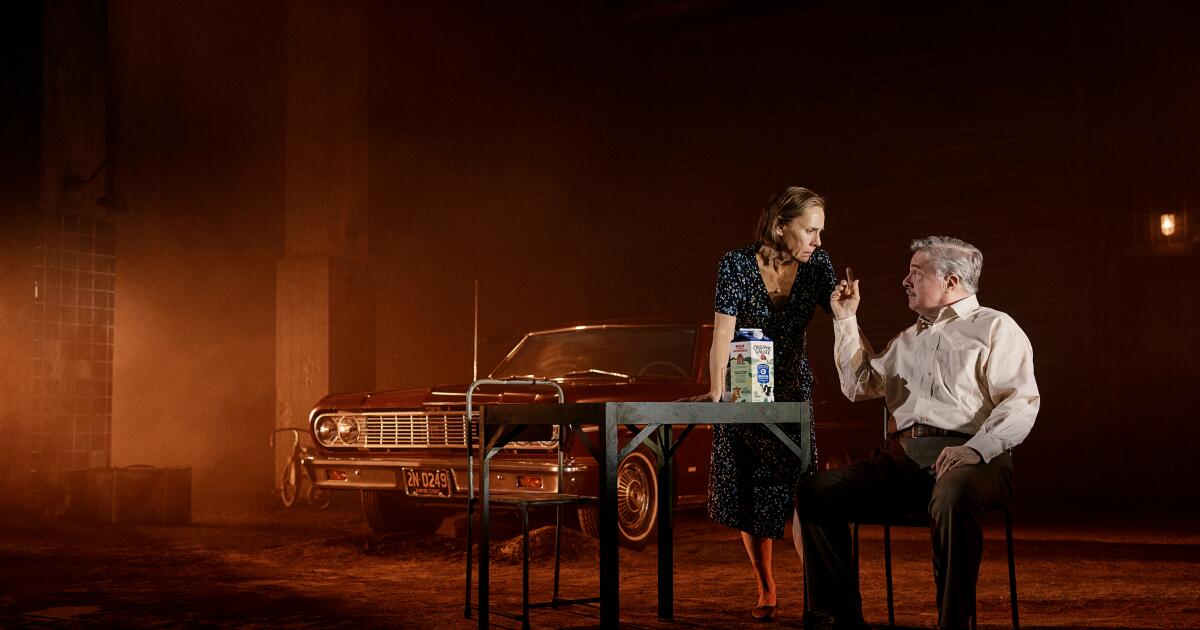
The show that has had everyone clamoring for tickets this spring, Joe Mantello’s cobweb-clearing production of Arthur Miller’s “Death of a Salesman,” won, as expected, for best revival.
Mantello, who received a Tony for his direction (his third such award), swept away the cliches that have accumulated around this American classic to reveal a “Salesman” like none we’ve experienced before. The Loman family home isn’t depicted in a literal fashion but instead fluidly suggested in a warehouse space that allows the actors to move unfetteredly between past and present. (The physical production was honored with awards for Mikaal Sulaiman’s sound design, Jack Knowles’ lighting and Chloe Lamford’s scenic design.)
Laurie Metcalf, confirming her standing as the First Lady of the American Theater, won for her portrayal of Linda Loman, a more formidable than usual interpretation of Willy’s stalwart wife. Metcalf, who endowed her characterization with a sharp-edged autonomy and transfixing gravitas, added another Tony to her two previous acting wins (“Three Tall Women,” “A Doll’s House, Part II”).
Joe Mantello wins the Tony for his direction of “Death of a Salesman.”
(Evelyn Freja / For The Times)
Nathan Lane was in a tight race with John Lithgow, who won for his ruthlessly uncompromising portrayal of a wrathful and dyspeptic Roald Dahl in Mark Rosenblatt’s “Giant.” Lane’s Willy leaves a lasting memory in “Salesman,” but it would be hard to imagine “Giant” having the same impact without Lithgow, who provides a terrifying human foundation to this explosive play about a writer’s political commitments tipping over into toxic antisemitism. (The performance slips into a sinkhole of animus in the uncanny way of one of Dahl’s recognizably terrifying, psychologically plausible stories.) In his almost but not quite valedictory acceptance speech, the 80-year-old Lithgow acknowledged that this Tony win, his third, comes 53 years after his first — and feels every bit as satisfying.

Aya Cash and John Lithgow in “Giant.”
(Joan Marcus)
Rather than a slight to Lane, Lithgow’s win is a sign of the dramatic depth that characterized this otherwise squirrely season. Indeed, Lithgow’s performance was as thrilling to experience as that of British powerhouse Lesley Manville, who won for her portrayal of Jocasta in Robert Icke’s modern reworking of “Oedipus.” The play was categorized by the Tony committee as a revival, but it’s really an original drama — one that gave rise to one of the most enthralling productions of the year.
In a season lifted up by Bess Wohl’s magnificent “Liberation” and capacious enough to include a first-rate “Salesman,” a searing “Oedipus” and a smartly contentious “Giant,” it should be no surprise that there were more great performances than statuettes to dole out.

The show that has had everyone clamoring for tickets this spring, Joe Mantello’s cobweb-clearing production of Arthur Miller’s “Death of a Salesman,” won, as expected, for best revival.
Mantello, who received a Tony for his direction (his third such award), swept away the cliches that have accumulated around this American classic to reveal a “Salesman” like none we’ve experienced before. The Loman family home isn’t depicted in a literal fashion but instead fluidly suggested in a warehouse space that allows the actors to move unfetteredly between past and present. (The physical production was honored with awards for Mikaal Sulaiman’s sound design, Jack Knowles’ lighting and Chloe Lamford’s scenic design.)
Laurie Metcalf, confirming her standing as the First Lady of the American Theater, won for her portrayal of Linda Loman, a more formidable than usual interpretation of Willy’s stalwart wife. Metcalf, who endowed her characterization with a sharp-edged autonomy and transfixing gravitas, added another Tony to her two previous acting wins (“Three Tall Women,” “A Doll’s House, Part II”).
Joe Mantello wins the Tony for his direction of “Death of a Salesman.”
(Evelyn Freja / For The Times)
Nathan Lane was in a tight race with John Lithgow, who won for his ruthlessly uncompromising portrayal of a wrathful and dyspeptic Roald Dahl in Mark Rosenblatt’s “Giant.” Lane’s Willy leaves a lasting memory in “Salesman,” but it would be hard to imagine “Giant” having the same impact without Lithgow, who provides a terrifying human foundation to this explosive play about a writer’s political commitments tipping over into toxic antisemitism. (The performance slips into a sinkhole of animus in the uncanny way of one of Dahl’s recognizably terrifying, psychologically plausible stories.) In his almost but not quite valedictory acceptance speech, the 80-year-old Lithgow acknowledged that this Tony win, his third, comes 53 years after his first — and feels every bit as satisfying.
Aya Cash and John Lithgow in “Giant.”
(Joan Marcus)
Rather than a slight to Lane, Lithgow’s win is a sign of the dramatic depth that characterized this otherwise squirrely season. Indeed, Lithgow’s performance was as thrilling to experience as that of British powerhouse Lesley Manville, who won for her portrayal of Jocasta in Robert Icke’s modern reworking of “Oedipus.” The play was categorized by the Tony committee as a revival, but it’s really an original drama — one that gave rise to one of the most enthralling productions of the year.
In a season lifted up by Bess Wohl’s magnificent “Liberation” and capacious enough to include a first-rate “Salesman,” a searing “Oedipus” and a smartly contentious “Giant,” it should be no surprise that there were more great performances than statuettes to dole out.

The show that has had everyone clamoring for tickets this spring, Joe Mantello’s cobweb-clearing production of Arthur Miller’s “Death of a Salesman,” won, as expected, for best revival.
Mantello, who received a Tony for his direction (his third such award), swept away the cliches that have accumulated around this American classic to reveal a “Salesman” like none we’ve experienced before. The Loman family home isn’t depicted in a literal fashion but instead fluidly suggested in a warehouse space that allows the actors to move unfetteredly between past and present. (The physical production was honored with awards for Mikaal Sulaiman’s sound design, Jack Knowles’ lighting and Chloe Lamford’s scenic design.)
Laurie Metcalf, confirming her standing as the First Lady of the American Theater, won for her portrayal of Linda Loman, a more formidable than usual interpretation of Willy’s stalwart wife. Metcalf, who endowed her characterization with a sharp-edged autonomy and transfixing gravitas, added another Tony to her two previous acting wins (“Three Tall Women,” “A Doll’s House, Part II”).
Joe Mantello wins the Tony for his direction of “Death of a Salesman.”
(Evelyn Freja / For The Times)
Nathan Lane was in a tight race with John Lithgow, who won for his ruthlessly uncompromising portrayal of a wrathful and dyspeptic Roald Dahl in Mark Rosenblatt’s “Giant.” Lane’s Willy leaves a lasting memory in “Salesman,” but it would be hard to imagine “Giant” having the same impact without Lithgow, who provides a terrifying human foundation to this explosive play about a writer’s political commitments tipping over into toxic antisemitism. (The performance slips into a sinkhole of animus in the uncanny way of one of Dahl’s recognizably terrifying, psychologically plausible stories.) In his almost but not quite valedictory acceptance speech, the 80-year-old Lithgow acknowledged that this Tony win, his third, comes 53 years after his first — and feels every bit as satisfying.
Aya Cash and John Lithgow in “Giant.”
(Joan Marcus)
Rather than a slight to Lane, Lithgow’s win is a sign of the dramatic depth that characterized this otherwise squirrely season. Indeed, Lithgow’s performance was as thrilling to experience as that of British powerhouse Lesley Manville, who won for her portrayal of Jocasta in Robert Icke’s modern reworking of “Oedipus.” The play was categorized by the Tony committee as a revival, but it’s really an original drama — one that gave rise to one of the most enthralling productions of the year.
In a season lifted up by Bess Wohl’s magnificent “Liberation” and capacious enough to include a first-rate “Salesman,” a searing “Oedipus” and a smartly contentious “Giant,” it should be no surprise that there were more great performances than statuettes to dole out.
The show that has had everyone clamoring for tickets this spring, Joe Mantello’s cobweb-clearing production of Arthur Miller’s “Death of a Salesman,” won, as expected, for best revival.
Mantello, who received a Tony for his direction (his third such award), swept away the cliches that have accumulated around this American classic to reveal a “Salesman” like none we’ve experienced before. The Loman family home isn’t depicted in a literal fashion but instead fluidly suggested in a warehouse space that allows the actors to move unfetteredly between past and present. (The physical production was honored with awards for Mikaal Sulaiman’s sound design, Jack Knowles’ lighting and Chloe Lamford’s scenic design.)
Laurie Metcalf, confirming her standing as the First Lady of the American Theater, won for her portrayal of Linda Loman, a more formidable than usual interpretation of Willy’s stalwart wife. Metcalf, who endowed her characterization with a sharp-edged autonomy and transfixing gravitas, added another Tony to her two previous acting wins (“Three Tall Women,” “A Doll’s House, Part II”).
Joe Mantello wins the Tony for his direction of “Death of a Salesman.”
(Evelyn Freja / For The Times)
Nathan Lane was in a tight race with John Lithgow, who won for his ruthlessly uncompromising portrayal of a wrathful and dyspeptic Roald Dahl in Mark Rosenblatt’s “Giant.” Lane’s Willy leaves a lasting memory in “Salesman,” but it would be hard to imagine “Giant” having the same impact without Lithgow, who provides a terrifying human foundation to this explosive play about a writer’s political commitments tipping over into toxic antisemitism. (The performance slips into a sinkhole of animus in the uncanny way of one of Dahl’s recognizably terrifying, psychologically plausible stories.) In his almost but not quite valedictory acceptance speech, the 80-year-old Lithgow acknowledged that this Tony win, his third, comes 53 years after his first — and feels every bit as satisfying.
Aya Cash and John Lithgow in “Giant.”
(Joan Marcus)
Rather than a slight to Lane, Lithgow’s win is a sign of the dramatic depth that characterized this otherwise squirrely season. Indeed, Lithgow’s performance was as thrilling to experience as that of British powerhouse Lesley Manville, who won for her portrayal of Jocasta in Robert Icke’s modern reworking of “Oedipus.” The play was categorized by the Tony committee as a revival, but it’s really an original drama — one that gave rise to one of the most enthralling productions of the year.
In a season lifted up by Bess Wohl’s magnificent “Liberation” and capacious enough to include a first-rate “Salesman,” a searing “Oedipus” and a smartly contentious “Giant,” it should be no surprise that there were more great performances than statuettes to dole out.

The show that has had everyone clamoring for tickets this spring, Joe Mantello’s cobweb-clearing production of Arthur Miller’s “Death of a Salesman,” won, as expected, for best revival.
Mantello, who received a Tony for his direction (his third such award), swept away the cliches that have accumulated around this American classic to reveal a “Salesman” like none we’ve experienced before. The Loman family home isn’t depicted in a literal fashion but instead fluidly suggested in a warehouse space that allows the actors to move unfetteredly between past and present. (The physical production was honored with awards for Mikaal Sulaiman’s sound design, Jack Knowles’ lighting and Chloe Lamford’s scenic design.)
Laurie Metcalf, confirming her standing as the First Lady of the American Theater, won for her portrayal of Linda Loman, a more formidable than usual interpretation of Willy’s stalwart wife. Metcalf, who endowed her characterization with a sharp-edged autonomy and transfixing gravitas, added another Tony to her two previous acting wins (“Three Tall Women,” “A Doll’s House, Part II”).
Joe Mantello wins the Tony for his direction of “Death of a Salesman.”
(Evelyn Freja / For The Times)
Nathan Lane was in a tight race with John Lithgow, who won for his ruthlessly uncompromising portrayal of a wrathful and dyspeptic Roald Dahl in Mark Rosenblatt’s “Giant.” Lane’s Willy leaves a lasting memory in “Salesman,” but it would be hard to imagine “Giant” having the same impact without Lithgow, who provides a terrifying human foundation to this explosive play about a writer’s political commitments tipping over into toxic antisemitism. (The performance slips into a sinkhole of animus in the uncanny way of one of Dahl’s recognizably terrifying, psychologically plausible stories.) In his almost but not quite valedictory acceptance speech, the 80-year-old Lithgow acknowledged that this Tony win, his third, comes 53 years after his first — and feels every bit as satisfying.
Aya Cash and John Lithgow in “Giant.”
(Joan Marcus)
Rather than a slight to Lane, Lithgow’s win is a sign of the dramatic depth that characterized this otherwise squirrely season. Indeed, Lithgow’s performance was as thrilling to experience as that of British powerhouse Lesley Manville, who won for her portrayal of Jocasta in Robert Icke’s modern reworking of “Oedipus.” The play was categorized by the Tony committee as a revival, but it’s really an original drama — one that gave rise to one of the most enthralling productions of the year.
In a season lifted up by Bess Wohl’s magnificent “Liberation” and capacious enough to include a first-rate “Salesman,” a searing “Oedipus” and a smartly contentious “Giant,” it should be no surprise that there were more great performances than statuettes to dole out.
The show that has had everyone clamoring for tickets this spring, Joe Mantello’s cobweb-clearing production of Arthur Miller’s “Death of a Salesman,” won, as expected, for best revival.
Mantello, who received a Tony for his direction (his third such award), swept away the cliches that have accumulated around this American classic to reveal a “Salesman” like none we’ve experienced before. The Loman family home isn’t depicted in a literal fashion but instead fluidly suggested in a warehouse space that allows the actors to move unfetteredly between past and present. (The physical production was honored with awards for Mikaal Sulaiman’s sound design, Jack Knowles’ lighting and Chloe Lamford’s scenic design.)
Laurie Metcalf, confirming her standing as the First Lady of the American Theater, won for her portrayal of Linda Loman, a more formidable than usual interpretation of Willy’s stalwart wife. Metcalf, who endowed her characterization with a sharp-edged autonomy and transfixing gravitas, added another Tony to her two previous acting wins (“Three Tall Women,” “A Doll’s House, Part II”).
Joe Mantello wins the Tony for his direction of “Death of a Salesman.”
(Evelyn Freja / For The Times)
Nathan Lane was in a tight race with John Lithgow, who won for his ruthlessly uncompromising portrayal of a wrathful and dyspeptic Roald Dahl in Mark Rosenblatt’s “Giant.” Lane’s Willy leaves a lasting memory in “Salesman,” but it would be hard to imagine “Giant” having the same impact without Lithgow, who provides a terrifying human foundation to this explosive play about a writer’s political commitments tipping over into toxic antisemitism. (The performance slips into a sinkhole of animus in the uncanny way of one of Dahl’s recognizably terrifying, psychologically plausible stories.) In his almost but not quite valedictory acceptance speech, the 80-year-old Lithgow acknowledged that this Tony win, his third, comes 53 years after his first — and feels every bit as satisfying.
Aya Cash and John Lithgow in “Giant.”
(Joan Marcus)
Rather than a slight to Lane, Lithgow’s win is a sign of the dramatic depth that characterized this otherwise squirrely season. Indeed, Lithgow’s performance was as thrilling to experience as that of British powerhouse Lesley Manville, who won for her portrayal of Jocasta in Robert Icke’s modern reworking of “Oedipus.” The play was categorized by the Tony committee as a revival, but it’s really an original drama — one that gave rise to one of the most enthralling productions of the year.
In a season lifted up by Bess Wohl’s magnificent “Liberation” and capacious enough to include a first-rate “Salesman,” a searing “Oedipus” and a smartly contentious “Giant,” it should be no surprise that there were more great performances than statuettes to dole out.
The show that has had everyone clamoring for tickets this spring, Joe Mantello’s cobweb-clearing production of Arthur Miller’s “Death of a Salesman,” won, as expected, for best revival.
Mantello, who received a Tony for his direction (his third such award), swept away the cliches that have accumulated around this American classic to reveal a “Salesman” like none we’ve experienced before. The Loman family home isn’t depicted in a literal fashion but instead fluidly suggested in a warehouse space that allows the actors to move unfetteredly between past and present. (The physical production was honored with awards for Mikaal Sulaiman’s sound design, Jack Knowles’ lighting and Chloe Lamford’s scenic design.)
Laurie Metcalf, confirming her standing as the First Lady of the American Theater, won for her portrayal of Linda Loman, a more formidable than usual interpretation of Willy’s stalwart wife. Metcalf, who endowed her characterization with a sharp-edged autonomy and transfixing gravitas, added another Tony to her two previous acting wins (“Three Tall Women,” “A Doll’s House, Part II”).
Joe Mantello wins the Tony for his direction of “Death of a Salesman.”
(Evelyn Freja / For The Times)
Nathan Lane was in a tight race with John Lithgow, who won for his ruthlessly uncompromising portrayal of a wrathful and dyspeptic Roald Dahl in Mark Rosenblatt’s “Giant.” Lane’s Willy leaves a lasting memory in “Salesman,” but it would be hard to imagine “Giant” having the same impact without Lithgow, who provides a terrifying human foundation to this explosive play about a writer’s political commitments tipping over into toxic antisemitism. (The performance slips into a sinkhole of animus in the uncanny way of one of Dahl’s recognizably terrifying, psychologically plausible stories.) In his almost but not quite valedictory acceptance speech, the 80-year-old Lithgow acknowledged that this Tony win, his third, comes 53 years after his first — and feels every bit as satisfying.
Aya Cash and John Lithgow in “Giant.”
(Joan Marcus)
Rather than a slight to Lane, Lithgow’s win is a sign of the dramatic depth that characterized this otherwise squirrely season. Indeed, Lithgow’s performance was as thrilling to experience as that of British powerhouse Lesley Manville, who won for her portrayal of Jocasta in Robert Icke’s modern reworking of “Oedipus.” The play was categorized by the Tony committee as a revival, but it’s really an original drama — one that gave rise to one of the most enthralling productions of the year.
In a season lifted up by Bess Wohl’s magnificent “Liberation” and capacious enough to include a first-rate “Salesman,” a searing “Oedipus” and a smartly contentious “Giant,” it should be no surprise that there were more great performances than statuettes to dole out.
The show that has had everyone clamoring for tickets this spring, Joe Mantello’s cobweb-clearing production of Arthur Miller’s “Death of a Salesman,” won, as expected, for best revival.
Mantello, who received a Tony for his direction (his third such award), swept away the cliches that have accumulated around this American classic to reveal a “Salesman” like none we’ve experienced before. The Loman family home isn’t depicted in a literal fashion but instead fluidly suggested in a warehouse space that allows the actors to move unfetteredly between past and present. (The physical production was honored with awards for Mikaal Sulaiman’s sound design, Jack Knowles’ lighting and Chloe Lamford’s scenic design.)
Laurie Metcalf, confirming her standing as the First Lady of the American Theater, won for her portrayal of Linda Loman, a more formidable than usual interpretation of Willy’s stalwart wife. Metcalf, who endowed her characterization with a sharp-edged autonomy and transfixing gravitas, added another Tony to her two previous acting wins (“Three Tall Women,” “A Doll’s House, Part II”).
Joe Mantello wins the Tony for his direction of “Death of a Salesman.”
(Evelyn Freja / For The Times)
Nathan Lane was in a tight race with John Lithgow, who won for his ruthlessly uncompromising portrayal of a wrathful and dyspeptic Roald Dahl in Mark Rosenblatt’s “Giant.” Lane’s Willy leaves a lasting memory in “Salesman,” but it would be hard to imagine “Giant” having the same impact without Lithgow, who provides a terrifying human foundation to this explosive play about a writer’s political commitments tipping over into toxic antisemitism. (The performance slips into a sinkhole of animus in the uncanny way of one of Dahl’s recognizably terrifying, psychologically plausible stories.) In his almost but not quite valedictory acceptance speech, the 80-year-old Lithgow acknowledged that this Tony win, his third, comes 53 years after his first — and feels every bit as satisfying.
Aya Cash and John Lithgow in “Giant.”
(Joan Marcus)
Rather than a slight to Lane, Lithgow’s win is a sign of the dramatic depth that characterized this otherwise squirrely season. Indeed, Lithgow’s performance was as thrilling to experience as that of British powerhouse Lesley Manville, who won for her portrayal of Jocasta in Robert Icke’s modern reworking of “Oedipus.” The play was categorized by the Tony committee as a revival, but it’s really an original drama — one that gave rise to one of the most enthralling productions of the year.
In a season lifted up by Bess Wohl’s magnificent “Liberation” and capacious enough to include a first-rate “Salesman,” a searing “Oedipus” and a smartly contentious “Giant,” it should be no surprise that there were more great performances than statuettes to dole out.