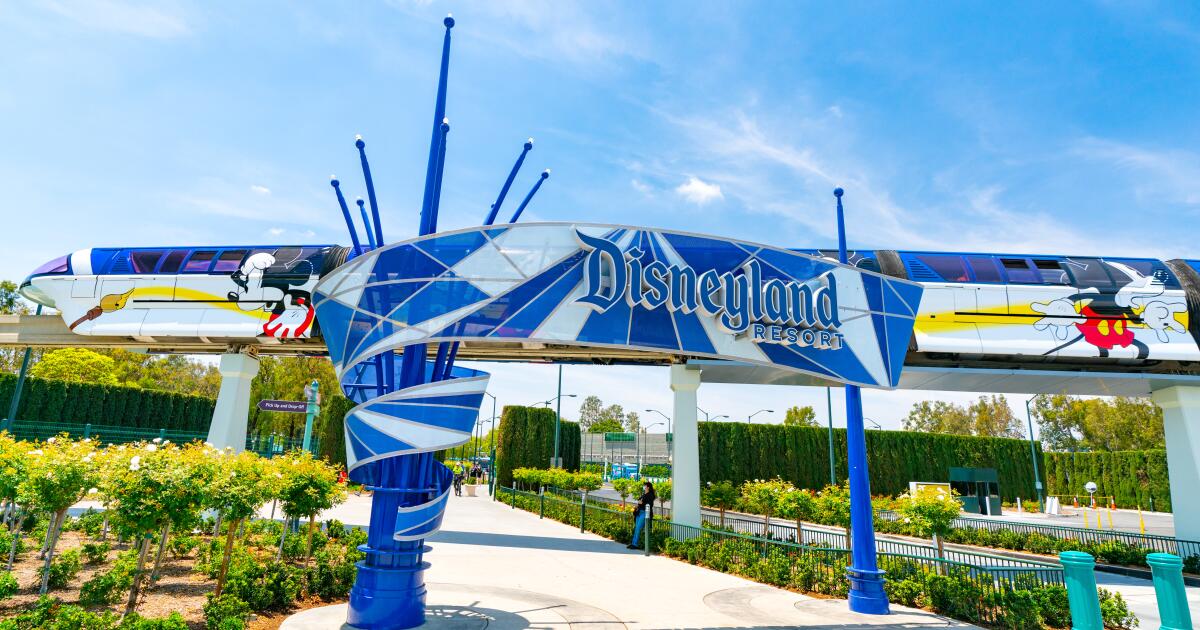


Walt Disney Co.’s theme parks and cruise line business is holding steady despite national concerns about discretionary consumer spending and higher gas prices.
The Burbank media and entertainment giant’s experiences division reported $9.5 billion in revenue in its fiscal second quarter, up 7% compared with the same period a year ago.
The increase was due to higher guest spending at Disney’s domestic parks and experiences, which reported a 6% bump in revenue to $6.9 billion, and more capacity on the company’s cruise line with the introduction of two new ships. The segment saw a 5% increase in operating income to $2.6 billion for the three-month period that ended March 28.
Disney’s theme parks segment was under close scrutiny given the national conversation about rising consumer costs and gas prices due to the U.S.-Iran war. Analysts had wondered whether consumers would tighten their belts and forgo vacations given the higher travel costs.
Disney did see a 1% decline in attendance at its U.S.-based parks compared with the prior year, which the company attributed to “continued softness” in international visitors, but said it was starting to move past those issues. Company executives have previously said Disney pivoted marketing and promotional efforts to attract local visitors.
Last quarter, executives indicated that results in the company’s second fiscal quarter could be affected, in part, by “international visitation headwinds,” a nod to the lower number of foreign visitors now traveling to the U.S.
Though the heightened economic uncertainty around the world could have a “potential impact” on the business, Disney Chief Executive Josh D’Amaro and Chief Financial Officer Hugh Johnston said in a shareholder letter Wednesday that the company was “encouraged by current demand.” The company expected that fiscal third-quarter domestic attendance numbers would improve, they wrote.
The company’s overall earnings were powered by its entertainment business, which posted revenue of $11.7 billion, up 10% compared with the prior year’s quarter.
That growth was driven by big gains for Disney’s streaming services — Disney+ and Hulu — which raked in nearly $5.5 billion in revenue, an increase of 13% compared with 2025, thanks to higher subscription fees from user growth and more advertising revenue. Operating income for the streaming business jumped 88% to $582 million.
Disney’s entertainment segment also had a stronger quarter at the theatrical box office, with standout performances from 20th Century Studios’ “Avatar: Fire and Ash,” the animated sequel “Zootopia 2” and Pixar’s “Hoppers.”
Overall, the company reported $25.2 billion in revenue, a 7% bump from the prior year. Income before income taxes totaled $3.4 billion, an increase of 9% compared with the same period in 2025, while operating income rose 4% to $4.6 billion. Earnings per share, excluding certain items, was $1.57, compared with $1.45 a year earlier.
Disney’s sports segment, which includes ESPN, reported revenue of $4.6 billion, a 2% increase from the same period in 2025. It brought in operating income of $652 million, a 5% slide that the company attributed to higher sports rights costs and the absence of UFC pay-per-view revenue compared with last year.
Disney also alluded to the company’s view of artificial intelligence as a “meaningful long-term opportunity,” saying it could play a role in content creation and production, monetization, workforce productivity, consumer and guest experiences and enterprise operations.
“At the same time, we are committed to implementing AI in a way that keeps human creativity at the center of everything we do and respects creators and the value of our intellectual property,” D’Amaro and Johnston said in the shareholder letter.
After noting OpenAI’s closure of the text-to-video AI tool Sora, which Disney had planned to invest in, D’Amaro and Johnston said the company will “continue to explore” commercial opportunities with OpenAI and other companies.

Walt Disney Co.’s theme parks and cruise line business is holding steady despite national concerns about discretionary consumer spending and higher gas prices.
The Burbank media and entertainment giant’s experiences division reported $9.5 billion in revenue in its fiscal second quarter, up 7% compared with the same period a year ago.
The increase was due to higher guest spending at Disney’s domestic parks and experiences, which reported a 6% bump in revenue to $6.9 billion, and more capacity on the company’s cruise line with the introduction of two new ships. The segment saw a 5% increase in operating income to $2.6 billion for the three-month period that ended March 28.
Disney’s theme parks segment was under close scrutiny given the national conversation about rising consumer costs and gas prices due to the U.S.-Iran war. Analysts had wondered whether consumers would tighten their belts and forgo vacations given the higher travel costs.
Disney did see a 1% decline in attendance at its U.S.-based parks compared with the prior year, which the company attributed to “continued softness” in international visitors, but said it was starting to move past those issues. Company executives have previously said Disney pivoted marketing and promotional efforts to attract local visitors.
Last quarter, executives indicated that results in the company’s second fiscal quarter could be affected, in part, by “international visitation headwinds,” a nod to the lower number of foreign visitors now traveling to the U.S.
Though the heightened economic uncertainty around the world could have a “potential impact” on the business, Disney Chief Executive Josh D’Amaro and Chief Financial Officer Hugh Johnston said in a shareholder letter Wednesday that the company was “encouraged by current demand.” The company expected that fiscal third-quarter domestic attendance numbers would improve, they wrote.
The company’s overall earnings were powered by its entertainment business, which posted revenue of $11.7 billion, up 10% compared with the prior year’s quarter.
That growth was driven by big gains for Disney’s streaming services — Disney+ and Hulu — which raked in nearly $5.5 billion in revenue, an increase of 13% compared with 2025, thanks to higher subscription fees from user growth and more advertising revenue. Operating income for the streaming business jumped 88% to $582 million.
Disney’s entertainment segment also had a stronger quarter at the theatrical box office, with standout performances from 20th Century Studios’ “Avatar: Fire and Ash,” the animated sequel “Zootopia 2” and Pixar’s “Hoppers.”
Overall, the company reported $25.2 billion in revenue, a 7% bump from the prior year. Income before income taxes totaled $3.4 billion, an increase of 9% compared with the same period in 2025, while operating income rose 4% to $4.6 billion. Earnings per share, excluding certain items, was $1.57, compared with $1.45 a year earlier.
Disney’s sports segment, which includes ESPN, reported revenue of $4.6 billion, a 2% increase from the same period in 2025. It brought in operating income of $652 million, a 5% slide that the company attributed to higher sports rights costs and the absence of UFC pay-per-view revenue compared with last year.
Disney also alluded to the company’s view of artificial intelligence as a “meaningful long-term opportunity,” saying it could play a role in content creation and production, monetization, workforce productivity, consumer and guest experiences and enterprise operations.
“At the same time, we are committed to implementing AI in a way that keeps human creativity at the center of everything we do and respects creators and the value of our intellectual property,” D’Amaro and Johnston said in the shareholder letter.
After noting OpenAI’s closure of the text-to-video AI tool Sora, which Disney had planned to invest in, D’Amaro and Johnston said the company will “continue to explore” commercial opportunities with OpenAI and other companies.