The most dangerous band in Los Angeles has played a few dozen shows in its career. Many of them have ended in chaos, including arrests, a bloody head wound from an LAPD projectile, bonfires of garbage and ricocheting fireworks. Mayor Karen Bass said, after a clandestine downtown L.A. performance in 2025, that a rampage started by the band’s fans was “unacceptable under any and all circumstances, and those people who perpetrated this have to be held accountable to the full extent of the law.”
Not since Black Flag or N.W.A has a SoCal band spooked the powers that be like Dead City Punx.
For thousands of young fans, who swarmed the band’s outlaw concerts under blighted freeways during the pandemic, Dead City are a cathartic social phenomenon that’s reignited a riotous punk rock subculture in L.A. The band’s members have survived the worst L.A. can inflict — poverty, addiction and incarceration — and they’ve protested police brutality playing outside a downtown detention facility. A-list rock stars from Rage Against the Machine and underground peers like N8NOFACE have lauded them, and the fine art and film worlds have noticed too. So have their nemeses in the LAPD.
But Dead City fans have responded to cops raiding a concert by setting fires and ransacking a Metro train full of workers trying to get home. Some punk fans wonder if, while pointing out the failures of modern California, they’re also creating new ones.
“Dead City Punx,” a new documentary (co-produced by Rage Against the Machine’s Zack de la Rocha) debuting April 16 at the Regent Theater captures Dead City in their element — hardscrabble drug dens, graffiti-streaked overpasses, and eventually a packed Regent Theater downtown — as they decide if this whole project is gutsy social commentary, pure anarchic glee, or a real band that could jolt punk rock back to life, threatening the bleak status quo.
“A lot of people work their regular job, they hate their life. But they could go to our shows, and they could become this character, and a lot of people leaned into it,” said the band’s drummer Grumpy (they all go by mononymous stage names and declined to publicize their given names). “We can’t control what that person does. We’re just here to play music, and if you want to react to it by setting a stolen car on fire, that’s your choice.”
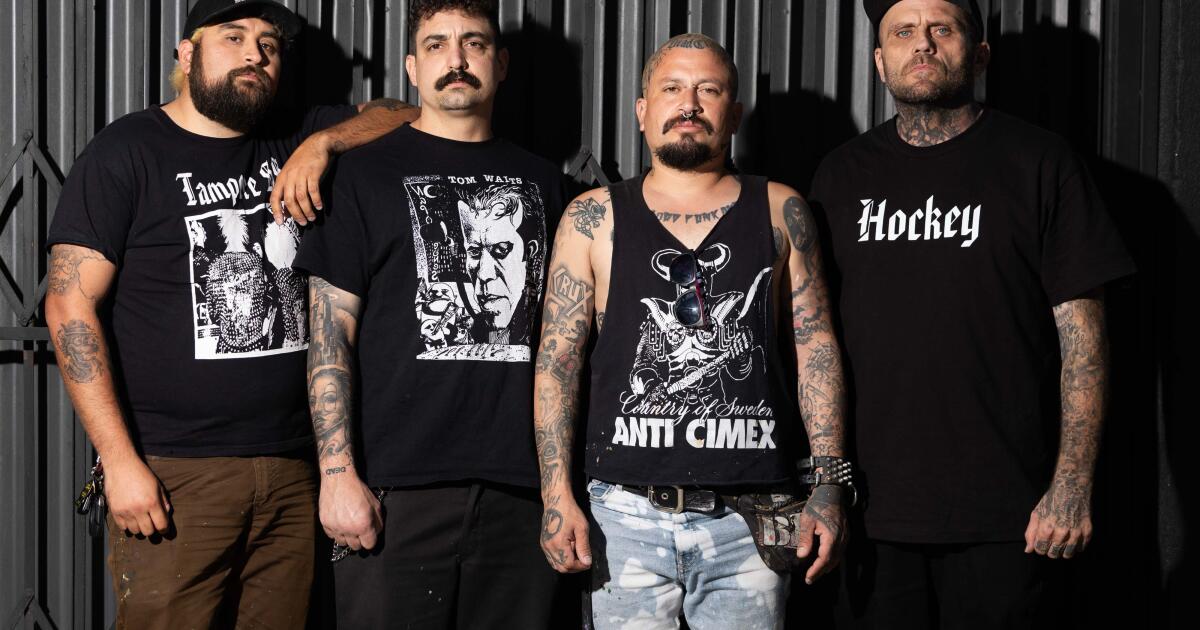
Mike, Grumpy, Meka, and Adrian of the band Dead City Punx at Beyond the Streets gallery.
(Brian Feinzimer / For The Times)
It’s fitting that this hardcore quartet, two of whose founding members bonded over smoking crack on Skid Row, is ascending during a time of economic and cultural decline.
Last month, at Beyond the Streets gallery on La Brea Avenue, Dead City’s four members — singer Mike, drummer Grumpy, guitarist Meka and bassist Adrian — met for a rare interview. Contrary to the crusty, chaotic libertinism of their shows, the band is disarmingly sweet and funny in person despite being duly crude. Within minutes of meeting a reporter, Meka recounted a recent sex injury that left his manhood bloody and engorged and required an emergency room visit (yes, he had pictures).
The band members’ backgrounds in music (they range in age from late 30s to 40s) span from wholesome backyard punk shows to the tagger scene to more serious criminality.
Grumpy was a teen punk drum prodigy, with stints (he said) as a car thief and insurance scammer. Adrian — the most straight-laced — was raised in a Latin music-filled household, while Meka had an unlikely cameo on the early-aughts reality show “The Simple Life,” when his childhood punk band, the Mucus, played to an aghast Paris Hilton.
Mike was the unlikely hardcore frontman — a Maywood hip-hop head who became a meth dealer after his father was arrested for manslaughter during his childhood. (“That’s the great thing about meth, it’s the best solution for homelessness,” Mike says in the documentary. “If you’ve got nowhere to sleep, you’ll be up all night.”) He estimates he had been arrested dozens of times on narcotics and theft charges (court records show he has several Los Angeles-area arrests and felony cases, with categories unspecified) before Dead City took off, after some heart-to-heart jail phone calls with his onetime drug pal Grumpy.
“Me personally, I didn’t even think I would live this long. I had no plan,” Mike said. “I probably thought I would have overdosed before the band even started.”
From the jump, though, they saw Dead City as something communal yet lawless. A band formed with instruments they stole from a church, born from a creeping sense that L.A. had failed. Their fast, vicious songs like “F— Peace” and “Human Chopshop” rip by in barely a minute but are just a part of the band’s broader ethic.
Their unpermitted April 2021 show at Lafayette Park in Westlake, publicized through social media and word of mouth, drew thousands of pent-up punks and kids looking for somewhere to go during the shutdown.
“It was COVID times, so cops were afraid to make contact with people. When George Floyd happened, everyone had that animosity and riot energy,” Grumpy said. Cops arrived to break up the crowd but soon realized they were outnumbered.
“They had to get bodies. They had to get into their tactical clothing and work on a game plan, because they were kind of blindsided. They were not expecting it,” Mike said. Police eventually cleared the show, but Dead City had the upper hand.

Dead City Punx perform live on the streets of L.A.
(Rick Castles)
Word spread that a new band was throwing wildcat ragers in the ugliest parts of town. A concert under a 5 Freeway overpass by the L.A. River drew even bigger crowds and a more serious police presence. But it also attracted scores of photographers, visual artists, taggers and scene kids who documented the unruly energy brimming over these grim industrial landscapes, lighted up with flames and police chopper spotlights.
“The film and entertainment industry tends to shape a certain image of Los Angeles that for the most part [bears] little or no resemblance to the realities faced by the majority of people who live and work and struggle here. Dead City for me is the reality of Los Angeles,” De la Rocha told The Times in an email. “The Los Angeles that asserts itself from the shadows of that spectacle, a concept that sharpens this contrast between how the dream factory depicts it, and the reality of life within the actual place.”
Subsequent concerts were even more incendiary. One fan severely burned himself jumping through a bonfire in the middle of a circle pit. The band planned a New York City debut that went off cleanly at the abandoned band shell where the hip-hop classic “Wild Style” was filmed. But a 2021 set at a notorious homeless encampment in Oakland earned backlash from advocates, who said the band was taking advantage of desperate people to throw aesthetically nihilistic punk shows.
“This is all a lot of people have,” one resident told the Oaklandside about the 2021 Dead City show. “But to them it was just fun and games, I guess.”
“Being attacked by people online was stressful, but we didn’t do anything wrong. It was outsiders who had no idea what was happening,” Grumpy insisted.
“We gave [the homeless residents] a generator. We got there the day before and talked to all the people, and paid them to help clean,” Meka added.
“There’s always going to be people offended by something we do, and we really don’t care,” Mike said. “Through the shows, maybe we are bringing up awareness of certain issues. Just say you were mad because you didn’t make it to the show.”
Dead City’s infamy spread throughout local law enforcement as well. One segment of the doc pulls from a somber video from the LAPD’s Hollenbeck division that describes Dead City’s Boyle Heights show in a “Critical Incident Community Briefing.” At the outlaw gig, a Dead City fan was shot in the head by a police projectile and left bloody and disoriented.
“There are so many terrible, heinous crimes going on in L.A. constantly. For the LAPD to give attention to what we’re doing is such a waste of resources,” Grumpy said. “Go find some rapists. Like, we’re just trying to have music and hope.”

Adrian, Grumpy, Meka and Mike of the band Dead City Punx.
(Brian Feinzimer / For The Times)
But the band does feel some regret after an infamous 2025 downtown L.A. rooftop show. Fans, angry that the concert had been raided, overwhelmed and tagged a Metro train and several businesses. (“I hope that they face some type of fines or at least jail time,” Teddy Lee, owner of DTLA Window Tint, told The Times afterward.) An LAPD representative did not respond to a request for comment about any arrests at that performance.
A music scene meant to give voice to the underdogs ended up making the night worse for many of them.
“Normal people getting f— with? Heck no,” Adrian said, clarifying that Dead City disapproved of the fans’ Metro vandalism.
Yet, “worse stuff happens after a Lakers parade,” Mike said. “Do you get mad at the Lakers for that? The city is just kind of using us as a scapegoat for their negligence. Our No. 1 priority is just playing our music, making sure everyone’s safe. Whatever happens after that is literally out of our hands.”
The band still hasn’t figured out just how political the Dead City project is. They were glad to rail against ICE at a February concert outside the Metropolitan Detention Center, in an echo of Rage Against the Machine’s 2000 show outside the Democratic National Convention. But when rallying the fanbase for causes, “You’re damned if you do and you’re damned if you don’t,” Mike said. “We don’t have a political agenda. But if something does come up that affects us, and we feel passionate about it, we will speak up about it.”
The band members are also at the precipice of something they thought impossible: a music career. That may come with compromises.
While they blew the roof off of the Regent in their above-ground debut, some fans were surprised to see them in a Live Nation venue, with entry handled by Ticketmaster, a famous corporate villain to many. The band thinks Dead City can play both sides at once.
“There are lots of people that are like ‘What the f— are you doing at this venue with Ticketmaster?’” Grumpy said. “I’m like, ‘Yeah, we played the last show for free.’ We all have our regular lives, we do what we do to make our money, but we’re not trying to capitalize on punk rock or think we’re gonna be rich and famous off this. We just want to enjoy making music.”
“Dead City has revitalized the L.A. punk scene for real. They returned it to its rightful place as an insurgent culture, and in tangible ways have de-commodified it,” De la Rocha insisted. “They made it truly communal again and have managed to do so on their own terms. When they organize a show, it’s more than a concert, it’s more than catharsis. It’s a real battle for public space in a city moving rapidly toward a privatized surveillance state.”
As Dead City grow beyond the outlaw punk scene, the entertainment industry is enticed yet wary of this genuinely divisive and chaotic band. The “Dead City Punx” documentary, and an accompanying “Dead City” book, and art exhibit of graffiti-scarred ephemera and gritty photos at the Beyond the Streets gallery, could enter the punk canon alongside “The Decline of Western Civilization” and “Our Band Could Be Your Life” as an era-defining work about a convulsive scene. Yet the doc has been shut out of film festivals and distribution so far; South by Southwest and Sundance rejections are stamped on a promotional flier.
Roger Gastman, owner of Beyond the Streets and an executive producer of the documentary, cited Black Flag and Sonic Youth’s visual collaborators when noting that “Dead City’s visual language picks up where Raymond Pettibon and Mike Kelley left off, but everyone seems afraid of this documentary.”
“People are jealous of the credibility they’ve created, but that’s not something a marketing budget can buy,” Gastman added. “The guys have been through hell more than once, and they’re willing to break things to make sure they’re heard.”

The most dangerous band in Los Angeles has played a few dozen shows in its career. Many of them have ended in chaos, including arrests, a bloody head wound from an LAPD projectile, bonfires of garbage and ricocheting fireworks. Mayor Karen Bass said, after a clandestine downtown L.A. performance in 2025, that a rampage started by the band’s fans was “unacceptable under any and all circumstances, and those people who perpetrated this have to be held accountable to the full extent of the law.”
Not since Black Flag or N.W.A has a SoCal band spooked the powers that be like Dead City Punx.
For thousands of young fans, who swarmed the band’s outlaw concerts under blighted freeways during the pandemic, Dead City are a cathartic social phenomenon that’s reignited a riotous punk rock subculture in L.A. The band’s members have survived the worst L.A. can inflict — poverty, addiction and incarceration — and they’ve protested police brutality playing outside a downtown detention facility. A-list rock stars from Rage Against the Machine and underground peers like N8NOFACE have lauded them, and the fine art and film worlds have noticed too. So have their nemeses in the LAPD.
But Dead City fans have responded to cops raiding a concert by setting fires and ransacking a Metro train full of workers trying to get home. Some punk fans wonder if, while pointing out the failures of modern California, they’re also creating new ones.
“Dead City Punx,” a new documentary (co-produced by Rage Against the Machine’s Zack de la Rocha) debuting April 16 at the Regent Theater captures Dead City in their element — hardscrabble drug dens, graffiti-streaked overpasses, and eventually a packed Regent Theater downtown — as they decide if this whole project is gutsy social commentary, pure anarchic glee, or a real band that could jolt punk rock back to life, threatening the bleak status quo.
“A lot of people work their regular job, they hate their life. But they could go to our shows, and they could become this character, and a lot of people leaned into it,” said the band’s drummer Grumpy (they all go by mononymous stage names and declined to publicize their given names). “We can’t control what that person does. We’re just here to play music, and if you want to react to it by setting a stolen car on fire, that’s your choice.”
Mike, Grumpy, Meka, and Adrian of the band Dead City Punx at Beyond the Streets gallery.
(Brian Feinzimer / For The Times)
It’s fitting that this hardcore quartet, two of whose founding members bonded over smoking crack on Skid Row, is ascending during a time of economic and cultural decline.
Last month, at Beyond the Streets gallery on La Brea Avenue, Dead City’s four members — singer Mike, drummer Grumpy, guitarist Meka and bassist Adrian — met for a rare interview. Contrary to the crusty, chaotic libertinism of their shows, the band is disarmingly sweet and funny in person despite being duly crude. Within minutes of meeting a reporter, Meka recounted a recent sex injury that left his manhood bloody and engorged and required an emergency room visit (yes, he had pictures).
The band members’ backgrounds in music (they range in age from late 30s to 40s) span from wholesome backyard punk shows to the tagger scene to more serious criminality.
Grumpy was a teen punk drum prodigy, with stints (he said) as a car thief and insurance scammer. Adrian — the most straight-laced — was raised in a Latin music-filled household, while Meka had an unlikely cameo on the early-aughts reality show “The Simple Life,” when his childhood punk band, the Mucus, played to an aghast Paris Hilton.
Mike was the unlikely hardcore frontman — a Maywood hip-hop head who became a meth dealer after his father was arrested for manslaughter during his childhood. (“That’s the great thing about meth, it’s the best solution for homelessness,” Mike says in the documentary. “If you’ve got nowhere to sleep, you’ll be up all night.”) He estimates he had been arrested dozens of times on narcotics and theft charges (court records show he has several Los Angeles-area arrests and felony cases, with categories unspecified) before Dead City took off, after some heart-to-heart jail phone calls with his onetime drug pal Grumpy.
“Me personally, I didn’t even think I would live this long. I had no plan,” Mike said. “I probably thought I would have overdosed before the band even started.”
From the jump, though, they saw Dead City as something communal yet lawless. A band formed with instruments they stole from a church, born from a creeping sense that L.A. had failed. Their fast, vicious songs like “F— Peace” and “Human Chopshop” rip by in barely a minute but are just a part of the band’s broader ethic.
Their unpermitted April 2021 show at Lafayette Park in Westlake, publicized through social media and word of mouth, drew thousands of pent-up punks and kids looking for somewhere to go during the shutdown.
“It was COVID times, so cops were afraid to make contact with people. When George Floyd happened, everyone had that animosity and riot energy,” Grumpy said. Cops arrived to break up the crowd but soon realized they were outnumbered.
“They had to get bodies. They had to get into their tactical clothing and work on a game plan, because they were kind of blindsided. They were not expecting it,” Mike said. Police eventually cleared the show, but Dead City had the upper hand.
Dead City Punx perform live on the streets of L.A.
(Rick Castles)
Word spread that a new band was throwing wildcat ragers in the ugliest parts of town. A concert under a 5 Freeway overpass by the L.A. River drew even bigger crowds and a more serious police presence. But it also attracted scores of photographers, visual artists, taggers and scene kids who documented the unruly energy brimming over these grim industrial landscapes, lighted up with flames and police chopper spotlights.
“The film and entertainment industry tends to shape a certain image of Los Angeles that for the most part [bears] little or no resemblance to the realities faced by the majority of people who live and work and struggle here. Dead City for me is the reality of Los Angeles,” De la Rocha told The Times in an email. “The Los Angeles that asserts itself from the shadows of that spectacle, a concept that sharpens this contrast between how the dream factory depicts it, and the reality of life within the actual place.”
Subsequent concerts were even more incendiary. One fan severely burned himself jumping through a bonfire in the middle of a circle pit. The band planned a New York City debut that went off cleanly at the abandoned band shell where the hip-hop classic “Wild Style” was filmed. But a 2021 set at a notorious homeless encampment in Oakland earned backlash from advocates, who said the band was taking advantage of desperate people to throw aesthetically nihilistic punk shows.
“This is all a lot of people have,” one resident told the Oaklandside about the 2021 Dead City show. “But to them it was just fun and games, I guess.”
“Being attacked by people online was stressful, but we didn’t do anything wrong. It was outsiders who had no idea what was happening,” Grumpy insisted.
“We gave [the homeless residents] a generator. We got there the day before and talked to all the people, and paid them to help clean,” Meka added.
“There’s always going to be people offended by something we do, and we really don’t care,” Mike said. “Through the shows, maybe we are bringing up awareness of certain issues. Just say you were mad because you didn’t make it to the show.”
Dead City’s infamy spread throughout local law enforcement as well. One segment of the doc pulls from a somber video from the LAPD’s Hollenbeck division that describes Dead City’s Boyle Heights show in a “Critical Incident Community Briefing.” At the outlaw gig, a Dead City fan was shot in the head by a police projectile and left bloody and disoriented.
“There are so many terrible, heinous crimes going on in L.A. constantly. For the LAPD to give attention to what we’re doing is such a waste of resources,” Grumpy said. “Go find some rapists. Like, we’re just trying to have music and hope.”
Adrian, Grumpy, Meka and Mike of the band Dead City Punx.
(Brian Feinzimer / For The Times)
But the band does feel some regret after an infamous 2025 downtown L.A. rooftop show. Fans, angry that the concert had been raided, overwhelmed and tagged a Metro train and several businesses. (“I hope that they face some type of fines or at least jail time,” Teddy Lee, owner of DTLA Window Tint, told The Times afterward.) An LAPD representative did not respond to a request for comment about any arrests at that performance.
A music scene meant to give voice to the underdogs ended up making the night worse for many of them.
“Normal people getting f— with? Heck no,” Adrian said, clarifying that Dead City disapproved of the fans’ Metro vandalism.
Yet, “worse stuff happens after a Lakers parade,” Mike said. “Do you get mad at the Lakers for that? The city is just kind of using us as a scapegoat for their negligence. Our No. 1 priority is just playing our music, making sure everyone’s safe. Whatever happens after that is literally out of our hands.”
The band still hasn’t figured out just how political the Dead City project is. They were glad to rail against ICE at a February concert outside the Metropolitan Detention Center, in an echo of Rage Against the Machine’s 2000 show outside the Democratic National Convention. But when rallying the fanbase for causes, “You’re damned if you do and you’re damned if you don’t,” Mike said. “We don’t have a political agenda. But if something does come up that affects us, and we feel passionate about it, we will speak up about it.”
The band members are also at the precipice of something they thought impossible: a music career. That may come with compromises.
While they blew the roof off of the Regent in their above-ground debut, some fans were surprised to see them in a Live Nation venue, with entry handled by Ticketmaster, a famous corporate villain to many. The band thinks Dead City can play both sides at once.
“There are lots of people that are like ‘What the f— are you doing at this venue with Ticketmaster?’” Grumpy said. “I’m like, ‘Yeah, we played the last show for free.’ We all have our regular lives, we do what we do to make our money, but we’re not trying to capitalize on punk rock or think we’re gonna be rich and famous off this. We just want to enjoy making music.”
“Dead City has revitalized the L.A. punk scene for real. They returned it to its rightful place as an insurgent culture, and in tangible ways have de-commodified it,” De la Rocha insisted. “They made it truly communal again and have managed to do so on their own terms. When they organize a show, it’s more than a concert, it’s more than catharsis. It’s a real battle for public space in a city moving rapidly toward a privatized surveillance state.”
As Dead City grow beyond the outlaw punk scene, the entertainment industry is enticed yet wary of this genuinely divisive and chaotic band. The “Dead City Punx” documentary, and an accompanying “Dead City” book, and art exhibit of graffiti-scarred ephemera and gritty photos at the Beyond the Streets gallery, could enter the punk canon alongside “The Decline of Western Civilization” and “Our Band Could Be Your Life” as an era-defining work about a convulsive scene. Yet the doc has been shut out of film festivals and distribution so far; South by Southwest and Sundance rejections are stamped on a promotional flier.
Roger Gastman, owner of Beyond the Streets and an executive producer of the documentary, cited Black Flag and Sonic Youth’s visual collaborators when noting that “Dead City’s visual language picks up where Raymond Pettibon and Mike Kelley left off, but everyone seems afraid of this documentary.”
“People are jealous of the credibility they’ve created, but that’s not something a marketing budget can buy,” Gastman added. “The guys have been through hell more than once, and they’re willing to break things to make sure they’re heard.”

The most dangerous band in Los Angeles has played a few dozen shows in its career. Many of them have ended in chaos, including arrests, a bloody head wound from an LAPD projectile, bonfires of garbage and ricocheting fireworks. Mayor Karen Bass said, after a clandestine downtown L.A. performance in 2025, that a rampage started by the band’s fans was “unacceptable under any and all circumstances, and those people who perpetrated this have to be held accountable to the full extent of the law.”
Not since Black Flag or N.W.A has a SoCal band spooked the powers that be like Dead City Punx.
For thousands of young fans, who swarmed the band’s outlaw concerts under blighted freeways during the pandemic, Dead City are a cathartic social phenomenon that’s reignited a riotous punk rock subculture in L.A. The band’s members have survived the worst L.A. can inflict — poverty, addiction and incarceration — and they’ve protested police brutality playing outside a downtown detention facility. A-list rock stars from Rage Against the Machine and underground peers like N8NOFACE have lauded them, and the fine art and film worlds have noticed too. So have their nemeses in the LAPD.
But Dead City fans have responded to cops raiding a concert by setting fires and ransacking a Metro train full of workers trying to get home. Some punk fans wonder if, while pointing out the failures of modern California, they’re also creating new ones.
“Dead City Punx,” a new documentary (co-produced by Rage Against the Machine’s Zack de la Rocha) debuting April 16 at the Regent Theater captures Dead City in their element — hardscrabble drug dens, graffiti-streaked overpasses, and eventually a packed Regent Theater downtown — as they decide if this whole project is gutsy social commentary, pure anarchic glee, or a real band that could jolt punk rock back to life, threatening the bleak status quo.
“A lot of people work their regular job, they hate their life. But they could go to our shows, and they could become this character, and a lot of people leaned into it,” said the band’s drummer Grumpy (they all go by mononymous stage names and declined to publicize their given names). “We can’t control what that person does. We’re just here to play music, and if you want to react to it by setting a stolen car on fire, that’s your choice.”
Mike, Grumpy, Meka, and Adrian of the band Dead City Punx at Beyond the Streets gallery.
(Brian Feinzimer / For The Times)
It’s fitting that this hardcore quartet, two of whose founding members bonded over smoking crack on Skid Row, is ascending during a time of economic and cultural decline.
Last month, at Beyond the Streets gallery on La Brea Avenue, Dead City’s four members — singer Mike, drummer Grumpy, guitarist Meka and bassist Adrian — met for a rare interview. Contrary to the crusty, chaotic libertinism of their shows, the band is disarmingly sweet and funny in person despite being duly crude. Within minutes of meeting a reporter, Meka recounted a recent sex injury that left his manhood bloody and engorged and required an emergency room visit (yes, he had pictures).
The band members’ backgrounds in music (they range in age from late 30s to 40s) span from wholesome backyard punk shows to the tagger scene to more serious criminality.
Grumpy was a teen punk drum prodigy, with stints (he said) as a car thief and insurance scammer. Adrian — the most straight-laced — was raised in a Latin music-filled household, while Meka had an unlikely cameo on the early-aughts reality show “The Simple Life,” when his childhood punk band, the Mucus, played to an aghast Paris Hilton.
Mike was the unlikely hardcore frontman — a Maywood hip-hop head who became a meth dealer after his father was arrested for manslaughter during his childhood. (“That’s the great thing about meth, it’s the best solution for homelessness,” Mike says in the documentary. “If you’ve got nowhere to sleep, you’ll be up all night.”) He estimates he had been arrested dozens of times on narcotics and theft charges (court records show he has several Los Angeles-area arrests and felony cases, with categories unspecified) before Dead City took off, after some heart-to-heart jail phone calls with his onetime drug pal Grumpy.
“Me personally, I didn’t even think I would live this long. I had no plan,” Mike said. “I probably thought I would have overdosed before the band even started.”
From the jump, though, they saw Dead City as something communal yet lawless. A band formed with instruments they stole from a church, born from a creeping sense that L.A. had failed. Their fast, vicious songs like “F— Peace” and “Human Chopshop” rip by in barely a minute but are just a part of the band’s broader ethic.
Their unpermitted April 2021 show at Lafayette Park in Westlake, publicized through social media and word of mouth, drew thousands of pent-up punks and kids looking for somewhere to go during the shutdown.
“It was COVID times, so cops were afraid to make contact with people. When George Floyd happened, everyone had that animosity and riot energy,” Grumpy said. Cops arrived to break up the crowd but soon realized they were outnumbered.
“They had to get bodies. They had to get into their tactical clothing and work on a game plan, because they were kind of blindsided. They were not expecting it,” Mike said. Police eventually cleared the show, but Dead City had the upper hand.
Dead City Punx perform live on the streets of L.A.
(Rick Castles)
Word spread that a new band was throwing wildcat ragers in the ugliest parts of town. A concert under a 5 Freeway overpass by the L.A. River drew even bigger crowds and a more serious police presence. But it also attracted scores of photographers, visual artists, taggers and scene kids who documented the unruly energy brimming over these grim industrial landscapes, lighted up with flames and police chopper spotlights.
“The film and entertainment industry tends to shape a certain image of Los Angeles that for the most part [bears] little or no resemblance to the realities faced by the majority of people who live and work and struggle here. Dead City for me is the reality of Los Angeles,” De la Rocha told The Times in an email. “The Los Angeles that asserts itself from the shadows of that spectacle, a concept that sharpens this contrast between how the dream factory depicts it, and the reality of life within the actual place.”
Subsequent concerts were even more incendiary. One fan severely burned himself jumping through a bonfire in the middle of a circle pit. The band planned a New York City debut that went off cleanly at the abandoned band shell where the hip-hop classic “Wild Style” was filmed. But a 2021 set at a notorious homeless encampment in Oakland earned backlash from advocates, who said the band was taking advantage of desperate people to throw aesthetically nihilistic punk shows.
“This is all a lot of people have,” one resident told the Oaklandside about the 2021 Dead City show. “But to them it was just fun and games, I guess.”
“Being attacked by people online was stressful, but we didn’t do anything wrong. It was outsiders who had no idea what was happening,” Grumpy insisted.
“We gave [the homeless residents] a generator. We got there the day before and talked to all the people, and paid them to help clean,” Meka added.
“There’s always going to be people offended by something we do, and we really don’t care,” Mike said. “Through the shows, maybe we are bringing up awareness of certain issues. Just say you were mad because you didn’t make it to the show.”
Dead City’s infamy spread throughout local law enforcement as well. One segment of the doc pulls from a somber video from the LAPD’s Hollenbeck division that describes Dead City’s Boyle Heights show in a “Critical Incident Community Briefing.” At the outlaw gig, a Dead City fan was shot in the head by a police projectile and left bloody and disoriented.
“There are so many terrible, heinous crimes going on in L.A. constantly. For the LAPD to give attention to what we’re doing is such a waste of resources,” Grumpy said. “Go find some rapists. Like, we’re just trying to have music and hope.”
Adrian, Grumpy, Meka and Mike of the band Dead City Punx.
(Brian Feinzimer / For The Times)
But the band does feel some regret after an infamous 2025 downtown L.A. rooftop show. Fans, angry that the concert had been raided, overwhelmed and tagged a Metro train and several businesses. (“I hope that they face some type of fines or at least jail time,” Teddy Lee, owner of DTLA Window Tint, told The Times afterward.) An LAPD representative did not respond to a request for comment about any arrests at that performance.
A music scene meant to give voice to the underdogs ended up making the night worse for many of them.
“Normal people getting f— with? Heck no,” Adrian said, clarifying that Dead City disapproved of the fans’ Metro vandalism.
Yet, “worse stuff happens after a Lakers parade,” Mike said. “Do you get mad at the Lakers for that? The city is just kind of using us as a scapegoat for their negligence. Our No. 1 priority is just playing our music, making sure everyone’s safe. Whatever happens after that is literally out of our hands.”
The band still hasn’t figured out just how political the Dead City project is. They were glad to rail against ICE at a February concert outside the Metropolitan Detention Center, in an echo of Rage Against the Machine’s 2000 show outside the Democratic National Convention. But when rallying the fanbase for causes, “You’re damned if you do and you’re damned if you don’t,” Mike said. “We don’t have a political agenda. But if something does come up that affects us, and we feel passionate about it, we will speak up about it.”
The band members are also at the precipice of something they thought impossible: a music career. That may come with compromises.
While they blew the roof off of the Regent in their above-ground debut, some fans were surprised to see them in a Live Nation venue, with entry handled by Ticketmaster, a famous corporate villain to many. The band thinks Dead City can play both sides at once.
“There are lots of people that are like ‘What the f— are you doing at this venue with Ticketmaster?’” Grumpy said. “I’m like, ‘Yeah, we played the last show for free.’ We all have our regular lives, we do what we do to make our money, but we’re not trying to capitalize on punk rock or think we’re gonna be rich and famous off this. We just want to enjoy making music.”
“Dead City has revitalized the L.A. punk scene for real. They returned it to its rightful place as an insurgent culture, and in tangible ways have de-commodified it,” De la Rocha insisted. “They made it truly communal again and have managed to do so on their own terms. When they organize a show, it’s more than a concert, it’s more than catharsis. It’s a real battle for public space in a city moving rapidly toward a privatized surveillance state.”
As Dead City grow beyond the outlaw punk scene, the entertainment industry is enticed yet wary of this genuinely divisive and chaotic band. The “Dead City Punx” documentary, and an accompanying “Dead City” book, and art exhibit of graffiti-scarred ephemera and gritty photos at the Beyond the Streets gallery, could enter the punk canon alongside “The Decline of Western Civilization” and “Our Band Could Be Your Life” as an era-defining work about a convulsive scene. Yet the doc has been shut out of film festivals and distribution so far; South by Southwest and Sundance rejections are stamped on a promotional flier.
Roger Gastman, owner of Beyond the Streets and an executive producer of the documentary, cited Black Flag and Sonic Youth’s visual collaborators when noting that “Dead City’s visual language picks up where Raymond Pettibon and Mike Kelley left off, but everyone seems afraid of this documentary.”
“People are jealous of the credibility they’ve created, but that’s not something a marketing budget can buy,” Gastman added. “The guys have been through hell more than once, and they’re willing to break things to make sure they’re heard.”
The most dangerous band in Los Angeles has played a few dozen shows in its career. Many of them have ended in chaos, including arrests, a bloody head wound from an LAPD projectile, bonfires of garbage and ricocheting fireworks. Mayor Karen Bass said, after a clandestine downtown L.A. performance in 2025, that a rampage started by the band’s fans was “unacceptable under any and all circumstances, and those people who perpetrated this have to be held accountable to the full extent of the law.”
Not since Black Flag or N.W.A has a SoCal band spooked the powers that be like Dead City Punx.
For thousands of young fans, who swarmed the band’s outlaw concerts under blighted freeways during the pandemic, Dead City are a cathartic social phenomenon that’s reignited a riotous punk rock subculture in L.A. The band’s members have survived the worst L.A. can inflict — poverty, addiction and incarceration — and they’ve protested police brutality playing outside a downtown detention facility. A-list rock stars from Rage Against the Machine and underground peers like N8NOFACE have lauded them, and the fine art and film worlds have noticed too. So have their nemeses in the LAPD.
But Dead City fans have responded to cops raiding a concert by setting fires and ransacking a Metro train full of workers trying to get home. Some punk fans wonder if, while pointing out the failures of modern California, they’re also creating new ones.
“Dead City Punx,” a new documentary (co-produced by Rage Against the Machine’s Zack de la Rocha) debuting April 16 at the Regent Theater captures Dead City in their element — hardscrabble drug dens, graffiti-streaked overpasses, and eventually a packed Regent Theater downtown — as they decide if this whole project is gutsy social commentary, pure anarchic glee, or a real band that could jolt punk rock back to life, threatening the bleak status quo.
“A lot of people work their regular job, they hate their life. But they could go to our shows, and they could become this character, and a lot of people leaned into it,” said the band’s drummer Grumpy (they all go by mononymous stage names and declined to publicize their given names). “We can’t control what that person does. We’re just here to play music, and if you want to react to it by setting a stolen car on fire, that’s your choice.”
Mike, Grumpy, Meka, and Adrian of the band Dead City Punx at Beyond the Streets gallery.
(Brian Feinzimer / For The Times)
It’s fitting that this hardcore quartet, two of whose founding members bonded over smoking crack on Skid Row, is ascending during a time of economic and cultural decline.
Last month, at Beyond the Streets gallery on La Brea Avenue, Dead City’s four members — singer Mike, drummer Grumpy, guitarist Meka and bassist Adrian — met for a rare interview. Contrary to the crusty, chaotic libertinism of their shows, the band is disarmingly sweet and funny in person despite being duly crude. Within minutes of meeting a reporter, Meka recounted a recent sex injury that left his manhood bloody and engorged and required an emergency room visit (yes, he had pictures).
The band members’ backgrounds in music (they range in age from late 30s to 40s) span from wholesome backyard punk shows to the tagger scene to more serious criminality.
Grumpy was a teen punk drum prodigy, with stints (he said) as a car thief and insurance scammer. Adrian — the most straight-laced — was raised in a Latin music-filled household, while Meka had an unlikely cameo on the early-aughts reality show “The Simple Life,” when his childhood punk band, the Mucus, played to an aghast Paris Hilton.
Mike was the unlikely hardcore frontman — a Maywood hip-hop head who became a meth dealer after his father was arrested for manslaughter during his childhood. (“That’s the great thing about meth, it’s the best solution for homelessness,” Mike says in the documentary. “If you’ve got nowhere to sleep, you’ll be up all night.”) He estimates he had been arrested dozens of times on narcotics and theft charges (court records show he has several Los Angeles-area arrests and felony cases, with categories unspecified) before Dead City took off, after some heart-to-heart jail phone calls with his onetime drug pal Grumpy.
“Me personally, I didn’t even think I would live this long. I had no plan,” Mike said. “I probably thought I would have overdosed before the band even started.”
From the jump, though, they saw Dead City as something communal yet lawless. A band formed with instruments they stole from a church, born from a creeping sense that L.A. had failed. Their fast, vicious songs like “F— Peace” and “Human Chopshop” rip by in barely a minute but are just a part of the band’s broader ethic.
Their unpermitted April 2021 show at Lafayette Park in Westlake, publicized through social media and word of mouth, drew thousands of pent-up punks and kids looking for somewhere to go during the shutdown.
“It was COVID times, so cops were afraid to make contact with people. When George Floyd happened, everyone had that animosity and riot energy,” Grumpy said. Cops arrived to break up the crowd but soon realized they were outnumbered.
“They had to get bodies. They had to get into their tactical clothing and work on a game plan, because they were kind of blindsided. They were not expecting it,” Mike said. Police eventually cleared the show, but Dead City had the upper hand.
Dead City Punx perform live on the streets of L.A.
(Rick Castles)
Word spread that a new band was throwing wildcat ragers in the ugliest parts of town. A concert under a 5 Freeway overpass by the L.A. River drew even bigger crowds and a more serious police presence. But it also attracted scores of photographers, visual artists, taggers and scene kids who documented the unruly energy brimming over these grim industrial landscapes, lighted up with flames and police chopper spotlights.
“The film and entertainment industry tends to shape a certain image of Los Angeles that for the most part [bears] little or no resemblance to the realities faced by the majority of people who live and work and struggle here. Dead City for me is the reality of Los Angeles,” De la Rocha told The Times in an email. “The Los Angeles that asserts itself from the shadows of that spectacle, a concept that sharpens this contrast between how the dream factory depicts it, and the reality of life within the actual place.”
Subsequent concerts were even more incendiary. One fan severely burned himself jumping through a bonfire in the middle of a circle pit. The band planned a New York City debut that went off cleanly at the abandoned band shell where the hip-hop classic “Wild Style” was filmed. But a 2021 set at a notorious homeless encampment in Oakland earned backlash from advocates, who said the band was taking advantage of desperate people to throw aesthetically nihilistic punk shows.
“This is all a lot of people have,” one resident told the Oaklandside about the 2021 Dead City show. “But to them it was just fun and games, I guess.”
“Being attacked by people online was stressful, but we didn’t do anything wrong. It was outsiders who had no idea what was happening,” Grumpy insisted.
“We gave [the homeless residents] a generator. We got there the day before and talked to all the people, and paid them to help clean,” Meka added.
“There’s always going to be people offended by something we do, and we really don’t care,” Mike said. “Through the shows, maybe we are bringing up awareness of certain issues. Just say you were mad because you didn’t make it to the show.”
Dead City’s infamy spread throughout local law enforcement as well. One segment of the doc pulls from a somber video from the LAPD’s Hollenbeck division that describes Dead City’s Boyle Heights show in a “Critical Incident Community Briefing.” At the outlaw gig, a Dead City fan was shot in the head by a police projectile and left bloody and disoriented.
“There are so many terrible, heinous crimes going on in L.A. constantly. For the LAPD to give attention to what we’re doing is such a waste of resources,” Grumpy said. “Go find some rapists. Like, we’re just trying to have music and hope.”
Adrian, Grumpy, Meka and Mike of the band Dead City Punx.
(Brian Feinzimer / For The Times)
But the band does feel some regret after an infamous 2025 downtown L.A. rooftop show. Fans, angry that the concert had been raided, overwhelmed and tagged a Metro train and several businesses. (“I hope that they face some type of fines or at least jail time,” Teddy Lee, owner of DTLA Window Tint, told The Times afterward.) An LAPD representative did not respond to a request for comment about any arrests at that performance.
A music scene meant to give voice to the underdogs ended up making the night worse for many of them.
“Normal people getting f— with? Heck no,” Adrian said, clarifying that Dead City disapproved of the fans’ Metro vandalism.
Yet, “worse stuff happens after a Lakers parade,” Mike said. “Do you get mad at the Lakers for that? The city is just kind of using us as a scapegoat for their negligence. Our No. 1 priority is just playing our music, making sure everyone’s safe. Whatever happens after that is literally out of our hands.”
The band still hasn’t figured out just how political the Dead City project is. They were glad to rail against ICE at a February concert outside the Metropolitan Detention Center, in an echo of Rage Against the Machine’s 2000 show outside the Democratic National Convention. But when rallying the fanbase for causes, “You’re damned if you do and you’re damned if you don’t,” Mike said. “We don’t have a political agenda. But if something does come up that affects us, and we feel passionate about it, we will speak up about it.”
The band members are also at the precipice of something they thought impossible: a music career. That may come with compromises.
While they blew the roof off of the Regent in their above-ground debut, some fans were surprised to see them in a Live Nation venue, with entry handled by Ticketmaster, a famous corporate villain to many. The band thinks Dead City can play both sides at once.
“There are lots of people that are like ‘What the f— are you doing at this venue with Ticketmaster?’” Grumpy said. “I’m like, ‘Yeah, we played the last show for free.’ We all have our regular lives, we do what we do to make our money, but we’re not trying to capitalize on punk rock or think we’re gonna be rich and famous off this. We just want to enjoy making music.”
“Dead City has revitalized the L.A. punk scene for real. They returned it to its rightful place as an insurgent culture, and in tangible ways have de-commodified it,” De la Rocha insisted. “They made it truly communal again and have managed to do so on their own terms. When they organize a show, it’s more than a concert, it’s more than catharsis. It’s a real battle for public space in a city moving rapidly toward a privatized surveillance state.”
As Dead City grow beyond the outlaw punk scene, the entertainment industry is enticed yet wary of this genuinely divisive and chaotic band. The “Dead City Punx” documentary, and an accompanying “Dead City” book, and art exhibit of graffiti-scarred ephemera and gritty photos at the Beyond the Streets gallery, could enter the punk canon alongside “The Decline of Western Civilization” and “Our Band Could Be Your Life” as an era-defining work about a convulsive scene. Yet the doc has been shut out of film festivals and distribution so far; South by Southwest and Sundance rejections are stamped on a promotional flier.
Roger Gastman, owner of Beyond the Streets and an executive producer of the documentary, cited Black Flag and Sonic Youth’s visual collaborators when noting that “Dead City’s visual language picks up where Raymond Pettibon and Mike Kelley left off, but everyone seems afraid of this documentary.”
“People are jealous of the credibility they’ve created, but that’s not something a marketing budget can buy,” Gastman added. “The guys have been through hell more than once, and they’re willing to break things to make sure they’re heard.”

The most dangerous band in Los Angeles has played a few dozen shows in its career. Many of them have ended in chaos, including arrests, a bloody head wound from an LAPD projectile, bonfires of garbage and ricocheting fireworks. Mayor Karen Bass said, after a clandestine downtown L.A. performance in 2025, that a rampage started by the band’s fans was “unacceptable under any and all circumstances, and those people who perpetrated this have to be held accountable to the full extent of the law.”
Not since Black Flag or N.W.A has a SoCal band spooked the powers that be like Dead City Punx.
For thousands of young fans, who swarmed the band’s outlaw concerts under blighted freeways during the pandemic, Dead City are a cathartic social phenomenon that’s reignited a riotous punk rock subculture in L.A. The band’s members have survived the worst L.A. can inflict — poverty, addiction and incarceration — and they’ve protested police brutality playing outside a downtown detention facility. A-list rock stars from Rage Against the Machine and underground peers like N8NOFACE have lauded them, and the fine art and film worlds have noticed too. So have their nemeses in the LAPD.
But Dead City fans have responded to cops raiding a concert by setting fires and ransacking a Metro train full of workers trying to get home. Some punk fans wonder if, while pointing out the failures of modern California, they’re also creating new ones.
“Dead City Punx,” a new documentary (co-produced by Rage Against the Machine’s Zack de la Rocha) debuting April 16 at the Regent Theater captures Dead City in their element — hardscrabble drug dens, graffiti-streaked overpasses, and eventually a packed Regent Theater downtown — as they decide if this whole project is gutsy social commentary, pure anarchic glee, or a real band that could jolt punk rock back to life, threatening the bleak status quo.
“A lot of people work their regular job, they hate their life. But they could go to our shows, and they could become this character, and a lot of people leaned into it,” said the band’s drummer Grumpy (they all go by mononymous stage names and declined to publicize their given names). “We can’t control what that person does. We’re just here to play music, and if you want to react to it by setting a stolen car on fire, that’s your choice.”
Mike, Grumpy, Meka, and Adrian of the band Dead City Punx at Beyond the Streets gallery.
(Brian Feinzimer / For The Times)
It’s fitting that this hardcore quartet, two of whose founding members bonded over smoking crack on Skid Row, is ascending during a time of economic and cultural decline.
Last month, at Beyond the Streets gallery on La Brea Avenue, Dead City’s four members — singer Mike, drummer Grumpy, guitarist Meka and bassist Adrian — met for a rare interview. Contrary to the crusty, chaotic libertinism of their shows, the band is disarmingly sweet and funny in person despite being duly crude. Within minutes of meeting a reporter, Meka recounted a recent sex injury that left his manhood bloody and engorged and required an emergency room visit (yes, he had pictures).
The band members’ backgrounds in music (they range in age from late 30s to 40s) span from wholesome backyard punk shows to the tagger scene to more serious criminality.
Grumpy was a teen punk drum prodigy, with stints (he said) as a car thief and insurance scammer. Adrian — the most straight-laced — was raised in a Latin music-filled household, while Meka had an unlikely cameo on the early-aughts reality show “The Simple Life,” when his childhood punk band, the Mucus, played to an aghast Paris Hilton.
Mike was the unlikely hardcore frontman — a Maywood hip-hop head who became a meth dealer after his father was arrested for manslaughter during his childhood. (“That’s the great thing about meth, it’s the best solution for homelessness,” Mike says in the documentary. “If you’ve got nowhere to sleep, you’ll be up all night.”) He estimates he had been arrested dozens of times on narcotics and theft charges (court records show he has several Los Angeles-area arrests and felony cases, with categories unspecified) before Dead City took off, after some heart-to-heart jail phone calls with his onetime drug pal Grumpy.
“Me personally, I didn’t even think I would live this long. I had no plan,” Mike said. “I probably thought I would have overdosed before the band even started.”
From the jump, though, they saw Dead City as something communal yet lawless. A band formed with instruments they stole from a church, born from a creeping sense that L.A. had failed. Their fast, vicious songs like “F— Peace” and “Human Chopshop” rip by in barely a minute but are just a part of the band’s broader ethic.
Their unpermitted April 2021 show at Lafayette Park in Westlake, publicized through social media and word of mouth, drew thousands of pent-up punks and kids looking for somewhere to go during the shutdown.
“It was COVID times, so cops were afraid to make contact with people. When George Floyd happened, everyone had that animosity and riot energy,” Grumpy said. Cops arrived to break up the crowd but soon realized they were outnumbered.
“They had to get bodies. They had to get into their tactical clothing and work on a game plan, because they were kind of blindsided. They were not expecting it,” Mike said. Police eventually cleared the show, but Dead City had the upper hand.
Dead City Punx perform live on the streets of L.A.
(Rick Castles)
Word spread that a new band was throwing wildcat ragers in the ugliest parts of town. A concert under a 5 Freeway overpass by the L.A. River drew even bigger crowds and a more serious police presence. But it also attracted scores of photographers, visual artists, taggers and scene kids who documented the unruly energy brimming over these grim industrial landscapes, lighted up with flames and police chopper spotlights.
“The film and entertainment industry tends to shape a certain image of Los Angeles that for the most part [bears] little or no resemblance to the realities faced by the majority of people who live and work and struggle here. Dead City for me is the reality of Los Angeles,” De la Rocha told The Times in an email. “The Los Angeles that asserts itself from the shadows of that spectacle, a concept that sharpens this contrast between how the dream factory depicts it, and the reality of life within the actual place.”
Subsequent concerts were even more incendiary. One fan severely burned himself jumping through a bonfire in the middle of a circle pit. The band planned a New York City debut that went off cleanly at the abandoned band shell where the hip-hop classic “Wild Style” was filmed. But a 2021 set at a notorious homeless encampment in Oakland earned backlash from advocates, who said the band was taking advantage of desperate people to throw aesthetically nihilistic punk shows.
“This is all a lot of people have,” one resident told the Oaklandside about the 2021 Dead City show. “But to them it was just fun and games, I guess.”
“Being attacked by people online was stressful, but we didn’t do anything wrong. It was outsiders who had no idea what was happening,” Grumpy insisted.
“We gave [the homeless residents] a generator. We got there the day before and talked to all the people, and paid them to help clean,” Meka added.
“There’s always going to be people offended by something we do, and we really don’t care,” Mike said. “Through the shows, maybe we are bringing up awareness of certain issues. Just say you were mad because you didn’t make it to the show.”
Dead City’s infamy spread throughout local law enforcement as well. One segment of the doc pulls from a somber video from the LAPD’s Hollenbeck division that describes Dead City’s Boyle Heights show in a “Critical Incident Community Briefing.” At the outlaw gig, a Dead City fan was shot in the head by a police projectile and left bloody and disoriented.
“There are so many terrible, heinous crimes going on in L.A. constantly. For the LAPD to give attention to what we’re doing is such a waste of resources,” Grumpy said. “Go find some rapists. Like, we’re just trying to have music and hope.”
Adrian, Grumpy, Meka and Mike of the band Dead City Punx.
(Brian Feinzimer / For The Times)
But the band does feel some regret after an infamous 2025 downtown L.A. rooftop show. Fans, angry that the concert had been raided, overwhelmed and tagged a Metro train and several businesses. (“I hope that they face some type of fines or at least jail time,” Teddy Lee, owner of DTLA Window Tint, told The Times afterward.) An LAPD representative did not respond to a request for comment about any arrests at that performance.
A music scene meant to give voice to the underdogs ended up making the night worse for many of them.
“Normal people getting f— with? Heck no,” Adrian said, clarifying that Dead City disapproved of the fans’ Metro vandalism.
Yet, “worse stuff happens after a Lakers parade,” Mike said. “Do you get mad at the Lakers for that? The city is just kind of using us as a scapegoat for their negligence. Our No. 1 priority is just playing our music, making sure everyone’s safe. Whatever happens after that is literally out of our hands.”
The band still hasn’t figured out just how political the Dead City project is. They were glad to rail against ICE at a February concert outside the Metropolitan Detention Center, in an echo of Rage Against the Machine’s 2000 show outside the Democratic National Convention. But when rallying the fanbase for causes, “You’re damned if you do and you’re damned if you don’t,” Mike said. “We don’t have a political agenda. But if something does come up that affects us, and we feel passionate about it, we will speak up about it.”
The band members are also at the precipice of something they thought impossible: a music career. That may come with compromises.
While they blew the roof off of the Regent in their above-ground debut, some fans were surprised to see them in a Live Nation venue, with entry handled by Ticketmaster, a famous corporate villain to many. The band thinks Dead City can play both sides at once.
“There are lots of people that are like ‘What the f— are you doing at this venue with Ticketmaster?’” Grumpy said. “I’m like, ‘Yeah, we played the last show for free.’ We all have our regular lives, we do what we do to make our money, but we’re not trying to capitalize on punk rock or think we’re gonna be rich and famous off this. We just want to enjoy making music.”
“Dead City has revitalized the L.A. punk scene for real. They returned it to its rightful place as an insurgent culture, and in tangible ways have de-commodified it,” De la Rocha insisted. “They made it truly communal again and have managed to do so on their own terms. When they organize a show, it’s more than a concert, it’s more than catharsis. It’s a real battle for public space in a city moving rapidly toward a privatized surveillance state.”
As Dead City grow beyond the outlaw punk scene, the entertainment industry is enticed yet wary of this genuinely divisive and chaotic band. The “Dead City Punx” documentary, and an accompanying “Dead City” book, and art exhibit of graffiti-scarred ephemera and gritty photos at the Beyond the Streets gallery, could enter the punk canon alongside “The Decline of Western Civilization” and “Our Band Could Be Your Life” as an era-defining work about a convulsive scene. Yet the doc has been shut out of film festivals and distribution so far; South by Southwest and Sundance rejections are stamped on a promotional flier.
Roger Gastman, owner of Beyond the Streets and an executive producer of the documentary, cited Black Flag and Sonic Youth’s visual collaborators when noting that “Dead City’s visual language picks up where Raymond Pettibon and Mike Kelley left off, but everyone seems afraid of this documentary.”
“People are jealous of the credibility they’ve created, but that’s not something a marketing budget can buy,” Gastman added. “The guys have been through hell more than once, and they’re willing to break things to make sure they’re heard.”
The most dangerous band in Los Angeles has played a few dozen shows in its career. Many of them have ended in chaos, including arrests, a bloody head wound from an LAPD projectile, bonfires of garbage and ricocheting fireworks. Mayor Karen Bass said, after a clandestine downtown L.A. performance in 2025, that a rampage started by the band’s fans was “unacceptable under any and all circumstances, and those people who perpetrated this have to be held accountable to the full extent of the law.”
Not since Black Flag or N.W.A has a SoCal band spooked the powers that be like Dead City Punx.
For thousands of young fans, who swarmed the band’s outlaw concerts under blighted freeways during the pandemic, Dead City are a cathartic social phenomenon that’s reignited a riotous punk rock subculture in L.A. The band’s members have survived the worst L.A. can inflict — poverty, addiction and incarceration — and they’ve protested police brutality playing outside a downtown detention facility. A-list rock stars from Rage Against the Machine and underground peers like N8NOFACE have lauded them, and the fine art and film worlds have noticed too. So have their nemeses in the LAPD.
But Dead City fans have responded to cops raiding a concert by setting fires and ransacking a Metro train full of workers trying to get home. Some punk fans wonder if, while pointing out the failures of modern California, they’re also creating new ones.
“Dead City Punx,” a new documentary (co-produced by Rage Against the Machine’s Zack de la Rocha) debuting April 16 at the Regent Theater captures Dead City in their element — hardscrabble drug dens, graffiti-streaked overpasses, and eventually a packed Regent Theater downtown — as they decide if this whole project is gutsy social commentary, pure anarchic glee, or a real band that could jolt punk rock back to life, threatening the bleak status quo.
“A lot of people work their regular job, they hate their life. But they could go to our shows, and they could become this character, and a lot of people leaned into it,” said the band’s drummer Grumpy (they all go by mononymous stage names and declined to publicize their given names). “We can’t control what that person does. We’re just here to play music, and if you want to react to it by setting a stolen car on fire, that’s your choice.”
Mike, Grumpy, Meka, and Adrian of the band Dead City Punx at Beyond the Streets gallery.
(Brian Feinzimer / For The Times)
It’s fitting that this hardcore quartet, two of whose founding members bonded over smoking crack on Skid Row, is ascending during a time of economic and cultural decline.
Last month, at Beyond the Streets gallery on La Brea Avenue, Dead City’s four members — singer Mike, drummer Grumpy, guitarist Meka and bassist Adrian — met for a rare interview. Contrary to the crusty, chaotic libertinism of their shows, the band is disarmingly sweet and funny in person despite being duly crude. Within minutes of meeting a reporter, Meka recounted a recent sex injury that left his manhood bloody and engorged and required an emergency room visit (yes, he had pictures).
The band members’ backgrounds in music (they range in age from late 30s to 40s) span from wholesome backyard punk shows to the tagger scene to more serious criminality.
Grumpy was a teen punk drum prodigy, with stints (he said) as a car thief and insurance scammer. Adrian — the most straight-laced — was raised in a Latin music-filled household, while Meka had an unlikely cameo on the early-aughts reality show “The Simple Life,” when his childhood punk band, the Mucus, played to an aghast Paris Hilton.
Mike was the unlikely hardcore frontman — a Maywood hip-hop head who became a meth dealer after his father was arrested for manslaughter during his childhood. (“That’s the great thing about meth, it’s the best solution for homelessness,” Mike says in the documentary. “If you’ve got nowhere to sleep, you’ll be up all night.”) He estimates he had been arrested dozens of times on narcotics and theft charges (court records show he has several Los Angeles-area arrests and felony cases, with categories unspecified) before Dead City took off, after some heart-to-heart jail phone calls with his onetime drug pal Grumpy.
“Me personally, I didn’t even think I would live this long. I had no plan,” Mike said. “I probably thought I would have overdosed before the band even started.”
From the jump, though, they saw Dead City as something communal yet lawless. A band formed with instruments they stole from a church, born from a creeping sense that L.A. had failed. Their fast, vicious songs like “F— Peace” and “Human Chopshop” rip by in barely a minute but are just a part of the band’s broader ethic.
Their unpermitted April 2021 show at Lafayette Park in Westlake, publicized through social media and word of mouth, drew thousands of pent-up punks and kids looking for somewhere to go during the shutdown.
“It was COVID times, so cops were afraid to make contact with people. When George Floyd happened, everyone had that animosity and riot energy,” Grumpy said. Cops arrived to break up the crowd but soon realized they were outnumbered.
“They had to get bodies. They had to get into their tactical clothing and work on a game plan, because they were kind of blindsided. They were not expecting it,” Mike said. Police eventually cleared the show, but Dead City had the upper hand.
Dead City Punx perform live on the streets of L.A.
(Rick Castles)
Word spread that a new band was throwing wildcat ragers in the ugliest parts of town. A concert under a 5 Freeway overpass by the L.A. River drew even bigger crowds and a more serious police presence. But it also attracted scores of photographers, visual artists, taggers and scene kids who documented the unruly energy brimming over these grim industrial landscapes, lighted up with flames and police chopper spotlights.
“The film and entertainment industry tends to shape a certain image of Los Angeles that for the most part [bears] little or no resemblance to the realities faced by the majority of people who live and work and struggle here. Dead City for me is the reality of Los Angeles,” De la Rocha told The Times in an email. “The Los Angeles that asserts itself from the shadows of that spectacle, a concept that sharpens this contrast between how the dream factory depicts it, and the reality of life within the actual place.”
Subsequent concerts were even more incendiary. One fan severely burned himself jumping through a bonfire in the middle of a circle pit. The band planned a New York City debut that went off cleanly at the abandoned band shell where the hip-hop classic “Wild Style” was filmed. But a 2021 set at a notorious homeless encampment in Oakland earned backlash from advocates, who said the band was taking advantage of desperate people to throw aesthetically nihilistic punk shows.
“This is all a lot of people have,” one resident told the Oaklandside about the 2021 Dead City show. “But to them it was just fun and games, I guess.”
“Being attacked by people online was stressful, but we didn’t do anything wrong. It was outsiders who had no idea what was happening,” Grumpy insisted.
“We gave [the homeless residents] a generator. We got there the day before and talked to all the people, and paid them to help clean,” Meka added.
“There’s always going to be people offended by something we do, and we really don’t care,” Mike said. “Through the shows, maybe we are bringing up awareness of certain issues. Just say you were mad because you didn’t make it to the show.”
Dead City’s infamy spread throughout local law enforcement as well. One segment of the doc pulls from a somber video from the LAPD’s Hollenbeck division that describes Dead City’s Boyle Heights show in a “Critical Incident Community Briefing.” At the outlaw gig, a Dead City fan was shot in the head by a police projectile and left bloody and disoriented.
“There are so many terrible, heinous crimes going on in L.A. constantly. For the LAPD to give attention to what we’re doing is such a waste of resources,” Grumpy said. “Go find some rapists. Like, we’re just trying to have music and hope.”
Adrian, Grumpy, Meka and Mike of the band Dead City Punx.
(Brian Feinzimer / For The Times)
But the band does feel some regret after an infamous 2025 downtown L.A. rooftop show. Fans, angry that the concert had been raided, overwhelmed and tagged a Metro train and several businesses. (“I hope that they face some type of fines or at least jail time,” Teddy Lee, owner of DTLA Window Tint, told The Times afterward.) An LAPD representative did not respond to a request for comment about any arrests at that performance.
A music scene meant to give voice to the underdogs ended up making the night worse for many of them.
“Normal people getting f— with? Heck no,” Adrian said, clarifying that Dead City disapproved of the fans’ Metro vandalism.
Yet, “worse stuff happens after a Lakers parade,” Mike said. “Do you get mad at the Lakers for that? The city is just kind of using us as a scapegoat for their negligence. Our No. 1 priority is just playing our music, making sure everyone’s safe. Whatever happens after that is literally out of our hands.”
The band still hasn’t figured out just how political the Dead City project is. They were glad to rail against ICE at a February concert outside the Metropolitan Detention Center, in an echo of Rage Against the Machine’s 2000 show outside the Democratic National Convention. But when rallying the fanbase for causes, “You’re damned if you do and you’re damned if you don’t,” Mike said. “We don’t have a political agenda. But if something does come up that affects us, and we feel passionate about it, we will speak up about it.”
The band members are also at the precipice of something they thought impossible: a music career. That may come with compromises.
While they blew the roof off of the Regent in their above-ground debut, some fans were surprised to see them in a Live Nation venue, with entry handled by Ticketmaster, a famous corporate villain to many. The band thinks Dead City can play both sides at once.
“There are lots of people that are like ‘What the f— are you doing at this venue with Ticketmaster?’” Grumpy said. “I’m like, ‘Yeah, we played the last show for free.’ We all have our regular lives, we do what we do to make our money, but we’re not trying to capitalize on punk rock or think we’re gonna be rich and famous off this. We just want to enjoy making music.”
“Dead City has revitalized the L.A. punk scene for real. They returned it to its rightful place as an insurgent culture, and in tangible ways have de-commodified it,” De la Rocha insisted. “They made it truly communal again and have managed to do so on their own terms. When they organize a show, it’s more than a concert, it’s more than catharsis. It’s a real battle for public space in a city moving rapidly toward a privatized surveillance state.”
As Dead City grow beyond the outlaw punk scene, the entertainment industry is enticed yet wary of this genuinely divisive and chaotic band. The “Dead City Punx” documentary, and an accompanying “Dead City” book, and art exhibit of graffiti-scarred ephemera and gritty photos at the Beyond the Streets gallery, could enter the punk canon alongside “The Decline of Western Civilization” and “Our Band Could Be Your Life” as an era-defining work about a convulsive scene. Yet the doc has been shut out of film festivals and distribution so far; South by Southwest and Sundance rejections are stamped on a promotional flier.
Roger Gastman, owner of Beyond the Streets and an executive producer of the documentary, cited Black Flag and Sonic Youth’s visual collaborators when noting that “Dead City’s visual language picks up where Raymond Pettibon and Mike Kelley left off, but everyone seems afraid of this documentary.”
“People are jealous of the credibility they’ve created, but that’s not something a marketing budget can buy,” Gastman added. “The guys have been through hell more than once, and they’re willing to break things to make sure they’re heard.”
The most dangerous band in Los Angeles has played a few dozen shows in its career. Many of them have ended in chaos, including arrests, a bloody head wound from an LAPD projectile, bonfires of garbage and ricocheting fireworks. Mayor Karen Bass said, after a clandestine downtown L.A. performance in 2025, that a rampage started by the band’s fans was “unacceptable under any and all circumstances, and those people who perpetrated this have to be held accountable to the full extent of the law.”
Not since Black Flag or N.W.A has a SoCal band spooked the powers that be like Dead City Punx.
For thousands of young fans, who swarmed the band’s outlaw concerts under blighted freeways during the pandemic, Dead City are a cathartic social phenomenon that’s reignited a riotous punk rock subculture in L.A. The band’s members have survived the worst L.A. can inflict — poverty, addiction and incarceration — and they’ve protested police brutality playing outside a downtown detention facility. A-list rock stars from Rage Against the Machine and underground peers like N8NOFACE have lauded them, and the fine art and film worlds have noticed too. So have their nemeses in the LAPD.
But Dead City fans have responded to cops raiding a concert by setting fires and ransacking a Metro train full of workers trying to get home. Some punk fans wonder if, while pointing out the failures of modern California, they’re also creating new ones.
“Dead City Punx,” a new documentary (co-produced by Rage Against the Machine’s Zack de la Rocha) debuting April 16 at the Regent Theater captures Dead City in their element — hardscrabble drug dens, graffiti-streaked overpasses, and eventually a packed Regent Theater downtown — as they decide if this whole project is gutsy social commentary, pure anarchic glee, or a real band that could jolt punk rock back to life, threatening the bleak status quo.
“A lot of people work their regular job, they hate their life. But they could go to our shows, and they could become this character, and a lot of people leaned into it,” said the band’s drummer Grumpy (they all go by mononymous stage names and declined to publicize their given names). “We can’t control what that person does. We’re just here to play music, and if you want to react to it by setting a stolen car on fire, that’s your choice.”
Mike, Grumpy, Meka, and Adrian of the band Dead City Punx at Beyond the Streets gallery.
(Brian Feinzimer / For The Times)
It’s fitting that this hardcore quartet, two of whose founding members bonded over smoking crack on Skid Row, is ascending during a time of economic and cultural decline.
Last month, at Beyond the Streets gallery on La Brea Avenue, Dead City’s four members — singer Mike, drummer Grumpy, guitarist Meka and bassist Adrian — met for a rare interview. Contrary to the crusty, chaotic libertinism of their shows, the band is disarmingly sweet and funny in person despite being duly crude. Within minutes of meeting a reporter, Meka recounted a recent sex injury that left his manhood bloody and engorged and required an emergency room visit (yes, he had pictures).
The band members’ backgrounds in music (they range in age from late 30s to 40s) span from wholesome backyard punk shows to the tagger scene to more serious criminality.
Grumpy was a teen punk drum prodigy, with stints (he said) as a car thief and insurance scammer. Adrian — the most straight-laced — was raised in a Latin music-filled household, while Meka had an unlikely cameo on the early-aughts reality show “The Simple Life,” when his childhood punk band, the Mucus, played to an aghast Paris Hilton.
Mike was the unlikely hardcore frontman — a Maywood hip-hop head who became a meth dealer after his father was arrested for manslaughter during his childhood. (“That’s the great thing about meth, it’s the best solution for homelessness,” Mike says in the documentary. “If you’ve got nowhere to sleep, you’ll be up all night.”) He estimates he had been arrested dozens of times on narcotics and theft charges (court records show he has several Los Angeles-area arrests and felony cases, with categories unspecified) before Dead City took off, after some heart-to-heart jail phone calls with his onetime drug pal Grumpy.
“Me personally, I didn’t even think I would live this long. I had no plan,” Mike said. “I probably thought I would have overdosed before the band even started.”
From the jump, though, they saw Dead City as something communal yet lawless. A band formed with instruments they stole from a church, born from a creeping sense that L.A. had failed. Their fast, vicious songs like “F— Peace” and “Human Chopshop” rip by in barely a minute but are just a part of the band’s broader ethic.
Their unpermitted April 2021 show at Lafayette Park in Westlake, publicized through social media and word of mouth, drew thousands of pent-up punks and kids looking for somewhere to go during the shutdown.
“It was COVID times, so cops were afraid to make contact with people. When George Floyd happened, everyone had that animosity and riot energy,” Grumpy said. Cops arrived to break up the crowd but soon realized they were outnumbered.
“They had to get bodies. They had to get into their tactical clothing and work on a game plan, because they were kind of blindsided. They were not expecting it,” Mike said. Police eventually cleared the show, but Dead City had the upper hand.
Dead City Punx perform live on the streets of L.A.
(Rick Castles)
Word spread that a new band was throwing wildcat ragers in the ugliest parts of town. A concert under a 5 Freeway overpass by the L.A. River drew even bigger crowds and a more serious police presence. But it also attracted scores of photographers, visual artists, taggers and scene kids who documented the unruly energy brimming over these grim industrial landscapes, lighted up with flames and police chopper spotlights.
“The film and entertainment industry tends to shape a certain image of Los Angeles that for the most part [bears] little or no resemblance to the realities faced by the majority of people who live and work and struggle here. Dead City for me is the reality of Los Angeles,” De la Rocha told The Times in an email. “The Los Angeles that asserts itself from the shadows of that spectacle, a concept that sharpens this contrast between how the dream factory depicts it, and the reality of life within the actual place.”
Subsequent concerts were even more incendiary. One fan severely burned himself jumping through a bonfire in the middle of a circle pit. The band planned a New York City debut that went off cleanly at the abandoned band shell where the hip-hop classic “Wild Style” was filmed. But a 2021 set at a notorious homeless encampment in Oakland earned backlash from advocates, who said the band was taking advantage of desperate people to throw aesthetically nihilistic punk shows.
“This is all a lot of people have,” one resident told the Oaklandside about the 2021 Dead City show. “But to them it was just fun and games, I guess.”
“Being attacked by people online was stressful, but we didn’t do anything wrong. It was outsiders who had no idea what was happening,” Grumpy insisted.
“We gave [the homeless residents] a generator. We got there the day before and talked to all the people, and paid them to help clean,” Meka added.
“There’s always going to be people offended by something we do, and we really don’t care,” Mike said. “Through the shows, maybe we are bringing up awareness of certain issues. Just say you were mad because you didn’t make it to the show.”
Dead City’s infamy spread throughout local law enforcement as well. One segment of the doc pulls from a somber video from the LAPD’s Hollenbeck division that describes Dead City’s Boyle Heights show in a “Critical Incident Community Briefing.” At the outlaw gig, a Dead City fan was shot in the head by a police projectile and left bloody and disoriented.
“There are so many terrible, heinous crimes going on in L.A. constantly. For the LAPD to give attention to what we’re doing is such a waste of resources,” Grumpy said. “Go find some rapists. Like, we’re just trying to have music and hope.”
Adrian, Grumpy, Meka and Mike of the band Dead City Punx.
(Brian Feinzimer / For The Times)
But the band does feel some regret after an infamous 2025 downtown L.A. rooftop show. Fans, angry that the concert had been raided, overwhelmed and tagged a Metro train and several businesses. (“I hope that they face some type of fines or at least jail time,” Teddy Lee, owner of DTLA Window Tint, told The Times afterward.) An LAPD representative did not respond to a request for comment about any arrests at that performance.
A music scene meant to give voice to the underdogs ended up making the night worse for many of them.
“Normal people getting f— with? Heck no,” Adrian said, clarifying that Dead City disapproved of the fans’ Metro vandalism.
Yet, “worse stuff happens after a Lakers parade,” Mike said. “Do you get mad at the Lakers for that? The city is just kind of using us as a scapegoat for their negligence. Our No. 1 priority is just playing our music, making sure everyone’s safe. Whatever happens after that is literally out of our hands.”
The band still hasn’t figured out just how political the Dead City project is. They were glad to rail against ICE at a February concert outside the Metropolitan Detention Center, in an echo of Rage Against the Machine’s 2000 show outside the Democratic National Convention. But when rallying the fanbase for causes, “You’re damned if you do and you’re damned if you don’t,” Mike said. “We don’t have a political agenda. But if something does come up that affects us, and we feel passionate about it, we will speak up about it.”
The band members are also at the precipice of something they thought impossible: a music career. That may come with compromises.
While they blew the roof off of the Regent in their above-ground debut, some fans were surprised to see them in a Live Nation venue, with entry handled by Ticketmaster, a famous corporate villain to many. The band thinks Dead City can play both sides at once.
“There are lots of people that are like ‘What the f— are you doing at this venue with Ticketmaster?’” Grumpy said. “I’m like, ‘Yeah, we played the last show for free.’ We all have our regular lives, we do what we do to make our money, but we’re not trying to capitalize on punk rock or think we’re gonna be rich and famous off this. We just want to enjoy making music.”
“Dead City has revitalized the L.A. punk scene for real. They returned it to its rightful place as an insurgent culture, and in tangible ways have de-commodified it,” De la Rocha insisted. “They made it truly communal again and have managed to do so on their own terms. When they organize a show, it’s more than a concert, it’s more than catharsis. It’s a real battle for public space in a city moving rapidly toward a privatized surveillance state.”
As Dead City grow beyond the outlaw punk scene, the entertainment industry is enticed yet wary of this genuinely divisive and chaotic band. The “Dead City Punx” documentary, and an accompanying “Dead City” book, and art exhibit of graffiti-scarred ephemera and gritty photos at the Beyond the Streets gallery, could enter the punk canon alongside “The Decline of Western Civilization” and “Our Band Could Be Your Life” as an era-defining work about a convulsive scene. Yet the doc has been shut out of film festivals and distribution so far; South by Southwest and Sundance rejections are stamped on a promotional flier.
Roger Gastman, owner of Beyond the Streets and an executive producer of the documentary, cited Black Flag and Sonic Youth’s visual collaborators when noting that “Dead City’s visual language picks up where Raymond Pettibon and Mike Kelley left off, but everyone seems afraid of this documentary.”
“People are jealous of the credibility they’ve created, but that’s not something a marketing budget can buy,” Gastman added. “The guys have been through hell more than once, and they’re willing to break things to make sure they’re heard.”
The most dangerous band in Los Angeles has played a few dozen shows in its career. Many of them have ended in chaos, including arrests, a bloody head wound from an LAPD projectile, bonfires of garbage and ricocheting fireworks. Mayor Karen Bass said, after a clandestine downtown L.A. performance in 2025, that a rampage started by the band’s fans was “unacceptable under any and all circumstances, and those people who perpetrated this have to be held accountable to the full extent of the law.”
Not since Black Flag or N.W.A has a SoCal band spooked the powers that be like Dead City Punx.
For thousands of young fans, who swarmed the band’s outlaw concerts under blighted freeways during the pandemic, Dead City are a cathartic social phenomenon that’s reignited a riotous punk rock subculture in L.A. The band’s members have survived the worst L.A. can inflict — poverty, addiction and incarceration — and they’ve protested police brutality playing outside a downtown detention facility. A-list rock stars from Rage Against the Machine and underground peers like N8NOFACE have lauded them, and the fine art and film worlds have noticed too. So have their nemeses in the LAPD.
But Dead City fans have responded to cops raiding a concert by setting fires and ransacking a Metro train full of workers trying to get home. Some punk fans wonder if, while pointing out the failures of modern California, they’re also creating new ones.
“Dead City Punx,” a new documentary (co-produced by Rage Against the Machine’s Zack de la Rocha) debuting April 16 at the Regent Theater captures Dead City in their element — hardscrabble drug dens, graffiti-streaked overpasses, and eventually a packed Regent Theater downtown — as they decide if this whole project is gutsy social commentary, pure anarchic glee, or a real band that could jolt punk rock back to life, threatening the bleak status quo.
“A lot of people work their regular job, they hate their life. But they could go to our shows, and they could become this character, and a lot of people leaned into it,” said the band’s drummer Grumpy (they all go by mononymous stage names and declined to publicize their given names). “We can’t control what that person does. We’re just here to play music, and if you want to react to it by setting a stolen car on fire, that’s your choice.”
Mike, Grumpy, Meka, and Adrian of the band Dead City Punx at Beyond the Streets gallery.
(Brian Feinzimer / For The Times)
It’s fitting that this hardcore quartet, two of whose founding members bonded over smoking crack on Skid Row, is ascending during a time of economic and cultural decline.
Last month, at Beyond the Streets gallery on La Brea Avenue, Dead City’s four members — singer Mike, drummer Grumpy, guitarist Meka and bassist Adrian — met for a rare interview. Contrary to the crusty, chaotic libertinism of their shows, the band is disarmingly sweet and funny in person despite being duly crude. Within minutes of meeting a reporter, Meka recounted a recent sex injury that left his manhood bloody and engorged and required an emergency room visit (yes, he had pictures).
The band members’ backgrounds in music (they range in age from late 30s to 40s) span from wholesome backyard punk shows to the tagger scene to more serious criminality.
Grumpy was a teen punk drum prodigy, with stints (he said) as a car thief and insurance scammer. Adrian — the most straight-laced — was raised in a Latin music-filled household, while Meka had an unlikely cameo on the early-aughts reality show “The Simple Life,” when his childhood punk band, the Mucus, played to an aghast Paris Hilton.
Mike was the unlikely hardcore frontman — a Maywood hip-hop head who became a meth dealer after his father was arrested for manslaughter during his childhood. (“That’s the great thing about meth, it’s the best solution for homelessness,” Mike says in the documentary. “If you’ve got nowhere to sleep, you’ll be up all night.”) He estimates he had been arrested dozens of times on narcotics and theft charges (court records show he has several Los Angeles-area arrests and felony cases, with categories unspecified) before Dead City took off, after some heart-to-heart jail phone calls with his onetime drug pal Grumpy.
“Me personally, I didn’t even think I would live this long. I had no plan,” Mike said. “I probably thought I would have overdosed before the band even started.”
From the jump, though, they saw Dead City as something communal yet lawless. A band formed with instruments they stole from a church, born from a creeping sense that L.A. had failed. Their fast, vicious songs like “F— Peace” and “Human Chopshop” rip by in barely a minute but are just a part of the band’s broader ethic.
Their unpermitted April 2021 show at Lafayette Park in Westlake, publicized through social media and word of mouth, drew thousands of pent-up punks and kids looking for somewhere to go during the shutdown.
“It was COVID times, so cops were afraid to make contact with people. When George Floyd happened, everyone had that animosity and riot energy,” Grumpy said. Cops arrived to break up the crowd but soon realized they were outnumbered.
“They had to get bodies. They had to get into their tactical clothing and work on a game plan, because they were kind of blindsided. They were not expecting it,” Mike said. Police eventually cleared the show, but Dead City had the upper hand.
Dead City Punx perform live on the streets of L.A.
(Rick Castles)
Word spread that a new band was throwing wildcat ragers in the ugliest parts of town. A concert under a 5 Freeway overpass by the L.A. River drew even bigger crowds and a more serious police presence. But it also attracted scores of photographers, visual artists, taggers and scene kids who documented the unruly energy brimming over these grim industrial landscapes, lighted up with flames and police chopper spotlights.
“The film and entertainment industry tends to shape a certain image of Los Angeles that for the most part [bears] little or no resemblance to the realities faced by the majority of people who live and work and struggle here. Dead City for me is the reality of Los Angeles,” De la Rocha told The Times in an email. “The Los Angeles that asserts itself from the shadows of that spectacle, a concept that sharpens this contrast between how the dream factory depicts it, and the reality of life within the actual place.”
Subsequent concerts were even more incendiary. One fan severely burned himself jumping through a bonfire in the middle of a circle pit. The band planned a New York City debut that went off cleanly at the abandoned band shell where the hip-hop classic “Wild Style” was filmed. But a 2021 set at a notorious homeless encampment in Oakland earned backlash from advocates, who said the band was taking advantage of desperate people to throw aesthetically nihilistic punk shows.
“This is all a lot of people have,” one resident told the Oaklandside about the 2021 Dead City show. “But to them it was just fun and games, I guess.”
“Being attacked by people online was stressful, but we didn’t do anything wrong. It was outsiders who had no idea what was happening,” Grumpy insisted.
“We gave [the homeless residents] a generator. We got there the day before and talked to all the people, and paid them to help clean,” Meka added.
“There’s always going to be people offended by something we do, and we really don’t care,” Mike said. “Through the shows, maybe we are bringing up awareness of certain issues. Just say you were mad because you didn’t make it to the show.”
Dead City’s infamy spread throughout local law enforcement as well. One segment of the doc pulls from a somber video from the LAPD’s Hollenbeck division that describes Dead City’s Boyle Heights show in a “Critical Incident Community Briefing.” At the outlaw gig, a Dead City fan was shot in the head by a police projectile and left bloody and disoriented.
“There are so many terrible, heinous crimes going on in L.A. constantly. For the LAPD to give attention to what we’re doing is such a waste of resources,” Grumpy said. “Go find some rapists. Like, we’re just trying to have music and hope.”
Adrian, Grumpy, Meka and Mike of the band Dead City Punx.
(Brian Feinzimer / For The Times)
But the band does feel some regret after an infamous 2025 downtown L.A. rooftop show. Fans, angry that the concert had been raided, overwhelmed and tagged a Metro train and several businesses. (“I hope that they face some type of fines or at least jail time,” Teddy Lee, owner of DTLA Window Tint, told The Times afterward.) An LAPD representative did not respond to a request for comment about any arrests at that performance.
A music scene meant to give voice to the underdogs ended up making the night worse for many of them.
“Normal people getting f— with? Heck no,” Adrian said, clarifying that Dead City disapproved of the fans’ Metro vandalism.
Yet, “worse stuff happens after a Lakers parade,” Mike said. “Do you get mad at the Lakers for that? The city is just kind of using us as a scapegoat for their negligence. Our No. 1 priority is just playing our music, making sure everyone’s safe. Whatever happens after that is literally out of our hands.”
The band still hasn’t figured out just how political the Dead City project is. They were glad to rail against ICE at a February concert outside the Metropolitan Detention Center, in an echo of Rage Against the Machine’s 2000 show outside the Democratic National Convention. But when rallying the fanbase for causes, “You’re damned if you do and you’re damned if you don’t,” Mike said. “We don’t have a political agenda. But if something does come up that affects us, and we feel passionate about it, we will speak up about it.”
The band members are also at the precipice of something they thought impossible: a music career. That may come with compromises.
While they blew the roof off of the Regent in their above-ground debut, some fans were surprised to see them in a Live Nation venue, with entry handled by Ticketmaster, a famous corporate villain to many. The band thinks Dead City can play both sides at once.
“There are lots of people that are like ‘What the f— are you doing at this venue with Ticketmaster?’” Grumpy said. “I’m like, ‘Yeah, we played the last show for free.’ We all have our regular lives, we do what we do to make our money, but we’re not trying to capitalize on punk rock or think we’re gonna be rich and famous off this. We just want to enjoy making music.”
“Dead City has revitalized the L.A. punk scene for real. They returned it to its rightful place as an insurgent culture, and in tangible ways have de-commodified it,” De la Rocha insisted. “They made it truly communal again and have managed to do so on their own terms. When they organize a show, it’s more than a concert, it’s more than catharsis. It’s a real battle for public space in a city moving rapidly toward a privatized surveillance state.”
As Dead City grow beyond the outlaw punk scene, the entertainment industry is enticed yet wary of this genuinely divisive and chaotic band. The “Dead City Punx” documentary, and an accompanying “Dead City” book, and art exhibit of graffiti-scarred ephemera and gritty photos at the Beyond the Streets gallery, could enter the punk canon alongside “The Decline of Western Civilization” and “Our Band Could Be Your Life” as an era-defining work about a convulsive scene. Yet the doc has been shut out of film festivals and distribution so far; South by Southwest and Sundance rejections are stamped on a promotional flier.
Roger Gastman, owner of Beyond the Streets and an executive producer of the documentary, cited Black Flag and Sonic Youth’s visual collaborators when noting that “Dead City’s visual language picks up where Raymond Pettibon and Mike Kelley left off, but everyone seems afraid of this documentary.”
“People are jealous of the credibility they’ve created, but that’s not something a marketing budget can buy,” Gastman added. “The guys have been through hell more than once, and they’re willing to break things to make sure they’re heard.”