Book Review
If you buy books linked on our site, The Times may earn a commission from Bookshop.org, whose fees support independent bookstores.
In 2024, in a story I wrote for this newspaper about a glam L.A. event, I name-checked “ ‘The Color Purple’ star Cynthia Erivo.” My editor deleted the description, noting, “Everyone knows who Cynthia Erivo is.”
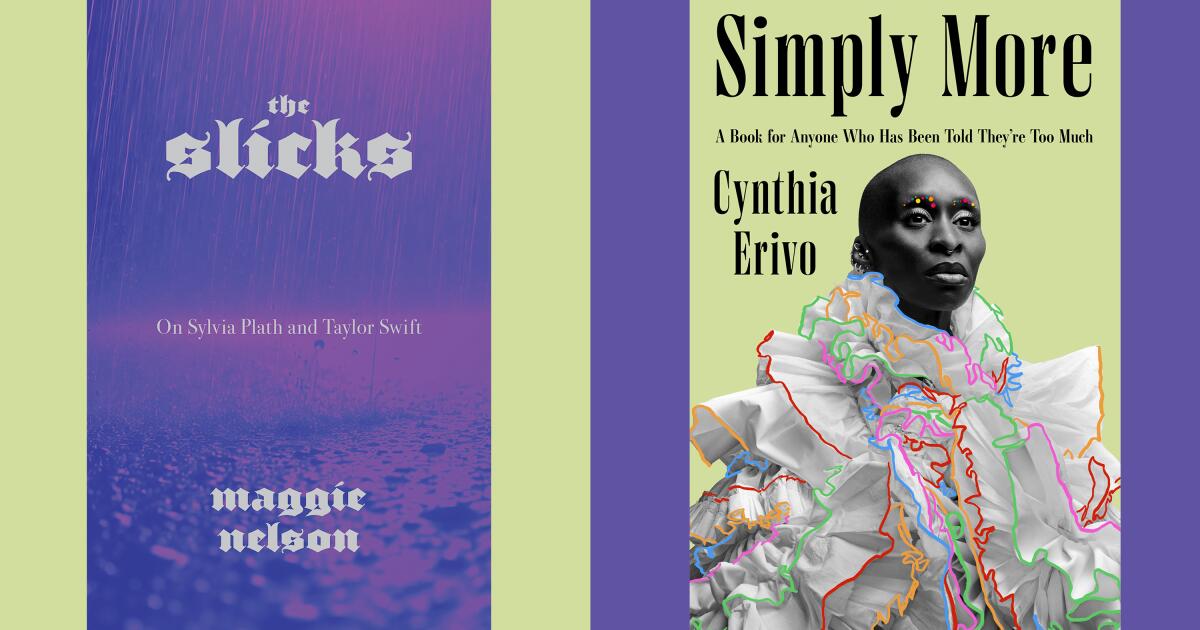
It might never have been so. In her first book, “Simply More,” a lean memoir interlaced with snippets of commonsensical advice, Erivo glowingly recalls her childhood in uber-diverse South London, where her Nigerian immigrant mom raised Cynthia and her younger sister in a maisonette “with everything shrunk down because it was such a small building.” Rather than bemoaning the hardships of growing up with a working single mom and an absent father, in “Simply More” Erivo expresses gratitude for the “kind of made-up family” that her neighbors of many languages comprised. “I learned so much about the world in that little space,” she writes, describing “an astonishing, captivating blend of cultures that influences me to this very day.”
“Simply More” explores Erivo’s milestones lived and lessons learned between her birth in 1987 and June 2025, when we meet her at 38, preparing to star in “Jesus Christ Superstar” at the Hollywood Bowl. By then Erivo has won an Emmy, a Grammy and a Tony, and she’s been nominated for an Oscar. She’s released several singles and two solo albums. She’s made her Broadway debut in her 2015-2017 run as Celie in “The Color Purple.” She’s played Harriet Tubman in the 2019 film “Harriet,” Aretha Franklin in the 2021 TV anthology series “Genius: Aretha,” and, most famously, Elphaba in “Wicked” (2024).
When she was cast as Jesus in 2025, Erivo’s achievements failed to protect her, a queer Black woman, from controversy fueled mostly by Christian conservatives. Fox News commentator Pastor John K. Amanchukwu Sr. called Erivo “too BALD, too BROWN, and too BI to play Jesus” on social media. This dispute just points out to me, yet again,” the resilient Erivo writes in “Simply More,” “that sometimes I’m simply more than many people expect or want.”
Cynthia Erivo at Los Angeles County Museum of Art.
(Monica Schipper / FilmMagic via Getty Images)
“Maybe you’re the same?” she asks the reader. “We who are just a bit more than others are … willing to be deeply, wholeheartedly, and authentically ourselves.”
Populating one’s life with equally expansive souls, Erivo advises, makes it easier to reframe “too much” as “simply more.” Much tea has been spilled on the nature of Erivo’s close connection with her “Wicked” co-star, Ariana Grande, including a fake post that went viral, calling theirs a “non-demi-curious semi-binary relationship.” In “Simply More” Erivo sets the record, well, straight. “Before Wicked really started rolling, Ariana and I … committed to protecting and caring for each other through this process. We were determined … to build on each other’s strengths, to encourage the other, to see if, like our voices, we could become more than the sum of our parts.”
Erivo follows this vignette and many others with questions that engage the reader in the conversation. “Is there someone in your life you can make a pact with, to care for, to be kind to, to support?” she writes. “Life is hard enough as it is. Commit to helping another person, and let that person commit to helping you.”
No matter what, Erivo says, “We cannot let other people’s judgments keep us from giving what we’re on this earth to give. Those who are afraid to approach the fullness of their own humanity are often threatened by those of us who are not. We can’t let that stop us.”
At first glance, the similarities between Cynthia Erivo and public intellectual Maggie Nelson seem limited to their shared sexual orientation (both identify as queer), and the late 2025 publication dates of their new books. The confluences deserve a deeper look.
Like Erivo, Nelson is a gleaming star in a vast sky. Excelling in multiple art forms, Nelson, too, is renowned for coloring outside the lines. Winner of the National Book Critics Circle Award, the recipient of Guggenheim, MacArthur, and National Endowment for the Arts fellowships among many other awards, Nelson writes poetry, autobiography, art criticism, and feminist, queer and identity theory, serving her fans from an abundant combo platter of critical and commercial success.
In “The Slicks: On Sylvia Plath and Taylor Swift,” Nelson invites her readers to consider another odd artistic couple, both of whom have also been accused of being “too much” in the realms of their productivity, the shared theme of their work (women’s intimate lives), and in the credit they claim for what they do. “Women scarcely need reminding that for every record broken, every freedom taken, every bit of power wielded, there is someone out there who would like very much to put them back in their place.”
Plath and Swift, Nelson argues, have been judged by “the same script that has greeted female profusion, personalism, and ambition literally for millennia.”
The New York Times, Nelson writes, is one perpetrator of that script. “The Times posed the question, ‘Will Swift ever voluntarily step away from the spotlight?’ as if beholding a woman in full flow and power invariably summoned the fantasy of her involuntary removal from the scene.”

Author Maggie Nelson.
(Sophie Bassouls / Sygma via Getty Images)
“The derision of the personal — especially in regard to women — as a politically, aesthetically, and ethically rotten source of art is hard to keep track of, as it arrives dressed up in new clothes every decade or two.” As Taylor Swift’s success makes clear — she is the wealthiest female musician on earth, “[A few grumpy critics don’t] dictate the terms of Swift’s reception. Her fans do, and her fans adore the abundance. For them, there’s no such thing as ‘too much.’”
Nelson finds other significant similarities between Swift and Plath. “Both evidence a nearly superhuman ability to perform or create under great pressure, albeit of distinct varieties… While critics of varying affiliations carry on with their distaste, readers and listeners everywhere continue to be drawn to deeply personal work.”
Arguing against the literary misogyny that “Slicks” uncovers and protests (the book title is the magazine industry term for the “slick,” as opposed to “pulp” magazines that published Plath), Nelson fiercely admires the dynamic duo that is the subject of the book. “Over the course of her short life,” Nelson writes, “Plath’s [work] included a copious amount of poetry, one novel published and another allegedly destroyed, short stories, letters, journals, children’s books, and more… Meanwhile, Swift’s flow goes on — record-breaking, omnipresent, its own version of unstoppable.”
Similarly, the reader is likely to fiercely admire the dynamic duo of Erivo and Nelson. As dissonant as these authors and their powerful books might seem, I found value in reading them as a pair. Erivo asks the central question from the interior point of view; Nelson peers at it through a sociological, historical lens. But the question raised by both pairs of female artists under investigation here — Erivo and Nelson, Plath and Swift — is the same. How can women of all persuasions, genres, professions, genders, backgrounds, races, personalities and social standings hasten the glacial speed at which female artists’ freedom — women’s freedom — is progressing: to freely write about our lives, to freely live them?
Taken together, the twin messages of these two books answer that age-old question with the age-old feminist slogan: “The personal is political.” Erivo focuses on the personal change required to “be deeply, wholeheartedly, and authentically ourselves;” Nelson on the political resistance needed to defeat feminism’s opponents “who would like very much to put them back in their place.” An army of self-loving, well-organized women, Erivo and Nelson assure us, can and surely will win.
Maran is the author of “The New Old Me” and a dozen other books. She lives in beautiful Silver Lake, Los Angeles.

Book Review
If you buy books linked on our site, The Times may earn a commission from Bookshop.org, whose fees support independent bookstores.
In 2024, in a story I wrote for this newspaper about a glam L.A. event, I name-checked “ ‘The Color Purple’ star Cynthia Erivo.” My editor deleted the description, noting, “Everyone knows who Cynthia Erivo is.”
It might never have been so. In her first book, “Simply More,” a lean memoir interlaced with snippets of commonsensical advice, Erivo glowingly recalls her childhood in uber-diverse South London, where her Nigerian immigrant mom raised Cynthia and her younger sister in a maisonette “with everything shrunk down because it was such a small building.” Rather than bemoaning the hardships of growing up with a working single mom and an absent father, in “Simply More” Erivo expresses gratitude for the “kind of made-up family” that her neighbors of many languages comprised. “I learned so much about the world in that little space,” she writes, describing “an astonishing, captivating blend of cultures that influences me to this very day.”
“Simply More” explores Erivo’s milestones lived and lessons learned between her birth in 1987 and June 2025, when we meet her at 38, preparing to star in “Jesus Christ Superstar” at the Hollywood Bowl. By then Erivo has won an Emmy, a Grammy and a Tony, and she’s been nominated for an Oscar. She’s released several singles and two solo albums. She’s made her Broadway debut in her 2015-2017 run as Celie in “The Color Purple.” She’s played Harriet Tubman in the 2019 film “Harriet,” Aretha Franklin in the 2021 TV anthology series “Genius: Aretha,” and, most famously, Elphaba in “Wicked” (2024).
When she was cast as Jesus in 2025, Erivo’s achievements failed to protect her, a queer Black woman, from controversy fueled mostly by Christian conservatives. Fox News commentator Pastor John K. Amanchukwu Sr. called Erivo “too BALD, too BROWN, and too BI to play Jesus” on social media. This dispute just points out to me, yet again,” the resilient Erivo writes in “Simply More,” “that sometimes I’m simply more than many people expect or want.”
Cynthia Erivo at Los Angeles County Museum of Art.
(Monica Schipper / FilmMagic via Getty Images)
“Maybe you’re the same?” she asks the reader. “We who are just a bit more than others are … willing to be deeply, wholeheartedly, and authentically ourselves.”
Populating one’s life with equally expansive souls, Erivo advises, makes it easier to reframe “too much” as “simply more.” Much tea has been spilled on the nature of Erivo’s close connection with her “Wicked” co-star, Ariana Grande, including a fake post that went viral, calling theirs a “non-demi-curious semi-binary relationship.” In “Simply More” Erivo sets the record, well, straight. “Before Wicked really started rolling, Ariana and I … committed to protecting and caring for each other through this process. We were determined … to build on each other’s strengths, to encourage the other, to see if, like our voices, we could become more than the sum of our parts.”
Erivo follows this vignette and many others with questions that engage the reader in the conversation. “Is there someone in your life you can make a pact with, to care for, to be kind to, to support?” she writes. “Life is hard enough as it is. Commit to helping another person, and let that person commit to helping you.”
No matter what, Erivo says, “We cannot let other people’s judgments keep us from giving what we’re on this earth to give. Those who are afraid to approach the fullness of their own humanity are often threatened by those of us who are not. We can’t let that stop us.”
At first glance, the similarities between Cynthia Erivo and public intellectual Maggie Nelson seem limited to their shared sexual orientation (both identify as queer), and the late 2025 publication dates of their new books. The confluences deserve a deeper look.
Like Erivo, Nelson is a gleaming star in a vast sky. Excelling in multiple art forms, Nelson, too, is renowned for coloring outside the lines. Winner of the National Book Critics Circle Award, the recipient of Guggenheim, MacArthur, and National Endowment for the Arts fellowships among many other awards, Nelson writes poetry, autobiography, art criticism, and feminist, queer and identity theory, serving her fans from an abundant combo platter of critical and commercial success.
In “The Slicks: On Sylvia Plath and Taylor Swift,” Nelson invites her readers to consider another odd artistic couple, both of whom have also been accused of being “too much” in the realms of their productivity, the shared theme of their work (women’s intimate lives), and in the credit they claim for what they do. “Women scarcely need reminding that for every record broken, every freedom taken, every bit of power wielded, there is someone out there who would like very much to put them back in their place.”
Plath and Swift, Nelson argues, have been judged by “the same script that has greeted female profusion, personalism, and ambition literally for millennia.”
The New York Times, Nelson writes, is one perpetrator of that script. “The Times posed the question, ‘Will Swift ever voluntarily step away from the spotlight?’ as if beholding a woman in full flow and power invariably summoned the fantasy of her involuntary removal from the scene.”
Author Maggie Nelson.
(Sophie Bassouls / Sygma via Getty Images)
“The derision of the personal — especially in regard to women — as a politically, aesthetically, and ethically rotten source of art is hard to keep track of, as it arrives dressed up in new clothes every decade or two.” As Taylor Swift’s success makes clear — she is the wealthiest female musician on earth, “[A few grumpy critics don’t] dictate the terms of Swift’s reception. Her fans do, and her fans adore the abundance. For them, there’s no such thing as ‘too much.’”
Nelson finds other significant similarities between Swift and Plath. “Both evidence a nearly superhuman ability to perform or create under great pressure, albeit of distinct varieties… While critics of varying affiliations carry on with their distaste, readers and listeners everywhere continue to be drawn to deeply personal work.”
Arguing against the literary misogyny that “Slicks” uncovers and protests (the book title is the magazine industry term for the “slick,” as opposed to “pulp” magazines that published Plath), Nelson fiercely admires the dynamic duo that is the subject of the book. “Over the course of her short life,” Nelson writes, “Plath’s [work] included a copious amount of poetry, one novel published and another allegedly destroyed, short stories, letters, journals, children’s books, and more… Meanwhile, Swift’s flow goes on — record-breaking, omnipresent, its own version of unstoppable.”
Similarly, the reader is likely to fiercely admire the dynamic duo of Erivo and Nelson. As dissonant as these authors and their powerful books might seem, I found value in reading them as a pair. Erivo asks the central question from the interior point of view; Nelson peers at it through a sociological, historical lens. But the question raised by both pairs of female artists under investigation here — Erivo and Nelson, Plath and Swift — is the same. How can women of all persuasions, genres, professions, genders, backgrounds, races, personalities and social standings hasten the glacial speed at which female artists’ freedom — women’s freedom — is progressing: to freely write about our lives, to freely live them?
Taken together, the twin messages of these two books answer that age-old question with the age-old feminist slogan: “The personal is political.” Erivo focuses on the personal change required to “be deeply, wholeheartedly, and authentically ourselves;” Nelson on the political resistance needed to defeat feminism’s opponents “who would like very much to put them back in their place.” An army of self-loving, well-organized women, Erivo and Nelson assure us, can and surely will win.
Maran is the author of “The New Old Me” and a dozen other books. She lives in beautiful Silver Lake, Los Angeles.

Book Review
If you buy books linked on our site, The Times may earn a commission from Bookshop.org, whose fees support independent bookstores.
In 2024, in a story I wrote for this newspaper about a glam L.A. event, I name-checked “ ‘The Color Purple’ star Cynthia Erivo.” My editor deleted the description, noting, “Everyone knows who Cynthia Erivo is.”
It might never have been so. In her first book, “Simply More,” a lean memoir interlaced with snippets of commonsensical advice, Erivo glowingly recalls her childhood in uber-diverse South London, where her Nigerian immigrant mom raised Cynthia and her younger sister in a maisonette “with everything shrunk down because it was such a small building.” Rather than bemoaning the hardships of growing up with a working single mom and an absent father, in “Simply More” Erivo expresses gratitude for the “kind of made-up family” that her neighbors of many languages comprised. “I learned so much about the world in that little space,” she writes, describing “an astonishing, captivating blend of cultures that influences me to this very day.”
“Simply More” explores Erivo’s milestones lived and lessons learned between her birth in 1987 and June 2025, when we meet her at 38, preparing to star in “Jesus Christ Superstar” at the Hollywood Bowl. By then Erivo has won an Emmy, a Grammy and a Tony, and she’s been nominated for an Oscar. She’s released several singles and two solo albums. She’s made her Broadway debut in her 2015-2017 run as Celie in “The Color Purple.” She’s played Harriet Tubman in the 2019 film “Harriet,” Aretha Franklin in the 2021 TV anthology series “Genius: Aretha,” and, most famously, Elphaba in “Wicked” (2024).
When she was cast as Jesus in 2025, Erivo’s achievements failed to protect her, a queer Black woman, from controversy fueled mostly by Christian conservatives. Fox News commentator Pastor John K. Amanchukwu Sr. called Erivo “too BALD, too BROWN, and too BI to play Jesus” on social media. This dispute just points out to me, yet again,” the resilient Erivo writes in “Simply More,” “that sometimes I’m simply more than many people expect or want.”
Cynthia Erivo at Los Angeles County Museum of Art.
(Monica Schipper / FilmMagic via Getty Images)
“Maybe you’re the same?” she asks the reader. “We who are just a bit more than others are … willing to be deeply, wholeheartedly, and authentically ourselves.”
Populating one’s life with equally expansive souls, Erivo advises, makes it easier to reframe “too much” as “simply more.” Much tea has been spilled on the nature of Erivo’s close connection with her “Wicked” co-star, Ariana Grande, including a fake post that went viral, calling theirs a “non-demi-curious semi-binary relationship.” In “Simply More” Erivo sets the record, well, straight. “Before Wicked really started rolling, Ariana and I … committed to protecting and caring for each other through this process. We were determined … to build on each other’s strengths, to encourage the other, to see if, like our voices, we could become more than the sum of our parts.”
Erivo follows this vignette and many others with questions that engage the reader in the conversation. “Is there someone in your life you can make a pact with, to care for, to be kind to, to support?” she writes. “Life is hard enough as it is. Commit to helping another person, and let that person commit to helping you.”
No matter what, Erivo says, “We cannot let other people’s judgments keep us from giving what we’re on this earth to give. Those who are afraid to approach the fullness of their own humanity are often threatened by those of us who are not. We can’t let that stop us.”
At first glance, the similarities between Cynthia Erivo and public intellectual Maggie Nelson seem limited to their shared sexual orientation (both identify as queer), and the late 2025 publication dates of their new books. The confluences deserve a deeper look.
Like Erivo, Nelson is a gleaming star in a vast sky. Excelling in multiple art forms, Nelson, too, is renowned for coloring outside the lines. Winner of the National Book Critics Circle Award, the recipient of Guggenheim, MacArthur, and National Endowment for the Arts fellowships among many other awards, Nelson writes poetry, autobiography, art criticism, and feminist, queer and identity theory, serving her fans from an abundant combo platter of critical and commercial success.
In “The Slicks: On Sylvia Plath and Taylor Swift,” Nelson invites her readers to consider another odd artistic couple, both of whom have also been accused of being “too much” in the realms of their productivity, the shared theme of their work (women’s intimate lives), and in the credit they claim for what they do. “Women scarcely need reminding that for every record broken, every freedom taken, every bit of power wielded, there is someone out there who would like very much to put them back in their place.”
Plath and Swift, Nelson argues, have been judged by “the same script that has greeted female profusion, personalism, and ambition literally for millennia.”
The New York Times, Nelson writes, is one perpetrator of that script. “The Times posed the question, ‘Will Swift ever voluntarily step away from the spotlight?’ as if beholding a woman in full flow and power invariably summoned the fantasy of her involuntary removal from the scene.”
Author Maggie Nelson.
(Sophie Bassouls / Sygma via Getty Images)
“The derision of the personal — especially in regard to women — as a politically, aesthetically, and ethically rotten source of art is hard to keep track of, as it arrives dressed up in new clothes every decade or two.” As Taylor Swift’s success makes clear — she is the wealthiest female musician on earth, “[A few grumpy critics don’t] dictate the terms of Swift’s reception. Her fans do, and her fans adore the abundance. For them, there’s no such thing as ‘too much.’”
Nelson finds other significant similarities between Swift and Plath. “Both evidence a nearly superhuman ability to perform or create under great pressure, albeit of distinct varieties… While critics of varying affiliations carry on with their distaste, readers and listeners everywhere continue to be drawn to deeply personal work.”
Arguing against the literary misogyny that “Slicks” uncovers and protests (the book title is the magazine industry term for the “slick,” as opposed to “pulp” magazines that published Plath), Nelson fiercely admires the dynamic duo that is the subject of the book. “Over the course of her short life,” Nelson writes, “Plath’s [work] included a copious amount of poetry, one novel published and another allegedly destroyed, short stories, letters, journals, children’s books, and more… Meanwhile, Swift’s flow goes on — record-breaking, omnipresent, its own version of unstoppable.”
Similarly, the reader is likely to fiercely admire the dynamic duo of Erivo and Nelson. As dissonant as these authors and their powerful books might seem, I found value in reading them as a pair. Erivo asks the central question from the interior point of view; Nelson peers at it through a sociological, historical lens. But the question raised by both pairs of female artists under investigation here — Erivo and Nelson, Plath and Swift — is the same. How can women of all persuasions, genres, professions, genders, backgrounds, races, personalities and social standings hasten the glacial speed at which female artists’ freedom — women’s freedom — is progressing: to freely write about our lives, to freely live them?
Taken together, the twin messages of these two books answer that age-old question with the age-old feminist slogan: “The personal is political.” Erivo focuses on the personal change required to “be deeply, wholeheartedly, and authentically ourselves;” Nelson on the political resistance needed to defeat feminism’s opponents “who would like very much to put them back in their place.” An army of self-loving, well-organized women, Erivo and Nelson assure us, can and surely will win.
Maran is the author of “The New Old Me” and a dozen other books. She lives in beautiful Silver Lake, Los Angeles.
Book Review
If you buy books linked on our site, The Times may earn a commission from Bookshop.org, whose fees support independent bookstores.
In 2024, in a story I wrote for this newspaper about a glam L.A. event, I name-checked “ ‘The Color Purple’ star Cynthia Erivo.” My editor deleted the description, noting, “Everyone knows who Cynthia Erivo is.”
It might never have been so. In her first book, “Simply More,” a lean memoir interlaced with snippets of commonsensical advice, Erivo glowingly recalls her childhood in uber-diverse South London, where her Nigerian immigrant mom raised Cynthia and her younger sister in a maisonette “with everything shrunk down because it was such a small building.” Rather than bemoaning the hardships of growing up with a working single mom and an absent father, in “Simply More” Erivo expresses gratitude for the “kind of made-up family” that her neighbors of many languages comprised. “I learned so much about the world in that little space,” she writes, describing “an astonishing, captivating blend of cultures that influences me to this very day.”
“Simply More” explores Erivo’s milestones lived and lessons learned between her birth in 1987 and June 2025, when we meet her at 38, preparing to star in “Jesus Christ Superstar” at the Hollywood Bowl. By then Erivo has won an Emmy, a Grammy and a Tony, and she’s been nominated for an Oscar. She’s released several singles and two solo albums. She’s made her Broadway debut in her 2015-2017 run as Celie in “The Color Purple.” She’s played Harriet Tubman in the 2019 film “Harriet,” Aretha Franklin in the 2021 TV anthology series “Genius: Aretha,” and, most famously, Elphaba in “Wicked” (2024).
When she was cast as Jesus in 2025, Erivo’s achievements failed to protect her, a queer Black woman, from controversy fueled mostly by Christian conservatives. Fox News commentator Pastor John K. Amanchukwu Sr. called Erivo “too BALD, too BROWN, and too BI to play Jesus” on social media. This dispute just points out to me, yet again,” the resilient Erivo writes in “Simply More,” “that sometimes I’m simply more than many people expect or want.”
Cynthia Erivo at Los Angeles County Museum of Art.
(Monica Schipper / FilmMagic via Getty Images)
“Maybe you’re the same?” she asks the reader. “We who are just a bit more than others are … willing to be deeply, wholeheartedly, and authentically ourselves.”
Populating one’s life with equally expansive souls, Erivo advises, makes it easier to reframe “too much” as “simply more.” Much tea has been spilled on the nature of Erivo’s close connection with her “Wicked” co-star, Ariana Grande, including a fake post that went viral, calling theirs a “non-demi-curious semi-binary relationship.” In “Simply More” Erivo sets the record, well, straight. “Before Wicked really started rolling, Ariana and I … committed to protecting and caring for each other through this process. We were determined … to build on each other’s strengths, to encourage the other, to see if, like our voices, we could become more than the sum of our parts.”
Erivo follows this vignette and many others with questions that engage the reader in the conversation. “Is there someone in your life you can make a pact with, to care for, to be kind to, to support?” she writes. “Life is hard enough as it is. Commit to helping another person, and let that person commit to helping you.”
No matter what, Erivo says, “We cannot let other people’s judgments keep us from giving what we’re on this earth to give. Those who are afraid to approach the fullness of their own humanity are often threatened by those of us who are not. We can’t let that stop us.”
At first glance, the similarities between Cynthia Erivo and public intellectual Maggie Nelson seem limited to their shared sexual orientation (both identify as queer), and the late 2025 publication dates of their new books. The confluences deserve a deeper look.
Like Erivo, Nelson is a gleaming star in a vast sky. Excelling in multiple art forms, Nelson, too, is renowned for coloring outside the lines. Winner of the National Book Critics Circle Award, the recipient of Guggenheim, MacArthur, and National Endowment for the Arts fellowships among many other awards, Nelson writes poetry, autobiography, art criticism, and feminist, queer and identity theory, serving her fans from an abundant combo platter of critical and commercial success.
In “The Slicks: On Sylvia Plath and Taylor Swift,” Nelson invites her readers to consider another odd artistic couple, both of whom have also been accused of being “too much” in the realms of their productivity, the shared theme of their work (women’s intimate lives), and in the credit they claim for what they do. “Women scarcely need reminding that for every record broken, every freedom taken, every bit of power wielded, there is someone out there who would like very much to put them back in their place.”
Plath and Swift, Nelson argues, have been judged by “the same script that has greeted female profusion, personalism, and ambition literally for millennia.”
The New York Times, Nelson writes, is one perpetrator of that script. “The Times posed the question, ‘Will Swift ever voluntarily step away from the spotlight?’ as if beholding a woman in full flow and power invariably summoned the fantasy of her involuntary removal from the scene.”
Author Maggie Nelson.
(Sophie Bassouls / Sygma via Getty Images)
“The derision of the personal — especially in regard to women — as a politically, aesthetically, and ethically rotten source of art is hard to keep track of, as it arrives dressed up in new clothes every decade or two.” As Taylor Swift’s success makes clear — she is the wealthiest female musician on earth, “[A few grumpy critics don’t] dictate the terms of Swift’s reception. Her fans do, and her fans adore the abundance. For them, there’s no such thing as ‘too much.’”
Nelson finds other significant similarities between Swift and Plath. “Both evidence a nearly superhuman ability to perform or create under great pressure, albeit of distinct varieties… While critics of varying affiliations carry on with their distaste, readers and listeners everywhere continue to be drawn to deeply personal work.”
Arguing against the literary misogyny that “Slicks” uncovers and protests (the book title is the magazine industry term for the “slick,” as opposed to “pulp” magazines that published Plath), Nelson fiercely admires the dynamic duo that is the subject of the book. “Over the course of her short life,” Nelson writes, “Plath’s [work] included a copious amount of poetry, one novel published and another allegedly destroyed, short stories, letters, journals, children’s books, and more… Meanwhile, Swift’s flow goes on — record-breaking, omnipresent, its own version of unstoppable.”
Similarly, the reader is likely to fiercely admire the dynamic duo of Erivo and Nelson. As dissonant as these authors and their powerful books might seem, I found value in reading them as a pair. Erivo asks the central question from the interior point of view; Nelson peers at it through a sociological, historical lens. But the question raised by both pairs of female artists under investigation here — Erivo and Nelson, Plath and Swift — is the same. How can women of all persuasions, genres, professions, genders, backgrounds, races, personalities and social standings hasten the glacial speed at which female artists’ freedom — women’s freedom — is progressing: to freely write about our lives, to freely live them?
Taken together, the twin messages of these two books answer that age-old question with the age-old feminist slogan: “The personal is political.” Erivo focuses on the personal change required to “be deeply, wholeheartedly, and authentically ourselves;” Nelson on the political resistance needed to defeat feminism’s opponents “who would like very much to put them back in their place.” An army of self-loving, well-organized women, Erivo and Nelson assure us, can and surely will win.
Maran is the author of “The New Old Me” and a dozen other books. She lives in beautiful Silver Lake, Los Angeles.

Book Review
If you buy books linked on our site, The Times may earn a commission from Bookshop.org, whose fees support independent bookstores.
In 2024, in a story I wrote for this newspaper about a glam L.A. event, I name-checked “ ‘The Color Purple’ star Cynthia Erivo.” My editor deleted the description, noting, “Everyone knows who Cynthia Erivo is.”
It might never have been so. In her first book, “Simply More,” a lean memoir interlaced with snippets of commonsensical advice, Erivo glowingly recalls her childhood in uber-diverse South London, where her Nigerian immigrant mom raised Cynthia and her younger sister in a maisonette “with everything shrunk down because it was such a small building.” Rather than bemoaning the hardships of growing up with a working single mom and an absent father, in “Simply More” Erivo expresses gratitude for the “kind of made-up family” that her neighbors of many languages comprised. “I learned so much about the world in that little space,” she writes, describing “an astonishing, captivating blend of cultures that influences me to this very day.”
“Simply More” explores Erivo’s milestones lived and lessons learned between her birth in 1987 and June 2025, when we meet her at 38, preparing to star in “Jesus Christ Superstar” at the Hollywood Bowl. By then Erivo has won an Emmy, a Grammy and a Tony, and she’s been nominated for an Oscar. She’s released several singles and two solo albums. She’s made her Broadway debut in her 2015-2017 run as Celie in “The Color Purple.” She’s played Harriet Tubman in the 2019 film “Harriet,” Aretha Franklin in the 2021 TV anthology series “Genius: Aretha,” and, most famously, Elphaba in “Wicked” (2024).
When she was cast as Jesus in 2025, Erivo’s achievements failed to protect her, a queer Black woman, from controversy fueled mostly by Christian conservatives. Fox News commentator Pastor John K. Amanchukwu Sr. called Erivo “too BALD, too BROWN, and too BI to play Jesus” on social media. This dispute just points out to me, yet again,” the resilient Erivo writes in “Simply More,” “that sometimes I’m simply more than many people expect or want.”
Cynthia Erivo at Los Angeles County Museum of Art.
(Monica Schipper / FilmMagic via Getty Images)
“Maybe you’re the same?” she asks the reader. “We who are just a bit more than others are … willing to be deeply, wholeheartedly, and authentically ourselves.”
Populating one’s life with equally expansive souls, Erivo advises, makes it easier to reframe “too much” as “simply more.” Much tea has been spilled on the nature of Erivo’s close connection with her “Wicked” co-star, Ariana Grande, including a fake post that went viral, calling theirs a “non-demi-curious semi-binary relationship.” In “Simply More” Erivo sets the record, well, straight. “Before Wicked really started rolling, Ariana and I … committed to protecting and caring for each other through this process. We were determined … to build on each other’s strengths, to encourage the other, to see if, like our voices, we could become more than the sum of our parts.”
Erivo follows this vignette and many others with questions that engage the reader in the conversation. “Is there someone in your life you can make a pact with, to care for, to be kind to, to support?” she writes. “Life is hard enough as it is. Commit to helping another person, and let that person commit to helping you.”
No matter what, Erivo says, “We cannot let other people’s judgments keep us from giving what we’re on this earth to give. Those who are afraid to approach the fullness of their own humanity are often threatened by those of us who are not. We can’t let that stop us.”
At first glance, the similarities between Cynthia Erivo and public intellectual Maggie Nelson seem limited to their shared sexual orientation (both identify as queer), and the late 2025 publication dates of their new books. The confluences deserve a deeper look.
Like Erivo, Nelson is a gleaming star in a vast sky. Excelling in multiple art forms, Nelson, too, is renowned for coloring outside the lines. Winner of the National Book Critics Circle Award, the recipient of Guggenheim, MacArthur, and National Endowment for the Arts fellowships among many other awards, Nelson writes poetry, autobiography, art criticism, and feminist, queer and identity theory, serving her fans from an abundant combo platter of critical and commercial success.
In “The Slicks: On Sylvia Plath and Taylor Swift,” Nelson invites her readers to consider another odd artistic couple, both of whom have also been accused of being “too much” in the realms of their productivity, the shared theme of their work (women’s intimate lives), and in the credit they claim for what they do. “Women scarcely need reminding that for every record broken, every freedom taken, every bit of power wielded, there is someone out there who would like very much to put them back in their place.”
Plath and Swift, Nelson argues, have been judged by “the same script that has greeted female profusion, personalism, and ambition literally for millennia.”
The New York Times, Nelson writes, is one perpetrator of that script. “The Times posed the question, ‘Will Swift ever voluntarily step away from the spotlight?’ as if beholding a woman in full flow and power invariably summoned the fantasy of her involuntary removal from the scene.”
Author Maggie Nelson.
(Sophie Bassouls / Sygma via Getty Images)
“The derision of the personal — especially in regard to women — as a politically, aesthetically, and ethically rotten source of art is hard to keep track of, as it arrives dressed up in new clothes every decade or two.” As Taylor Swift’s success makes clear — she is the wealthiest female musician on earth, “[A few grumpy critics don’t] dictate the terms of Swift’s reception. Her fans do, and her fans adore the abundance. For them, there’s no such thing as ‘too much.’”
Nelson finds other significant similarities between Swift and Plath. “Both evidence a nearly superhuman ability to perform or create under great pressure, albeit of distinct varieties… While critics of varying affiliations carry on with their distaste, readers and listeners everywhere continue to be drawn to deeply personal work.”
Arguing against the literary misogyny that “Slicks” uncovers and protests (the book title is the magazine industry term for the “slick,” as opposed to “pulp” magazines that published Plath), Nelson fiercely admires the dynamic duo that is the subject of the book. “Over the course of her short life,” Nelson writes, “Plath’s [work] included a copious amount of poetry, one novel published and another allegedly destroyed, short stories, letters, journals, children’s books, and more… Meanwhile, Swift’s flow goes on — record-breaking, omnipresent, its own version of unstoppable.”
Similarly, the reader is likely to fiercely admire the dynamic duo of Erivo and Nelson. As dissonant as these authors and their powerful books might seem, I found value in reading them as a pair. Erivo asks the central question from the interior point of view; Nelson peers at it through a sociological, historical lens. But the question raised by both pairs of female artists under investigation here — Erivo and Nelson, Plath and Swift — is the same. How can women of all persuasions, genres, professions, genders, backgrounds, races, personalities and social standings hasten the glacial speed at which female artists’ freedom — women’s freedom — is progressing: to freely write about our lives, to freely live them?
Taken together, the twin messages of these two books answer that age-old question with the age-old feminist slogan: “The personal is political.” Erivo focuses on the personal change required to “be deeply, wholeheartedly, and authentically ourselves;” Nelson on the political resistance needed to defeat feminism’s opponents “who would like very much to put them back in their place.” An army of self-loving, well-organized women, Erivo and Nelson assure us, can and surely will win.
Maran is the author of “The New Old Me” and a dozen other books. She lives in beautiful Silver Lake, Los Angeles.
Book Review
If you buy books linked on our site, The Times may earn a commission from Bookshop.org, whose fees support independent bookstores.
In 2024, in a story I wrote for this newspaper about a glam L.A. event, I name-checked “ ‘The Color Purple’ star Cynthia Erivo.” My editor deleted the description, noting, “Everyone knows who Cynthia Erivo is.”
It might never have been so. In her first book, “Simply More,” a lean memoir interlaced with snippets of commonsensical advice, Erivo glowingly recalls her childhood in uber-diverse South London, where her Nigerian immigrant mom raised Cynthia and her younger sister in a maisonette “with everything shrunk down because it was such a small building.” Rather than bemoaning the hardships of growing up with a working single mom and an absent father, in “Simply More” Erivo expresses gratitude for the “kind of made-up family” that her neighbors of many languages comprised. “I learned so much about the world in that little space,” she writes, describing “an astonishing, captivating blend of cultures that influences me to this very day.”
“Simply More” explores Erivo’s milestones lived and lessons learned between her birth in 1987 and June 2025, when we meet her at 38, preparing to star in “Jesus Christ Superstar” at the Hollywood Bowl. By then Erivo has won an Emmy, a Grammy and a Tony, and she’s been nominated for an Oscar. She’s released several singles and two solo albums. She’s made her Broadway debut in her 2015-2017 run as Celie in “The Color Purple.” She’s played Harriet Tubman in the 2019 film “Harriet,” Aretha Franklin in the 2021 TV anthology series “Genius: Aretha,” and, most famously, Elphaba in “Wicked” (2024).
When she was cast as Jesus in 2025, Erivo’s achievements failed to protect her, a queer Black woman, from controversy fueled mostly by Christian conservatives. Fox News commentator Pastor John K. Amanchukwu Sr. called Erivo “too BALD, too BROWN, and too BI to play Jesus” on social media. This dispute just points out to me, yet again,” the resilient Erivo writes in “Simply More,” “that sometimes I’m simply more than many people expect or want.”
Cynthia Erivo at Los Angeles County Museum of Art.
(Monica Schipper / FilmMagic via Getty Images)
“Maybe you’re the same?” she asks the reader. “We who are just a bit more than others are … willing to be deeply, wholeheartedly, and authentically ourselves.”
Populating one’s life with equally expansive souls, Erivo advises, makes it easier to reframe “too much” as “simply more.” Much tea has been spilled on the nature of Erivo’s close connection with her “Wicked” co-star, Ariana Grande, including a fake post that went viral, calling theirs a “non-demi-curious semi-binary relationship.” In “Simply More” Erivo sets the record, well, straight. “Before Wicked really started rolling, Ariana and I … committed to protecting and caring for each other through this process. We were determined … to build on each other’s strengths, to encourage the other, to see if, like our voices, we could become more than the sum of our parts.”
Erivo follows this vignette and many others with questions that engage the reader in the conversation. “Is there someone in your life you can make a pact with, to care for, to be kind to, to support?” she writes. “Life is hard enough as it is. Commit to helping another person, and let that person commit to helping you.”
No matter what, Erivo says, “We cannot let other people’s judgments keep us from giving what we’re on this earth to give. Those who are afraid to approach the fullness of their own humanity are often threatened by those of us who are not. We can’t let that stop us.”
At first glance, the similarities between Cynthia Erivo and public intellectual Maggie Nelson seem limited to their shared sexual orientation (both identify as queer), and the late 2025 publication dates of their new books. The confluences deserve a deeper look.
Like Erivo, Nelson is a gleaming star in a vast sky. Excelling in multiple art forms, Nelson, too, is renowned for coloring outside the lines. Winner of the National Book Critics Circle Award, the recipient of Guggenheim, MacArthur, and National Endowment for the Arts fellowships among many other awards, Nelson writes poetry, autobiography, art criticism, and feminist, queer and identity theory, serving her fans from an abundant combo platter of critical and commercial success.
In “The Slicks: On Sylvia Plath and Taylor Swift,” Nelson invites her readers to consider another odd artistic couple, both of whom have also been accused of being “too much” in the realms of their productivity, the shared theme of their work (women’s intimate lives), and in the credit they claim for what they do. “Women scarcely need reminding that for every record broken, every freedom taken, every bit of power wielded, there is someone out there who would like very much to put them back in their place.”
Plath and Swift, Nelson argues, have been judged by “the same script that has greeted female profusion, personalism, and ambition literally for millennia.”
The New York Times, Nelson writes, is one perpetrator of that script. “The Times posed the question, ‘Will Swift ever voluntarily step away from the spotlight?’ as if beholding a woman in full flow and power invariably summoned the fantasy of her involuntary removal from the scene.”
Author Maggie Nelson.
(Sophie Bassouls / Sygma via Getty Images)
“The derision of the personal — especially in regard to women — as a politically, aesthetically, and ethically rotten source of art is hard to keep track of, as it arrives dressed up in new clothes every decade or two.” As Taylor Swift’s success makes clear — she is the wealthiest female musician on earth, “[A few grumpy critics don’t] dictate the terms of Swift’s reception. Her fans do, and her fans adore the abundance. For them, there’s no such thing as ‘too much.’”
Nelson finds other significant similarities between Swift and Plath. “Both evidence a nearly superhuman ability to perform or create under great pressure, albeit of distinct varieties… While critics of varying affiliations carry on with their distaste, readers and listeners everywhere continue to be drawn to deeply personal work.”
Arguing against the literary misogyny that “Slicks” uncovers and protests (the book title is the magazine industry term for the “slick,” as opposed to “pulp” magazines that published Plath), Nelson fiercely admires the dynamic duo that is the subject of the book. “Over the course of her short life,” Nelson writes, “Plath’s [work] included a copious amount of poetry, one novel published and another allegedly destroyed, short stories, letters, journals, children’s books, and more… Meanwhile, Swift’s flow goes on — record-breaking, omnipresent, its own version of unstoppable.”
Similarly, the reader is likely to fiercely admire the dynamic duo of Erivo and Nelson. As dissonant as these authors and their powerful books might seem, I found value in reading them as a pair. Erivo asks the central question from the interior point of view; Nelson peers at it through a sociological, historical lens. But the question raised by both pairs of female artists under investigation here — Erivo and Nelson, Plath and Swift — is the same. How can women of all persuasions, genres, professions, genders, backgrounds, races, personalities and social standings hasten the glacial speed at which female artists’ freedom — women’s freedom — is progressing: to freely write about our lives, to freely live them?
Taken together, the twin messages of these two books answer that age-old question with the age-old feminist slogan: “The personal is political.” Erivo focuses on the personal change required to “be deeply, wholeheartedly, and authentically ourselves;” Nelson on the political resistance needed to defeat feminism’s opponents “who would like very much to put them back in their place.” An army of self-loving, well-organized women, Erivo and Nelson assure us, can and surely will win.
Maran is the author of “The New Old Me” and a dozen other books. She lives in beautiful Silver Lake, Los Angeles.
Book Review
If you buy books linked on our site, The Times may earn a commission from Bookshop.org, whose fees support independent bookstores.
In 2024, in a story I wrote for this newspaper about a glam L.A. event, I name-checked “ ‘The Color Purple’ star Cynthia Erivo.” My editor deleted the description, noting, “Everyone knows who Cynthia Erivo is.”
It might never have been so. In her first book, “Simply More,” a lean memoir interlaced with snippets of commonsensical advice, Erivo glowingly recalls her childhood in uber-diverse South London, where her Nigerian immigrant mom raised Cynthia and her younger sister in a maisonette “with everything shrunk down because it was such a small building.” Rather than bemoaning the hardships of growing up with a working single mom and an absent father, in “Simply More” Erivo expresses gratitude for the “kind of made-up family” that her neighbors of many languages comprised. “I learned so much about the world in that little space,” she writes, describing “an astonishing, captivating blend of cultures that influences me to this very day.”
“Simply More” explores Erivo’s milestones lived and lessons learned between her birth in 1987 and June 2025, when we meet her at 38, preparing to star in “Jesus Christ Superstar” at the Hollywood Bowl. By then Erivo has won an Emmy, a Grammy and a Tony, and she’s been nominated for an Oscar. She’s released several singles and two solo albums. She’s made her Broadway debut in her 2015-2017 run as Celie in “The Color Purple.” She’s played Harriet Tubman in the 2019 film “Harriet,” Aretha Franklin in the 2021 TV anthology series “Genius: Aretha,” and, most famously, Elphaba in “Wicked” (2024).
When she was cast as Jesus in 2025, Erivo’s achievements failed to protect her, a queer Black woman, from controversy fueled mostly by Christian conservatives. Fox News commentator Pastor John K. Amanchukwu Sr. called Erivo “too BALD, too BROWN, and too BI to play Jesus” on social media. This dispute just points out to me, yet again,” the resilient Erivo writes in “Simply More,” “that sometimes I’m simply more than many people expect or want.”
Cynthia Erivo at Los Angeles County Museum of Art.
(Monica Schipper / FilmMagic via Getty Images)
“Maybe you’re the same?” she asks the reader. “We who are just a bit more than others are … willing to be deeply, wholeheartedly, and authentically ourselves.”
Populating one’s life with equally expansive souls, Erivo advises, makes it easier to reframe “too much” as “simply more.” Much tea has been spilled on the nature of Erivo’s close connection with her “Wicked” co-star, Ariana Grande, including a fake post that went viral, calling theirs a “non-demi-curious semi-binary relationship.” In “Simply More” Erivo sets the record, well, straight. “Before Wicked really started rolling, Ariana and I … committed to protecting and caring for each other through this process. We were determined … to build on each other’s strengths, to encourage the other, to see if, like our voices, we could become more than the sum of our parts.”
Erivo follows this vignette and many others with questions that engage the reader in the conversation. “Is there someone in your life you can make a pact with, to care for, to be kind to, to support?” she writes. “Life is hard enough as it is. Commit to helping another person, and let that person commit to helping you.”
No matter what, Erivo says, “We cannot let other people’s judgments keep us from giving what we’re on this earth to give. Those who are afraid to approach the fullness of their own humanity are often threatened by those of us who are not. We can’t let that stop us.”
At first glance, the similarities between Cynthia Erivo and public intellectual Maggie Nelson seem limited to their shared sexual orientation (both identify as queer), and the late 2025 publication dates of their new books. The confluences deserve a deeper look.
Like Erivo, Nelson is a gleaming star in a vast sky. Excelling in multiple art forms, Nelson, too, is renowned for coloring outside the lines. Winner of the National Book Critics Circle Award, the recipient of Guggenheim, MacArthur, and National Endowment for the Arts fellowships among many other awards, Nelson writes poetry, autobiography, art criticism, and feminist, queer and identity theory, serving her fans from an abundant combo platter of critical and commercial success.
In “The Slicks: On Sylvia Plath and Taylor Swift,” Nelson invites her readers to consider another odd artistic couple, both of whom have also been accused of being “too much” in the realms of their productivity, the shared theme of their work (women’s intimate lives), and in the credit they claim for what they do. “Women scarcely need reminding that for every record broken, every freedom taken, every bit of power wielded, there is someone out there who would like very much to put them back in their place.”
Plath and Swift, Nelson argues, have been judged by “the same script that has greeted female profusion, personalism, and ambition literally for millennia.”
The New York Times, Nelson writes, is one perpetrator of that script. “The Times posed the question, ‘Will Swift ever voluntarily step away from the spotlight?’ as if beholding a woman in full flow and power invariably summoned the fantasy of her involuntary removal from the scene.”
Author Maggie Nelson.
(Sophie Bassouls / Sygma via Getty Images)
“The derision of the personal — especially in regard to women — as a politically, aesthetically, and ethically rotten source of art is hard to keep track of, as it arrives dressed up in new clothes every decade or two.” As Taylor Swift’s success makes clear — she is the wealthiest female musician on earth, “[A few grumpy critics don’t] dictate the terms of Swift’s reception. Her fans do, and her fans adore the abundance. For them, there’s no such thing as ‘too much.’”
Nelson finds other significant similarities between Swift and Plath. “Both evidence a nearly superhuman ability to perform or create under great pressure, albeit of distinct varieties… While critics of varying affiliations carry on with their distaste, readers and listeners everywhere continue to be drawn to deeply personal work.”
Arguing against the literary misogyny that “Slicks” uncovers and protests (the book title is the magazine industry term for the “slick,” as opposed to “pulp” magazines that published Plath), Nelson fiercely admires the dynamic duo that is the subject of the book. “Over the course of her short life,” Nelson writes, “Plath’s [work] included a copious amount of poetry, one novel published and another allegedly destroyed, short stories, letters, journals, children’s books, and more… Meanwhile, Swift’s flow goes on — record-breaking, omnipresent, its own version of unstoppable.”
Similarly, the reader is likely to fiercely admire the dynamic duo of Erivo and Nelson. As dissonant as these authors and their powerful books might seem, I found value in reading them as a pair. Erivo asks the central question from the interior point of view; Nelson peers at it through a sociological, historical lens. But the question raised by both pairs of female artists under investigation here — Erivo and Nelson, Plath and Swift — is the same. How can women of all persuasions, genres, professions, genders, backgrounds, races, personalities and social standings hasten the glacial speed at which female artists’ freedom — women’s freedom — is progressing: to freely write about our lives, to freely live them?
Taken together, the twin messages of these two books answer that age-old question with the age-old feminist slogan: “The personal is political.” Erivo focuses on the personal change required to “be deeply, wholeheartedly, and authentically ourselves;” Nelson on the political resistance needed to defeat feminism’s opponents “who would like very much to put them back in their place.” An army of self-loving, well-organized women, Erivo and Nelson assure us, can and surely will win.
Maran is the author of “The New Old Me” and a dozen other books. She lives in beautiful Silver Lake, Los Angeles.
Book Review
If you buy books linked on our site, The Times may earn a commission from Bookshop.org, whose fees support independent bookstores.
In 2024, in a story I wrote for this newspaper about a glam L.A. event, I name-checked “ ‘The Color Purple’ star Cynthia Erivo.” My editor deleted the description, noting, “Everyone knows who Cynthia Erivo is.”
It might never have been so. In her first book, “Simply More,” a lean memoir interlaced with snippets of commonsensical advice, Erivo glowingly recalls her childhood in uber-diverse South London, where her Nigerian immigrant mom raised Cynthia and her younger sister in a maisonette “with everything shrunk down because it was such a small building.” Rather than bemoaning the hardships of growing up with a working single mom and an absent father, in “Simply More” Erivo expresses gratitude for the “kind of made-up family” that her neighbors of many languages comprised. “I learned so much about the world in that little space,” she writes, describing “an astonishing, captivating blend of cultures that influences me to this very day.”
“Simply More” explores Erivo’s milestones lived and lessons learned between her birth in 1987 and June 2025, when we meet her at 38, preparing to star in “Jesus Christ Superstar” at the Hollywood Bowl. By then Erivo has won an Emmy, a Grammy and a Tony, and she’s been nominated for an Oscar. She’s released several singles and two solo albums. She’s made her Broadway debut in her 2015-2017 run as Celie in “The Color Purple.” She’s played Harriet Tubman in the 2019 film “Harriet,” Aretha Franklin in the 2021 TV anthology series “Genius: Aretha,” and, most famously, Elphaba in “Wicked” (2024).
When she was cast as Jesus in 2025, Erivo’s achievements failed to protect her, a queer Black woman, from controversy fueled mostly by Christian conservatives. Fox News commentator Pastor John K. Amanchukwu Sr. called Erivo “too BALD, too BROWN, and too BI to play Jesus” on social media. This dispute just points out to me, yet again,” the resilient Erivo writes in “Simply More,” “that sometimes I’m simply more than many people expect or want.”
Cynthia Erivo at Los Angeles County Museum of Art.
(Monica Schipper / FilmMagic via Getty Images)
“Maybe you’re the same?” she asks the reader. “We who are just a bit more than others are … willing to be deeply, wholeheartedly, and authentically ourselves.”
Populating one’s life with equally expansive souls, Erivo advises, makes it easier to reframe “too much” as “simply more.” Much tea has been spilled on the nature of Erivo’s close connection with her “Wicked” co-star, Ariana Grande, including a fake post that went viral, calling theirs a “non-demi-curious semi-binary relationship.” In “Simply More” Erivo sets the record, well, straight. “Before Wicked really started rolling, Ariana and I … committed to protecting and caring for each other through this process. We were determined … to build on each other’s strengths, to encourage the other, to see if, like our voices, we could become more than the sum of our parts.”
Erivo follows this vignette and many others with questions that engage the reader in the conversation. “Is there someone in your life you can make a pact with, to care for, to be kind to, to support?” she writes. “Life is hard enough as it is. Commit to helping another person, and let that person commit to helping you.”
No matter what, Erivo says, “We cannot let other people’s judgments keep us from giving what we’re on this earth to give. Those who are afraid to approach the fullness of their own humanity are often threatened by those of us who are not. We can’t let that stop us.”
At first glance, the similarities between Cynthia Erivo and public intellectual Maggie Nelson seem limited to their shared sexual orientation (both identify as queer), and the late 2025 publication dates of their new books. The confluences deserve a deeper look.
Like Erivo, Nelson is a gleaming star in a vast sky. Excelling in multiple art forms, Nelson, too, is renowned for coloring outside the lines. Winner of the National Book Critics Circle Award, the recipient of Guggenheim, MacArthur, and National Endowment for the Arts fellowships among many other awards, Nelson writes poetry, autobiography, art criticism, and feminist, queer and identity theory, serving her fans from an abundant combo platter of critical and commercial success.
In “The Slicks: On Sylvia Plath and Taylor Swift,” Nelson invites her readers to consider another odd artistic couple, both of whom have also been accused of being “too much” in the realms of their productivity, the shared theme of their work (women’s intimate lives), and in the credit they claim for what they do. “Women scarcely need reminding that for every record broken, every freedom taken, every bit of power wielded, there is someone out there who would like very much to put them back in their place.”
Plath and Swift, Nelson argues, have been judged by “the same script that has greeted female profusion, personalism, and ambition literally for millennia.”
The New York Times, Nelson writes, is one perpetrator of that script. “The Times posed the question, ‘Will Swift ever voluntarily step away from the spotlight?’ as if beholding a woman in full flow and power invariably summoned the fantasy of her involuntary removal from the scene.”
Author Maggie Nelson.
(Sophie Bassouls / Sygma via Getty Images)
“The derision of the personal — especially in regard to women — as a politically, aesthetically, and ethically rotten source of art is hard to keep track of, as it arrives dressed up in new clothes every decade or two.” As Taylor Swift’s success makes clear — she is the wealthiest female musician on earth, “[A few grumpy critics don’t] dictate the terms of Swift’s reception. Her fans do, and her fans adore the abundance. For them, there’s no such thing as ‘too much.’”
Nelson finds other significant similarities between Swift and Plath. “Both evidence a nearly superhuman ability to perform or create under great pressure, albeit of distinct varieties… While critics of varying affiliations carry on with their distaste, readers and listeners everywhere continue to be drawn to deeply personal work.”
Arguing against the literary misogyny that “Slicks” uncovers and protests (the book title is the magazine industry term for the “slick,” as opposed to “pulp” magazines that published Plath), Nelson fiercely admires the dynamic duo that is the subject of the book. “Over the course of her short life,” Nelson writes, “Plath’s [work] included a copious amount of poetry, one novel published and another allegedly destroyed, short stories, letters, journals, children’s books, and more… Meanwhile, Swift’s flow goes on — record-breaking, omnipresent, its own version of unstoppable.”
Similarly, the reader is likely to fiercely admire the dynamic duo of Erivo and Nelson. As dissonant as these authors and their powerful books might seem, I found value in reading them as a pair. Erivo asks the central question from the interior point of view; Nelson peers at it through a sociological, historical lens. But the question raised by both pairs of female artists under investigation here — Erivo and Nelson, Plath and Swift — is the same. How can women of all persuasions, genres, professions, genders, backgrounds, races, personalities and social standings hasten the glacial speed at which female artists’ freedom — women’s freedom — is progressing: to freely write about our lives, to freely live them?
Taken together, the twin messages of these two books answer that age-old question with the age-old feminist slogan: “The personal is political.” Erivo focuses on the personal change required to “be deeply, wholeheartedly, and authentically ourselves;” Nelson on the political resistance needed to defeat feminism’s opponents “who would like very much to put them back in their place.” An army of self-loving, well-organized women, Erivo and Nelson assure us, can and surely will win.
Maran is the author of “The New Old Me” and a dozen other books. She lives in beautiful Silver Lake, Los Angeles.