
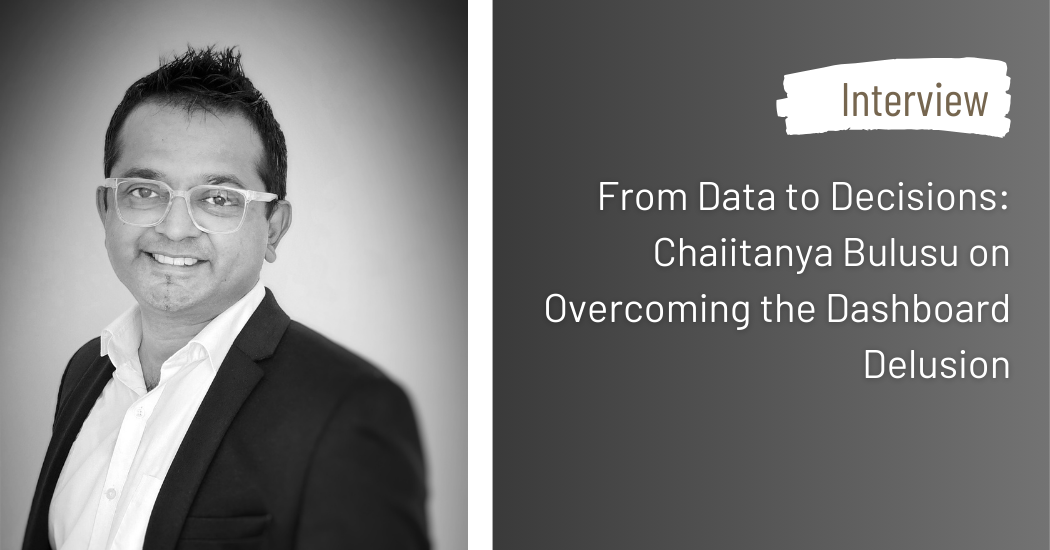
In an era where digital transformation can either propel industrial manufacturers to new heights or mire them in costly missteps, Chaiitanya Bulusu (CB), SVP & Business Head – Americas at Infinite Uptime, emerges as a beacon of clarity. With a distinguished career spanning leadership roles at Infinite Uptime, Rockwell Automation, Omron, Chaiitanya Bulusu has earned a reputation as a thought leader who bridges the gap between technological promise and operational reality. In this in-depth interview, he shares his vision for the future of manufacturing, offering COOs a robust playbook to navigate pitfalls like the dashboard delusion, pilot trap, and ROI mirage, and to drive efficiency, agility, and innovation through an outcome-driven approach.
Michael Funskin: Chaiitanya, the manufacturing sector is undergoing seismic changes. How do you see the COO’s role evolving to meet these challenges?
Chaiitanya Bulusu: The COO’s role has shifted dramatically from being the executor of boardroom strategies to a strategic architect of transformation. Today’s COOs must act as socio-technical integrators, weaving together advanced technologies—AI, IoT, digital twins—with the human elements of culture and collaboration. The old model of overseeing operations is obsolete; COOs now co-create the vision with the CEO, ensuring it’s grounded in operational realities while pushing the boundaries of what’s possible. This means focusing relentlessly on outcomes, like slashing unplanned downtime by 30% or cutting energy waste by 15%, rather than getting seduced by technology for its own sake. Falling into the pilot trap—where companies test tools like AI without clear goals—is a recipe for stagnation. COOs must anchor every initiative in a measurable problem, ensuring technology serves the business, not the other way around.
Michael Funskin: The “pilot trap” is a recurring issue you’ve highlighted. Can you unpack how COOs can avoid it and scale digital initiatives effectively?
Bulusu: The pilot trap is insidious because it feels like progress—companies launch proofs-of-concept, dazzled by IoT sensors or digital twins, but these initiatives often fizzle out. Why? Because they lack a clear business case or operational goal. I’ve seen billions wasted on pilots that solve no specific problem, like “Let’s build a data lake” with no plan for how it’ll be used. To escape this, COOs must start with the pain point. Take a steel plant losing 14 hours a week to micro-stoppages. A pilot should target a 20% reduction in that metric, using predictive maintenance with IoT sensors on critical assets like pumps or motors. The key is designing pilots for scalability from day one—integrate them with existing systems like ERP or CMMS, and measure success against operational KPIs within 90 days.

Once a pilot proves value—say, saving $500K in downtime—COOs should move swiftly to a phased enterprise rollout, leveraging cross-functional teams to ensure alignment. This approach avoids the pilot trap by tying every step to a tangible outcome, building trust and momentum for broader transformation. It’s not about testing technology; it’s about proving business impact.
Michael Funskin: You’ve also warned about the “dashboard delusion.” How can manufacturers ensure data translates into action?
Bulusu: The dashboard delusion is a trap where plants are flooded with real-time data—vibration alerts, energy readings, you name it—but it’s just noise. Studies show 70% of alerts are false positives, and without context, they’re ignored until a failure hits. I’ve walked into facilities with stunning dashboards, yet decisions are still made on gut instinct or yesterday’s reports. The problem isn’t data; it’s the lack of decision-ready intelligence. For example, in predictive maintenance, a vibration sensor flagging an anomaly is useless unless it answers: What’s failing? How urgent is it? What’s the fix? COOs must demand systems that go beyond visualization to prescription—like “replace bearing within 48 hours using SOP #14”—and integrate with workflows to trigger actions automatically.
To overcome the dashboard delusion, COOs should prioritize three things: First, ensure interfaces are persona-specific—maintenance techs need different insights than plant managers. Second, embed closed-loop feedback so every alert is validated, refining AI models over time. Third, train frontline teams to act on insights, not just monitor them. This turns data into a tool for action, not a distraction, and aligns with the outcome-driven mindset that separates leaders from laggards.
Michael Funskin: The “ROI mirage” is another critical pitfall. How can COOs ensure digital investments deliver real value?
Bulusu: The ROI mirage creeps in when companies measure success with tech metrics—like system uptime or data points collected—instead of business outcomes, like dollars saved or hours recovered. I’ve seen initiatives hailed as successes because they “went live,” yet they failed to move the needle on costs or efficiency. To avoid this, COOs must anchor investments in a clear financial or operational KPI. For instance, a predictive maintenance program might target a 25% reduction in maintenance costs, saving $1M annually, or a 10% boost in Overall Equipment Effectiveness (OEE). Start with a baseline—say, current downtime costs $2M a year—then track progress with a balanced scorecard: operational gains (e.g., reduced cycle times), financial returns (e.g., cost savings), customer impact (e.g., improved on-time delivery), and employee adoption rates.
COOs should also shift vendor relationships to outcome-based contracts. Instead of paying for software licenses, demand guarantees like “30% less downtime in 12 months.” This ensures accountability and dispels the ROI mirage. For example, a client I worked with achieved a 10x ROI by predicting 22% of failures 10 days in advance, saving $7M. That’s the kind of clarity COOs need to demand—real dollars, not tech buzzwords.
Michael Funskin: Predictive maintenance seems central to your vision. How does it fit into a broader transformation strategy, and how does it avoid these pitfalls?
Bulusu: Predictive maintenance is a linchpin for outcome-driven transformation because it directly addresses core challenges like downtime, which can cost $125K per hour, and energy waste, which consumes 5–15% of budgets. Unlike reactive fixes or rigid preventive schedules, it uses AI and IoT to predict failures with precision—down to the component and timeframe—enabling proactive repairs. For instance, a paper and Pulp mill I advised cut maintenance costs by 25% by predicting failures 10 days out, avoiding 140 hours of downtime.
But predictive maintenance isn’t a standalone fix; it’s part of a holistic strategy. It sidesteps the dashboard delusion by delivering prescribed actions, not just alerts—like “lubricate fan within 24 hours” instead of a vague warning. It avoids the pilot trap by starting with high-impact assets, like rotating machinery, and scaling based on proven results. And it counters the ROI mirage with clear metrics: 70–75% fewer breakdowns, 35–45% less downtime, and 20–30% longer asset life, per U.S. Department of Energy data. COOs should integrate it with energy optimization and quality control to create a unified system where reliability, efficiency, and sustainability amplify each other. This approach turns maintenance from a cost center into a value driver.
Michael Funskin: Change management is often the Achilles’ heel of transformation. How can COOs foster adoption and overcome resistance?
Bulusu: Transformation fails without people, and resistance can lock initiatives in the pilot trap. I’ve seen workers fear automation will replace them, leading to skepticism that derails even the best technology. COOs must lead with empathy and a human-centric approach. First, frame digital tools as enablers—predictive maintenance doesn’t eliminate jobs; it frees technicians for strategic tasks like process optimization. Second, invest heavily in training—$2,000–$5,000 per person—to build digital literacy and confidence. Third, engage frontline teams early, incorporating their feedback to design user-friendly systems that avoid the dashboard delusion.
Quick wins are critical. A pilot that cuts downtime by 10% in 90 days can turn skeptics into advocates. Celebrate these successes publicly to build trust and momentum. COOs should also appoint on-site champions to bridge operations and IT, ensuring pilots scale seamlessly. By aligning technology with human needs, COOs can transform resistance into advocacy, making digital adoption a cultural norm rather than a battle.

Michael Funskin: You’ve spoken about digital twins as a game-changer. How do they fit into this outcome-driven framework?
Bulusu: Digital twins are the apex of digital transformation, creating high-fidelity virtual replicas of assets, processes, or entire factories, updated in real-time via IoT data. They’re powerful because they enable risk-free experimentation—say, testing a new production line configuration without disrupting operations. This avoids the pilot trap by validating ideas before scaling. For predictive maintenance, digital twins elevate precision, forecasting not just failures but the Remaining Useful Life (RUL) of components, like pinpointing a bearing’s failure in 15 days under specific conditions. This counters the dashboard delusion by providing contextual, actionable insights.
COOs should deploy digital twins for three key outcomes: operational modeling (e.g., optimizing OEE), scenario planning (e.g., simulating supply chain disruptions), and advanced maintenance. Start with a single asset, ensure robust data governance to feed the twin, and validate its predictions against real-world outcomes. By tying twins to specific KPIs—like 15% less downtime—COOs ensure they deliver real value, not just a shiny 3D model, avoiding the ROI mirage.
Michael Funskin: Sustainability is increasingly critical. How does it factor into your vision for manufacturing?
Bulusu: Sustainability is no longer optional—it’s a strategic imperative, with ESG assets projected to hit $35 trillion by 2025. Digital transformation, when done right, drives sustainability by optimizing resource use. Predictive maintenance, for example, cuts energy waste by 18% by ensuring equipment runs efficiently. Digital twins can simulate energy-saving scenarios, like adjusting production schedules to leverage off-peak rates. These efforts align with operational goals, reducing costs while meeting regulatory demands.
The key is integrating sustainability into the outcome-driven framework. COOs should measure energy savings as a core KPI, alongside downtime or quality metrics, ensuring initiatives deliver both financial and environmental ROI. This avoids the ROI mirage by proving dual benefits—cost savings and a smaller carbon footprint. For instance, a client I advised cut CO2 emissions by 50% through precise energy monitoring, proving sustainability and profitability go hand-in-hand.
Michael Funskin: Looking ahead, what’s your vision for the future of industrial manufacturing?

Bulusu: By 2030, I envision a world of autonomous reliability, where AI-driven systems don’t just predict but autonomously optimize maintenance, energy, quality, and safety in real time. Digital twins will act as the central nervous system, simulating disruptions—like a supplier failure or demand spike—and prescribing responses instantly. This shift will eliminate the dashboard delusion by making data invisible but actionable, embedded in workflows. Sustainability will be core, with systems reducing material waste and energy use to meet circular economy goals.
The transition won’t be easy. COOs must navigate a skills gap—where only 29% of technicians feel prepared for advanced technologies, and cybersecurity risks from connected systems. But by staying outcome-focused—targeting specific KPIs like 20% uptime improvement or 15% energy savings—they can build resilient, future-ready operations. The future belongs to those who harness technology to solve real problems, not just chase innovation for its own sake.
Michael Funskin: What’s your final advice for COOs embarking on digital transformation?
Bulusu: Lead with purpose. Conduct an outcome audit: identify your biggest losses—downtime, energy, scrap—and set measurable goals, like “reduce stoppages by 30% in 6 months.” Avoid the pilot trap by designing scalable pilots that prove value fast—within 90–120 days. Steer clear of the dashboard delusion by demanding systems that deliver prescribed actions, not just data. Dispel the ROI mirage by tying every investment to a dollar value or operational KPI, using a balanced scorecard to track efficiency, financial, customer, and employee metrics. Invest in your people—train them, engage them, celebrate their wins. And hold vendors accountable with outcome-based contracts, ensuring they share the risk. Transformation isn’t about technology; it’s about building an operation that’s efficient, agile, and innovative for the long haul.
Chaiitanya Bulusu’s thought leadership offers a masterclass in navigating the complexities of digital transformation. His outcome-driven approach—rooted in avoiding the pilot trap, dashboard delusion, and ROI mirage—provides COOs with a clear path to turn technological potential into operational excellence.
He can be reached out on Linkedin as https://www.linkedin.com/in/bulusuchaiitanya/