

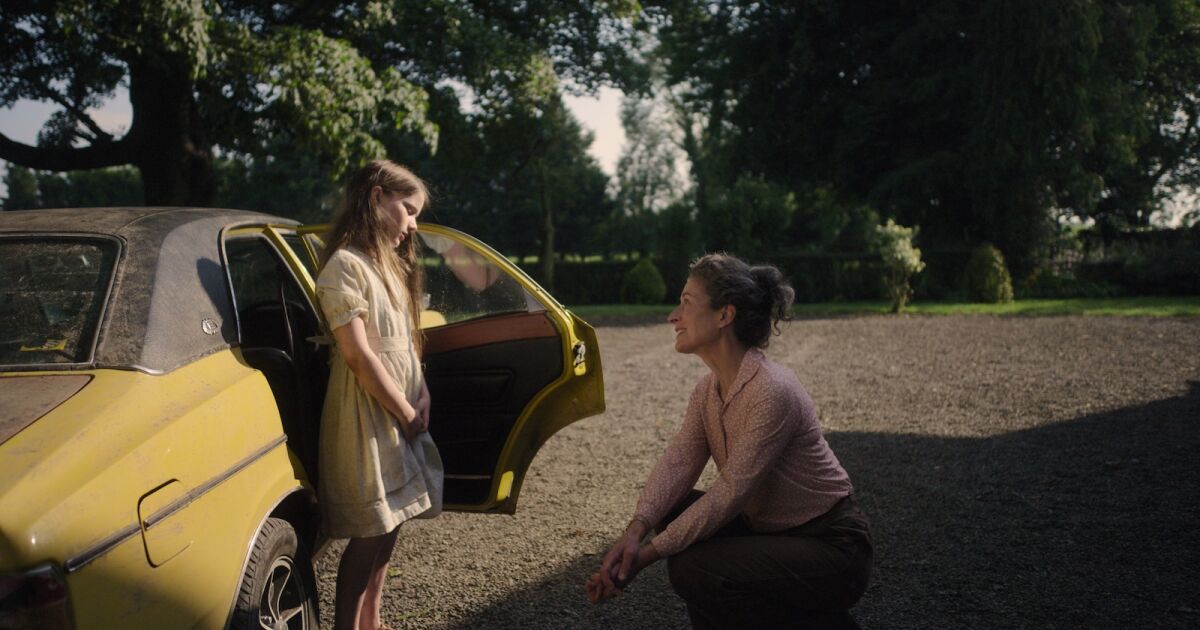
A neglected child discovers a her-shaped space to fill in “The Quiet Girl,” Colm Bairéad’s hushed, delicately rendered family drama, set in an Irish countryside of tasks and beauty, of the rarely-heard-in-movies Irish language, but also of things unsaid that, in their own way, become a shared language of the lost.
Faithfully transferred from Claire Keegan’s artful 2010 short story “Foster,” “The Quiet Girl” is both the best reason movies should look to more compact narratives for adaptation and, in a few instances, indicative of where cinematic choices can leave unnecessary footprints. But everything in this heartfelt tale is made with the deepest sincerity, and gently packed with soulful portrayals and lovely imagery.
One of those exquisite images from cinematographer Kate McCullough’s palette is among the movie’s first, the camera locating young Cáit (Catherine Clinch) — whose name we hear called out repeatedly by her impatient mother — lying in a field of tall grass, the blades nearly covering her in their comforting pastoral clasp. When around others, Cáit’s loneliness practically hums. She’s labeled a “weirdo” at school, and in her downtrodden family’s crowded, cold home among her older sisters, their pregnant and distracted mom (Kate Nic Chonaonaigh) and a checked-out, disdainful father (Michael Patric), Cáit’s default look is stricken discomfort.
In her cautiously impassive face, we can tell she’s internalized her parents’ decision to foster her out for the summer to the childless Kinsellas, distant relatives with a nice house, a dairy operation and what looks to be a calmer life. Cáit’s dad is so eager to dump her, he even drives off without leaving behind her suitcase. And while curt, stoic Seán Kinsella (Andrew Bennett) might be another taciturn man to navigate, he obviously loves his wife, Eibhlín (Carrie Crowley), whose smiling eyes and attentive affection toward her guest — food, friendliness, a bath and fresh clothes (not so girly but at least clean) — is so foreign to Cáit it registers as alien behavior.
“This is a house with no secrets,” Eibhlín says, the only time we detect a hint of gravity, of serious expectation. But to a guileless girl, it’s hardly a restriction when a new world of usefulness, warmth and learning has been opened by Eibhlín’s simply looking after her. And in Seán’s glimmers of consideration as his new charge joins in the farm chores, this tight-lipped guardian not only turns out to be nothing like Cáit’s dad but proves essential to an even greater emotional understanding for Cáit of why the Kinsellas are a household where kindness is, while genuine, also practiced, even cautious. Cáit isn’t the only one, it seems, struggling with expression.
In its depiction of one fatefully blossoming summer, “The Quiet Girl” doesn’t really break any new ground, but its heartbeat is steady and true, and young Clinch meets the demands of her inarticulate character with a beguiling humility, even as DP McCullough often frames her worried watchfulness as nearly incandescent. Bairéad is dedicated to Cáit’s detail-absorbing perspective to a fault, in that sometimes you wish scenes could vary a little more in their rhythms so that when he needs a little transcendence — as when Cáit breaks into a freeing run, or the symbolic moments of reflection and grace at the property’s well — it’s a lift, not a lateral move in a film studded with crystallized moments of aching tenderness.
This is aesthetic nitpicking, however. The key takeaway from “The Quiet Girl” is how rare cinematic depictions of everyday, unadorned sympathy are without the common narrative’s machinery of motive. I’ll admit to thinking, on first viewing, that there was too little to “The Quiet Girl,” that an absence of incident was a sign of willful preciousness. A second, closer look disabused me of that. It would be better to view this fine film as deceptively small, revealing its own distinctively filigreed array of the gentle and good in all that meaningful silence.
‘The Quiet Girl’
In Irish and English with English subtitles
Not rated
Running time: 1 hour, 35 minutes
Playing: Starts Dec. 16, AMC Sunset 5, West Hollywood

A neglected child discovers a her-shaped space to fill in “The Quiet Girl,” Colm Bairéad’s hushed, delicately rendered family drama, set in an Irish countryside of tasks and beauty, of the rarely-heard-in-movies Irish language, but also of things unsaid that, in their own way, become a shared language of the lost.
Faithfully transferred from Claire Keegan’s artful 2010 short story “Foster,” “The Quiet Girl” is both the best reason movies should look to more compact narratives for adaptation and, in a few instances, indicative of where cinematic choices can leave unnecessary footprints. But everything in this heartfelt tale is made with the deepest sincerity, and gently packed with soulful portrayals and lovely imagery.
One of those exquisite images from cinematographer Kate McCullough’s palette is among the movie’s first, the camera locating young Cáit (Catherine Clinch) — whose name we hear called out repeatedly by her impatient mother — lying in a field of tall grass, the blades nearly covering her in their comforting pastoral clasp. When around others, Cáit’s loneliness practically hums. She’s labeled a “weirdo” at school, and in her downtrodden family’s crowded, cold home among her older sisters, their pregnant and distracted mom (Kate Nic Chonaonaigh) and a checked-out, disdainful father (Michael Patric), Cáit’s default look is stricken discomfort.
In her cautiously impassive face, we can tell she’s internalized her parents’ decision to foster her out for the summer to the childless Kinsellas, distant relatives with a nice house, a dairy operation and what looks to be a calmer life. Cáit’s dad is so eager to dump her, he even drives off without leaving behind her suitcase. And while curt, stoic Seán Kinsella (Andrew Bennett) might be another taciturn man to navigate, he obviously loves his wife, Eibhlín (Carrie Crowley), whose smiling eyes and attentive affection toward her guest — food, friendliness, a bath and fresh clothes (not so girly but at least clean) — is so foreign to Cáit it registers as alien behavior.
“This is a house with no secrets,” Eibhlín says, the only time we detect a hint of gravity, of serious expectation. But to a guileless girl, it’s hardly a restriction when a new world of usefulness, warmth and learning has been opened by Eibhlín’s simply looking after her. And in Seán’s glimmers of consideration as his new charge joins in the farm chores, this tight-lipped guardian not only turns out to be nothing like Cáit’s dad but proves essential to an even greater emotional understanding for Cáit of why the Kinsellas are a household where kindness is, while genuine, also practiced, even cautious. Cáit isn’t the only one, it seems, struggling with expression.
In its depiction of one fatefully blossoming summer, “The Quiet Girl” doesn’t really break any new ground, but its heartbeat is steady and true, and young Clinch meets the demands of her inarticulate character with a beguiling humility, even as DP McCullough often frames her worried watchfulness as nearly incandescent. Bairéad is dedicated to Cáit’s detail-absorbing perspective to a fault, in that sometimes you wish scenes could vary a little more in their rhythms so that when he needs a little transcendence — as when Cáit breaks into a freeing run, or the symbolic moments of reflection and grace at the property’s well — it’s a lift, not a lateral move in a film studded with crystallized moments of aching tenderness.
This is aesthetic nitpicking, however. The key takeaway from “The Quiet Girl” is how rare cinematic depictions of everyday, unadorned sympathy are without the common narrative’s machinery of motive. I’ll admit to thinking, on first viewing, that there was too little to “The Quiet Girl,” that an absence of incident was a sign of willful preciousness. A second, closer look disabused me of that. It would be better to view this fine film as deceptively small, revealing its own distinctively filigreed array of the gentle and good in all that meaningful silence.
‘The Quiet Girl’
In Irish and English with English subtitles
Not rated
Running time: 1 hour, 35 minutes
Playing: Starts Dec. 16, AMC Sunset 5, West Hollywood

A neglected child discovers a her-shaped space to fill in “The Quiet Girl,” Colm Bairéad’s hushed, delicately rendered family drama, set in an Irish countryside of tasks and beauty, of the rarely-heard-in-movies Irish language, but also of things unsaid that, in their own way, become a shared language of the lost.
Faithfully transferred from Claire Keegan’s artful 2010 short story “Foster,” “The Quiet Girl” is both the best reason movies should look to more compact narratives for adaptation and, in a few instances, indicative of where cinematic choices can leave unnecessary footprints. But everything in this heartfelt tale is made with the deepest sincerity, and gently packed with soulful portrayals and lovely imagery.
One of those exquisite images from cinematographer Kate McCullough’s palette is among the movie’s first, the camera locating young Cáit (Catherine Clinch) — whose name we hear called out repeatedly by her impatient mother — lying in a field of tall grass, the blades nearly covering her in their comforting pastoral clasp. When around others, Cáit’s loneliness practically hums. She’s labeled a “weirdo” at school, and in her downtrodden family’s crowded, cold home among her older sisters, their pregnant and distracted mom (Kate Nic Chonaonaigh) and a checked-out, disdainful father (Michael Patric), Cáit’s default look is stricken discomfort.
In her cautiously impassive face, we can tell she’s internalized her parents’ decision to foster her out for the summer to the childless Kinsellas, distant relatives with a nice house, a dairy operation and what looks to be a calmer life. Cáit’s dad is so eager to dump her, he even drives off without leaving behind her suitcase. And while curt, stoic Seán Kinsella (Andrew Bennett) might be another taciturn man to navigate, he obviously loves his wife, Eibhlín (Carrie Crowley), whose smiling eyes and attentive affection toward her guest — food, friendliness, a bath and fresh clothes (not so girly but at least clean) — is so foreign to Cáit it registers as alien behavior.
“This is a house with no secrets,” Eibhlín says, the only time we detect a hint of gravity, of serious expectation. But to a guileless girl, it’s hardly a restriction when a new world of usefulness, warmth and learning has been opened by Eibhlín’s simply looking after her. And in Seán’s glimmers of consideration as his new charge joins in the farm chores, this tight-lipped guardian not only turns out to be nothing like Cáit’s dad but proves essential to an even greater emotional understanding for Cáit of why the Kinsellas are a household where kindness is, while genuine, also practiced, even cautious. Cáit isn’t the only one, it seems, struggling with expression.
In its depiction of one fatefully blossoming summer, “The Quiet Girl” doesn’t really break any new ground, but its heartbeat is steady and true, and young Clinch meets the demands of her inarticulate character with a beguiling humility, even as DP McCullough often frames her worried watchfulness as nearly incandescent. Bairéad is dedicated to Cáit’s detail-absorbing perspective to a fault, in that sometimes you wish scenes could vary a little more in their rhythms so that when he needs a little transcendence — as when Cáit breaks into a freeing run, or the symbolic moments of reflection and grace at the property’s well — it’s a lift, not a lateral move in a film studded with crystallized moments of aching tenderness.
This is aesthetic nitpicking, however. The key takeaway from “The Quiet Girl” is how rare cinematic depictions of everyday, unadorned sympathy are without the common narrative’s machinery of motive. I’ll admit to thinking, on first viewing, that there was too little to “The Quiet Girl,” that an absence of incident was a sign of willful preciousness. A second, closer look disabused me of that. It would be better to view this fine film as deceptively small, revealing its own distinctively filigreed array of the gentle and good in all that meaningful silence.
‘The Quiet Girl’
In Irish and English with English subtitles
Not rated
Running time: 1 hour, 35 minutes
Playing: Starts Dec. 16, AMC Sunset 5, West Hollywood
A neglected child discovers a her-shaped space to fill in “The Quiet Girl,” Colm Bairéad’s hushed, delicately rendered family drama, set in an Irish countryside of tasks and beauty, of the rarely-heard-in-movies Irish language, but also of things unsaid that, in their own way, become a shared language of the lost.
Faithfully transferred from Claire Keegan’s artful 2010 short story “Foster,” “The Quiet Girl” is both the best reason movies should look to more compact narratives for adaptation and, in a few instances, indicative of where cinematic choices can leave unnecessary footprints. But everything in this heartfelt tale is made with the deepest sincerity, and gently packed with soulful portrayals and lovely imagery.
One of those exquisite images from cinematographer Kate McCullough’s palette is among the movie’s first, the camera locating young Cáit (Catherine Clinch) — whose name we hear called out repeatedly by her impatient mother — lying in a field of tall grass, the blades nearly covering her in their comforting pastoral clasp. When around others, Cáit’s loneliness practically hums. She’s labeled a “weirdo” at school, and in her downtrodden family’s crowded, cold home among her older sisters, their pregnant and distracted mom (Kate Nic Chonaonaigh) and a checked-out, disdainful father (Michael Patric), Cáit’s default look is stricken discomfort.
In her cautiously impassive face, we can tell she’s internalized her parents’ decision to foster her out for the summer to the childless Kinsellas, distant relatives with a nice house, a dairy operation and what looks to be a calmer life. Cáit’s dad is so eager to dump her, he even drives off without leaving behind her suitcase. And while curt, stoic Seán Kinsella (Andrew Bennett) might be another taciturn man to navigate, he obviously loves his wife, Eibhlín (Carrie Crowley), whose smiling eyes and attentive affection toward her guest — food, friendliness, a bath and fresh clothes (not so girly but at least clean) — is so foreign to Cáit it registers as alien behavior.
“This is a house with no secrets,” Eibhlín says, the only time we detect a hint of gravity, of serious expectation. But to a guileless girl, it’s hardly a restriction when a new world of usefulness, warmth and learning has been opened by Eibhlín’s simply looking after her. And in Seán’s glimmers of consideration as his new charge joins in the farm chores, this tight-lipped guardian not only turns out to be nothing like Cáit’s dad but proves essential to an even greater emotional understanding for Cáit of why the Kinsellas are a household where kindness is, while genuine, also practiced, even cautious. Cáit isn’t the only one, it seems, struggling with expression.
In its depiction of one fatefully blossoming summer, “The Quiet Girl” doesn’t really break any new ground, but its heartbeat is steady and true, and young Clinch meets the demands of her inarticulate character with a beguiling humility, even as DP McCullough often frames her worried watchfulness as nearly incandescent. Bairéad is dedicated to Cáit’s detail-absorbing perspective to a fault, in that sometimes you wish scenes could vary a little more in their rhythms so that when he needs a little transcendence — as when Cáit breaks into a freeing run, or the symbolic moments of reflection and grace at the property’s well — it’s a lift, not a lateral move in a film studded with crystallized moments of aching tenderness.
This is aesthetic nitpicking, however. The key takeaway from “The Quiet Girl” is how rare cinematic depictions of everyday, unadorned sympathy are without the common narrative’s machinery of motive. I’ll admit to thinking, on first viewing, that there was too little to “The Quiet Girl,” that an absence of incident was a sign of willful preciousness. A second, closer look disabused me of that. It would be better to view this fine film as deceptively small, revealing its own distinctively filigreed array of the gentle and good in all that meaningful silence.
‘The Quiet Girl’
In Irish and English with English subtitles
Not rated
Running time: 1 hour, 35 minutes
Playing: Starts Dec. 16, AMC Sunset 5, West Hollywood

A neglected child discovers a her-shaped space to fill in “The Quiet Girl,” Colm Bairéad’s hushed, delicately rendered family drama, set in an Irish countryside of tasks and beauty, of the rarely-heard-in-movies Irish language, but also of things unsaid that, in their own way, become a shared language of the lost.
Faithfully transferred from Claire Keegan’s artful 2010 short story “Foster,” “The Quiet Girl” is both the best reason movies should look to more compact narratives for adaptation and, in a few instances, indicative of where cinematic choices can leave unnecessary footprints. But everything in this heartfelt tale is made with the deepest sincerity, and gently packed with soulful portrayals and lovely imagery.
One of those exquisite images from cinematographer Kate McCullough’s palette is among the movie’s first, the camera locating young Cáit (Catherine Clinch) — whose name we hear called out repeatedly by her impatient mother — lying in a field of tall grass, the blades nearly covering her in their comforting pastoral clasp. When around others, Cáit’s loneliness practically hums. She’s labeled a “weirdo” at school, and in her downtrodden family’s crowded, cold home among her older sisters, their pregnant and distracted mom (Kate Nic Chonaonaigh) and a checked-out, disdainful father (Michael Patric), Cáit’s default look is stricken discomfort.
In her cautiously impassive face, we can tell she’s internalized her parents’ decision to foster her out for the summer to the childless Kinsellas, distant relatives with a nice house, a dairy operation and what looks to be a calmer life. Cáit’s dad is so eager to dump her, he even drives off without leaving behind her suitcase. And while curt, stoic Seán Kinsella (Andrew Bennett) might be another taciturn man to navigate, he obviously loves his wife, Eibhlín (Carrie Crowley), whose smiling eyes and attentive affection toward her guest — food, friendliness, a bath and fresh clothes (not so girly but at least clean) — is so foreign to Cáit it registers as alien behavior.
“This is a house with no secrets,” Eibhlín says, the only time we detect a hint of gravity, of serious expectation. But to a guileless girl, it’s hardly a restriction when a new world of usefulness, warmth and learning has been opened by Eibhlín’s simply looking after her. And in Seán’s glimmers of consideration as his new charge joins in the farm chores, this tight-lipped guardian not only turns out to be nothing like Cáit’s dad but proves essential to an even greater emotional understanding for Cáit of why the Kinsellas are a household where kindness is, while genuine, also practiced, even cautious. Cáit isn’t the only one, it seems, struggling with expression.
In its depiction of one fatefully blossoming summer, “The Quiet Girl” doesn’t really break any new ground, but its heartbeat is steady and true, and young Clinch meets the demands of her inarticulate character with a beguiling humility, even as DP McCullough often frames her worried watchfulness as nearly incandescent. Bairéad is dedicated to Cáit’s detail-absorbing perspective to a fault, in that sometimes you wish scenes could vary a little more in their rhythms so that when he needs a little transcendence — as when Cáit breaks into a freeing run, or the symbolic moments of reflection and grace at the property’s well — it’s a lift, not a lateral move in a film studded with crystallized moments of aching tenderness.
This is aesthetic nitpicking, however. The key takeaway from “The Quiet Girl” is how rare cinematic depictions of everyday, unadorned sympathy are without the common narrative’s machinery of motive. I’ll admit to thinking, on first viewing, that there was too little to “The Quiet Girl,” that an absence of incident was a sign of willful preciousness. A second, closer look disabused me of that. It would be better to view this fine film as deceptively small, revealing its own distinctively filigreed array of the gentle and good in all that meaningful silence.
‘The Quiet Girl’
In Irish and English with English subtitles
Not rated
Running time: 1 hour, 35 minutes
Playing: Starts Dec. 16, AMC Sunset 5, West Hollywood
A neglected child discovers a her-shaped space to fill in “The Quiet Girl,” Colm Bairéad’s hushed, delicately rendered family drama, set in an Irish countryside of tasks and beauty, of the rarely-heard-in-movies Irish language, but also of things unsaid that, in their own way, become a shared language of the lost.
Faithfully transferred from Claire Keegan’s artful 2010 short story “Foster,” “The Quiet Girl” is both the best reason movies should look to more compact narratives for adaptation and, in a few instances, indicative of where cinematic choices can leave unnecessary footprints. But everything in this heartfelt tale is made with the deepest sincerity, and gently packed with soulful portrayals and lovely imagery.
One of those exquisite images from cinematographer Kate McCullough’s palette is among the movie’s first, the camera locating young Cáit (Catherine Clinch) — whose name we hear called out repeatedly by her impatient mother — lying in a field of tall grass, the blades nearly covering her in their comforting pastoral clasp. When around others, Cáit’s loneliness practically hums. She’s labeled a “weirdo” at school, and in her downtrodden family’s crowded, cold home among her older sisters, their pregnant and distracted mom (Kate Nic Chonaonaigh) and a checked-out, disdainful father (Michael Patric), Cáit’s default look is stricken discomfort.
In her cautiously impassive face, we can tell she’s internalized her parents’ decision to foster her out for the summer to the childless Kinsellas, distant relatives with a nice house, a dairy operation and what looks to be a calmer life. Cáit’s dad is so eager to dump her, he even drives off without leaving behind her suitcase. And while curt, stoic Seán Kinsella (Andrew Bennett) might be another taciturn man to navigate, he obviously loves his wife, Eibhlín (Carrie Crowley), whose smiling eyes and attentive affection toward her guest — food, friendliness, a bath and fresh clothes (not so girly but at least clean) — is so foreign to Cáit it registers as alien behavior.
“This is a house with no secrets,” Eibhlín says, the only time we detect a hint of gravity, of serious expectation. But to a guileless girl, it’s hardly a restriction when a new world of usefulness, warmth and learning has been opened by Eibhlín’s simply looking after her. And in Seán’s glimmers of consideration as his new charge joins in the farm chores, this tight-lipped guardian not only turns out to be nothing like Cáit’s dad but proves essential to an even greater emotional understanding for Cáit of why the Kinsellas are a household where kindness is, while genuine, also practiced, even cautious. Cáit isn’t the only one, it seems, struggling with expression.
In its depiction of one fatefully blossoming summer, “The Quiet Girl” doesn’t really break any new ground, but its heartbeat is steady and true, and young Clinch meets the demands of her inarticulate character with a beguiling humility, even as DP McCullough often frames her worried watchfulness as nearly incandescent. Bairéad is dedicated to Cáit’s detail-absorbing perspective to a fault, in that sometimes you wish scenes could vary a little more in their rhythms so that when he needs a little transcendence — as when Cáit breaks into a freeing run, or the symbolic moments of reflection and grace at the property’s well — it’s a lift, not a lateral move in a film studded with crystallized moments of aching tenderness.
This is aesthetic nitpicking, however. The key takeaway from “The Quiet Girl” is how rare cinematic depictions of everyday, unadorned sympathy are without the common narrative’s machinery of motive. I’ll admit to thinking, on first viewing, that there was too little to “The Quiet Girl,” that an absence of incident was a sign of willful preciousness. A second, closer look disabused me of that. It would be better to view this fine film as deceptively small, revealing its own distinctively filigreed array of the gentle and good in all that meaningful silence.
‘The Quiet Girl’
In Irish and English with English subtitles
Not rated
Running time: 1 hour, 35 minutes
Playing: Starts Dec. 16, AMC Sunset 5, West Hollywood
A neglected child discovers a her-shaped space to fill in “The Quiet Girl,” Colm Bairéad’s hushed, delicately rendered family drama, set in an Irish countryside of tasks and beauty, of the rarely-heard-in-movies Irish language, but also of things unsaid that, in their own way, become a shared language of the lost.
Faithfully transferred from Claire Keegan’s artful 2010 short story “Foster,” “The Quiet Girl” is both the best reason movies should look to more compact narratives for adaptation and, in a few instances, indicative of where cinematic choices can leave unnecessary footprints. But everything in this heartfelt tale is made with the deepest sincerity, and gently packed with soulful portrayals and lovely imagery.
One of those exquisite images from cinematographer Kate McCullough’s palette is among the movie’s first, the camera locating young Cáit (Catherine Clinch) — whose name we hear called out repeatedly by her impatient mother — lying in a field of tall grass, the blades nearly covering her in their comforting pastoral clasp. When around others, Cáit’s loneliness practically hums. She’s labeled a “weirdo” at school, and in her downtrodden family’s crowded, cold home among her older sisters, their pregnant and distracted mom (Kate Nic Chonaonaigh) and a checked-out, disdainful father (Michael Patric), Cáit’s default look is stricken discomfort.
In her cautiously impassive face, we can tell she’s internalized her parents’ decision to foster her out for the summer to the childless Kinsellas, distant relatives with a nice house, a dairy operation and what looks to be a calmer life. Cáit’s dad is so eager to dump her, he even drives off without leaving behind her suitcase. And while curt, stoic Seán Kinsella (Andrew Bennett) might be another taciturn man to navigate, he obviously loves his wife, Eibhlín (Carrie Crowley), whose smiling eyes and attentive affection toward her guest — food, friendliness, a bath and fresh clothes (not so girly but at least clean) — is so foreign to Cáit it registers as alien behavior.
“This is a house with no secrets,” Eibhlín says, the only time we detect a hint of gravity, of serious expectation. But to a guileless girl, it’s hardly a restriction when a new world of usefulness, warmth and learning has been opened by Eibhlín’s simply looking after her. And in Seán’s glimmers of consideration as his new charge joins in the farm chores, this tight-lipped guardian not only turns out to be nothing like Cáit’s dad but proves essential to an even greater emotional understanding for Cáit of why the Kinsellas are a household where kindness is, while genuine, also practiced, even cautious. Cáit isn’t the only one, it seems, struggling with expression.
In its depiction of one fatefully blossoming summer, “The Quiet Girl” doesn’t really break any new ground, but its heartbeat is steady and true, and young Clinch meets the demands of her inarticulate character with a beguiling humility, even as DP McCullough often frames her worried watchfulness as nearly incandescent. Bairéad is dedicated to Cáit’s detail-absorbing perspective to a fault, in that sometimes you wish scenes could vary a little more in their rhythms so that when he needs a little transcendence — as when Cáit breaks into a freeing run, or the symbolic moments of reflection and grace at the property’s well — it’s a lift, not a lateral move in a film studded with crystallized moments of aching tenderness.
This is aesthetic nitpicking, however. The key takeaway from “The Quiet Girl” is how rare cinematic depictions of everyday, unadorned sympathy are without the common narrative’s machinery of motive. I’ll admit to thinking, on first viewing, that there was too little to “The Quiet Girl,” that an absence of incident was a sign of willful preciousness. A second, closer look disabused me of that. It would be better to view this fine film as deceptively small, revealing its own distinctively filigreed array of the gentle and good in all that meaningful silence.
‘The Quiet Girl’
In Irish and English with English subtitles
Not rated
Running time: 1 hour, 35 minutes
Playing: Starts Dec. 16, AMC Sunset 5, West Hollywood
A neglected child discovers a her-shaped space to fill in “The Quiet Girl,” Colm Bairéad’s hushed, delicately rendered family drama, set in an Irish countryside of tasks and beauty, of the rarely-heard-in-movies Irish language, but also of things unsaid that, in their own way, become a shared language of the lost.
Faithfully transferred from Claire Keegan’s artful 2010 short story “Foster,” “The Quiet Girl” is both the best reason movies should look to more compact narratives for adaptation and, in a few instances, indicative of where cinematic choices can leave unnecessary footprints. But everything in this heartfelt tale is made with the deepest sincerity, and gently packed with soulful portrayals and lovely imagery.
One of those exquisite images from cinematographer Kate McCullough’s palette is among the movie’s first, the camera locating young Cáit (Catherine Clinch) — whose name we hear called out repeatedly by her impatient mother — lying in a field of tall grass, the blades nearly covering her in their comforting pastoral clasp. When around others, Cáit’s loneliness practically hums. She’s labeled a “weirdo” at school, and in her downtrodden family’s crowded, cold home among her older sisters, their pregnant and distracted mom (Kate Nic Chonaonaigh) and a checked-out, disdainful father (Michael Patric), Cáit’s default look is stricken discomfort.
In her cautiously impassive face, we can tell she’s internalized her parents’ decision to foster her out for the summer to the childless Kinsellas, distant relatives with a nice house, a dairy operation and what looks to be a calmer life. Cáit’s dad is so eager to dump her, he even drives off without leaving behind her suitcase. And while curt, stoic Seán Kinsella (Andrew Bennett) might be another taciturn man to navigate, he obviously loves his wife, Eibhlín (Carrie Crowley), whose smiling eyes and attentive affection toward her guest — food, friendliness, a bath and fresh clothes (not so girly but at least clean) — is so foreign to Cáit it registers as alien behavior.
“This is a house with no secrets,” Eibhlín says, the only time we detect a hint of gravity, of serious expectation. But to a guileless girl, it’s hardly a restriction when a new world of usefulness, warmth and learning has been opened by Eibhlín’s simply looking after her. And in Seán’s glimmers of consideration as his new charge joins in the farm chores, this tight-lipped guardian not only turns out to be nothing like Cáit’s dad but proves essential to an even greater emotional understanding for Cáit of why the Kinsellas are a household where kindness is, while genuine, also practiced, even cautious. Cáit isn’t the only one, it seems, struggling with expression.
In its depiction of one fatefully blossoming summer, “The Quiet Girl” doesn’t really break any new ground, but its heartbeat is steady and true, and young Clinch meets the demands of her inarticulate character with a beguiling humility, even as DP McCullough often frames her worried watchfulness as nearly incandescent. Bairéad is dedicated to Cáit’s detail-absorbing perspective to a fault, in that sometimes you wish scenes could vary a little more in their rhythms so that when he needs a little transcendence — as when Cáit breaks into a freeing run, or the symbolic moments of reflection and grace at the property’s well — it’s a lift, not a lateral move in a film studded with crystallized moments of aching tenderness.
This is aesthetic nitpicking, however. The key takeaway from “The Quiet Girl” is how rare cinematic depictions of everyday, unadorned sympathy are without the common narrative’s machinery of motive. I’ll admit to thinking, on first viewing, that there was too little to “The Quiet Girl,” that an absence of incident was a sign of willful preciousness. A second, closer look disabused me of that. It would be better to view this fine film as deceptively small, revealing its own distinctively filigreed array of the gentle and good in all that meaningful silence.
‘The Quiet Girl’
In Irish and English with English subtitles
Not rated
Running time: 1 hour, 35 minutes
Playing: Starts Dec. 16, AMC Sunset 5, West Hollywood


