Girls who grow up realizing they need to know how to fight don’t necessarily become boxers. But Flint, Mich., native Claressa Shields, for whom pugilism was a passion, entered the ring early: As a teenage phenom, she punched her way to record-setting, Olympic-gold levels. (Twice, back to back.)
It sounds like the type of real-life sports saga made for the movies, via a time-tested playbook, one that “The Fire Inside” — the fleet, full-of-feeling directorial debut of Oscar-nominated cinematographer Rachel Morrison — very much embraces at first. You’ve got the hardscrabble upbringing, the tough-love coach/boxer camaraderie and the mental hurdles to overcome before the big moment. Gifted, driven and played by a memorable Ryan Destiny (as if glowering were a renewable energy source), Claressa competed with the dreams of a broken town on her shoulders, and won like none of that was a burden.
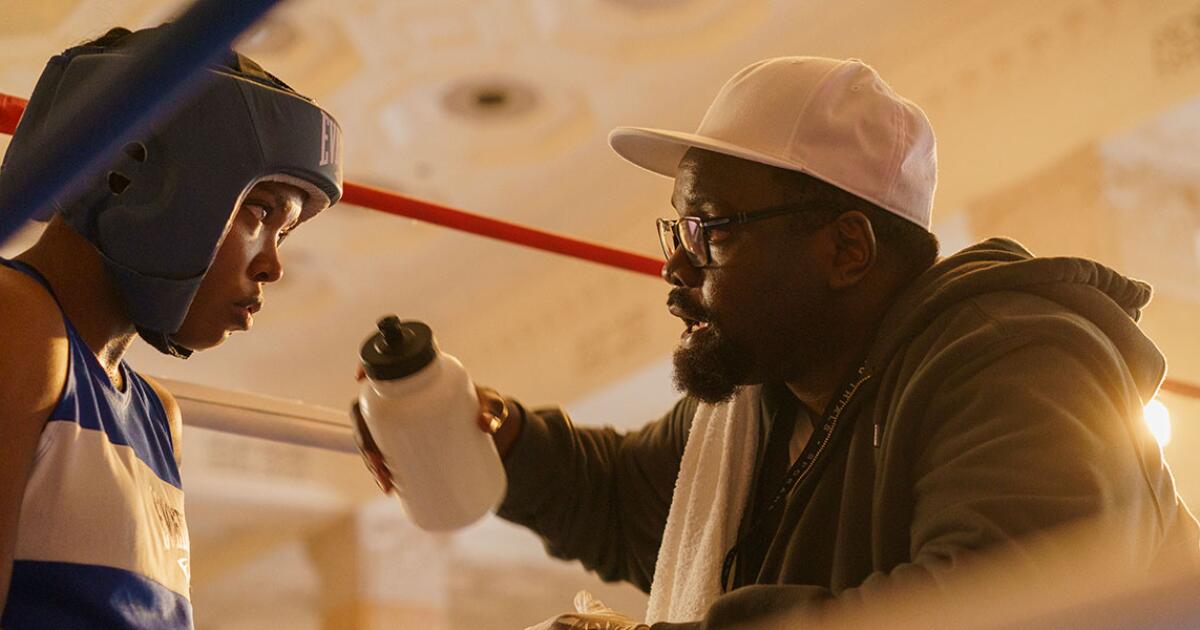
Most storytellers wouldn’t require more than that to fill up a feature, and the details of Claressa’s rise make up the movie’s familiar setup. Going the distance begins with running in the snow, away from an understocked house and neglectful single mom (Oluniké Adeliyi) and toward the boxing classes across town operated by volunteer coach Jason Crutchfield (the formidable Brian Tyree Henry), an ex-fighter. Claressa’s no-nonsense talent and confidence quickly erase Jason’s prejudices about girls in the ring, and under his gritty, paternal stewardship, she goes on to triumph in the first-ever appearance of women’s boxing at the Olympics.
Yet what makes “The Fire Inside” more powerful than just another heroic biopic about a superior athlete (“Moonight’s” Barry Jenkins’ wrote the superlative, big-canvas screenplay) is what happens after the bell rings and the medals come out. In fact, when Morrison delivers that ceremonial moment for 17-year-old Shields in London in 2012, though we see pride, hands on hearts and mouths singing the American anthem, what we hear is composer Tamar-kali’s score — a melancholy, yearning strain that signals, paradoxically, that there’s more to tell.
As it turns out, Claressa’s post-gold life wasn’t the rise-and-fall problem typical of so many boxing yarns, but a rise-and-stall one. Averse to performed femininity, honest in interviews (“I like hitting people,” she says, smiling) and disdainful of being anything other than who she was, this new female American champion in a historically male sport wasn’t showered with life-changing endorsements and opportunities after coming home. Six months later, she’s a high schooler signing shirts at bowling alleys for cash, while Jason’s efforts to get her signed are met with the same narrow-mindedness about the image of girls in boxing that he had to disabuse himself of years ago. (Is there any better actor than Henry right now at conveying those moment-to-moment pleasures and setbacks that imply a fully absorbed life?)
It’s a flip side of athletic achievement that feels underexplored in movies: the idea of how sports success is marketed and sold. That reality hits home in a scene in which Claressa, alone and without help, makes an emergency run to the grocery store with her teen sister’s soiled baby on her hip, and encounters a wall of Michael Phelps-adorned Wheaties boxes. It’s a stark, powerful juxtaposition, heart-wrenching and enraging.
But “The Fire Inside” is no pity party about a system’s inequality, and the movie’s refusal to paint anyone in Claressa’s life as simply an impediment or an ally is another sign of the movie’s welcome (and very Jenkins-esque) emotional intelligence. And while the boxing is kinetically directed, Morrison grasps that the movie’s fiercest stands are taken outside the ring, when Claressa — faced with tough choices about her future — asserts herself to the people who need to hear it. That spin on on an ever-roiling motivation to win, even when the bout is over, is what sets “The Fire Inside” apart from so many others of its ilk.
‘The Fire Inside’
Rated: PG-13, for some strong language, thematic elements, and brief suggestive material
Running time: 1 hour, 48 minutes
Playing: In wide release Wednesday, Dec. 25

Girls who grow up realizing they need to know how to fight don’t necessarily become boxers. But Flint, Mich., native Claressa Shields, for whom pugilism was a passion, entered the ring early: As a teenage phenom, she punched her way to record-setting, Olympic-gold levels. (Twice, back to back.)
It sounds like the type of real-life sports saga made for the movies, via a time-tested playbook, one that “The Fire Inside” — the fleet, full-of-feeling directorial debut of Oscar-nominated cinematographer Rachel Morrison — very much embraces at first. You’ve got the hardscrabble upbringing, the tough-love coach/boxer camaraderie and the mental hurdles to overcome before the big moment. Gifted, driven and played by a memorable Ryan Destiny (as if glowering were a renewable energy source), Claressa competed with the dreams of a broken town on her shoulders, and won like none of that was a burden.
Most storytellers wouldn’t require more than that to fill up a feature, and the details of Claressa’s rise make up the movie’s familiar setup. Going the distance begins with running in the snow, away from an understocked house and neglectful single mom (Oluniké Adeliyi) and toward the boxing classes across town operated by volunteer coach Jason Crutchfield (the formidable Brian Tyree Henry), an ex-fighter. Claressa’s no-nonsense talent and confidence quickly erase Jason’s prejudices about girls in the ring, and under his gritty, paternal stewardship, she goes on to triumph in the first-ever appearance of women’s boxing at the Olympics.
Yet what makes “The Fire Inside” more powerful than just another heroic biopic about a superior athlete (“Moonight’s” Barry Jenkins’ wrote the superlative, big-canvas screenplay) is what happens after the bell rings and the medals come out. In fact, when Morrison delivers that ceremonial moment for 17-year-old Shields in London in 2012, though we see pride, hands on hearts and mouths singing the American anthem, what we hear is composer Tamar-kali’s score — a melancholy, yearning strain that signals, paradoxically, that there’s more to tell.
As it turns out, Claressa’s post-gold life wasn’t the rise-and-fall problem typical of so many boxing yarns, but a rise-and-stall one. Averse to performed femininity, honest in interviews (“I like hitting people,” she says, smiling) and disdainful of being anything other than who she was, this new female American champion in a historically male sport wasn’t showered with life-changing endorsements and opportunities after coming home. Six months later, she’s a high schooler signing shirts at bowling alleys for cash, while Jason’s efforts to get her signed are met with the same narrow-mindedness about the image of girls in boxing that he had to disabuse himself of years ago. (Is there any better actor than Henry right now at conveying those moment-to-moment pleasures and setbacks that imply a fully absorbed life?)
It’s a flip side of athletic achievement that feels underexplored in movies: the idea of how sports success is marketed and sold. That reality hits home in a scene in which Claressa, alone and without help, makes an emergency run to the grocery store with her teen sister’s soiled baby on her hip, and encounters a wall of Michael Phelps-adorned Wheaties boxes. It’s a stark, powerful juxtaposition, heart-wrenching and enraging.
But “The Fire Inside” is no pity party about a system’s inequality, and the movie’s refusal to paint anyone in Claressa’s life as simply an impediment or an ally is another sign of the movie’s welcome (and very Jenkins-esque) emotional intelligence. And while the boxing is kinetically directed, Morrison grasps that the movie’s fiercest stands are taken outside the ring, when Claressa — faced with tough choices about her future — asserts herself to the people who need to hear it. That spin on on an ever-roiling motivation to win, even when the bout is over, is what sets “The Fire Inside” apart from so many others of its ilk.
‘The Fire Inside’
Rated: PG-13, for some strong language, thematic elements, and brief suggestive material
Running time: 1 hour, 48 minutes
Playing: In wide release Wednesday, Dec. 25

Girls who grow up realizing they need to know how to fight don’t necessarily become boxers. But Flint, Mich., native Claressa Shields, for whom pugilism was a passion, entered the ring early: As a teenage phenom, she punched her way to record-setting, Olympic-gold levels. (Twice, back to back.)
It sounds like the type of real-life sports saga made for the movies, via a time-tested playbook, one that “The Fire Inside” — the fleet, full-of-feeling directorial debut of Oscar-nominated cinematographer Rachel Morrison — very much embraces at first. You’ve got the hardscrabble upbringing, the tough-love coach/boxer camaraderie and the mental hurdles to overcome before the big moment. Gifted, driven and played by a memorable Ryan Destiny (as if glowering were a renewable energy source), Claressa competed with the dreams of a broken town on her shoulders, and won like none of that was a burden.
Most storytellers wouldn’t require more than that to fill up a feature, and the details of Claressa’s rise make up the movie’s familiar setup. Going the distance begins with running in the snow, away from an understocked house and neglectful single mom (Oluniké Adeliyi) and toward the boxing classes across town operated by volunteer coach Jason Crutchfield (the formidable Brian Tyree Henry), an ex-fighter. Claressa’s no-nonsense talent and confidence quickly erase Jason’s prejudices about girls in the ring, and under his gritty, paternal stewardship, she goes on to triumph in the first-ever appearance of women’s boxing at the Olympics.
Yet what makes “The Fire Inside” more powerful than just another heroic biopic about a superior athlete (“Moonight’s” Barry Jenkins’ wrote the superlative, big-canvas screenplay) is what happens after the bell rings and the medals come out. In fact, when Morrison delivers that ceremonial moment for 17-year-old Shields in London in 2012, though we see pride, hands on hearts and mouths singing the American anthem, what we hear is composer Tamar-kali’s score — a melancholy, yearning strain that signals, paradoxically, that there’s more to tell.
As it turns out, Claressa’s post-gold life wasn’t the rise-and-fall problem typical of so many boxing yarns, but a rise-and-stall one. Averse to performed femininity, honest in interviews (“I like hitting people,” she says, smiling) and disdainful of being anything other than who she was, this new female American champion in a historically male sport wasn’t showered with life-changing endorsements and opportunities after coming home. Six months later, she’s a high schooler signing shirts at bowling alleys for cash, while Jason’s efforts to get her signed are met with the same narrow-mindedness about the image of girls in boxing that he had to disabuse himself of years ago. (Is there any better actor than Henry right now at conveying those moment-to-moment pleasures and setbacks that imply a fully absorbed life?)
It’s a flip side of athletic achievement that feels underexplored in movies: the idea of how sports success is marketed and sold. That reality hits home in a scene in which Claressa, alone and without help, makes an emergency run to the grocery store with her teen sister’s soiled baby on her hip, and encounters a wall of Michael Phelps-adorned Wheaties boxes. It’s a stark, powerful juxtaposition, heart-wrenching and enraging.
But “The Fire Inside” is no pity party about a system’s inequality, and the movie’s refusal to paint anyone in Claressa’s life as simply an impediment or an ally is another sign of the movie’s welcome (and very Jenkins-esque) emotional intelligence. And while the boxing is kinetically directed, Morrison grasps that the movie’s fiercest stands are taken outside the ring, when Claressa — faced with tough choices about her future — asserts herself to the people who need to hear it. That spin on on an ever-roiling motivation to win, even when the bout is over, is what sets “The Fire Inside” apart from so many others of its ilk.
‘The Fire Inside’
Rated: PG-13, for some strong language, thematic elements, and brief suggestive material
Running time: 1 hour, 48 minutes
Playing: In wide release Wednesday, Dec. 25
Girls who grow up realizing they need to know how to fight don’t necessarily become boxers. But Flint, Mich., native Claressa Shields, for whom pugilism was a passion, entered the ring early: As a teenage phenom, she punched her way to record-setting, Olympic-gold levels. (Twice, back to back.)
It sounds like the type of real-life sports saga made for the movies, via a time-tested playbook, one that “The Fire Inside” — the fleet, full-of-feeling directorial debut of Oscar-nominated cinematographer Rachel Morrison — very much embraces at first. You’ve got the hardscrabble upbringing, the tough-love coach/boxer camaraderie and the mental hurdles to overcome before the big moment. Gifted, driven and played by a memorable Ryan Destiny (as if glowering were a renewable energy source), Claressa competed with the dreams of a broken town on her shoulders, and won like none of that was a burden.
Most storytellers wouldn’t require more than that to fill up a feature, and the details of Claressa’s rise make up the movie’s familiar setup. Going the distance begins with running in the snow, away from an understocked house and neglectful single mom (Oluniké Adeliyi) and toward the boxing classes across town operated by volunteer coach Jason Crutchfield (the formidable Brian Tyree Henry), an ex-fighter. Claressa’s no-nonsense talent and confidence quickly erase Jason’s prejudices about girls in the ring, and under his gritty, paternal stewardship, she goes on to triumph in the first-ever appearance of women’s boxing at the Olympics.
Yet what makes “The Fire Inside” more powerful than just another heroic biopic about a superior athlete (“Moonight’s” Barry Jenkins’ wrote the superlative, big-canvas screenplay) is what happens after the bell rings and the medals come out. In fact, when Morrison delivers that ceremonial moment for 17-year-old Shields in London in 2012, though we see pride, hands on hearts and mouths singing the American anthem, what we hear is composer Tamar-kali’s score — a melancholy, yearning strain that signals, paradoxically, that there’s more to tell.
As it turns out, Claressa’s post-gold life wasn’t the rise-and-fall problem typical of so many boxing yarns, but a rise-and-stall one. Averse to performed femininity, honest in interviews (“I like hitting people,” she says, smiling) and disdainful of being anything other than who she was, this new female American champion in a historically male sport wasn’t showered with life-changing endorsements and opportunities after coming home. Six months later, she’s a high schooler signing shirts at bowling alleys for cash, while Jason’s efforts to get her signed are met with the same narrow-mindedness about the image of girls in boxing that he had to disabuse himself of years ago. (Is there any better actor than Henry right now at conveying those moment-to-moment pleasures and setbacks that imply a fully absorbed life?)
It’s a flip side of athletic achievement that feels underexplored in movies: the idea of how sports success is marketed and sold. That reality hits home in a scene in which Claressa, alone and without help, makes an emergency run to the grocery store with her teen sister’s soiled baby on her hip, and encounters a wall of Michael Phelps-adorned Wheaties boxes. It’s a stark, powerful juxtaposition, heart-wrenching and enraging.
But “The Fire Inside” is no pity party about a system’s inequality, and the movie’s refusal to paint anyone in Claressa’s life as simply an impediment or an ally is another sign of the movie’s welcome (and very Jenkins-esque) emotional intelligence. And while the boxing is kinetically directed, Morrison grasps that the movie’s fiercest stands are taken outside the ring, when Claressa — faced with tough choices about her future — asserts herself to the people who need to hear it. That spin on on an ever-roiling motivation to win, even when the bout is over, is what sets “The Fire Inside” apart from so many others of its ilk.
‘The Fire Inside’
Rated: PG-13, for some strong language, thematic elements, and brief suggestive material
Running time: 1 hour, 48 minutes
Playing: In wide release Wednesday, Dec. 25

Girls who grow up realizing they need to know how to fight don’t necessarily become boxers. But Flint, Mich., native Claressa Shields, for whom pugilism was a passion, entered the ring early: As a teenage phenom, she punched her way to record-setting, Olympic-gold levels. (Twice, back to back.)
It sounds like the type of real-life sports saga made for the movies, via a time-tested playbook, one that “The Fire Inside” — the fleet, full-of-feeling directorial debut of Oscar-nominated cinematographer Rachel Morrison — very much embraces at first. You’ve got the hardscrabble upbringing, the tough-love coach/boxer camaraderie and the mental hurdles to overcome before the big moment. Gifted, driven and played by a memorable Ryan Destiny (as if glowering were a renewable energy source), Claressa competed with the dreams of a broken town on her shoulders, and won like none of that was a burden.
Most storytellers wouldn’t require more than that to fill up a feature, and the details of Claressa’s rise make up the movie’s familiar setup. Going the distance begins with running in the snow, away from an understocked house and neglectful single mom (Oluniké Adeliyi) and toward the boxing classes across town operated by volunteer coach Jason Crutchfield (the formidable Brian Tyree Henry), an ex-fighter. Claressa’s no-nonsense talent and confidence quickly erase Jason’s prejudices about girls in the ring, and under his gritty, paternal stewardship, she goes on to triumph in the first-ever appearance of women’s boxing at the Olympics.
Yet what makes “The Fire Inside” more powerful than just another heroic biopic about a superior athlete (“Moonight’s” Barry Jenkins’ wrote the superlative, big-canvas screenplay) is what happens after the bell rings and the medals come out. In fact, when Morrison delivers that ceremonial moment for 17-year-old Shields in London in 2012, though we see pride, hands on hearts and mouths singing the American anthem, what we hear is composer Tamar-kali’s score — a melancholy, yearning strain that signals, paradoxically, that there’s more to tell.
As it turns out, Claressa’s post-gold life wasn’t the rise-and-fall problem typical of so many boxing yarns, but a rise-and-stall one. Averse to performed femininity, honest in interviews (“I like hitting people,” she says, smiling) and disdainful of being anything other than who she was, this new female American champion in a historically male sport wasn’t showered with life-changing endorsements and opportunities after coming home. Six months later, she’s a high schooler signing shirts at bowling alleys for cash, while Jason’s efforts to get her signed are met with the same narrow-mindedness about the image of girls in boxing that he had to disabuse himself of years ago. (Is there any better actor than Henry right now at conveying those moment-to-moment pleasures and setbacks that imply a fully absorbed life?)
It’s a flip side of athletic achievement that feels underexplored in movies: the idea of how sports success is marketed and sold. That reality hits home in a scene in which Claressa, alone and without help, makes an emergency run to the grocery store with her teen sister’s soiled baby on her hip, and encounters a wall of Michael Phelps-adorned Wheaties boxes. It’s a stark, powerful juxtaposition, heart-wrenching and enraging.
But “The Fire Inside” is no pity party about a system’s inequality, and the movie’s refusal to paint anyone in Claressa’s life as simply an impediment or an ally is another sign of the movie’s welcome (and very Jenkins-esque) emotional intelligence. And while the boxing is kinetically directed, Morrison grasps that the movie’s fiercest stands are taken outside the ring, when Claressa — faced with tough choices about her future — asserts herself to the people who need to hear it. That spin on on an ever-roiling motivation to win, even when the bout is over, is what sets “The Fire Inside” apart from so many others of its ilk.
‘The Fire Inside’
Rated: PG-13, for some strong language, thematic elements, and brief suggestive material
Running time: 1 hour, 48 minutes
Playing: In wide release Wednesday, Dec. 25
Girls who grow up realizing they need to know how to fight don’t necessarily become boxers. But Flint, Mich., native Claressa Shields, for whom pugilism was a passion, entered the ring early: As a teenage phenom, she punched her way to record-setting, Olympic-gold levels. (Twice, back to back.)
It sounds like the type of real-life sports saga made for the movies, via a time-tested playbook, one that “The Fire Inside” — the fleet, full-of-feeling directorial debut of Oscar-nominated cinematographer Rachel Morrison — very much embraces at first. You’ve got the hardscrabble upbringing, the tough-love coach/boxer camaraderie and the mental hurdles to overcome before the big moment. Gifted, driven and played by a memorable Ryan Destiny (as if glowering were a renewable energy source), Claressa competed with the dreams of a broken town on her shoulders, and won like none of that was a burden.
Most storytellers wouldn’t require more than that to fill up a feature, and the details of Claressa’s rise make up the movie’s familiar setup. Going the distance begins with running in the snow, away from an understocked house and neglectful single mom (Oluniké Adeliyi) and toward the boxing classes across town operated by volunteer coach Jason Crutchfield (the formidable Brian Tyree Henry), an ex-fighter. Claressa’s no-nonsense talent and confidence quickly erase Jason’s prejudices about girls in the ring, and under his gritty, paternal stewardship, she goes on to triumph in the first-ever appearance of women’s boxing at the Olympics.
Yet what makes “The Fire Inside” more powerful than just another heroic biopic about a superior athlete (“Moonight’s” Barry Jenkins’ wrote the superlative, big-canvas screenplay) is what happens after the bell rings and the medals come out. In fact, when Morrison delivers that ceremonial moment for 17-year-old Shields in London in 2012, though we see pride, hands on hearts and mouths singing the American anthem, what we hear is composer Tamar-kali’s score — a melancholy, yearning strain that signals, paradoxically, that there’s more to tell.
As it turns out, Claressa’s post-gold life wasn’t the rise-and-fall problem typical of so many boxing yarns, but a rise-and-stall one. Averse to performed femininity, honest in interviews (“I like hitting people,” she says, smiling) and disdainful of being anything other than who she was, this new female American champion in a historically male sport wasn’t showered with life-changing endorsements and opportunities after coming home. Six months later, she’s a high schooler signing shirts at bowling alleys for cash, while Jason’s efforts to get her signed are met with the same narrow-mindedness about the image of girls in boxing that he had to disabuse himself of years ago. (Is there any better actor than Henry right now at conveying those moment-to-moment pleasures and setbacks that imply a fully absorbed life?)
It’s a flip side of athletic achievement that feels underexplored in movies: the idea of how sports success is marketed and sold. That reality hits home in a scene in which Claressa, alone and without help, makes an emergency run to the grocery store with her teen sister’s soiled baby on her hip, and encounters a wall of Michael Phelps-adorned Wheaties boxes. It’s a stark, powerful juxtaposition, heart-wrenching and enraging.
But “The Fire Inside” is no pity party about a system’s inequality, and the movie’s refusal to paint anyone in Claressa’s life as simply an impediment or an ally is another sign of the movie’s welcome (and very Jenkins-esque) emotional intelligence. And while the boxing is kinetically directed, Morrison grasps that the movie’s fiercest stands are taken outside the ring, when Claressa — faced with tough choices about her future — asserts herself to the people who need to hear it. That spin on on an ever-roiling motivation to win, even when the bout is over, is what sets “The Fire Inside” apart from so many others of its ilk.
‘The Fire Inside’
Rated: PG-13, for some strong language, thematic elements, and brief suggestive material
Running time: 1 hour, 48 minutes
Playing: In wide release Wednesday, Dec. 25
Girls who grow up realizing they need to know how to fight don’t necessarily become boxers. But Flint, Mich., native Claressa Shields, for whom pugilism was a passion, entered the ring early: As a teenage phenom, she punched her way to record-setting, Olympic-gold levels. (Twice, back to back.)
It sounds like the type of real-life sports saga made for the movies, via a time-tested playbook, one that “The Fire Inside” — the fleet, full-of-feeling directorial debut of Oscar-nominated cinematographer Rachel Morrison — very much embraces at first. You’ve got the hardscrabble upbringing, the tough-love coach/boxer camaraderie and the mental hurdles to overcome before the big moment. Gifted, driven and played by a memorable Ryan Destiny (as if glowering were a renewable energy source), Claressa competed with the dreams of a broken town on her shoulders, and won like none of that was a burden.
Most storytellers wouldn’t require more than that to fill up a feature, and the details of Claressa’s rise make up the movie’s familiar setup. Going the distance begins with running in the snow, away from an understocked house and neglectful single mom (Oluniké Adeliyi) and toward the boxing classes across town operated by volunteer coach Jason Crutchfield (the formidable Brian Tyree Henry), an ex-fighter. Claressa’s no-nonsense talent and confidence quickly erase Jason’s prejudices about girls in the ring, and under his gritty, paternal stewardship, she goes on to triumph in the first-ever appearance of women’s boxing at the Olympics.
Yet what makes “The Fire Inside” more powerful than just another heroic biopic about a superior athlete (“Moonight’s” Barry Jenkins’ wrote the superlative, big-canvas screenplay) is what happens after the bell rings and the medals come out. In fact, when Morrison delivers that ceremonial moment for 17-year-old Shields in London in 2012, though we see pride, hands on hearts and mouths singing the American anthem, what we hear is composer Tamar-kali’s score — a melancholy, yearning strain that signals, paradoxically, that there’s more to tell.
As it turns out, Claressa’s post-gold life wasn’t the rise-and-fall problem typical of so many boxing yarns, but a rise-and-stall one. Averse to performed femininity, honest in interviews (“I like hitting people,” she says, smiling) and disdainful of being anything other than who she was, this new female American champion in a historically male sport wasn’t showered with life-changing endorsements and opportunities after coming home. Six months later, she’s a high schooler signing shirts at bowling alleys for cash, while Jason’s efforts to get her signed are met with the same narrow-mindedness about the image of girls in boxing that he had to disabuse himself of years ago. (Is there any better actor than Henry right now at conveying those moment-to-moment pleasures and setbacks that imply a fully absorbed life?)
It’s a flip side of athletic achievement that feels underexplored in movies: the idea of how sports success is marketed and sold. That reality hits home in a scene in which Claressa, alone and without help, makes an emergency run to the grocery store with her teen sister’s soiled baby on her hip, and encounters a wall of Michael Phelps-adorned Wheaties boxes. It’s a stark, powerful juxtaposition, heart-wrenching and enraging.
But “The Fire Inside” is no pity party about a system’s inequality, and the movie’s refusal to paint anyone in Claressa’s life as simply an impediment or an ally is another sign of the movie’s welcome (and very Jenkins-esque) emotional intelligence. And while the boxing is kinetically directed, Morrison grasps that the movie’s fiercest stands are taken outside the ring, when Claressa — faced with tough choices about her future — asserts herself to the people who need to hear it. That spin on on an ever-roiling motivation to win, even when the bout is over, is what sets “The Fire Inside” apart from so many others of its ilk.
‘The Fire Inside’
Rated: PG-13, for some strong language, thematic elements, and brief suggestive material
Running time: 1 hour, 48 minutes
Playing: In wide release Wednesday, Dec. 25
Girls who grow up realizing they need to know how to fight don’t necessarily become boxers. But Flint, Mich., native Claressa Shields, for whom pugilism was a passion, entered the ring early: As a teenage phenom, she punched her way to record-setting, Olympic-gold levels. (Twice, back to back.)
It sounds like the type of real-life sports saga made for the movies, via a time-tested playbook, one that “The Fire Inside” — the fleet, full-of-feeling directorial debut of Oscar-nominated cinematographer Rachel Morrison — very much embraces at first. You’ve got the hardscrabble upbringing, the tough-love coach/boxer camaraderie and the mental hurdles to overcome before the big moment. Gifted, driven and played by a memorable Ryan Destiny (as if glowering were a renewable energy source), Claressa competed with the dreams of a broken town on her shoulders, and won like none of that was a burden.
Most storytellers wouldn’t require more than that to fill up a feature, and the details of Claressa’s rise make up the movie’s familiar setup. Going the distance begins with running in the snow, away from an understocked house and neglectful single mom (Oluniké Adeliyi) and toward the boxing classes across town operated by volunteer coach Jason Crutchfield (the formidable Brian Tyree Henry), an ex-fighter. Claressa’s no-nonsense talent and confidence quickly erase Jason’s prejudices about girls in the ring, and under his gritty, paternal stewardship, she goes on to triumph in the first-ever appearance of women’s boxing at the Olympics.
Yet what makes “The Fire Inside” more powerful than just another heroic biopic about a superior athlete (“Moonight’s” Barry Jenkins’ wrote the superlative, big-canvas screenplay) is what happens after the bell rings and the medals come out. In fact, when Morrison delivers that ceremonial moment for 17-year-old Shields in London in 2012, though we see pride, hands on hearts and mouths singing the American anthem, what we hear is composer Tamar-kali’s score — a melancholy, yearning strain that signals, paradoxically, that there’s more to tell.
As it turns out, Claressa’s post-gold life wasn’t the rise-and-fall problem typical of so many boxing yarns, but a rise-and-stall one. Averse to performed femininity, honest in interviews (“I like hitting people,” she says, smiling) and disdainful of being anything other than who she was, this new female American champion in a historically male sport wasn’t showered with life-changing endorsements and opportunities after coming home. Six months later, she’s a high schooler signing shirts at bowling alleys for cash, while Jason’s efforts to get her signed are met with the same narrow-mindedness about the image of girls in boxing that he had to disabuse himself of years ago. (Is there any better actor than Henry right now at conveying those moment-to-moment pleasures and setbacks that imply a fully absorbed life?)
It’s a flip side of athletic achievement that feels underexplored in movies: the idea of how sports success is marketed and sold. That reality hits home in a scene in which Claressa, alone and without help, makes an emergency run to the grocery store with her teen sister’s soiled baby on her hip, and encounters a wall of Michael Phelps-adorned Wheaties boxes. It’s a stark, powerful juxtaposition, heart-wrenching and enraging.
But “The Fire Inside” is no pity party about a system’s inequality, and the movie’s refusal to paint anyone in Claressa’s life as simply an impediment or an ally is another sign of the movie’s welcome (and very Jenkins-esque) emotional intelligence. And while the boxing is kinetically directed, Morrison grasps that the movie’s fiercest stands are taken outside the ring, when Claressa — faced with tough choices about her future — asserts herself to the people who need to hear it. That spin on on an ever-roiling motivation to win, even when the bout is over, is what sets “The Fire Inside” apart from so many others of its ilk.
‘The Fire Inside’
Rated: PG-13, for some strong language, thematic elements, and brief suggestive material
Running time: 1 hour, 48 minutes
Playing: In wide release Wednesday, Dec. 25