Created by Liz Feldman and premiering Thursday on Netflix, “No Good Deed” is a real estate black comedy set in one of the country’s most annoying markets — yes, it’s Los Angeles. It’s most notable for a cast worthy of the name “all-stars”; they are TV stars, mostly, but that is a noble breed, and not every movie actor can translate big-screen charisma to the smaller one.
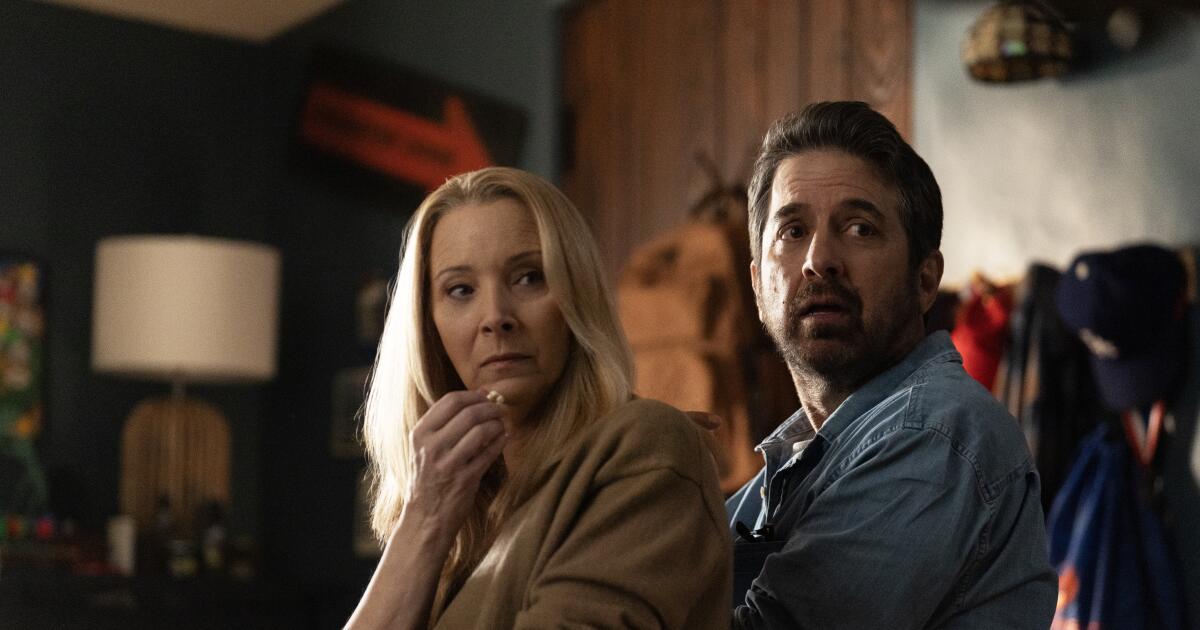
Paul (Ray Romano) and Lydia (Lisa Kudrow) are selling their house, a two-story 1920s Spanish Colonial on a corner lot ostensibly in Los Feliz, though to a local’s eye clearly not. (Hancock Park doesn’t sound as cool.) It’s an open house as the show begins, and nearly all the major characters will walk through, while Paul and Lydia spy on them via video from a locked room upstairs, eating popcorn. The exposition comes fast and fierce.
Sarah (Poppy Liu), a doctor, and Leslie (Abbi Jacobson), a lawyer, are a married couple who have walked by the house “so many times.” They’re excited to finally see inside: “Do we not have these exact arches on our vision board?” exults Leslie. Sarah, who spends too much time looking at a Nextdoor-style app, worries about the neighborhood. Dennis (O-T Fagbenle), a novelist, and Carla (Teyonah Parris), an architect, are pregnant newlyweds; attached to them is his mother, Denise (Anna Maria Horsford), to whom he’s a trifle too attached. He sees the house as aspirational, several steps up from his Bed-Stuy childhood; Carla thinks Baldwin Hills might be more their speed.
Wandering in separately from the modernist monstrosity across the street are JD (Luke Wilson), a depressed out-of-work actor, and glittery, shallow Margo (Linda Cardellini), who will presently be identified as his wife. Luke is underwater on their house; Margo, who is also sleeping with Gwen (Kate Moennig), a high-powered financial something or other, is a woman whose “love language,” says JD, is “gifts.”
Completing the main cast is Mikey (Denis Leary), who shows up unexpectedly while Paul is in his garage doing something on a table saw to sell the idea that he works as a contractor. Mikey is out of prison after three years, upset that Paul never came to visit him, and he wants $80,000 by the next day, a request Paul feels powerless to deny — Mikey knows what “really happened” in the house — even though they’re broke. The second mortgage killed them and Lydia left her post as a pianist with the L.A. Philharmonic when her hands began to shake after a family tragedy — which is why they are selling a home they love.
Mikey (Denis Leary) shows up unexpectedly at an open house after three years in prison and makes demands of the homeowner.
(Saeed Adyani / Netflix)
Filling in the cracks are Greg (Matt Rogers), a passive-aggressive real estate agent; Phyllis (Linda Lavin), a nosy neighbor, with dogs; and Emily (Chloe East), Paul and Lydia’s semi-estranged daughter.
I can easily imagine that the spark for the series was the ritual of visiting open houses, popular among L.A. buyers and lookers alike, or simply as a device to bring a lot of disparate characters into a shared dramatic space. (Though the Dennis-Carla-Denise storyline exists mostly on its own.) In any case, the series has the quality of being written on the whole from the outside in, its characters created to accommodate a plot, rather than plot emerging from the characters. Like Feldman’s very twisty “Dead to Me,” in which Cardellini co-starred, there’s a (murder) mystery at the center of the story and characters who are keeping mum about something important — most of them, in fact.
The intertwining plots unroll in a mishmash of styles. Jacobsen throws herself into slapstick, clumsily stalking the house, about which she has questions. (She’s a lawyer, remember.) The heavy drama surrounding Paul and Mikey wouldn’t be out of place in a Sam Shepard play; in certain scenes, Paul and Lydia might have stepped out of a Cassavetes film. Dennis, Carla and Denise occupy a sort of family sitcom, while Margo and JD enact a variation on James M. Cain’s SoCal noir.
Characters change too, or seem to change, throughout. revealing true — or other — selves. At times the plotting takes a break and gives them time to talk in a more or less relaxed manner, and the series becomes interesting on a normal human level; Leary’s character, introduced essentially as a thug, benefits especially from these moments, but Romano, who spends most of the series in a state of agitation, does too. Cardellini imbues Margo with a kind of desperation not always seen in such characters, which makes her hard to figure out, though Lydia’s estimation of her as “an AI-generated bitch” sustains. And Kudrow, who is more than a great comic actress, makes whatever she’s in worth watching. She’s the show’s emotional core.
After the main mysteries reach their climax, the series jumps forward six months to an ending so tidy and generous and sentimental that it verges on parody. Not that one shouldn’t be generous to one’s characters, but it’s almost as if the series runs out of breath, and that finally there is nothing to do but settle everyone’s business in the neatest and (mostly) nicest way possible.

Created by Liz Feldman and premiering Thursday on Netflix, “No Good Deed” is a real estate black comedy set in one of the country’s most annoying markets — yes, it’s Los Angeles. It’s most notable for a cast worthy of the name “all-stars”; they are TV stars, mostly, but that is a noble breed, and not every movie actor can translate big-screen charisma to the smaller one.
Paul (Ray Romano) and Lydia (Lisa Kudrow) are selling their house, a two-story 1920s Spanish Colonial on a corner lot ostensibly in Los Feliz, though to a local’s eye clearly not. (Hancock Park doesn’t sound as cool.) It’s an open house as the show begins, and nearly all the major characters will walk through, while Paul and Lydia spy on them via video from a locked room upstairs, eating popcorn. The exposition comes fast and fierce.
Sarah (Poppy Liu), a doctor, and Leslie (Abbi Jacobson), a lawyer, are a married couple who have walked by the house “so many times.” They’re excited to finally see inside: “Do we not have these exact arches on our vision board?” exults Leslie. Sarah, who spends too much time looking at a Nextdoor-style app, worries about the neighborhood. Dennis (O-T Fagbenle), a novelist, and Carla (Teyonah Parris), an architect, are pregnant newlyweds; attached to them is his mother, Denise (Anna Maria Horsford), to whom he’s a trifle too attached. He sees the house as aspirational, several steps up from his Bed-Stuy childhood; Carla thinks Baldwin Hills might be more their speed.
Wandering in separately from the modernist monstrosity across the street are JD (Luke Wilson), a depressed out-of-work actor, and glittery, shallow Margo (Linda Cardellini), who will presently be identified as his wife. Luke is underwater on their house; Margo, who is also sleeping with Gwen (Kate Moennig), a high-powered financial something or other, is a woman whose “love language,” says JD, is “gifts.”
Completing the main cast is Mikey (Denis Leary), who shows up unexpectedly while Paul is in his garage doing something on a table saw to sell the idea that he works as a contractor. Mikey is out of prison after three years, upset that Paul never came to visit him, and he wants $80,000 by the next day, a request Paul feels powerless to deny — Mikey knows what “really happened” in the house — even though they’re broke. The second mortgage killed them and Lydia left her post as a pianist with the L.A. Philharmonic when her hands began to shake after a family tragedy — which is why they are selling a home they love.
Mikey (Denis Leary) shows up unexpectedly at an open house after three years in prison and makes demands of the homeowner.
(Saeed Adyani / Netflix)
Filling in the cracks are Greg (Matt Rogers), a passive-aggressive real estate agent; Phyllis (Linda Lavin), a nosy neighbor, with dogs; and Emily (Chloe East), Paul and Lydia’s semi-estranged daughter.
I can easily imagine that the spark for the series was the ritual of visiting open houses, popular among L.A. buyers and lookers alike, or simply as a device to bring a lot of disparate characters into a shared dramatic space. (Though the Dennis-Carla-Denise storyline exists mostly on its own.) In any case, the series has the quality of being written on the whole from the outside in, its characters created to accommodate a plot, rather than plot emerging from the characters. Like Feldman’s very twisty “Dead to Me,” in which Cardellini co-starred, there’s a (murder) mystery at the center of the story and characters who are keeping mum about something important — most of them, in fact.
The intertwining plots unroll in a mishmash of styles. Jacobsen throws herself into slapstick, clumsily stalking the house, about which she has questions. (She’s a lawyer, remember.) The heavy drama surrounding Paul and Mikey wouldn’t be out of place in a Sam Shepard play; in certain scenes, Paul and Lydia might have stepped out of a Cassavetes film. Dennis, Carla and Denise occupy a sort of family sitcom, while Margo and JD enact a variation on James M. Cain’s SoCal noir.
Characters change too, or seem to change, throughout. revealing true — or other — selves. At times the plotting takes a break and gives them time to talk in a more or less relaxed manner, and the series becomes interesting on a normal human level; Leary’s character, introduced essentially as a thug, benefits especially from these moments, but Romano, who spends most of the series in a state of agitation, does too. Cardellini imbues Margo with a kind of desperation not always seen in such characters, which makes her hard to figure out, though Lydia’s estimation of her as “an AI-generated bitch” sustains. And Kudrow, who is more than a great comic actress, makes whatever she’s in worth watching. She’s the show’s emotional core.
After the main mysteries reach their climax, the series jumps forward six months to an ending so tidy and generous and sentimental that it verges on parody. Not that one shouldn’t be generous to one’s characters, but it’s almost as if the series runs out of breath, and that finally there is nothing to do but settle everyone’s business in the neatest and (mostly) nicest way possible.

Created by Liz Feldman and premiering Thursday on Netflix, “No Good Deed” is a real estate black comedy set in one of the country’s most annoying markets — yes, it’s Los Angeles. It’s most notable for a cast worthy of the name “all-stars”; they are TV stars, mostly, but that is a noble breed, and not every movie actor can translate big-screen charisma to the smaller one.
Paul (Ray Romano) and Lydia (Lisa Kudrow) are selling their house, a two-story 1920s Spanish Colonial on a corner lot ostensibly in Los Feliz, though to a local’s eye clearly not. (Hancock Park doesn’t sound as cool.) It’s an open house as the show begins, and nearly all the major characters will walk through, while Paul and Lydia spy on them via video from a locked room upstairs, eating popcorn. The exposition comes fast and fierce.
Sarah (Poppy Liu), a doctor, and Leslie (Abbi Jacobson), a lawyer, are a married couple who have walked by the house “so many times.” They’re excited to finally see inside: “Do we not have these exact arches on our vision board?” exults Leslie. Sarah, who spends too much time looking at a Nextdoor-style app, worries about the neighborhood. Dennis (O-T Fagbenle), a novelist, and Carla (Teyonah Parris), an architect, are pregnant newlyweds; attached to them is his mother, Denise (Anna Maria Horsford), to whom he’s a trifle too attached. He sees the house as aspirational, several steps up from his Bed-Stuy childhood; Carla thinks Baldwin Hills might be more their speed.
Wandering in separately from the modernist monstrosity across the street are JD (Luke Wilson), a depressed out-of-work actor, and glittery, shallow Margo (Linda Cardellini), who will presently be identified as his wife. Luke is underwater on their house; Margo, who is also sleeping with Gwen (Kate Moennig), a high-powered financial something or other, is a woman whose “love language,” says JD, is “gifts.”
Completing the main cast is Mikey (Denis Leary), who shows up unexpectedly while Paul is in his garage doing something on a table saw to sell the idea that he works as a contractor. Mikey is out of prison after three years, upset that Paul never came to visit him, and he wants $80,000 by the next day, a request Paul feels powerless to deny — Mikey knows what “really happened” in the house — even though they’re broke. The second mortgage killed them and Lydia left her post as a pianist with the L.A. Philharmonic when her hands began to shake after a family tragedy — which is why they are selling a home they love.
Mikey (Denis Leary) shows up unexpectedly at an open house after three years in prison and makes demands of the homeowner.
(Saeed Adyani / Netflix)
Filling in the cracks are Greg (Matt Rogers), a passive-aggressive real estate agent; Phyllis (Linda Lavin), a nosy neighbor, with dogs; and Emily (Chloe East), Paul and Lydia’s semi-estranged daughter.
I can easily imagine that the spark for the series was the ritual of visiting open houses, popular among L.A. buyers and lookers alike, or simply as a device to bring a lot of disparate characters into a shared dramatic space. (Though the Dennis-Carla-Denise storyline exists mostly on its own.) In any case, the series has the quality of being written on the whole from the outside in, its characters created to accommodate a plot, rather than plot emerging from the characters. Like Feldman’s very twisty “Dead to Me,” in which Cardellini co-starred, there’s a (murder) mystery at the center of the story and characters who are keeping mum about something important — most of them, in fact.
The intertwining plots unroll in a mishmash of styles. Jacobsen throws herself into slapstick, clumsily stalking the house, about which she has questions. (She’s a lawyer, remember.) The heavy drama surrounding Paul and Mikey wouldn’t be out of place in a Sam Shepard play; in certain scenes, Paul and Lydia might have stepped out of a Cassavetes film. Dennis, Carla and Denise occupy a sort of family sitcom, while Margo and JD enact a variation on James M. Cain’s SoCal noir.
Characters change too, or seem to change, throughout. revealing true — or other — selves. At times the plotting takes a break and gives them time to talk in a more or less relaxed manner, and the series becomes interesting on a normal human level; Leary’s character, introduced essentially as a thug, benefits especially from these moments, but Romano, who spends most of the series in a state of agitation, does too. Cardellini imbues Margo with a kind of desperation not always seen in such characters, which makes her hard to figure out, though Lydia’s estimation of her as “an AI-generated bitch” sustains. And Kudrow, who is more than a great comic actress, makes whatever she’s in worth watching. She’s the show’s emotional core.
After the main mysteries reach their climax, the series jumps forward six months to an ending so tidy and generous and sentimental that it verges on parody. Not that one shouldn’t be generous to one’s characters, but it’s almost as if the series runs out of breath, and that finally there is nothing to do but settle everyone’s business in the neatest and (mostly) nicest way possible.
Created by Liz Feldman and premiering Thursday on Netflix, “No Good Deed” is a real estate black comedy set in one of the country’s most annoying markets — yes, it’s Los Angeles. It’s most notable for a cast worthy of the name “all-stars”; they are TV stars, mostly, but that is a noble breed, and not every movie actor can translate big-screen charisma to the smaller one.
Paul (Ray Romano) and Lydia (Lisa Kudrow) are selling their house, a two-story 1920s Spanish Colonial on a corner lot ostensibly in Los Feliz, though to a local’s eye clearly not. (Hancock Park doesn’t sound as cool.) It’s an open house as the show begins, and nearly all the major characters will walk through, while Paul and Lydia spy on them via video from a locked room upstairs, eating popcorn. The exposition comes fast and fierce.
Sarah (Poppy Liu), a doctor, and Leslie (Abbi Jacobson), a lawyer, are a married couple who have walked by the house “so many times.” They’re excited to finally see inside: “Do we not have these exact arches on our vision board?” exults Leslie. Sarah, who spends too much time looking at a Nextdoor-style app, worries about the neighborhood. Dennis (O-T Fagbenle), a novelist, and Carla (Teyonah Parris), an architect, are pregnant newlyweds; attached to them is his mother, Denise (Anna Maria Horsford), to whom he’s a trifle too attached. He sees the house as aspirational, several steps up from his Bed-Stuy childhood; Carla thinks Baldwin Hills might be more their speed.
Wandering in separately from the modernist monstrosity across the street are JD (Luke Wilson), a depressed out-of-work actor, and glittery, shallow Margo (Linda Cardellini), who will presently be identified as his wife. Luke is underwater on their house; Margo, who is also sleeping with Gwen (Kate Moennig), a high-powered financial something or other, is a woman whose “love language,” says JD, is “gifts.”
Completing the main cast is Mikey (Denis Leary), who shows up unexpectedly while Paul is in his garage doing something on a table saw to sell the idea that he works as a contractor. Mikey is out of prison after three years, upset that Paul never came to visit him, and he wants $80,000 by the next day, a request Paul feels powerless to deny — Mikey knows what “really happened” in the house — even though they’re broke. The second mortgage killed them and Lydia left her post as a pianist with the L.A. Philharmonic when her hands began to shake after a family tragedy — which is why they are selling a home they love.
Mikey (Denis Leary) shows up unexpectedly at an open house after three years in prison and makes demands of the homeowner.
(Saeed Adyani / Netflix)
Filling in the cracks are Greg (Matt Rogers), a passive-aggressive real estate agent; Phyllis (Linda Lavin), a nosy neighbor, with dogs; and Emily (Chloe East), Paul and Lydia’s semi-estranged daughter.
I can easily imagine that the spark for the series was the ritual of visiting open houses, popular among L.A. buyers and lookers alike, or simply as a device to bring a lot of disparate characters into a shared dramatic space. (Though the Dennis-Carla-Denise storyline exists mostly on its own.) In any case, the series has the quality of being written on the whole from the outside in, its characters created to accommodate a plot, rather than plot emerging from the characters. Like Feldman’s very twisty “Dead to Me,” in which Cardellini co-starred, there’s a (murder) mystery at the center of the story and characters who are keeping mum about something important — most of them, in fact.
The intertwining plots unroll in a mishmash of styles. Jacobsen throws herself into slapstick, clumsily stalking the house, about which she has questions. (She’s a lawyer, remember.) The heavy drama surrounding Paul and Mikey wouldn’t be out of place in a Sam Shepard play; in certain scenes, Paul and Lydia might have stepped out of a Cassavetes film. Dennis, Carla and Denise occupy a sort of family sitcom, while Margo and JD enact a variation on James M. Cain’s SoCal noir.
Characters change too, or seem to change, throughout. revealing true — or other — selves. At times the plotting takes a break and gives them time to talk in a more or less relaxed manner, and the series becomes interesting on a normal human level; Leary’s character, introduced essentially as a thug, benefits especially from these moments, but Romano, who spends most of the series in a state of agitation, does too. Cardellini imbues Margo with a kind of desperation not always seen in such characters, which makes her hard to figure out, though Lydia’s estimation of her as “an AI-generated bitch” sustains. And Kudrow, who is more than a great comic actress, makes whatever she’s in worth watching. She’s the show’s emotional core.
After the main mysteries reach their climax, the series jumps forward six months to an ending so tidy and generous and sentimental that it verges on parody. Not that one shouldn’t be generous to one’s characters, but it’s almost as if the series runs out of breath, and that finally there is nothing to do but settle everyone’s business in the neatest and (mostly) nicest way possible.

Created by Liz Feldman and premiering Thursday on Netflix, “No Good Deed” is a real estate black comedy set in one of the country’s most annoying markets — yes, it’s Los Angeles. It’s most notable for a cast worthy of the name “all-stars”; they are TV stars, mostly, but that is a noble breed, and not every movie actor can translate big-screen charisma to the smaller one.
Paul (Ray Romano) and Lydia (Lisa Kudrow) are selling their house, a two-story 1920s Spanish Colonial on a corner lot ostensibly in Los Feliz, though to a local’s eye clearly not. (Hancock Park doesn’t sound as cool.) It’s an open house as the show begins, and nearly all the major characters will walk through, while Paul and Lydia spy on them via video from a locked room upstairs, eating popcorn. The exposition comes fast and fierce.
Sarah (Poppy Liu), a doctor, and Leslie (Abbi Jacobson), a lawyer, are a married couple who have walked by the house “so many times.” They’re excited to finally see inside: “Do we not have these exact arches on our vision board?” exults Leslie. Sarah, who spends too much time looking at a Nextdoor-style app, worries about the neighborhood. Dennis (O-T Fagbenle), a novelist, and Carla (Teyonah Parris), an architect, are pregnant newlyweds; attached to them is his mother, Denise (Anna Maria Horsford), to whom he’s a trifle too attached. He sees the house as aspirational, several steps up from his Bed-Stuy childhood; Carla thinks Baldwin Hills might be more their speed.
Wandering in separately from the modernist monstrosity across the street are JD (Luke Wilson), a depressed out-of-work actor, and glittery, shallow Margo (Linda Cardellini), who will presently be identified as his wife. Luke is underwater on their house; Margo, who is also sleeping with Gwen (Kate Moennig), a high-powered financial something or other, is a woman whose “love language,” says JD, is “gifts.”
Completing the main cast is Mikey (Denis Leary), who shows up unexpectedly while Paul is in his garage doing something on a table saw to sell the idea that he works as a contractor. Mikey is out of prison after three years, upset that Paul never came to visit him, and he wants $80,000 by the next day, a request Paul feels powerless to deny — Mikey knows what “really happened” in the house — even though they’re broke. The second mortgage killed them and Lydia left her post as a pianist with the L.A. Philharmonic when her hands began to shake after a family tragedy — which is why they are selling a home they love.
Mikey (Denis Leary) shows up unexpectedly at an open house after three years in prison and makes demands of the homeowner.
(Saeed Adyani / Netflix)
Filling in the cracks are Greg (Matt Rogers), a passive-aggressive real estate agent; Phyllis (Linda Lavin), a nosy neighbor, with dogs; and Emily (Chloe East), Paul and Lydia’s semi-estranged daughter.
I can easily imagine that the spark for the series was the ritual of visiting open houses, popular among L.A. buyers and lookers alike, or simply as a device to bring a lot of disparate characters into a shared dramatic space. (Though the Dennis-Carla-Denise storyline exists mostly on its own.) In any case, the series has the quality of being written on the whole from the outside in, its characters created to accommodate a plot, rather than plot emerging from the characters. Like Feldman’s very twisty “Dead to Me,” in which Cardellini co-starred, there’s a (murder) mystery at the center of the story and characters who are keeping mum about something important — most of them, in fact.
The intertwining plots unroll in a mishmash of styles. Jacobsen throws herself into slapstick, clumsily stalking the house, about which she has questions. (She’s a lawyer, remember.) The heavy drama surrounding Paul and Mikey wouldn’t be out of place in a Sam Shepard play; in certain scenes, Paul and Lydia might have stepped out of a Cassavetes film. Dennis, Carla and Denise occupy a sort of family sitcom, while Margo and JD enact a variation on James M. Cain’s SoCal noir.
Characters change too, or seem to change, throughout. revealing true — or other — selves. At times the plotting takes a break and gives them time to talk in a more or less relaxed manner, and the series becomes interesting on a normal human level; Leary’s character, introduced essentially as a thug, benefits especially from these moments, but Romano, who spends most of the series in a state of agitation, does too. Cardellini imbues Margo with a kind of desperation not always seen in such characters, which makes her hard to figure out, though Lydia’s estimation of her as “an AI-generated bitch” sustains. And Kudrow, who is more than a great comic actress, makes whatever she’s in worth watching. She’s the show’s emotional core.
After the main mysteries reach their climax, the series jumps forward six months to an ending so tidy and generous and sentimental that it verges on parody. Not that one shouldn’t be generous to one’s characters, but it’s almost as if the series runs out of breath, and that finally there is nothing to do but settle everyone’s business in the neatest and (mostly) nicest way possible.
Created by Liz Feldman and premiering Thursday on Netflix, “No Good Deed” is a real estate black comedy set in one of the country’s most annoying markets — yes, it’s Los Angeles. It’s most notable for a cast worthy of the name “all-stars”; they are TV stars, mostly, but that is a noble breed, and not every movie actor can translate big-screen charisma to the smaller one.
Paul (Ray Romano) and Lydia (Lisa Kudrow) are selling their house, a two-story 1920s Spanish Colonial on a corner lot ostensibly in Los Feliz, though to a local’s eye clearly not. (Hancock Park doesn’t sound as cool.) It’s an open house as the show begins, and nearly all the major characters will walk through, while Paul and Lydia spy on them via video from a locked room upstairs, eating popcorn. The exposition comes fast and fierce.
Sarah (Poppy Liu), a doctor, and Leslie (Abbi Jacobson), a lawyer, are a married couple who have walked by the house “so many times.” They’re excited to finally see inside: “Do we not have these exact arches on our vision board?” exults Leslie. Sarah, who spends too much time looking at a Nextdoor-style app, worries about the neighborhood. Dennis (O-T Fagbenle), a novelist, and Carla (Teyonah Parris), an architect, are pregnant newlyweds; attached to them is his mother, Denise (Anna Maria Horsford), to whom he’s a trifle too attached. He sees the house as aspirational, several steps up from his Bed-Stuy childhood; Carla thinks Baldwin Hills might be more their speed.
Wandering in separately from the modernist monstrosity across the street are JD (Luke Wilson), a depressed out-of-work actor, and glittery, shallow Margo (Linda Cardellini), who will presently be identified as his wife. Luke is underwater on their house; Margo, who is also sleeping with Gwen (Kate Moennig), a high-powered financial something or other, is a woman whose “love language,” says JD, is “gifts.”
Completing the main cast is Mikey (Denis Leary), who shows up unexpectedly while Paul is in his garage doing something on a table saw to sell the idea that he works as a contractor. Mikey is out of prison after three years, upset that Paul never came to visit him, and he wants $80,000 by the next day, a request Paul feels powerless to deny — Mikey knows what “really happened” in the house — even though they’re broke. The second mortgage killed them and Lydia left her post as a pianist with the L.A. Philharmonic when her hands began to shake after a family tragedy — which is why they are selling a home they love.
Mikey (Denis Leary) shows up unexpectedly at an open house after three years in prison and makes demands of the homeowner.
(Saeed Adyani / Netflix)
Filling in the cracks are Greg (Matt Rogers), a passive-aggressive real estate agent; Phyllis (Linda Lavin), a nosy neighbor, with dogs; and Emily (Chloe East), Paul and Lydia’s semi-estranged daughter.
I can easily imagine that the spark for the series was the ritual of visiting open houses, popular among L.A. buyers and lookers alike, or simply as a device to bring a lot of disparate characters into a shared dramatic space. (Though the Dennis-Carla-Denise storyline exists mostly on its own.) In any case, the series has the quality of being written on the whole from the outside in, its characters created to accommodate a plot, rather than plot emerging from the characters. Like Feldman’s very twisty “Dead to Me,” in which Cardellini co-starred, there’s a (murder) mystery at the center of the story and characters who are keeping mum about something important — most of them, in fact.
The intertwining plots unroll in a mishmash of styles. Jacobsen throws herself into slapstick, clumsily stalking the house, about which she has questions. (She’s a lawyer, remember.) The heavy drama surrounding Paul and Mikey wouldn’t be out of place in a Sam Shepard play; in certain scenes, Paul and Lydia might have stepped out of a Cassavetes film. Dennis, Carla and Denise occupy a sort of family sitcom, while Margo and JD enact a variation on James M. Cain’s SoCal noir.
Characters change too, or seem to change, throughout. revealing true — or other — selves. At times the plotting takes a break and gives them time to talk in a more or less relaxed manner, and the series becomes interesting on a normal human level; Leary’s character, introduced essentially as a thug, benefits especially from these moments, but Romano, who spends most of the series in a state of agitation, does too. Cardellini imbues Margo with a kind of desperation not always seen in such characters, which makes her hard to figure out, though Lydia’s estimation of her as “an AI-generated bitch” sustains. And Kudrow, who is more than a great comic actress, makes whatever she’s in worth watching. She’s the show’s emotional core.
After the main mysteries reach their climax, the series jumps forward six months to an ending so tidy and generous and sentimental that it verges on parody. Not that one shouldn’t be generous to one’s characters, but it’s almost as if the series runs out of breath, and that finally there is nothing to do but settle everyone’s business in the neatest and (mostly) nicest way possible.
Created by Liz Feldman and premiering Thursday on Netflix, “No Good Deed” is a real estate black comedy set in one of the country’s most annoying markets — yes, it’s Los Angeles. It’s most notable for a cast worthy of the name “all-stars”; they are TV stars, mostly, but that is a noble breed, and not every movie actor can translate big-screen charisma to the smaller one.
Paul (Ray Romano) and Lydia (Lisa Kudrow) are selling their house, a two-story 1920s Spanish Colonial on a corner lot ostensibly in Los Feliz, though to a local’s eye clearly not. (Hancock Park doesn’t sound as cool.) It’s an open house as the show begins, and nearly all the major characters will walk through, while Paul and Lydia spy on them via video from a locked room upstairs, eating popcorn. The exposition comes fast and fierce.
Sarah (Poppy Liu), a doctor, and Leslie (Abbi Jacobson), a lawyer, are a married couple who have walked by the house “so many times.” They’re excited to finally see inside: “Do we not have these exact arches on our vision board?” exults Leslie. Sarah, who spends too much time looking at a Nextdoor-style app, worries about the neighborhood. Dennis (O-T Fagbenle), a novelist, and Carla (Teyonah Parris), an architect, are pregnant newlyweds; attached to them is his mother, Denise (Anna Maria Horsford), to whom he’s a trifle too attached. He sees the house as aspirational, several steps up from his Bed-Stuy childhood; Carla thinks Baldwin Hills might be more their speed.
Wandering in separately from the modernist monstrosity across the street are JD (Luke Wilson), a depressed out-of-work actor, and glittery, shallow Margo (Linda Cardellini), who will presently be identified as his wife. Luke is underwater on their house; Margo, who is also sleeping with Gwen (Kate Moennig), a high-powered financial something or other, is a woman whose “love language,” says JD, is “gifts.”
Completing the main cast is Mikey (Denis Leary), who shows up unexpectedly while Paul is in his garage doing something on a table saw to sell the idea that he works as a contractor. Mikey is out of prison after three years, upset that Paul never came to visit him, and he wants $80,000 by the next day, a request Paul feels powerless to deny — Mikey knows what “really happened” in the house — even though they’re broke. The second mortgage killed them and Lydia left her post as a pianist with the L.A. Philharmonic when her hands began to shake after a family tragedy — which is why they are selling a home they love.
Mikey (Denis Leary) shows up unexpectedly at an open house after three years in prison and makes demands of the homeowner.
(Saeed Adyani / Netflix)
Filling in the cracks are Greg (Matt Rogers), a passive-aggressive real estate agent; Phyllis (Linda Lavin), a nosy neighbor, with dogs; and Emily (Chloe East), Paul and Lydia’s semi-estranged daughter.
I can easily imagine that the spark for the series was the ritual of visiting open houses, popular among L.A. buyers and lookers alike, or simply as a device to bring a lot of disparate characters into a shared dramatic space. (Though the Dennis-Carla-Denise storyline exists mostly on its own.) In any case, the series has the quality of being written on the whole from the outside in, its characters created to accommodate a plot, rather than plot emerging from the characters. Like Feldman’s very twisty “Dead to Me,” in which Cardellini co-starred, there’s a (murder) mystery at the center of the story and characters who are keeping mum about something important — most of them, in fact.
The intertwining plots unroll in a mishmash of styles. Jacobsen throws herself into slapstick, clumsily stalking the house, about which she has questions. (She’s a lawyer, remember.) The heavy drama surrounding Paul and Mikey wouldn’t be out of place in a Sam Shepard play; in certain scenes, Paul and Lydia might have stepped out of a Cassavetes film. Dennis, Carla and Denise occupy a sort of family sitcom, while Margo and JD enact a variation on James M. Cain’s SoCal noir.
Characters change too, or seem to change, throughout. revealing true — or other — selves. At times the plotting takes a break and gives them time to talk in a more or less relaxed manner, and the series becomes interesting on a normal human level; Leary’s character, introduced essentially as a thug, benefits especially from these moments, but Romano, who spends most of the series in a state of agitation, does too. Cardellini imbues Margo with a kind of desperation not always seen in such characters, which makes her hard to figure out, though Lydia’s estimation of her as “an AI-generated bitch” sustains. And Kudrow, who is more than a great comic actress, makes whatever she’s in worth watching. She’s the show’s emotional core.
After the main mysteries reach their climax, the series jumps forward six months to an ending so tidy and generous and sentimental that it verges on parody. Not that one shouldn’t be generous to one’s characters, but it’s almost as if the series runs out of breath, and that finally there is nothing to do but settle everyone’s business in the neatest and (mostly) nicest way possible.
Created by Liz Feldman and premiering Thursday on Netflix, “No Good Deed” is a real estate black comedy set in one of the country’s most annoying markets — yes, it’s Los Angeles. It’s most notable for a cast worthy of the name “all-stars”; they are TV stars, mostly, but that is a noble breed, and not every movie actor can translate big-screen charisma to the smaller one.
Paul (Ray Romano) and Lydia (Lisa Kudrow) are selling their house, a two-story 1920s Spanish Colonial on a corner lot ostensibly in Los Feliz, though to a local’s eye clearly not. (Hancock Park doesn’t sound as cool.) It’s an open house as the show begins, and nearly all the major characters will walk through, while Paul and Lydia spy on them via video from a locked room upstairs, eating popcorn. The exposition comes fast and fierce.
Sarah (Poppy Liu), a doctor, and Leslie (Abbi Jacobson), a lawyer, are a married couple who have walked by the house “so many times.” They’re excited to finally see inside: “Do we not have these exact arches on our vision board?” exults Leslie. Sarah, who spends too much time looking at a Nextdoor-style app, worries about the neighborhood. Dennis (O-T Fagbenle), a novelist, and Carla (Teyonah Parris), an architect, are pregnant newlyweds; attached to them is his mother, Denise (Anna Maria Horsford), to whom he’s a trifle too attached. He sees the house as aspirational, several steps up from his Bed-Stuy childhood; Carla thinks Baldwin Hills might be more their speed.
Wandering in separately from the modernist monstrosity across the street are JD (Luke Wilson), a depressed out-of-work actor, and glittery, shallow Margo (Linda Cardellini), who will presently be identified as his wife. Luke is underwater on their house; Margo, who is also sleeping with Gwen (Kate Moennig), a high-powered financial something or other, is a woman whose “love language,” says JD, is “gifts.”
Completing the main cast is Mikey (Denis Leary), who shows up unexpectedly while Paul is in his garage doing something on a table saw to sell the idea that he works as a contractor. Mikey is out of prison after three years, upset that Paul never came to visit him, and he wants $80,000 by the next day, a request Paul feels powerless to deny — Mikey knows what “really happened” in the house — even though they’re broke. The second mortgage killed them and Lydia left her post as a pianist with the L.A. Philharmonic when her hands began to shake after a family tragedy — which is why they are selling a home they love.
Mikey (Denis Leary) shows up unexpectedly at an open house after three years in prison and makes demands of the homeowner.
(Saeed Adyani / Netflix)
Filling in the cracks are Greg (Matt Rogers), a passive-aggressive real estate agent; Phyllis (Linda Lavin), a nosy neighbor, with dogs; and Emily (Chloe East), Paul and Lydia’s semi-estranged daughter.
I can easily imagine that the spark for the series was the ritual of visiting open houses, popular among L.A. buyers and lookers alike, or simply as a device to bring a lot of disparate characters into a shared dramatic space. (Though the Dennis-Carla-Denise storyline exists mostly on its own.) In any case, the series has the quality of being written on the whole from the outside in, its characters created to accommodate a plot, rather than plot emerging from the characters. Like Feldman’s very twisty “Dead to Me,” in which Cardellini co-starred, there’s a (murder) mystery at the center of the story and characters who are keeping mum about something important — most of them, in fact.
The intertwining plots unroll in a mishmash of styles. Jacobsen throws herself into slapstick, clumsily stalking the house, about which she has questions. (She’s a lawyer, remember.) The heavy drama surrounding Paul and Mikey wouldn’t be out of place in a Sam Shepard play; in certain scenes, Paul and Lydia might have stepped out of a Cassavetes film. Dennis, Carla and Denise occupy a sort of family sitcom, while Margo and JD enact a variation on James M. Cain’s SoCal noir.
Characters change too, or seem to change, throughout. revealing true — or other — selves. At times the plotting takes a break and gives them time to talk in a more or less relaxed manner, and the series becomes interesting on a normal human level; Leary’s character, introduced essentially as a thug, benefits especially from these moments, but Romano, who spends most of the series in a state of agitation, does too. Cardellini imbues Margo with a kind of desperation not always seen in such characters, which makes her hard to figure out, though Lydia’s estimation of her as “an AI-generated bitch” sustains. And Kudrow, who is more than a great comic actress, makes whatever she’s in worth watching. She’s the show’s emotional core.
After the main mysteries reach their climax, the series jumps forward six months to an ending so tidy and generous and sentimental that it verges on parody. Not that one shouldn’t be generous to one’s characters, but it’s almost as if the series runs out of breath, and that finally there is nothing to do but settle everyone’s business in the neatest and (mostly) nicest way possible.