

The world in its current state probably needs more movies built around smart people talking to — and not past — each other. Just as essential to that need are filmmakers with a grasp of how these scenarios work best.
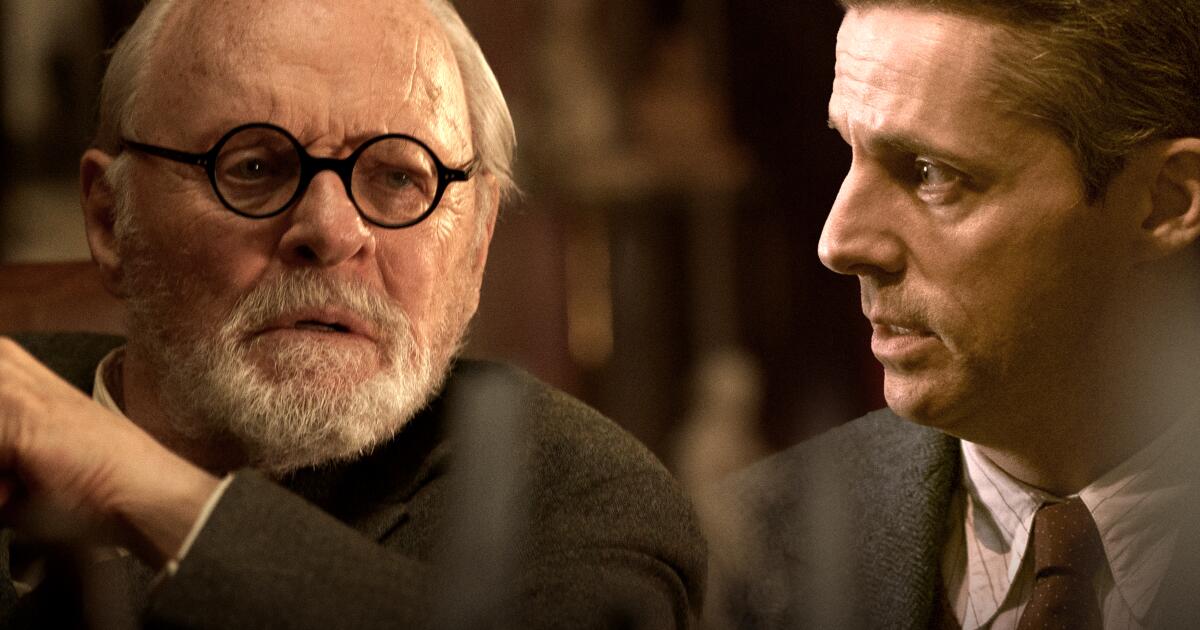
Such is the sense of promise and loss manifested by “Freud’s Last Session,” an old-fashioned bout of ideas and beliefs in the Two Great Men of History Enter One Room vein, speculating a 1939 encounter in London between born-again British author C.S. Lewis, rendered with elegant politeness by Matthew Goode, and the father of psychoanalytical reason, Sigmund Freud, roared into life by Anthony Hopkins.
It’s hardly surprising that this was stage material first: Playwright Mark St. Germain turned a tantalizing historical tidbit — Freud met with an unnamed Oxford don shortly after Adolf Hitler invaded Poland — into a dramatized debate about religion and reason, imagining the pre-“Narnia” Lewis as that visiting professor. With the world on the brink of war, an ailing atheist facing his mortality, and an ascetic theologian still in the flush of his embrace of Christianity (this Lewis is not yet the lovelorn academic whom Hopkins played so memorably in 1993’s “Shadowlands”), there’s plenty on tap for any heady two-hander worth its salt, whether performed in front of a live audience or cameras.
But director Matthew Brown, who also co-adapted St. Germain’s 2010 play, has fallen for the regrettable, rarely well-proved view that movies should “open up” plays with flashbacks and subplots. In this instance, the flashbacks mostly apply to Lewis’ back story of World War I scars and meaningful relationships with a friend’s mother (Orla Brady) and colleague J.R.R. Tolkien. In Freud’s case, they’re about his impactful childhood and last years in a worsening Austria. The unintended effect, however, is of cramped twin biographies, when what we’re here for is a drawn-out colloquy in a tight space: Lewis’ gentle prodding of a rationalist’s edges versus Freud’s fulminating about God’s existence.
Not that their pasts wouldn’t factor into such a debate, and cinematographer Ben Smithard is as accomplished with a misty forest or war scene as he is the period richness of Freud’s study. But what suffers in these expansions is the pleasure of sustained characterization: a memory no longer entrusted solely to its portrayer’s voice, eyes and movement, but instead a portal to something superfluous, as if depth of character were best captured with a location budget instead of what an actor can inject directly into our brains.
Liv Lisa Fries in the movie “Freud’s Last Session.”
(Sony Pictures Classics)
The problem exists also in the well-intentioned but lurching attempt to give a story line of equal weight to Freud’s daughter, Anna (Liv Lisa Fries), herself both the dutiful heir to her father’s legacy (she would become a child psychology pioneer) and the sum of his disturbing attempts to psychoanalyze the lesbianism out of her. Her scenes, often with Dorothy Burlingham (Jodi Balfour) in stern judgment of her lover’s lack of independence, feel tacked on to give Lewis’ and Freud’s discussions of sexuality some added oomph, when the complexity of Anna’s situation deserves its own fully attentive telling.
With so much chronological haphazardness, the handsomely produced if choppily edited “Freud’s Last Session” becomes trapped in a no-patient’s-land, neither effectively enlarged nor satisfyingly intimate. There are a handful of thick and thorny exchanges, the kind that remind us how invigorating it is when ideological opposites wrestle the big questions with passion and humor, and we’re left with the impression that soulful coexistence is better than definitive answers.
But with so much extra wedged in, those moments can’t help but feel rushed. The leads give it their all — Hopkins’ vinegary parrying is especially lively — but the overall takeaway is of historical puppets playing philosophical gotcha, when we yearn for three-dimensional humans filling up a room with their lives, learnings and flaws.
‘Freud’s Last Session’
Rating: PG-13, for thematic material, some bloody/violent images, sexual material and smoking
Running time: 1 hour, 48 minutes
Playing: Laemmle Royal, West Los Angeles; AMC The Grove 14, West Los Angeles

The world in its current state probably needs more movies built around smart people talking to — and not past — each other. Just as essential to that need are filmmakers with a grasp of how these scenarios work best.
Such is the sense of promise and loss manifested by “Freud’s Last Session,” an old-fashioned bout of ideas and beliefs in the Two Great Men of History Enter One Room vein, speculating a 1939 encounter in London between born-again British author C.S. Lewis, rendered with elegant politeness by Matthew Goode, and the father of psychoanalytical reason, Sigmund Freud, roared into life by Anthony Hopkins.
It’s hardly surprising that this was stage material first: Playwright Mark St. Germain turned a tantalizing historical tidbit — Freud met with an unnamed Oxford don shortly after Adolf Hitler invaded Poland — into a dramatized debate about religion and reason, imagining the pre-“Narnia” Lewis as that visiting professor. With the world on the brink of war, an ailing atheist facing his mortality, and an ascetic theologian still in the flush of his embrace of Christianity (this Lewis is not yet the lovelorn academic whom Hopkins played so memorably in 1993’s “Shadowlands”), there’s plenty on tap for any heady two-hander worth its salt, whether performed in front of a live audience or cameras.
But director Matthew Brown, who also co-adapted St. Germain’s 2010 play, has fallen for the regrettable, rarely well-proved view that movies should “open up” plays with flashbacks and subplots. In this instance, the flashbacks mostly apply to Lewis’ back story of World War I scars and meaningful relationships with a friend’s mother (Orla Brady) and colleague J.R.R. Tolkien. In Freud’s case, they’re about his impactful childhood and last years in a worsening Austria. The unintended effect, however, is of cramped twin biographies, when what we’re here for is a drawn-out colloquy in a tight space: Lewis’ gentle prodding of a rationalist’s edges versus Freud’s fulminating about God’s existence.
Not that their pasts wouldn’t factor into such a debate, and cinematographer Ben Smithard is as accomplished with a misty forest or war scene as he is the period richness of Freud’s study. But what suffers in these expansions is the pleasure of sustained characterization: a memory no longer entrusted solely to its portrayer’s voice, eyes and movement, but instead a portal to something superfluous, as if depth of character were best captured with a location budget instead of what an actor can inject directly into our brains.
Liv Lisa Fries in the movie “Freud’s Last Session.”
(Sony Pictures Classics)
The problem exists also in the well-intentioned but lurching attempt to give a story line of equal weight to Freud’s daughter, Anna (Liv Lisa Fries), herself both the dutiful heir to her father’s legacy (she would become a child psychology pioneer) and the sum of his disturbing attempts to psychoanalyze the lesbianism out of her. Her scenes, often with Dorothy Burlingham (Jodi Balfour) in stern judgment of her lover’s lack of independence, feel tacked on to give Lewis’ and Freud’s discussions of sexuality some added oomph, when the complexity of Anna’s situation deserves its own fully attentive telling.
With so much chronological haphazardness, the handsomely produced if choppily edited “Freud’s Last Session” becomes trapped in a no-patient’s-land, neither effectively enlarged nor satisfyingly intimate. There are a handful of thick and thorny exchanges, the kind that remind us how invigorating it is when ideological opposites wrestle the big questions with passion and humor, and we’re left with the impression that soulful coexistence is better than definitive answers.
But with so much extra wedged in, those moments can’t help but feel rushed. The leads give it their all — Hopkins’ vinegary parrying is especially lively — but the overall takeaway is of historical puppets playing philosophical gotcha, when we yearn for three-dimensional humans filling up a room with their lives, learnings and flaws.
‘Freud’s Last Session’
Rating: PG-13, for thematic material, some bloody/violent images, sexual material and smoking
Running time: 1 hour, 48 minutes
Playing: Laemmle Royal, West Los Angeles; AMC The Grove 14, West Los Angeles

The world in its current state probably needs more movies built around smart people talking to — and not past — each other. Just as essential to that need are filmmakers with a grasp of how these scenarios work best.
Such is the sense of promise and loss manifested by “Freud’s Last Session,” an old-fashioned bout of ideas and beliefs in the Two Great Men of History Enter One Room vein, speculating a 1939 encounter in London between born-again British author C.S. Lewis, rendered with elegant politeness by Matthew Goode, and the father of psychoanalytical reason, Sigmund Freud, roared into life by Anthony Hopkins.
It’s hardly surprising that this was stage material first: Playwright Mark St. Germain turned a tantalizing historical tidbit — Freud met with an unnamed Oxford don shortly after Adolf Hitler invaded Poland — into a dramatized debate about religion and reason, imagining the pre-“Narnia” Lewis as that visiting professor. With the world on the brink of war, an ailing atheist facing his mortality, and an ascetic theologian still in the flush of his embrace of Christianity (this Lewis is not yet the lovelorn academic whom Hopkins played so memorably in 1993’s “Shadowlands”), there’s plenty on tap for any heady two-hander worth its salt, whether performed in front of a live audience or cameras.
But director Matthew Brown, who also co-adapted St. Germain’s 2010 play, has fallen for the regrettable, rarely well-proved view that movies should “open up” plays with flashbacks and subplots. In this instance, the flashbacks mostly apply to Lewis’ back story of World War I scars and meaningful relationships with a friend’s mother (Orla Brady) and colleague J.R.R. Tolkien. In Freud’s case, they’re about his impactful childhood and last years in a worsening Austria. The unintended effect, however, is of cramped twin biographies, when what we’re here for is a drawn-out colloquy in a tight space: Lewis’ gentle prodding of a rationalist’s edges versus Freud’s fulminating about God’s existence.
Not that their pasts wouldn’t factor into such a debate, and cinematographer Ben Smithard is as accomplished with a misty forest or war scene as he is the period richness of Freud’s study. But what suffers in these expansions is the pleasure of sustained characterization: a memory no longer entrusted solely to its portrayer’s voice, eyes and movement, but instead a portal to something superfluous, as if depth of character were best captured with a location budget instead of what an actor can inject directly into our brains.
Liv Lisa Fries in the movie “Freud’s Last Session.”
(Sony Pictures Classics)
The problem exists also in the well-intentioned but lurching attempt to give a story line of equal weight to Freud’s daughter, Anna (Liv Lisa Fries), herself both the dutiful heir to her father’s legacy (she would become a child psychology pioneer) and the sum of his disturbing attempts to psychoanalyze the lesbianism out of her. Her scenes, often with Dorothy Burlingham (Jodi Balfour) in stern judgment of her lover’s lack of independence, feel tacked on to give Lewis’ and Freud’s discussions of sexuality some added oomph, when the complexity of Anna’s situation deserves its own fully attentive telling.
With so much chronological haphazardness, the handsomely produced if choppily edited “Freud’s Last Session” becomes trapped in a no-patient’s-land, neither effectively enlarged nor satisfyingly intimate. There are a handful of thick and thorny exchanges, the kind that remind us how invigorating it is when ideological opposites wrestle the big questions with passion and humor, and we’re left with the impression that soulful coexistence is better than definitive answers.
But with so much extra wedged in, those moments can’t help but feel rushed. The leads give it their all — Hopkins’ vinegary parrying is especially lively — but the overall takeaway is of historical puppets playing philosophical gotcha, when we yearn for three-dimensional humans filling up a room with their lives, learnings and flaws.
‘Freud’s Last Session’
Rating: PG-13, for thematic material, some bloody/violent images, sexual material and smoking
Running time: 1 hour, 48 minutes
Playing: Laemmle Royal, West Los Angeles; AMC The Grove 14, West Los Angeles
The world in its current state probably needs more movies built around smart people talking to — and not past — each other. Just as essential to that need are filmmakers with a grasp of how these scenarios work best.
Such is the sense of promise and loss manifested by “Freud’s Last Session,” an old-fashioned bout of ideas and beliefs in the Two Great Men of History Enter One Room vein, speculating a 1939 encounter in London between born-again British author C.S. Lewis, rendered with elegant politeness by Matthew Goode, and the father of psychoanalytical reason, Sigmund Freud, roared into life by Anthony Hopkins.
It’s hardly surprising that this was stage material first: Playwright Mark St. Germain turned a tantalizing historical tidbit — Freud met with an unnamed Oxford don shortly after Adolf Hitler invaded Poland — into a dramatized debate about religion and reason, imagining the pre-“Narnia” Lewis as that visiting professor. With the world on the brink of war, an ailing atheist facing his mortality, and an ascetic theologian still in the flush of his embrace of Christianity (this Lewis is not yet the lovelorn academic whom Hopkins played so memorably in 1993’s “Shadowlands”), there’s plenty on tap for any heady two-hander worth its salt, whether performed in front of a live audience or cameras.
But director Matthew Brown, who also co-adapted St. Germain’s 2010 play, has fallen for the regrettable, rarely well-proved view that movies should “open up” plays with flashbacks and subplots. In this instance, the flashbacks mostly apply to Lewis’ back story of World War I scars and meaningful relationships with a friend’s mother (Orla Brady) and colleague J.R.R. Tolkien. In Freud’s case, they’re about his impactful childhood and last years in a worsening Austria. The unintended effect, however, is of cramped twin biographies, when what we’re here for is a drawn-out colloquy in a tight space: Lewis’ gentle prodding of a rationalist’s edges versus Freud’s fulminating about God’s existence.
Not that their pasts wouldn’t factor into such a debate, and cinematographer Ben Smithard is as accomplished with a misty forest or war scene as he is the period richness of Freud’s study. But what suffers in these expansions is the pleasure of sustained characterization: a memory no longer entrusted solely to its portrayer’s voice, eyes and movement, but instead a portal to something superfluous, as if depth of character were best captured with a location budget instead of what an actor can inject directly into our brains.
Liv Lisa Fries in the movie “Freud’s Last Session.”
(Sony Pictures Classics)
The problem exists also in the well-intentioned but lurching attempt to give a story line of equal weight to Freud’s daughter, Anna (Liv Lisa Fries), herself both the dutiful heir to her father’s legacy (she would become a child psychology pioneer) and the sum of his disturbing attempts to psychoanalyze the lesbianism out of her. Her scenes, often with Dorothy Burlingham (Jodi Balfour) in stern judgment of her lover’s lack of independence, feel tacked on to give Lewis’ and Freud’s discussions of sexuality some added oomph, when the complexity of Anna’s situation deserves its own fully attentive telling.
With so much chronological haphazardness, the handsomely produced if choppily edited “Freud’s Last Session” becomes trapped in a no-patient’s-land, neither effectively enlarged nor satisfyingly intimate. There are a handful of thick and thorny exchanges, the kind that remind us how invigorating it is when ideological opposites wrestle the big questions with passion and humor, and we’re left with the impression that soulful coexistence is better than definitive answers.
But with so much extra wedged in, those moments can’t help but feel rushed. The leads give it their all — Hopkins’ vinegary parrying is especially lively — but the overall takeaway is of historical puppets playing philosophical gotcha, when we yearn for three-dimensional humans filling up a room with their lives, learnings and flaws.
‘Freud’s Last Session’
Rating: PG-13, for thematic material, some bloody/violent images, sexual material and smoking
Running time: 1 hour, 48 minutes
Playing: Laemmle Royal, West Los Angeles; AMC The Grove 14, West Los Angeles

The world in its current state probably needs more movies built around smart people talking to — and not past — each other. Just as essential to that need are filmmakers with a grasp of how these scenarios work best.
Such is the sense of promise and loss manifested by “Freud’s Last Session,” an old-fashioned bout of ideas and beliefs in the Two Great Men of History Enter One Room vein, speculating a 1939 encounter in London between born-again British author C.S. Lewis, rendered with elegant politeness by Matthew Goode, and the father of psychoanalytical reason, Sigmund Freud, roared into life by Anthony Hopkins.
It’s hardly surprising that this was stage material first: Playwright Mark St. Germain turned a tantalizing historical tidbit — Freud met with an unnamed Oxford don shortly after Adolf Hitler invaded Poland — into a dramatized debate about religion and reason, imagining the pre-“Narnia” Lewis as that visiting professor. With the world on the brink of war, an ailing atheist facing his mortality, and an ascetic theologian still in the flush of his embrace of Christianity (this Lewis is not yet the lovelorn academic whom Hopkins played so memorably in 1993’s “Shadowlands”), there’s plenty on tap for any heady two-hander worth its salt, whether performed in front of a live audience or cameras.
But director Matthew Brown, who also co-adapted St. Germain’s 2010 play, has fallen for the regrettable, rarely well-proved view that movies should “open up” plays with flashbacks and subplots. In this instance, the flashbacks mostly apply to Lewis’ back story of World War I scars and meaningful relationships with a friend’s mother (Orla Brady) and colleague J.R.R. Tolkien. In Freud’s case, they’re about his impactful childhood and last years in a worsening Austria. The unintended effect, however, is of cramped twin biographies, when what we’re here for is a drawn-out colloquy in a tight space: Lewis’ gentle prodding of a rationalist’s edges versus Freud’s fulminating about God’s existence.
Not that their pasts wouldn’t factor into such a debate, and cinematographer Ben Smithard is as accomplished with a misty forest or war scene as he is the period richness of Freud’s study. But what suffers in these expansions is the pleasure of sustained characterization: a memory no longer entrusted solely to its portrayer’s voice, eyes and movement, but instead a portal to something superfluous, as if depth of character were best captured with a location budget instead of what an actor can inject directly into our brains.
Liv Lisa Fries in the movie “Freud’s Last Session.”
(Sony Pictures Classics)
The problem exists also in the well-intentioned but lurching attempt to give a story line of equal weight to Freud’s daughter, Anna (Liv Lisa Fries), herself both the dutiful heir to her father’s legacy (she would become a child psychology pioneer) and the sum of his disturbing attempts to psychoanalyze the lesbianism out of her. Her scenes, often with Dorothy Burlingham (Jodi Balfour) in stern judgment of her lover’s lack of independence, feel tacked on to give Lewis’ and Freud’s discussions of sexuality some added oomph, when the complexity of Anna’s situation deserves its own fully attentive telling.
With so much chronological haphazardness, the handsomely produced if choppily edited “Freud’s Last Session” becomes trapped in a no-patient’s-land, neither effectively enlarged nor satisfyingly intimate. There are a handful of thick and thorny exchanges, the kind that remind us how invigorating it is when ideological opposites wrestle the big questions with passion and humor, and we’re left with the impression that soulful coexistence is better than definitive answers.
But with so much extra wedged in, those moments can’t help but feel rushed. The leads give it their all — Hopkins’ vinegary parrying is especially lively — but the overall takeaway is of historical puppets playing philosophical gotcha, when we yearn for three-dimensional humans filling up a room with their lives, learnings and flaws.
‘Freud’s Last Session’
Rating: PG-13, for thematic material, some bloody/violent images, sexual material and smoking
Running time: 1 hour, 48 minutes
Playing: Laemmle Royal, West Los Angeles; AMC The Grove 14, West Los Angeles
The world in its current state probably needs more movies built around smart people talking to — and not past — each other. Just as essential to that need are filmmakers with a grasp of how these scenarios work best.
Such is the sense of promise and loss manifested by “Freud’s Last Session,” an old-fashioned bout of ideas and beliefs in the Two Great Men of History Enter One Room vein, speculating a 1939 encounter in London between born-again British author C.S. Lewis, rendered with elegant politeness by Matthew Goode, and the father of psychoanalytical reason, Sigmund Freud, roared into life by Anthony Hopkins.
It’s hardly surprising that this was stage material first: Playwright Mark St. Germain turned a tantalizing historical tidbit — Freud met with an unnamed Oxford don shortly after Adolf Hitler invaded Poland — into a dramatized debate about religion and reason, imagining the pre-“Narnia” Lewis as that visiting professor. With the world on the brink of war, an ailing atheist facing his mortality, and an ascetic theologian still in the flush of his embrace of Christianity (this Lewis is not yet the lovelorn academic whom Hopkins played so memorably in 1993’s “Shadowlands”), there’s plenty on tap for any heady two-hander worth its salt, whether performed in front of a live audience or cameras.
But director Matthew Brown, who also co-adapted St. Germain’s 2010 play, has fallen for the regrettable, rarely well-proved view that movies should “open up” plays with flashbacks and subplots. In this instance, the flashbacks mostly apply to Lewis’ back story of World War I scars and meaningful relationships with a friend’s mother (Orla Brady) and colleague J.R.R. Tolkien. In Freud’s case, they’re about his impactful childhood and last years in a worsening Austria. The unintended effect, however, is of cramped twin biographies, when what we’re here for is a drawn-out colloquy in a tight space: Lewis’ gentle prodding of a rationalist’s edges versus Freud’s fulminating about God’s existence.
Not that their pasts wouldn’t factor into such a debate, and cinematographer Ben Smithard is as accomplished with a misty forest or war scene as he is the period richness of Freud’s study. But what suffers in these expansions is the pleasure of sustained characterization: a memory no longer entrusted solely to its portrayer’s voice, eyes and movement, but instead a portal to something superfluous, as if depth of character were best captured with a location budget instead of what an actor can inject directly into our brains.
Liv Lisa Fries in the movie “Freud’s Last Session.”
(Sony Pictures Classics)
The problem exists also in the well-intentioned but lurching attempt to give a story line of equal weight to Freud’s daughter, Anna (Liv Lisa Fries), herself both the dutiful heir to her father’s legacy (she would become a child psychology pioneer) and the sum of his disturbing attempts to psychoanalyze the lesbianism out of her. Her scenes, often with Dorothy Burlingham (Jodi Balfour) in stern judgment of her lover’s lack of independence, feel tacked on to give Lewis’ and Freud’s discussions of sexuality some added oomph, when the complexity of Anna’s situation deserves its own fully attentive telling.
With so much chronological haphazardness, the handsomely produced if choppily edited “Freud’s Last Session” becomes trapped in a no-patient’s-land, neither effectively enlarged nor satisfyingly intimate. There are a handful of thick and thorny exchanges, the kind that remind us how invigorating it is when ideological opposites wrestle the big questions with passion and humor, and we’re left with the impression that soulful coexistence is better than definitive answers.
But with so much extra wedged in, those moments can’t help but feel rushed. The leads give it their all — Hopkins’ vinegary parrying is especially lively — but the overall takeaway is of historical puppets playing philosophical gotcha, when we yearn for three-dimensional humans filling up a room with their lives, learnings and flaws.
‘Freud’s Last Session’
Rating: PG-13, for thematic material, some bloody/violent images, sexual material and smoking
Running time: 1 hour, 48 minutes
Playing: Laemmle Royal, West Los Angeles; AMC The Grove 14, West Los Angeles
The world in its current state probably needs more movies built around smart people talking to — and not past — each other. Just as essential to that need are filmmakers with a grasp of how these scenarios work best.
Such is the sense of promise and loss manifested by “Freud’s Last Session,” an old-fashioned bout of ideas and beliefs in the Two Great Men of History Enter One Room vein, speculating a 1939 encounter in London between born-again British author C.S. Lewis, rendered with elegant politeness by Matthew Goode, and the father of psychoanalytical reason, Sigmund Freud, roared into life by Anthony Hopkins.
It’s hardly surprising that this was stage material first: Playwright Mark St. Germain turned a tantalizing historical tidbit — Freud met with an unnamed Oxford don shortly after Adolf Hitler invaded Poland — into a dramatized debate about religion and reason, imagining the pre-“Narnia” Lewis as that visiting professor. With the world on the brink of war, an ailing atheist facing his mortality, and an ascetic theologian still in the flush of his embrace of Christianity (this Lewis is not yet the lovelorn academic whom Hopkins played so memorably in 1993’s “Shadowlands”), there’s plenty on tap for any heady two-hander worth its salt, whether performed in front of a live audience or cameras.
But director Matthew Brown, who also co-adapted St. Germain’s 2010 play, has fallen for the regrettable, rarely well-proved view that movies should “open up” plays with flashbacks and subplots. In this instance, the flashbacks mostly apply to Lewis’ back story of World War I scars and meaningful relationships with a friend’s mother (Orla Brady) and colleague J.R.R. Tolkien. In Freud’s case, they’re about his impactful childhood and last years in a worsening Austria. The unintended effect, however, is of cramped twin biographies, when what we’re here for is a drawn-out colloquy in a tight space: Lewis’ gentle prodding of a rationalist’s edges versus Freud’s fulminating about God’s existence.
Not that their pasts wouldn’t factor into such a debate, and cinematographer Ben Smithard is as accomplished with a misty forest or war scene as he is the period richness of Freud’s study. But what suffers in these expansions is the pleasure of sustained characterization: a memory no longer entrusted solely to its portrayer’s voice, eyes and movement, but instead a portal to something superfluous, as if depth of character were best captured with a location budget instead of what an actor can inject directly into our brains.
Liv Lisa Fries in the movie “Freud’s Last Session.”
(Sony Pictures Classics)
The problem exists also in the well-intentioned but lurching attempt to give a story line of equal weight to Freud’s daughter, Anna (Liv Lisa Fries), herself both the dutiful heir to her father’s legacy (she would become a child psychology pioneer) and the sum of his disturbing attempts to psychoanalyze the lesbianism out of her. Her scenes, often with Dorothy Burlingham (Jodi Balfour) in stern judgment of her lover’s lack of independence, feel tacked on to give Lewis’ and Freud’s discussions of sexuality some added oomph, when the complexity of Anna’s situation deserves its own fully attentive telling.
With so much chronological haphazardness, the handsomely produced if choppily edited “Freud’s Last Session” becomes trapped in a no-patient’s-land, neither effectively enlarged nor satisfyingly intimate. There are a handful of thick and thorny exchanges, the kind that remind us how invigorating it is when ideological opposites wrestle the big questions with passion and humor, and we’re left with the impression that soulful coexistence is better than definitive answers.
But with so much extra wedged in, those moments can’t help but feel rushed. The leads give it their all — Hopkins’ vinegary parrying is especially lively — but the overall takeaway is of historical puppets playing philosophical gotcha, when we yearn for three-dimensional humans filling up a room with their lives, learnings and flaws.
‘Freud’s Last Session’
Rating: PG-13, for thematic material, some bloody/violent images, sexual material and smoking
Running time: 1 hour, 48 minutes
Playing: Laemmle Royal, West Los Angeles; AMC The Grove 14, West Los Angeles
The world in its current state probably needs more movies built around smart people talking to — and not past — each other. Just as essential to that need are filmmakers with a grasp of how these scenarios work best.
Such is the sense of promise and loss manifested by “Freud’s Last Session,” an old-fashioned bout of ideas and beliefs in the Two Great Men of History Enter One Room vein, speculating a 1939 encounter in London between born-again British author C.S. Lewis, rendered with elegant politeness by Matthew Goode, and the father of psychoanalytical reason, Sigmund Freud, roared into life by Anthony Hopkins.
It’s hardly surprising that this was stage material first: Playwright Mark St. Germain turned a tantalizing historical tidbit — Freud met with an unnamed Oxford don shortly after Adolf Hitler invaded Poland — into a dramatized debate about religion and reason, imagining the pre-“Narnia” Lewis as that visiting professor. With the world on the brink of war, an ailing atheist facing his mortality, and an ascetic theologian still in the flush of his embrace of Christianity (this Lewis is not yet the lovelorn academic whom Hopkins played so memorably in 1993’s “Shadowlands”), there’s plenty on tap for any heady two-hander worth its salt, whether performed in front of a live audience or cameras.
But director Matthew Brown, who also co-adapted St. Germain’s 2010 play, has fallen for the regrettable, rarely well-proved view that movies should “open up” plays with flashbacks and subplots. In this instance, the flashbacks mostly apply to Lewis’ back story of World War I scars and meaningful relationships with a friend’s mother (Orla Brady) and colleague J.R.R. Tolkien. In Freud’s case, they’re about his impactful childhood and last years in a worsening Austria. The unintended effect, however, is of cramped twin biographies, when what we’re here for is a drawn-out colloquy in a tight space: Lewis’ gentle prodding of a rationalist’s edges versus Freud’s fulminating about God’s existence.
Not that their pasts wouldn’t factor into such a debate, and cinematographer Ben Smithard is as accomplished with a misty forest or war scene as he is the period richness of Freud’s study. But what suffers in these expansions is the pleasure of sustained characterization: a memory no longer entrusted solely to its portrayer’s voice, eyes and movement, but instead a portal to something superfluous, as if depth of character were best captured with a location budget instead of what an actor can inject directly into our brains.
Liv Lisa Fries in the movie “Freud’s Last Session.”
(Sony Pictures Classics)
The problem exists also in the well-intentioned but lurching attempt to give a story line of equal weight to Freud’s daughter, Anna (Liv Lisa Fries), herself both the dutiful heir to her father’s legacy (she would become a child psychology pioneer) and the sum of his disturbing attempts to psychoanalyze the lesbianism out of her. Her scenes, often with Dorothy Burlingham (Jodi Balfour) in stern judgment of her lover’s lack of independence, feel tacked on to give Lewis’ and Freud’s discussions of sexuality some added oomph, when the complexity of Anna’s situation deserves its own fully attentive telling.
With so much chronological haphazardness, the handsomely produced if choppily edited “Freud’s Last Session” becomes trapped in a no-patient’s-land, neither effectively enlarged nor satisfyingly intimate. There are a handful of thick and thorny exchanges, the kind that remind us how invigorating it is when ideological opposites wrestle the big questions with passion and humor, and we’re left with the impression that soulful coexistence is better than definitive answers.
But with so much extra wedged in, those moments can’t help but feel rushed. The leads give it their all — Hopkins’ vinegary parrying is especially lively — but the overall takeaway is of historical puppets playing philosophical gotcha, when we yearn for three-dimensional humans filling up a room with their lives, learnings and flaws.
‘Freud’s Last Session’
Rating: PG-13, for thematic material, some bloody/violent images, sexual material and smoking
Running time: 1 hour, 48 minutes
Playing: Laemmle Royal, West Los Angeles; AMC The Grove 14, West Los Angeles


