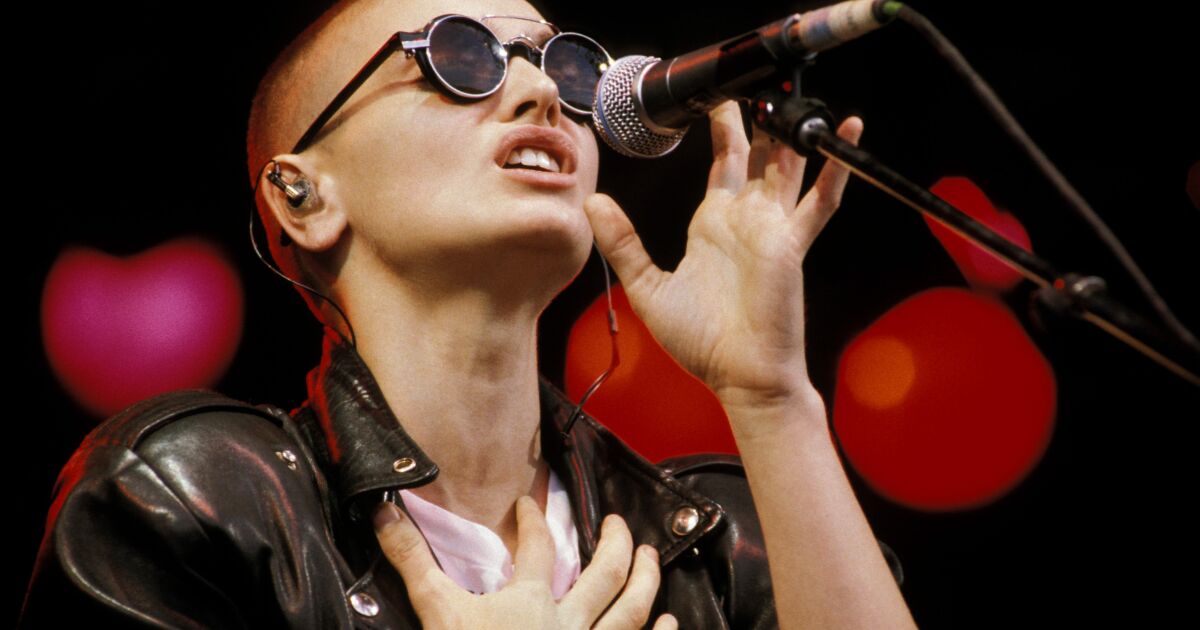
This week your social media timeline was probably flooded with images of Sinéad O’Connor, the Irish singer-songwriter who died Wednesday at 56, providing a contrast to all those bright “Barbie” memes.
Though her mainstream career effectively ended the moment she shredded a picture of Pope John Paul II on “Saturday Night Live,” O’Connor loomed large in the collective memory of Gen X thanks to the raw, emotive power of her music; an image that defiantly rejected everything expected of a young, female star in an era of slick pop; and a willingness to call out injustice wherever she saw it.
The documentary “Nothing Compares,” which aired on Showtime last year and is available to stream on Paramount+, offered a sympathetic reappraisal of O’Connor as a celebrity who was canceled long before the term came into fashion and an early, egregious example of the many high-profile women maligned as “crazy” in the 1990s.
Filmmaker Kathryn Ferguson, who also directed the video for O’Connor’s song “4th And Vine,” fell in love with O’Connor’s music as a young teenager in Belfast. “We just felt like we needed her,” she told The Times last year.
In an email interview this week, Ferguson reflected on O’Connor’s legacy and the lessons we have learned — or not learned — from her too-short life.
What were your impressions of Sinéad as a creative collaborator and documentary subject? Was there anything you found surprising once you got to know her, particularly in contrast to her public persona?
I was very lucky to first meet Sinéad in 2012 when I directed her music video for her track “4th And Vine.” My first impression was how softly spoken she was. Growing up watching Sinéad on TV and hearing that force of nature of a voice, I had presumed she would be like that in person. She was quiet, kind and funny.
She was always more to me than a documentary subject. She’d been the visceral soundtrack to my childhood and someone we adored and looked up to as teenagers growing up in Ireland.
When you interviewed her for “Nothing Compares,” did you find that she was open to talking about the more painful chapters in her life, like her childhood or the “SNL” backlash? Were there ever subjects that felt too difficult to broach with her, or that she declined to discuss?
We asked very little of Sinéad for “Nothing Compares.” It was one interview conducted over a few days in 2019. We weren’t asking to follow her around with a camera or tell us her life story. We had a very focused part of her story we wanted to tell that mainly covered the years 1987-1993. I think for that reason she was happy to be interviewed.
Sinéad O’Connor in “Nothing Compares.”
(Sheila Rock Photography/SHOWTIME)
So many women of a certain generation admired Sinéad and her music and have been expressing their feelings about her passing on social media. I wonder why you think she struck such a chord with them? What did she represent to people, especially young women, in the ‘90s?
As well as her incredible talent, she was authentic and bold and that was exciting to all of us. That’s certainly what appealed to me. She seemed so sure about what she had to say and was unwavering with her message. During an era of so much misogyny and confusing messaging she felt clear as a bell. She was also really f— cool.
Many of the obituaries and appreciations for Sinéad note that she was ahead of her time on so many issues — most obviously the Catholic Church’s track record on child abuse. Do you think that we’ve all learned anything from what she went through?
I wish I could say we had, but what has saddened me the most in her passing is how little we appear to have learned as a society. She was treated as a pariah for putting her head above the parapet. She was very open and honest about so many things including mental health, abortion, racism and homophobia, yet mocked and ridiculed for speaking out. She’s on the right side of history.
Your film ends shortly after the “SNL” backlash that derailed her mainstream music career, though she continued to write, record and perform for decades. Why did you want to focus on the earlier, most intense part of her fame?
Sinéad has had such a full life, and there’s so much in there to unpack, that to be able to put together a 90-minute film we had to be very focused on what we were going to look at. The key thing for me with the film was getting a foundation and rewriting the wrongs, and to be able to actually examine the cause and effect around what she did. If you can understand why she did what she did, everything else makes sense post-1993. So we had to go right back to understand the Ireland that had spawned her and why that had created these actions in 1992. To do a 1966-to-today film was deemed impossible without it being a very thinly spread mess. And honestly we weren’t interested in it. We want to go back and clear the air. There could be 10 documentaries made about Sinéad O’Connor — and I hope there will be.
How have you been memorializing her the last few days — any songs you’ve been listening to on repeat or pieces of video you’ve been watching?
To be honest, I’ve been shellshocked and deeply saddened by the events this week, so doing very little other than being with loved ones. The film will launch on Sky in the U.K. and Ireland [this weekend] after a long wait for it to be available here. I plan to watch it with close friends and celebrate her then.
Where do you see her legacy most visibly today? Are there singers or other artists who feel like her descendants in some way?
As she says in the film, “They tried to bury me. They didn’t realize I was a seed.” The biggest legacy is who Sinéad has inspired. In “Nothing Compares,” we show the change that has occurred in Ireland in recent years. We aren’t making the claim that she has directly changed the country, but what we are saying is that she directly inspired the young people who have. She’s finally being written into the history books as an Irish person of tremendous cultural significance and it’s been heartening to witness the nationwide mourning of her passing. It has felt almost presidential. We were extremely lucky to have her.
Do you know if Sinéad ever saw your film and what her reaction to it was?
I’m not sure if she did or not, to be honest, but she was amazingly supportive of it. I feel very privileged that we got to tell this part of her story, that we had her blessing and that she got to see the reaction to it and feel the love.

This week your social media timeline was probably flooded with images of Sinéad O’Connor, the Irish singer-songwriter who died Wednesday at 56, providing a contrast to all those bright “Barbie” memes.
Though her mainstream career effectively ended the moment she shredded a picture of Pope John Paul II on “Saturday Night Live,” O’Connor loomed large in the collective memory of Gen X thanks to the raw, emotive power of her music; an image that defiantly rejected everything expected of a young, female star in an era of slick pop; and a willingness to call out injustice wherever she saw it.
The documentary “Nothing Compares,” which aired on Showtime last year and is available to stream on Paramount+, offered a sympathetic reappraisal of O’Connor as a celebrity who was canceled long before the term came into fashion and an early, egregious example of the many high-profile women maligned as “crazy” in the 1990s.
Filmmaker Kathryn Ferguson, who also directed the video for O’Connor’s song “4th And Vine,” fell in love with O’Connor’s music as a young teenager in Belfast. “We just felt like we needed her,” she told The Times last year.
In an email interview this week, Ferguson reflected on O’Connor’s legacy and the lessons we have learned — or not learned — from her too-short life.
What were your impressions of Sinéad as a creative collaborator and documentary subject? Was there anything you found surprising once you got to know her, particularly in contrast to her public persona?
I was very lucky to first meet Sinéad in 2012 when I directed her music video for her track “4th And Vine.” My first impression was how softly spoken she was. Growing up watching Sinéad on TV and hearing that force of nature of a voice, I had presumed she would be like that in person. She was quiet, kind and funny.
She was always more to me than a documentary subject. She’d been the visceral soundtrack to my childhood and someone we adored and looked up to as teenagers growing up in Ireland.
When you interviewed her for “Nothing Compares,” did you find that she was open to talking about the more painful chapters in her life, like her childhood or the “SNL” backlash? Were there ever subjects that felt too difficult to broach with her, or that she declined to discuss?
We asked very little of Sinéad for “Nothing Compares.” It was one interview conducted over a few days in 2019. We weren’t asking to follow her around with a camera or tell us her life story. We had a very focused part of her story we wanted to tell that mainly covered the years 1987-1993. I think for that reason she was happy to be interviewed.
Sinéad O’Connor in “Nothing Compares.”
(Sheila Rock Photography/SHOWTIME)
So many women of a certain generation admired Sinéad and her music and have been expressing their feelings about her passing on social media. I wonder why you think she struck such a chord with them? What did she represent to people, especially young women, in the ‘90s?
As well as her incredible talent, she was authentic and bold and that was exciting to all of us. That’s certainly what appealed to me. She seemed so sure about what she had to say and was unwavering with her message. During an era of so much misogyny and confusing messaging she felt clear as a bell. She was also really f— cool.
Many of the obituaries and appreciations for Sinéad note that she was ahead of her time on so many issues — most obviously the Catholic Church’s track record on child abuse. Do you think that we’ve all learned anything from what she went through?
I wish I could say we had, but what has saddened me the most in her passing is how little we appear to have learned as a society. She was treated as a pariah for putting her head above the parapet. She was very open and honest about so many things including mental health, abortion, racism and homophobia, yet mocked and ridiculed for speaking out. She’s on the right side of history.
Your film ends shortly after the “SNL” backlash that derailed her mainstream music career, though she continued to write, record and perform for decades. Why did you want to focus on the earlier, most intense part of her fame?
Sinéad has had such a full life, and there’s so much in there to unpack, that to be able to put together a 90-minute film we had to be very focused on what we were going to look at. The key thing for me with the film was getting a foundation and rewriting the wrongs, and to be able to actually examine the cause and effect around what she did. If you can understand why she did what she did, everything else makes sense post-1993. So we had to go right back to understand the Ireland that had spawned her and why that had created these actions in 1992. To do a 1966-to-today film was deemed impossible without it being a very thinly spread mess. And honestly we weren’t interested in it. We want to go back and clear the air. There could be 10 documentaries made about Sinéad O’Connor — and I hope there will be.
How have you been memorializing her the last few days — any songs you’ve been listening to on repeat or pieces of video you’ve been watching?
To be honest, I’ve been shellshocked and deeply saddened by the events this week, so doing very little other than being with loved ones. The film will launch on Sky in the U.K. and Ireland [this weekend] after a long wait for it to be available here. I plan to watch it with close friends and celebrate her then.
Where do you see her legacy most visibly today? Are there singers or other artists who feel like her descendants in some way?
As she says in the film, “They tried to bury me. They didn’t realize I was a seed.” The biggest legacy is who Sinéad has inspired. In “Nothing Compares,” we show the change that has occurred in Ireland in recent years. We aren’t making the claim that she has directly changed the country, but what we are saying is that she directly inspired the young people who have. She’s finally being written into the history books as an Irish person of tremendous cultural significance and it’s been heartening to witness the nationwide mourning of her passing. It has felt almost presidential. We were extremely lucky to have her.
Do you know if Sinéad ever saw your film and what her reaction to it was?
I’m not sure if she did or not, to be honest, but she was amazingly supportive of it. I feel very privileged that we got to tell this part of her story, that we had her blessing and that she got to see the reaction to it and feel the love.

This week your social media timeline was probably flooded with images of Sinéad O’Connor, the Irish singer-songwriter who died Wednesday at 56, providing a contrast to all those bright “Barbie” memes.
Though her mainstream career effectively ended the moment she shredded a picture of Pope John Paul II on “Saturday Night Live,” O’Connor loomed large in the collective memory of Gen X thanks to the raw, emotive power of her music; an image that defiantly rejected everything expected of a young, female star in an era of slick pop; and a willingness to call out injustice wherever she saw it.
The documentary “Nothing Compares,” which aired on Showtime last year and is available to stream on Paramount+, offered a sympathetic reappraisal of O’Connor as a celebrity who was canceled long before the term came into fashion and an early, egregious example of the many high-profile women maligned as “crazy” in the 1990s.
Filmmaker Kathryn Ferguson, who also directed the video for O’Connor’s song “4th And Vine,” fell in love with O’Connor’s music as a young teenager in Belfast. “We just felt like we needed her,” she told The Times last year.
In an email interview this week, Ferguson reflected on O’Connor’s legacy and the lessons we have learned — or not learned — from her too-short life.
What were your impressions of Sinéad as a creative collaborator and documentary subject? Was there anything you found surprising once you got to know her, particularly in contrast to her public persona?
I was very lucky to first meet Sinéad in 2012 when I directed her music video for her track “4th And Vine.” My first impression was how softly spoken she was. Growing up watching Sinéad on TV and hearing that force of nature of a voice, I had presumed she would be like that in person. She was quiet, kind and funny.
She was always more to me than a documentary subject. She’d been the visceral soundtrack to my childhood and someone we adored and looked up to as teenagers growing up in Ireland.
When you interviewed her for “Nothing Compares,” did you find that she was open to talking about the more painful chapters in her life, like her childhood or the “SNL” backlash? Were there ever subjects that felt too difficult to broach with her, or that she declined to discuss?
We asked very little of Sinéad for “Nothing Compares.” It was one interview conducted over a few days in 2019. We weren’t asking to follow her around with a camera or tell us her life story. We had a very focused part of her story we wanted to tell that mainly covered the years 1987-1993. I think for that reason she was happy to be interviewed.
Sinéad O’Connor in “Nothing Compares.”
(Sheila Rock Photography/SHOWTIME)
So many women of a certain generation admired Sinéad and her music and have been expressing their feelings about her passing on social media. I wonder why you think she struck such a chord with them? What did she represent to people, especially young women, in the ‘90s?
As well as her incredible talent, she was authentic and bold and that was exciting to all of us. That’s certainly what appealed to me. She seemed so sure about what she had to say and was unwavering with her message. During an era of so much misogyny and confusing messaging she felt clear as a bell. She was also really f— cool.
Many of the obituaries and appreciations for Sinéad note that she was ahead of her time on so many issues — most obviously the Catholic Church’s track record on child abuse. Do you think that we’ve all learned anything from what she went through?
I wish I could say we had, but what has saddened me the most in her passing is how little we appear to have learned as a society. She was treated as a pariah for putting her head above the parapet. She was very open and honest about so many things including mental health, abortion, racism and homophobia, yet mocked and ridiculed for speaking out. She’s on the right side of history.
Your film ends shortly after the “SNL” backlash that derailed her mainstream music career, though she continued to write, record and perform for decades. Why did you want to focus on the earlier, most intense part of her fame?
Sinéad has had such a full life, and there’s so much in there to unpack, that to be able to put together a 90-minute film we had to be very focused on what we were going to look at. The key thing for me with the film was getting a foundation and rewriting the wrongs, and to be able to actually examine the cause and effect around what she did. If you can understand why she did what she did, everything else makes sense post-1993. So we had to go right back to understand the Ireland that had spawned her and why that had created these actions in 1992. To do a 1966-to-today film was deemed impossible without it being a very thinly spread mess. And honestly we weren’t interested in it. We want to go back and clear the air. There could be 10 documentaries made about Sinéad O’Connor — and I hope there will be.
How have you been memorializing her the last few days — any songs you’ve been listening to on repeat or pieces of video you’ve been watching?
To be honest, I’ve been shellshocked and deeply saddened by the events this week, so doing very little other than being with loved ones. The film will launch on Sky in the U.K. and Ireland [this weekend] after a long wait for it to be available here. I plan to watch it with close friends and celebrate her then.
Where do you see her legacy most visibly today? Are there singers or other artists who feel like her descendants in some way?
As she says in the film, “They tried to bury me. They didn’t realize I was a seed.” The biggest legacy is who Sinéad has inspired. In “Nothing Compares,” we show the change that has occurred in Ireland in recent years. We aren’t making the claim that she has directly changed the country, but what we are saying is that she directly inspired the young people who have. She’s finally being written into the history books as an Irish person of tremendous cultural significance and it’s been heartening to witness the nationwide mourning of her passing. It has felt almost presidential. We were extremely lucky to have her.
Do you know if Sinéad ever saw your film and what her reaction to it was?
I’m not sure if she did or not, to be honest, but she was amazingly supportive of it. I feel very privileged that we got to tell this part of her story, that we had her blessing and that she got to see the reaction to it and feel the love.
This week your social media timeline was probably flooded with images of Sinéad O’Connor, the Irish singer-songwriter who died Wednesday at 56, providing a contrast to all those bright “Barbie” memes.
Though her mainstream career effectively ended the moment she shredded a picture of Pope John Paul II on “Saturday Night Live,” O’Connor loomed large in the collective memory of Gen X thanks to the raw, emotive power of her music; an image that defiantly rejected everything expected of a young, female star in an era of slick pop; and a willingness to call out injustice wherever she saw it.
The documentary “Nothing Compares,” which aired on Showtime last year and is available to stream on Paramount+, offered a sympathetic reappraisal of O’Connor as a celebrity who was canceled long before the term came into fashion and an early, egregious example of the many high-profile women maligned as “crazy” in the 1990s.
Filmmaker Kathryn Ferguson, who also directed the video for O’Connor’s song “4th And Vine,” fell in love with O’Connor’s music as a young teenager in Belfast. “We just felt like we needed her,” she told The Times last year.
In an email interview this week, Ferguson reflected on O’Connor’s legacy and the lessons we have learned — or not learned — from her too-short life.
What were your impressions of Sinéad as a creative collaborator and documentary subject? Was there anything you found surprising once you got to know her, particularly in contrast to her public persona?
I was very lucky to first meet Sinéad in 2012 when I directed her music video for her track “4th And Vine.” My first impression was how softly spoken she was. Growing up watching Sinéad on TV and hearing that force of nature of a voice, I had presumed she would be like that in person. She was quiet, kind and funny.
She was always more to me than a documentary subject. She’d been the visceral soundtrack to my childhood and someone we adored and looked up to as teenagers growing up in Ireland.
When you interviewed her for “Nothing Compares,” did you find that she was open to talking about the more painful chapters in her life, like her childhood or the “SNL” backlash? Were there ever subjects that felt too difficult to broach with her, or that she declined to discuss?
We asked very little of Sinéad for “Nothing Compares.” It was one interview conducted over a few days in 2019. We weren’t asking to follow her around with a camera or tell us her life story. We had a very focused part of her story we wanted to tell that mainly covered the years 1987-1993. I think for that reason she was happy to be interviewed.
Sinéad O’Connor in “Nothing Compares.”
(Sheila Rock Photography/SHOWTIME)
So many women of a certain generation admired Sinéad and her music and have been expressing their feelings about her passing on social media. I wonder why you think she struck such a chord with them? What did she represent to people, especially young women, in the ‘90s?
As well as her incredible talent, she was authentic and bold and that was exciting to all of us. That’s certainly what appealed to me. She seemed so sure about what she had to say and was unwavering with her message. During an era of so much misogyny and confusing messaging she felt clear as a bell. She was also really f— cool.
Many of the obituaries and appreciations for Sinéad note that she was ahead of her time on so many issues — most obviously the Catholic Church’s track record on child abuse. Do you think that we’ve all learned anything from what she went through?
I wish I could say we had, but what has saddened me the most in her passing is how little we appear to have learned as a society. She was treated as a pariah for putting her head above the parapet. She was very open and honest about so many things including mental health, abortion, racism and homophobia, yet mocked and ridiculed for speaking out. She’s on the right side of history.
Your film ends shortly after the “SNL” backlash that derailed her mainstream music career, though she continued to write, record and perform for decades. Why did you want to focus on the earlier, most intense part of her fame?
Sinéad has had such a full life, and there’s so much in there to unpack, that to be able to put together a 90-minute film we had to be very focused on what we were going to look at. The key thing for me with the film was getting a foundation and rewriting the wrongs, and to be able to actually examine the cause and effect around what she did. If you can understand why she did what she did, everything else makes sense post-1993. So we had to go right back to understand the Ireland that had spawned her and why that had created these actions in 1992. To do a 1966-to-today film was deemed impossible without it being a very thinly spread mess. And honestly we weren’t interested in it. We want to go back and clear the air. There could be 10 documentaries made about Sinéad O’Connor — and I hope there will be.
How have you been memorializing her the last few days — any songs you’ve been listening to on repeat or pieces of video you’ve been watching?
To be honest, I’ve been shellshocked and deeply saddened by the events this week, so doing very little other than being with loved ones. The film will launch on Sky in the U.K. and Ireland [this weekend] after a long wait for it to be available here. I plan to watch it with close friends and celebrate her then.
Where do you see her legacy most visibly today? Are there singers or other artists who feel like her descendants in some way?
As she says in the film, “They tried to bury me. They didn’t realize I was a seed.” The biggest legacy is who Sinéad has inspired. In “Nothing Compares,” we show the change that has occurred in Ireland in recent years. We aren’t making the claim that she has directly changed the country, but what we are saying is that she directly inspired the young people who have. She’s finally being written into the history books as an Irish person of tremendous cultural significance and it’s been heartening to witness the nationwide mourning of her passing. It has felt almost presidential. We were extremely lucky to have her.
Do you know if Sinéad ever saw your film and what her reaction to it was?
I’m not sure if she did or not, to be honest, but she was amazingly supportive of it. I feel very privileged that we got to tell this part of her story, that we had her blessing and that she got to see the reaction to it and feel the love.

This week your social media timeline was probably flooded with images of Sinéad O’Connor, the Irish singer-songwriter who died Wednesday at 56, providing a contrast to all those bright “Barbie” memes.
Though her mainstream career effectively ended the moment she shredded a picture of Pope John Paul II on “Saturday Night Live,” O’Connor loomed large in the collective memory of Gen X thanks to the raw, emotive power of her music; an image that defiantly rejected everything expected of a young, female star in an era of slick pop; and a willingness to call out injustice wherever she saw it.
The documentary “Nothing Compares,” which aired on Showtime last year and is available to stream on Paramount+, offered a sympathetic reappraisal of O’Connor as a celebrity who was canceled long before the term came into fashion and an early, egregious example of the many high-profile women maligned as “crazy” in the 1990s.
Filmmaker Kathryn Ferguson, who also directed the video for O’Connor’s song “4th And Vine,” fell in love with O’Connor’s music as a young teenager in Belfast. “We just felt like we needed her,” she told The Times last year.
In an email interview this week, Ferguson reflected on O’Connor’s legacy and the lessons we have learned — or not learned — from her too-short life.
What were your impressions of Sinéad as a creative collaborator and documentary subject? Was there anything you found surprising once you got to know her, particularly in contrast to her public persona?
I was very lucky to first meet Sinéad in 2012 when I directed her music video for her track “4th And Vine.” My first impression was how softly spoken she was. Growing up watching Sinéad on TV and hearing that force of nature of a voice, I had presumed she would be like that in person. She was quiet, kind and funny.
She was always more to me than a documentary subject. She’d been the visceral soundtrack to my childhood and someone we adored and looked up to as teenagers growing up in Ireland.
When you interviewed her for “Nothing Compares,” did you find that she was open to talking about the more painful chapters in her life, like her childhood or the “SNL” backlash? Were there ever subjects that felt too difficult to broach with her, or that she declined to discuss?
We asked very little of Sinéad for “Nothing Compares.” It was one interview conducted over a few days in 2019. We weren’t asking to follow her around with a camera or tell us her life story. We had a very focused part of her story we wanted to tell that mainly covered the years 1987-1993. I think for that reason she was happy to be interviewed.
Sinéad O’Connor in “Nothing Compares.”
(Sheila Rock Photography/SHOWTIME)
So many women of a certain generation admired Sinéad and her music and have been expressing their feelings about her passing on social media. I wonder why you think she struck such a chord with them? What did she represent to people, especially young women, in the ‘90s?
As well as her incredible talent, she was authentic and bold and that was exciting to all of us. That’s certainly what appealed to me. She seemed so sure about what she had to say and was unwavering with her message. During an era of so much misogyny and confusing messaging she felt clear as a bell. She was also really f— cool.
Many of the obituaries and appreciations for Sinéad note that she was ahead of her time on so many issues — most obviously the Catholic Church’s track record on child abuse. Do you think that we’ve all learned anything from what she went through?
I wish I could say we had, but what has saddened me the most in her passing is how little we appear to have learned as a society. She was treated as a pariah for putting her head above the parapet. She was very open and honest about so many things including mental health, abortion, racism and homophobia, yet mocked and ridiculed for speaking out. She’s on the right side of history.
Your film ends shortly after the “SNL” backlash that derailed her mainstream music career, though she continued to write, record and perform for decades. Why did you want to focus on the earlier, most intense part of her fame?
Sinéad has had such a full life, and there’s so much in there to unpack, that to be able to put together a 90-minute film we had to be very focused on what we were going to look at. The key thing for me with the film was getting a foundation and rewriting the wrongs, and to be able to actually examine the cause and effect around what she did. If you can understand why she did what she did, everything else makes sense post-1993. So we had to go right back to understand the Ireland that had spawned her and why that had created these actions in 1992. To do a 1966-to-today film was deemed impossible without it being a very thinly spread mess. And honestly we weren’t interested in it. We want to go back and clear the air. There could be 10 documentaries made about Sinéad O’Connor — and I hope there will be.
How have you been memorializing her the last few days — any songs you’ve been listening to on repeat or pieces of video you’ve been watching?
To be honest, I’ve been shellshocked and deeply saddened by the events this week, so doing very little other than being with loved ones. The film will launch on Sky in the U.K. and Ireland [this weekend] after a long wait for it to be available here. I plan to watch it with close friends and celebrate her then.
Where do you see her legacy most visibly today? Are there singers or other artists who feel like her descendants in some way?
As she says in the film, “They tried to bury me. They didn’t realize I was a seed.” The biggest legacy is who Sinéad has inspired. In “Nothing Compares,” we show the change that has occurred in Ireland in recent years. We aren’t making the claim that she has directly changed the country, but what we are saying is that she directly inspired the young people who have. She’s finally being written into the history books as an Irish person of tremendous cultural significance and it’s been heartening to witness the nationwide mourning of her passing. It has felt almost presidential. We were extremely lucky to have her.
Do you know if Sinéad ever saw your film and what her reaction to it was?
I’m not sure if she did or not, to be honest, but she was amazingly supportive of it. I feel very privileged that we got to tell this part of her story, that we had her blessing and that she got to see the reaction to it and feel the love.
This week your social media timeline was probably flooded with images of Sinéad O’Connor, the Irish singer-songwriter who died Wednesday at 56, providing a contrast to all those bright “Barbie” memes.
Though her mainstream career effectively ended the moment she shredded a picture of Pope John Paul II on “Saturday Night Live,” O’Connor loomed large in the collective memory of Gen X thanks to the raw, emotive power of her music; an image that defiantly rejected everything expected of a young, female star in an era of slick pop; and a willingness to call out injustice wherever she saw it.
The documentary “Nothing Compares,” which aired on Showtime last year and is available to stream on Paramount+, offered a sympathetic reappraisal of O’Connor as a celebrity who was canceled long before the term came into fashion and an early, egregious example of the many high-profile women maligned as “crazy” in the 1990s.
Filmmaker Kathryn Ferguson, who also directed the video for O’Connor’s song “4th And Vine,” fell in love with O’Connor’s music as a young teenager in Belfast. “We just felt like we needed her,” she told The Times last year.
In an email interview this week, Ferguson reflected on O’Connor’s legacy and the lessons we have learned — or not learned — from her too-short life.
What were your impressions of Sinéad as a creative collaborator and documentary subject? Was there anything you found surprising once you got to know her, particularly in contrast to her public persona?
I was very lucky to first meet Sinéad in 2012 when I directed her music video for her track “4th And Vine.” My first impression was how softly spoken she was. Growing up watching Sinéad on TV and hearing that force of nature of a voice, I had presumed she would be like that in person. She was quiet, kind and funny.
She was always more to me than a documentary subject. She’d been the visceral soundtrack to my childhood and someone we adored and looked up to as teenagers growing up in Ireland.
When you interviewed her for “Nothing Compares,” did you find that she was open to talking about the more painful chapters in her life, like her childhood or the “SNL” backlash? Were there ever subjects that felt too difficult to broach with her, or that she declined to discuss?
We asked very little of Sinéad for “Nothing Compares.” It was one interview conducted over a few days in 2019. We weren’t asking to follow her around with a camera or tell us her life story. We had a very focused part of her story we wanted to tell that mainly covered the years 1987-1993. I think for that reason she was happy to be interviewed.
Sinéad O’Connor in “Nothing Compares.”
(Sheila Rock Photography/SHOWTIME)
So many women of a certain generation admired Sinéad and her music and have been expressing their feelings about her passing on social media. I wonder why you think she struck such a chord with them? What did she represent to people, especially young women, in the ‘90s?
As well as her incredible talent, she was authentic and bold and that was exciting to all of us. That’s certainly what appealed to me. She seemed so sure about what she had to say and was unwavering with her message. During an era of so much misogyny and confusing messaging she felt clear as a bell. She was also really f— cool.
Many of the obituaries and appreciations for Sinéad note that she was ahead of her time on so many issues — most obviously the Catholic Church’s track record on child abuse. Do you think that we’ve all learned anything from what she went through?
I wish I could say we had, but what has saddened me the most in her passing is how little we appear to have learned as a society. She was treated as a pariah for putting her head above the parapet. She was very open and honest about so many things including mental health, abortion, racism and homophobia, yet mocked and ridiculed for speaking out. She’s on the right side of history.
Your film ends shortly after the “SNL” backlash that derailed her mainstream music career, though she continued to write, record and perform for decades. Why did you want to focus on the earlier, most intense part of her fame?
Sinéad has had such a full life, and there’s so much in there to unpack, that to be able to put together a 90-minute film we had to be very focused on what we were going to look at. The key thing for me with the film was getting a foundation and rewriting the wrongs, and to be able to actually examine the cause and effect around what she did. If you can understand why she did what she did, everything else makes sense post-1993. So we had to go right back to understand the Ireland that had spawned her and why that had created these actions in 1992. To do a 1966-to-today film was deemed impossible without it being a very thinly spread mess. And honestly we weren’t interested in it. We want to go back and clear the air. There could be 10 documentaries made about Sinéad O’Connor — and I hope there will be.
How have you been memorializing her the last few days — any songs you’ve been listening to on repeat or pieces of video you’ve been watching?
To be honest, I’ve been shellshocked and deeply saddened by the events this week, so doing very little other than being with loved ones. The film will launch on Sky in the U.K. and Ireland [this weekend] after a long wait for it to be available here. I plan to watch it with close friends and celebrate her then.
Where do you see her legacy most visibly today? Are there singers or other artists who feel like her descendants in some way?
As she says in the film, “They tried to bury me. They didn’t realize I was a seed.” The biggest legacy is who Sinéad has inspired. In “Nothing Compares,” we show the change that has occurred in Ireland in recent years. We aren’t making the claim that she has directly changed the country, but what we are saying is that she directly inspired the young people who have. She’s finally being written into the history books as an Irish person of tremendous cultural significance and it’s been heartening to witness the nationwide mourning of her passing. It has felt almost presidential. We were extremely lucky to have her.
Do you know if Sinéad ever saw your film and what her reaction to it was?
I’m not sure if she did or not, to be honest, but she was amazingly supportive of it. I feel very privileged that we got to tell this part of her story, that we had her blessing and that she got to see the reaction to it and feel the love.
This week your social media timeline was probably flooded with images of Sinéad O’Connor, the Irish singer-songwriter who died Wednesday at 56, providing a contrast to all those bright “Barbie” memes.
Though her mainstream career effectively ended the moment she shredded a picture of Pope John Paul II on “Saturday Night Live,” O’Connor loomed large in the collective memory of Gen X thanks to the raw, emotive power of her music; an image that defiantly rejected everything expected of a young, female star in an era of slick pop; and a willingness to call out injustice wherever she saw it.
The documentary “Nothing Compares,” which aired on Showtime last year and is available to stream on Paramount+, offered a sympathetic reappraisal of O’Connor as a celebrity who was canceled long before the term came into fashion and an early, egregious example of the many high-profile women maligned as “crazy” in the 1990s.
Filmmaker Kathryn Ferguson, who also directed the video for O’Connor’s song “4th And Vine,” fell in love with O’Connor’s music as a young teenager in Belfast. “We just felt like we needed her,” she told The Times last year.
In an email interview this week, Ferguson reflected on O’Connor’s legacy and the lessons we have learned — or not learned — from her too-short life.
What were your impressions of Sinéad as a creative collaborator and documentary subject? Was there anything you found surprising once you got to know her, particularly in contrast to her public persona?
I was very lucky to first meet Sinéad in 2012 when I directed her music video for her track “4th And Vine.” My first impression was how softly spoken she was. Growing up watching Sinéad on TV and hearing that force of nature of a voice, I had presumed she would be like that in person. She was quiet, kind and funny.
She was always more to me than a documentary subject. She’d been the visceral soundtrack to my childhood and someone we adored and looked up to as teenagers growing up in Ireland.
When you interviewed her for “Nothing Compares,” did you find that she was open to talking about the more painful chapters in her life, like her childhood or the “SNL” backlash? Were there ever subjects that felt too difficult to broach with her, or that she declined to discuss?
We asked very little of Sinéad for “Nothing Compares.” It was one interview conducted over a few days in 2019. We weren’t asking to follow her around with a camera or tell us her life story. We had a very focused part of her story we wanted to tell that mainly covered the years 1987-1993. I think for that reason she was happy to be interviewed.
Sinéad O’Connor in “Nothing Compares.”
(Sheila Rock Photography/SHOWTIME)
So many women of a certain generation admired Sinéad and her music and have been expressing their feelings about her passing on social media. I wonder why you think she struck such a chord with them? What did she represent to people, especially young women, in the ‘90s?
As well as her incredible talent, she was authentic and bold and that was exciting to all of us. That’s certainly what appealed to me. She seemed so sure about what she had to say and was unwavering with her message. During an era of so much misogyny and confusing messaging she felt clear as a bell. She was also really f— cool.
Many of the obituaries and appreciations for Sinéad note that she was ahead of her time on so many issues — most obviously the Catholic Church’s track record on child abuse. Do you think that we’ve all learned anything from what she went through?
I wish I could say we had, but what has saddened me the most in her passing is how little we appear to have learned as a society. She was treated as a pariah for putting her head above the parapet. She was very open and honest about so many things including mental health, abortion, racism and homophobia, yet mocked and ridiculed for speaking out. She’s on the right side of history.
Your film ends shortly after the “SNL” backlash that derailed her mainstream music career, though she continued to write, record and perform for decades. Why did you want to focus on the earlier, most intense part of her fame?
Sinéad has had such a full life, and there’s so much in there to unpack, that to be able to put together a 90-minute film we had to be very focused on what we were going to look at. The key thing for me with the film was getting a foundation and rewriting the wrongs, and to be able to actually examine the cause and effect around what she did. If you can understand why she did what she did, everything else makes sense post-1993. So we had to go right back to understand the Ireland that had spawned her and why that had created these actions in 1992. To do a 1966-to-today film was deemed impossible without it being a very thinly spread mess. And honestly we weren’t interested in it. We want to go back and clear the air. There could be 10 documentaries made about Sinéad O’Connor — and I hope there will be.
How have you been memorializing her the last few days — any songs you’ve been listening to on repeat or pieces of video you’ve been watching?
To be honest, I’ve been shellshocked and deeply saddened by the events this week, so doing very little other than being with loved ones. The film will launch on Sky in the U.K. and Ireland [this weekend] after a long wait for it to be available here. I plan to watch it with close friends and celebrate her then.
Where do you see her legacy most visibly today? Are there singers or other artists who feel like her descendants in some way?
As she says in the film, “They tried to bury me. They didn’t realize I was a seed.” The biggest legacy is who Sinéad has inspired. In “Nothing Compares,” we show the change that has occurred in Ireland in recent years. We aren’t making the claim that she has directly changed the country, but what we are saying is that she directly inspired the young people who have. She’s finally being written into the history books as an Irish person of tremendous cultural significance and it’s been heartening to witness the nationwide mourning of her passing. It has felt almost presidential. We were extremely lucky to have her.
Do you know if Sinéad ever saw your film and what her reaction to it was?
I’m not sure if she did or not, to be honest, but she was amazingly supportive of it. I feel very privileged that we got to tell this part of her story, that we had her blessing and that she got to see the reaction to it and feel the love.
This week your social media timeline was probably flooded with images of Sinéad O’Connor, the Irish singer-songwriter who died Wednesday at 56, providing a contrast to all those bright “Barbie” memes.
Though her mainstream career effectively ended the moment she shredded a picture of Pope John Paul II on “Saturday Night Live,” O’Connor loomed large in the collective memory of Gen X thanks to the raw, emotive power of her music; an image that defiantly rejected everything expected of a young, female star in an era of slick pop; and a willingness to call out injustice wherever she saw it.
The documentary “Nothing Compares,” which aired on Showtime last year and is available to stream on Paramount+, offered a sympathetic reappraisal of O’Connor as a celebrity who was canceled long before the term came into fashion and an early, egregious example of the many high-profile women maligned as “crazy” in the 1990s.
Filmmaker Kathryn Ferguson, who also directed the video for O’Connor’s song “4th And Vine,” fell in love with O’Connor’s music as a young teenager in Belfast. “We just felt like we needed her,” she told The Times last year.
In an email interview this week, Ferguson reflected on O’Connor’s legacy and the lessons we have learned — or not learned — from her too-short life.
What were your impressions of Sinéad as a creative collaborator and documentary subject? Was there anything you found surprising once you got to know her, particularly in contrast to her public persona?
I was very lucky to first meet Sinéad in 2012 when I directed her music video for her track “4th And Vine.” My first impression was how softly spoken she was. Growing up watching Sinéad on TV and hearing that force of nature of a voice, I had presumed she would be like that in person. She was quiet, kind and funny.
She was always more to me than a documentary subject. She’d been the visceral soundtrack to my childhood and someone we adored and looked up to as teenagers growing up in Ireland.
When you interviewed her for “Nothing Compares,” did you find that she was open to talking about the more painful chapters in her life, like her childhood or the “SNL” backlash? Were there ever subjects that felt too difficult to broach with her, or that she declined to discuss?
We asked very little of Sinéad for “Nothing Compares.” It was one interview conducted over a few days in 2019. We weren’t asking to follow her around with a camera or tell us her life story. We had a very focused part of her story we wanted to tell that mainly covered the years 1987-1993. I think for that reason she was happy to be interviewed.
Sinéad O’Connor in “Nothing Compares.”
(Sheila Rock Photography/SHOWTIME)
So many women of a certain generation admired Sinéad and her music and have been expressing their feelings about her passing on social media. I wonder why you think she struck such a chord with them? What did she represent to people, especially young women, in the ‘90s?
As well as her incredible talent, she was authentic and bold and that was exciting to all of us. That’s certainly what appealed to me. She seemed so sure about what she had to say and was unwavering with her message. During an era of so much misogyny and confusing messaging she felt clear as a bell. She was also really f— cool.
Many of the obituaries and appreciations for Sinéad note that she was ahead of her time on so many issues — most obviously the Catholic Church’s track record on child abuse. Do you think that we’ve all learned anything from what she went through?
I wish I could say we had, but what has saddened me the most in her passing is how little we appear to have learned as a society. She was treated as a pariah for putting her head above the parapet. She was very open and honest about so many things including mental health, abortion, racism and homophobia, yet mocked and ridiculed for speaking out. She’s on the right side of history.
Your film ends shortly after the “SNL” backlash that derailed her mainstream music career, though she continued to write, record and perform for decades. Why did you want to focus on the earlier, most intense part of her fame?
Sinéad has had such a full life, and there’s so much in there to unpack, that to be able to put together a 90-minute film we had to be very focused on what we were going to look at. The key thing for me with the film was getting a foundation and rewriting the wrongs, and to be able to actually examine the cause and effect around what she did. If you can understand why she did what she did, everything else makes sense post-1993. So we had to go right back to understand the Ireland that had spawned her and why that had created these actions in 1992. To do a 1966-to-today film was deemed impossible without it being a very thinly spread mess. And honestly we weren’t interested in it. We want to go back and clear the air. There could be 10 documentaries made about Sinéad O’Connor — and I hope there will be.
How have you been memorializing her the last few days — any songs you’ve been listening to on repeat or pieces of video you’ve been watching?
To be honest, I’ve been shellshocked and deeply saddened by the events this week, so doing very little other than being with loved ones. The film will launch on Sky in the U.K. and Ireland [this weekend] after a long wait for it to be available here. I plan to watch it with close friends and celebrate her then.
Where do you see her legacy most visibly today? Are there singers or other artists who feel like her descendants in some way?
As she says in the film, “They tried to bury me. They didn’t realize I was a seed.” The biggest legacy is who Sinéad has inspired. In “Nothing Compares,” we show the change that has occurred in Ireland in recent years. We aren’t making the claim that she has directly changed the country, but what we are saying is that she directly inspired the young people who have. She’s finally being written into the history books as an Irish person of tremendous cultural significance and it’s been heartening to witness the nationwide mourning of her passing. It has felt almost presidential. We were extremely lucky to have her.
Do you know if Sinéad ever saw your film and what her reaction to it was?
I’m not sure if she did or not, to be honest, but she was amazingly supportive of it. I feel very privileged that we got to tell this part of her story, that we had her blessing and that she got to see the reaction to it and feel the love.