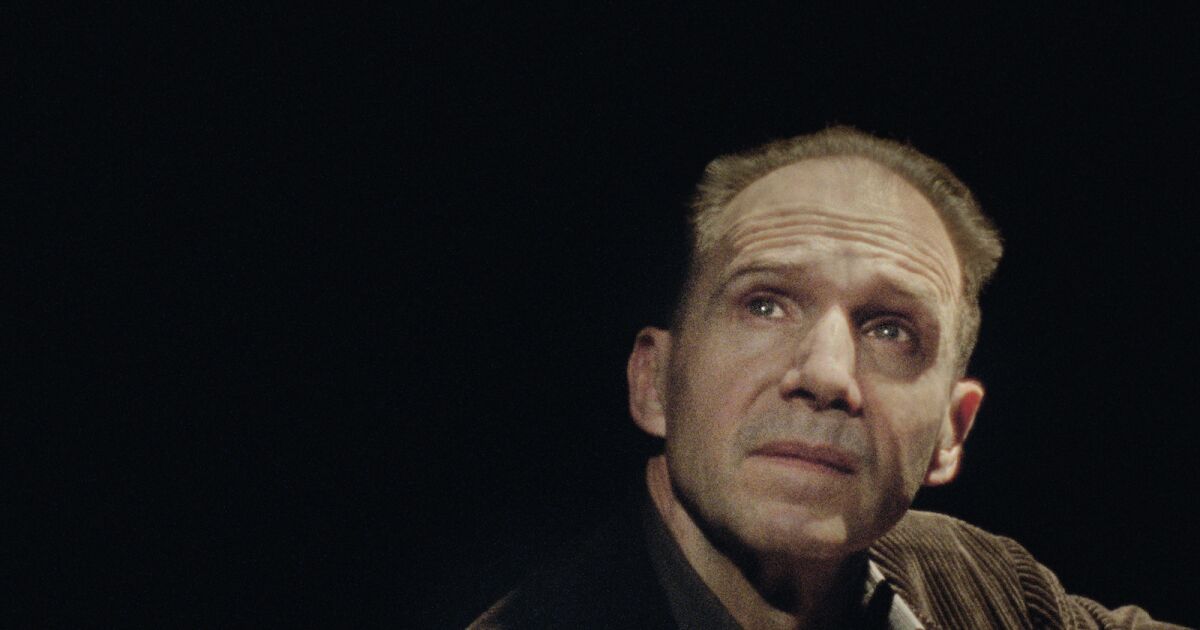
When it came to lockdown projects at the start of the pandemic, reassessing and reorganizing one’s possessions was a clear favorite. Ralph Fiennes’ version befit a consummate actor who’d long cherished T.S. Eliot’s “Four Quartets”: to transfer the entirety of the poet’s epic meditation on time and humanity — over a thousand lines — to his memory, and from there to theater audiences at the first opportunity.
Fiennes toured the U.K. with his one-man stage adaptation in 2021, and shortly afterward committed his widely praised performance to film, directed by his sister Sophie Fiennes. (Ralph had directed the stage version.) Unabashedly theatrical in presentation but broken up with interludes of nature, this “Four Quartets” is a multi-course feast of concentrated flavors: mesmerizing language, masterly invocation, and the kind of poetic imagery that in the hands of a great actor feels like a direct line from Eliot’s pen to our mind’s landscape.
Or to be more precise, to our here-and-now consciousness still wrestling with who we are in the wake of a polarizing global crisis, still trying to reconcile where we’ve been with what the future holds. Started in the 1930s but finished as World War II raged, Eliot’s last great work is obviously reflective of an England on the precipice, often given a religious framework. But in its soulfulness it speaks to today, too, ready to be absorbed by any modern-day audience no less concerned about existence at a fortuitous juncture, between history and progress, old ways and new ideas, living in “the unattended/Moment, the moment in and out of time” that Eliot believes will keep us spiritually, ungraciously stuck if we can’t embrace the present.
Fiennes is, of course, one of our more magnetically “present” actors, blessed with a bearish timbre both commanding and inviting. What I remember about the good fortune of once seeing him live in a small theater (a U.K. production of “Richard III”) is that he could dissolve whatever space was between him and you, no matter where you sat. (And we were close.) From his delivery of the temporally abstract opening lines of “Burnt Norton” (the first quartet), barefoot and in loose, slate-and-earth-colored clothing, suggesting someone of both country and city, Fiennes turns Eliot’s ecstatic descriptions and sharp pronouncements, allusive strolls and anxious philosophizing, into living and breathing discourse — a modernist-verse TED talk on the physical and the eternal.
Subsequently, the lens of cinematographer Mike Eley’s 16mm camera — an adroit choice for filming poetry come alive — no longer feels like a barrier separating the man on that spare, charcoal-slab set from our eyes and ears. Sophie Fiennes has an instinctive sense of when to cut to verdant fields or lapping, rocky shores as a way of breaking up the filmed-play vibe, and augmenting Eliot’s fertile, abstract imagery of regeneration and renewal. But I found myself wanting to quickly get back to her brother’s accessibly forlorn Eliot avatar on that stage, musing on ends as beginnings and the false wisdom in aging, forcefully delivering Eliot’s river-as-god metaphor, or giving world-weary weight to simple gestures, movements and presentations. (At one point, he sits at a table with an old radio microphone, the sound design scratch-filtering his voice as if he were giving a wartime broadcast.)
“Four Quartets” is the definition of specialized fare for a niche audience, but in its purity of connection gets one to wonder why there aren’t more opportunities to see intimately staged theater performances preserved on film. Though this modest format can sometimes smack of educational PBS evenings and visual stiltedness, it’s ripe for reappraisal and reimagining for its unobtrusively performance-driven humanity, as Sophie Fiennes’ starkly reverential capturing of her brother’s impressive passion project reveals.
‘Four Quartets’
Not rated
Running time: 1 hour, 24 minutes
Playing: Starts May 26, Laemmle Monica, Santa Monica

When it came to lockdown projects at the start of the pandemic, reassessing and reorganizing one’s possessions was a clear favorite. Ralph Fiennes’ version befit a consummate actor who’d long cherished T.S. Eliot’s “Four Quartets”: to transfer the entirety of the poet’s epic meditation on time and humanity — over a thousand lines — to his memory, and from there to theater audiences at the first opportunity.
Fiennes toured the U.K. with his one-man stage adaptation in 2021, and shortly afterward committed his widely praised performance to film, directed by his sister Sophie Fiennes. (Ralph had directed the stage version.) Unabashedly theatrical in presentation but broken up with interludes of nature, this “Four Quartets” is a multi-course feast of concentrated flavors: mesmerizing language, masterly invocation, and the kind of poetic imagery that in the hands of a great actor feels like a direct line from Eliot’s pen to our mind’s landscape.
Or to be more precise, to our here-and-now consciousness still wrestling with who we are in the wake of a polarizing global crisis, still trying to reconcile where we’ve been with what the future holds. Started in the 1930s but finished as World War II raged, Eliot’s last great work is obviously reflective of an England on the precipice, often given a religious framework. But in its soulfulness it speaks to today, too, ready to be absorbed by any modern-day audience no less concerned about existence at a fortuitous juncture, between history and progress, old ways and new ideas, living in “the unattended/Moment, the moment in and out of time” that Eliot believes will keep us spiritually, ungraciously stuck if we can’t embrace the present.
Fiennes is, of course, one of our more magnetically “present” actors, blessed with a bearish timbre both commanding and inviting. What I remember about the good fortune of once seeing him live in a small theater (a U.K. production of “Richard III”) is that he could dissolve whatever space was between him and you, no matter where you sat. (And we were close.) From his delivery of the temporally abstract opening lines of “Burnt Norton” (the first quartet), barefoot and in loose, slate-and-earth-colored clothing, suggesting someone of both country and city, Fiennes turns Eliot’s ecstatic descriptions and sharp pronouncements, allusive strolls and anxious philosophizing, into living and breathing discourse — a modernist-verse TED talk on the physical and the eternal.
Subsequently, the lens of cinematographer Mike Eley’s 16mm camera — an adroit choice for filming poetry come alive — no longer feels like a barrier separating the man on that spare, charcoal-slab set from our eyes and ears. Sophie Fiennes has an instinctive sense of when to cut to verdant fields or lapping, rocky shores as a way of breaking up the filmed-play vibe, and augmenting Eliot’s fertile, abstract imagery of regeneration and renewal. But I found myself wanting to quickly get back to her brother’s accessibly forlorn Eliot avatar on that stage, musing on ends as beginnings and the false wisdom in aging, forcefully delivering Eliot’s river-as-god metaphor, or giving world-weary weight to simple gestures, movements and presentations. (At one point, he sits at a table with an old radio microphone, the sound design scratch-filtering his voice as if he were giving a wartime broadcast.)
“Four Quartets” is the definition of specialized fare for a niche audience, but in its purity of connection gets one to wonder why there aren’t more opportunities to see intimately staged theater performances preserved on film. Though this modest format can sometimes smack of educational PBS evenings and visual stiltedness, it’s ripe for reappraisal and reimagining for its unobtrusively performance-driven humanity, as Sophie Fiennes’ starkly reverential capturing of her brother’s impressive passion project reveals.
‘Four Quartets’
Not rated
Running time: 1 hour, 24 minutes
Playing: Starts May 26, Laemmle Monica, Santa Monica

When it came to lockdown projects at the start of the pandemic, reassessing and reorganizing one’s possessions was a clear favorite. Ralph Fiennes’ version befit a consummate actor who’d long cherished T.S. Eliot’s “Four Quartets”: to transfer the entirety of the poet’s epic meditation on time and humanity — over a thousand lines — to his memory, and from there to theater audiences at the first opportunity.
Fiennes toured the U.K. with his one-man stage adaptation in 2021, and shortly afterward committed his widely praised performance to film, directed by his sister Sophie Fiennes. (Ralph had directed the stage version.) Unabashedly theatrical in presentation but broken up with interludes of nature, this “Four Quartets” is a multi-course feast of concentrated flavors: mesmerizing language, masterly invocation, and the kind of poetic imagery that in the hands of a great actor feels like a direct line from Eliot’s pen to our mind’s landscape.
Or to be more precise, to our here-and-now consciousness still wrestling with who we are in the wake of a polarizing global crisis, still trying to reconcile where we’ve been with what the future holds. Started in the 1930s but finished as World War II raged, Eliot’s last great work is obviously reflective of an England on the precipice, often given a religious framework. But in its soulfulness it speaks to today, too, ready to be absorbed by any modern-day audience no less concerned about existence at a fortuitous juncture, between history and progress, old ways and new ideas, living in “the unattended/Moment, the moment in and out of time” that Eliot believes will keep us spiritually, ungraciously stuck if we can’t embrace the present.
Fiennes is, of course, one of our more magnetically “present” actors, blessed with a bearish timbre both commanding and inviting. What I remember about the good fortune of once seeing him live in a small theater (a U.K. production of “Richard III”) is that he could dissolve whatever space was between him and you, no matter where you sat. (And we were close.) From his delivery of the temporally abstract opening lines of “Burnt Norton” (the first quartet), barefoot and in loose, slate-and-earth-colored clothing, suggesting someone of both country and city, Fiennes turns Eliot’s ecstatic descriptions and sharp pronouncements, allusive strolls and anxious philosophizing, into living and breathing discourse — a modernist-verse TED talk on the physical and the eternal.
Subsequently, the lens of cinematographer Mike Eley’s 16mm camera — an adroit choice for filming poetry come alive — no longer feels like a barrier separating the man on that spare, charcoal-slab set from our eyes and ears. Sophie Fiennes has an instinctive sense of when to cut to verdant fields or lapping, rocky shores as a way of breaking up the filmed-play vibe, and augmenting Eliot’s fertile, abstract imagery of regeneration and renewal. But I found myself wanting to quickly get back to her brother’s accessibly forlorn Eliot avatar on that stage, musing on ends as beginnings and the false wisdom in aging, forcefully delivering Eliot’s river-as-god metaphor, or giving world-weary weight to simple gestures, movements and presentations. (At one point, he sits at a table with an old radio microphone, the sound design scratch-filtering his voice as if he were giving a wartime broadcast.)
“Four Quartets” is the definition of specialized fare for a niche audience, but in its purity of connection gets one to wonder why there aren’t more opportunities to see intimately staged theater performances preserved on film. Though this modest format can sometimes smack of educational PBS evenings and visual stiltedness, it’s ripe for reappraisal and reimagining for its unobtrusively performance-driven humanity, as Sophie Fiennes’ starkly reverential capturing of her brother’s impressive passion project reveals.
‘Four Quartets’
Not rated
Running time: 1 hour, 24 minutes
Playing: Starts May 26, Laemmle Monica, Santa Monica
When it came to lockdown projects at the start of the pandemic, reassessing and reorganizing one’s possessions was a clear favorite. Ralph Fiennes’ version befit a consummate actor who’d long cherished T.S. Eliot’s “Four Quartets”: to transfer the entirety of the poet’s epic meditation on time and humanity — over a thousand lines — to his memory, and from there to theater audiences at the first opportunity.
Fiennes toured the U.K. with his one-man stage adaptation in 2021, and shortly afterward committed his widely praised performance to film, directed by his sister Sophie Fiennes. (Ralph had directed the stage version.) Unabashedly theatrical in presentation but broken up with interludes of nature, this “Four Quartets” is a multi-course feast of concentrated flavors: mesmerizing language, masterly invocation, and the kind of poetic imagery that in the hands of a great actor feels like a direct line from Eliot’s pen to our mind’s landscape.
Or to be more precise, to our here-and-now consciousness still wrestling with who we are in the wake of a polarizing global crisis, still trying to reconcile where we’ve been with what the future holds. Started in the 1930s but finished as World War II raged, Eliot’s last great work is obviously reflective of an England on the precipice, often given a religious framework. But in its soulfulness it speaks to today, too, ready to be absorbed by any modern-day audience no less concerned about existence at a fortuitous juncture, between history and progress, old ways and new ideas, living in “the unattended/Moment, the moment in and out of time” that Eliot believes will keep us spiritually, ungraciously stuck if we can’t embrace the present.
Fiennes is, of course, one of our more magnetically “present” actors, blessed with a bearish timbre both commanding and inviting. What I remember about the good fortune of once seeing him live in a small theater (a U.K. production of “Richard III”) is that he could dissolve whatever space was between him and you, no matter where you sat. (And we were close.) From his delivery of the temporally abstract opening lines of “Burnt Norton” (the first quartet), barefoot and in loose, slate-and-earth-colored clothing, suggesting someone of both country and city, Fiennes turns Eliot’s ecstatic descriptions and sharp pronouncements, allusive strolls and anxious philosophizing, into living and breathing discourse — a modernist-verse TED talk on the physical and the eternal.
Subsequently, the lens of cinematographer Mike Eley’s 16mm camera — an adroit choice for filming poetry come alive — no longer feels like a barrier separating the man on that spare, charcoal-slab set from our eyes and ears. Sophie Fiennes has an instinctive sense of when to cut to verdant fields or lapping, rocky shores as a way of breaking up the filmed-play vibe, and augmenting Eliot’s fertile, abstract imagery of regeneration and renewal. But I found myself wanting to quickly get back to her brother’s accessibly forlorn Eliot avatar on that stage, musing on ends as beginnings and the false wisdom in aging, forcefully delivering Eliot’s river-as-god metaphor, or giving world-weary weight to simple gestures, movements and presentations. (At one point, he sits at a table with an old radio microphone, the sound design scratch-filtering his voice as if he were giving a wartime broadcast.)
“Four Quartets” is the definition of specialized fare for a niche audience, but in its purity of connection gets one to wonder why there aren’t more opportunities to see intimately staged theater performances preserved on film. Though this modest format can sometimes smack of educational PBS evenings and visual stiltedness, it’s ripe for reappraisal and reimagining for its unobtrusively performance-driven humanity, as Sophie Fiennes’ starkly reverential capturing of her brother’s impressive passion project reveals.
‘Four Quartets’
Not rated
Running time: 1 hour, 24 minutes
Playing: Starts May 26, Laemmle Monica, Santa Monica

When it came to lockdown projects at the start of the pandemic, reassessing and reorganizing one’s possessions was a clear favorite. Ralph Fiennes’ version befit a consummate actor who’d long cherished T.S. Eliot’s “Four Quartets”: to transfer the entirety of the poet’s epic meditation on time and humanity — over a thousand lines — to his memory, and from there to theater audiences at the first opportunity.
Fiennes toured the U.K. with his one-man stage adaptation in 2021, and shortly afterward committed his widely praised performance to film, directed by his sister Sophie Fiennes. (Ralph had directed the stage version.) Unabashedly theatrical in presentation but broken up with interludes of nature, this “Four Quartets” is a multi-course feast of concentrated flavors: mesmerizing language, masterly invocation, and the kind of poetic imagery that in the hands of a great actor feels like a direct line from Eliot’s pen to our mind’s landscape.
Or to be more precise, to our here-and-now consciousness still wrestling with who we are in the wake of a polarizing global crisis, still trying to reconcile where we’ve been with what the future holds. Started in the 1930s but finished as World War II raged, Eliot’s last great work is obviously reflective of an England on the precipice, often given a religious framework. But in its soulfulness it speaks to today, too, ready to be absorbed by any modern-day audience no less concerned about existence at a fortuitous juncture, between history and progress, old ways and new ideas, living in “the unattended/Moment, the moment in and out of time” that Eliot believes will keep us spiritually, ungraciously stuck if we can’t embrace the present.
Fiennes is, of course, one of our more magnetically “present” actors, blessed with a bearish timbre both commanding and inviting. What I remember about the good fortune of once seeing him live in a small theater (a U.K. production of “Richard III”) is that he could dissolve whatever space was between him and you, no matter where you sat. (And we were close.) From his delivery of the temporally abstract opening lines of “Burnt Norton” (the first quartet), barefoot and in loose, slate-and-earth-colored clothing, suggesting someone of both country and city, Fiennes turns Eliot’s ecstatic descriptions and sharp pronouncements, allusive strolls and anxious philosophizing, into living and breathing discourse — a modernist-verse TED talk on the physical and the eternal.
Subsequently, the lens of cinematographer Mike Eley’s 16mm camera — an adroit choice for filming poetry come alive — no longer feels like a barrier separating the man on that spare, charcoal-slab set from our eyes and ears. Sophie Fiennes has an instinctive sense of when to cut to verdant fields or lapping, rocky shores as a way of breaking up the filmed-play vibe, and augmenting Eliot’s fertile, abstract imagery of regeneration and renewal. But I found myself wanting to quickly get back to her brother’s accessibly forlorn Eliot avatar on that stage, musing on ends as beginnings and the false wisdom in aging, forcefully delivering Eliot’s river-as-god metaphor, or giving world-weary weight to simple gestures, movements and presentations. (At one point, he sits at a table with an old radio microphone, the sound design scratch-filtering his voice as if he were giving a wartime broadcast.)
“Four Quartets” is the definition of specialized fare for a niche audience, but in its purity of connection gets one to wonder why there aren’t more opportunities to see intimately staged theater performances preserved on film. Though this modest format can sometimes smack of educational PBS evenings and visual stiltedness, it’s ripe for reappraisal and reimagining for its unobtrusively performance-driven humanity, as Sophie Fiennes’ starkly reverential capturing of her brother’s impressive passion project reveals.
‘Four Quartets’
Not rated
Running time: 1 hour, 24 minutes
Playing: Starts May 26, Laemmle Monica, Santa Monica
When it came to lockdown projects at the start of the pandemic, reassessing and reorganizing one’s possessions was a clear favorite. Ralph Fiennes’ version befit a consummate actor who’d long cherished T.S. Eliot’s “Four Quartets”: to transfer the entirety of the poet’s epic meditation on time and humanity — over a thousand lines — to his memory, and from there to theater audiences at the first opportunity.
Fiennes toured the U.K. with his one-man stage adaptation in 2021, and shortly afterward committed his widely praised performance to film, directed by his sister Sophie Fiennes. (Ralph had directed the stage version.) Unabashedly theatrical in presentation but broken up with interludes of nature, this “Four Quartets” is a multi-course feast of concentrated flavors: mesmerizing language, masterly invocation, and the kind of poetic imagery that in the hands of a great actor feels like a direct line from Eliot’s pen to our mind’s landscape.
Or to be more precise, to our here-and-now consciousness still wrestling with who we are in the wake of a polarizing global crisis, still trying to reconcile where we’ve been with what the future holds. Started in the 1930s but finished as World War II raged, Eliot’s last great work is obviously reflective of an England on the precipice, often given a religious framework. But in its soulfulness it speaks to today, too, ready to be absorbed by any modern-day audience no less concerned about existence at a fortuitous juncture, between history and progress, old ways and new ideas, living in “the unattended/Moment, the moment in and out of time” that Eliot believes will keep us spiritually, ungraciously stuck if we can’t embrace the present.
Fiennes is, of course, one of our more magnetically “present” actors, blessed with a bearish timbre both commanding and inviting. What I remember about the good fortune of once seeing him live in a small theater (a U.K. production of “Richard III”) is that he could dissolve whatever space was between him and you, no matter where you sat. (And we were close.) From his delivery of the temporally abstract opening lines of “Burnt Norton” (the first quartet), barefoot and in loose, slate-and-earth-colored clothing, suggesting someone of both country and city, Fiennes turns Eliot’s ecstatic descriptions and sharp pronouncements, allusive strolls and anxious philosophizing, into living and breathing discourse — a modernist-verse TED talk on the physical and the eternal.
Subsequently, the lens of cinematographer Mike Eley’s 16mm camera — an adroit choice for filming poetry come alive — no longer feels like a barrier separating the man on that spare, charcoal-slab set from our eyes and ears. Sophie Fiennes has an instinctive sense of when to cut to verdant fields or lapping, rocky shores as a way of breaking up the filmed-play vibe, and augmenting Eliot’s fertile, abstract imagery of regeneration and renewal. But I found myself wanting to quickly get back to her brother’s accessibly forlorn Eliot avatar on that stage, musing on ends as beginnings and the false wisdom in aging, forcefully delivering Eliot’s river-as-god metaphor, or giving world-weary weight to simple gestures, movements and presentations. (At one point, he sits at a table with an old radio microphone, the sound design scratch-filtering his voice as if he were giving a wartime broadcast.)
“Four Quartets” is the definition of specialized fare for a niche audience, but in its purity of connection gets one to wonder why there aren’t more opportunities to see intimately staged theater performances preserved on film. Though this modest format can sometimes smack of educational PBS evenings and visual stiltedness, it’s ripe for reappraisal and reimagining for its unobtrusively performance-driven humanity, as Sophie Fiennes’ starkly reverential capturing of her brother’s impressive passion project reveals.
‘Four Quartets’
Not rated
Running time: 1 hour, 24 minutes
Playing: Starts May 26, Laemmle Monica, Santa Monica
When it came to lockdown projects at the start of the pandemic, reassessing and reorganizing one’s possessions was a clear favorite. Ralph Fiennes’ version befit a consummate actor who’d long cherished T.S. Eliot’s “Four Quartets”: to transfer the entirety of the poet’s epic meditation on time and humanity — over a thousand lines — to his memory, and from there to theater audiences at the first opportunity.
Fiennes toured the U.K. with his one-man stage adaptation in 2021, and shortly afterward committed his widely praised performance to film, directed by his sister Sophie Fiennes. (Ralph had directed the stage version.) Unabashedly theatrical in presentation but broken up with interludes of nature, this “Four Quartets” is a multi-course feast of concentrated flavors: mesmerizing language, masterly invocation, and the kind of poetic imagery that in the hands of a great actor feels like a direct line from Eliot’s pen to our mind’s landscape.
Or to be more precise, to our here-and-now consciousness still wrestling with who we are in the wake of a polarizing global crisis, still trying to reconcile where we’ve been with what the future holds. Started in the 1930s but finished as World War II raged, Eliot’s last great work is obviously reflective of an England on the precipice, often given a religious framework. But in its soulfulness it speaks to today, too, ready to be absorbed by any modern-day audience no less concerned about existence at a fortuitous juncture, between history and progress, old ways and new ideas, living in “the unattended/Moment, the moment in and out of time” that Eliot believes will keep us spiritually, ungraciously stuck if we can’t embrace the present.
Fiennes is, of course, one of our more magnetically “present” actors, blessed with a bearish timbre both commanding and inviting. What I remember about the good fortune of once seeing him live in a small theater (a U.K. production of “Richard III”) is that he could dissolve whatever space was between him and you, no matter where you sat. (And we were close.) From his delivery of the temporally abstract opening lines of “Burnt Norton” (the first quartet), barefoot and in loose, slate-and-earth-colored clothing, suggesting someone of both country and city, Fiennes turns Eliot’s ecstatic descriptions and sharp pronouncements, allusive strolls and anxious philosophizing, into living and breathing discourse — a modernist-verse TED talk on the physical and the eternal.
Subsequently, the lens of cinematographer Mike Eley’s 16mm camera — an adroit choice for filming poetry come alive — no longer feels like a barrier separating the man on that spare, charcoal-slab set from our eyes and ears. Sophie Fiennes has an instinctive sense of when to cut to verdant fields or lapping, rocky shores as a way of breaking up the filmed-play vibe, and augmenting Eliot’s fertile, abstract imagery of regeneration and renewal. But I found myself wanting to quickly get back to her brother’s accessibly forlorn Eliot avatar on that stage, musing on ends as beginnings and the false wisdom in aging, forcefully delivering Eliot’s river-as-god metaphor, or giving world-weary weight to simple gestures, movements and presentations. (At one point, he sits at a table with an old radio microphone, the sound design scratch-filtering his voice as if he were giving a wartime broadcast.)
“Four Quartets” is the definition of specialized fare for a niche audience, but in its purity of connection gets one to wonder why there aren’t more opportunities to see intimately staged theater performances preserved on film. Though this modest format can sometimes smack of educational PBS evenings and visual stiltedness, it’s ripe for reappraisal and reimagining for its unobtrusively performance-driven humanity, as Sophie Fiennes’ starkly reverential capturing of her brother’s impressive passion project reveals.
‘Four Quartets’
Not rated
Running time: 1 hour, 24 minutes
Playing: Starts May 26, Laemmle Monica, Santa Monica
When it came to lockdown projects at the start of the pandemic, reassessing and reorganizing one’s possessions was a clear favorite. Ralph Fiennes’ version befit a consummate actor who’d long cherished T.S. Eliot’s “Four Quartets”: to transfer the entirety of the poet’s epic meditation on time and humanity — over a thousand lines — to his memory, and from there to theater audiences at the first opportunity.
Fiennes toured the U.K. with his one-man stage adaptation in 2021, and shortly afterward committed his widely praised performance to film, directed by his sister Sophie Fiennes. (Ralph had directed the stage version.) Unabashedly theatrical in presentation but broken up with interludes of nature, this “Four Quartets” is a multi-course feast of concentrated flavors: mesmerizing language, masterly invocation, and the kind of poetic imagery that in the hands of a great actor feels like a direct line from Eliot’s pen to our mind’s landscape.
Or to be more precise, to our here-and-now consciousness still wrestling with who we are in the wake of a polarizing global crisis, still trying to reconcile where we’ve been with what the future holds. Started in the 1930s but finished as World War II raged, Eliot’s last great work is obviously reflective of an England on the precipice, often given a religious framework. But in its soulfulness it speaks to today, too, ready to be absorbed by any modern-day audience no less concerned about existence at a fortuitous juncture, between history and progress, old ways and new ideas, living in “the unattended/Moment, the moment in and out of time” that Eliot believes will keep us spiritually, ungraciously stuck if we can’t embrace the present.
Fiennes is, of course, one of our more magnetically “present” actors, blessed with a bearish timbre both commanding and inviting. What I remember about the good fortune of once seeing him live in a small theater (a U.K. production of “Richard III”) is that he could dissolve whatever space was between him and you, no matter where you sat. (And we were close.) From his delivery of the temporally abstract opening lines of “Burnt Norton” (the first quartet), barefoot and in loose, slate-and-earth-colored clothing, suggesting someone of both country and city, Fiennes turns Eliot’s ecstatic descriptions and sharp pronouncements, allusive strolls and anxious philosophizing, into living and breathing discourse — a modernist-verse TED talk on the physical and the eternal.
Subsequently, the lens of cinematographer Mike Eley’s 16mm camera — an adroit choice for filming poetry come alive — no longer feels like a barrier separating the man on that spare, charcoal-slab set from our eyes and ears. Sophie Fiennes has an instinctive sense of when to cut to verdant fields or lapping, rocky shores as a way of breaking up the filmed-play vibe, and augmenting Eliot’s fertile, abstract imagery of regeneration and renewal. But I found myself wanting to quickly get back to her brother’s accessibly forlorn Eliot avatar on that stage, musing on ends as beginnings and the false wisdom in aging, forcefully delivering Eliot’s river-as-god metaphor, or giving world-weary weight to simple gestures, movements and presentations. (At one point, he sits at a table with an old radio microphone, the sound design scratch-filtering his voice as if he were giving a wartime broadcast.)
“Four Quartets” is the definition of specialized fare for a niche audience, but in its purity of connection gets one to wonder why there aren’t more opportunities to see intimately staged theater performances preserved on film. Though this modest format can sometimes smack of educational PBS evenings and visual stiltedness, it’s ripe for reappraisal and reimagining for its unobtrusively performance-driven humanity, as Sophie Fiennes’ starkly reverential capturing of her brother’s impressive passion project reveals.
‘Four Quartets’
Not rated
Running time: 1 hour, 24 minutes
Playing: Starts May 26, Laemmle Monica, Santa Monica