Consider — as one might for St. Patrick’s Day — that humbly delicious and eminently classic cocktail, the Irish coffee.
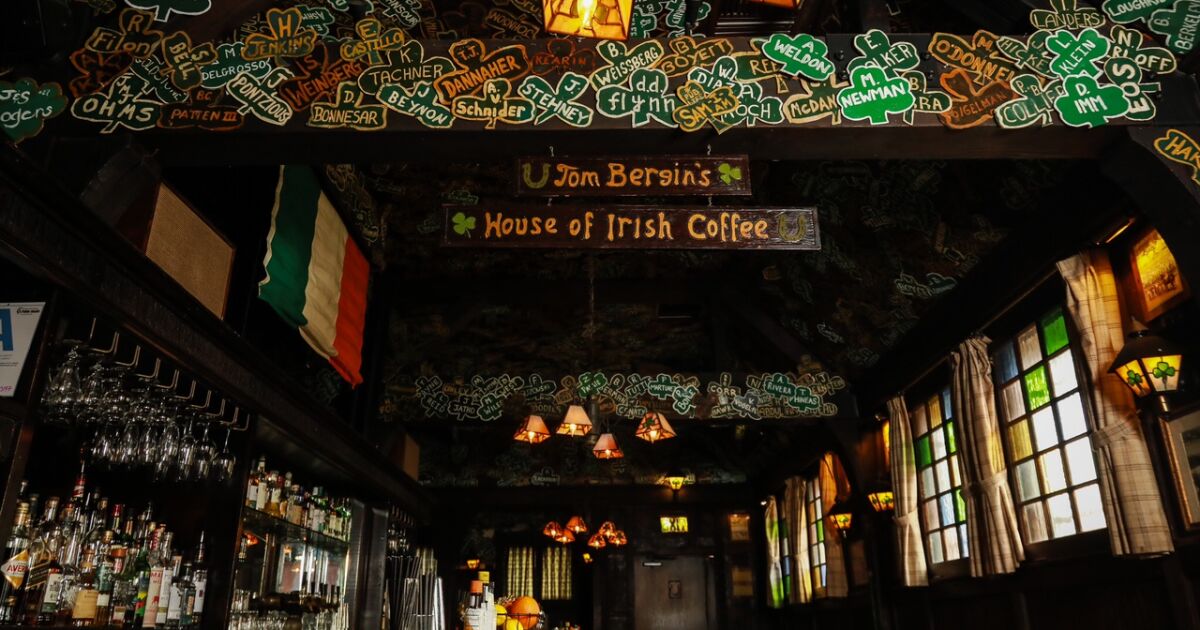
It’s a deceptively simple drink, yet its form belies a series of small choices yielding a cocktail greater than the sum of its parts. These days you can find what might be the modern ideal of an Irish coffee cocktail at Tom Bergin’s, the historic Irish pub on Fairfax Avenue open since 1936. Brothers Dave and Francis Castagnetti took ownership of the bar in late 2019, after the building was designated as a historic monument by the Los Angeles City Council and saved from demolition. “If you have a neon sign out front that says ‘House of Irish Coffee,’ you’ve got to come correct,” laughs Francis Castagnetti.
And come correct they do. Irish coffees have been served in one form or another at Tom Bergin’s for the better part of a century, but its current form is a master class in considered structure, built for repeatability and complexity with subtle modern updates. The basic elements include coffee, Irish whiskey (Tullamore Dew is the standard pour), a touch of sweetener and textured cream — not quite whipped but not quite liquid, and thick enough so as to form a sort of layered, sealed float at the top of a tulip glass. Tom Bergin’s serves several hundred of the drinks daily, but on St. Patrick’s Day that number explodes into the thousands.
The Irish coffee at Tom Bergin’s is sweetened with turbinado sugar and topped with shaken heavy cream.
(Tom Bergin’s)
The Irish coffee’s history has Californian roots. Though its origins in County Limerick are the subject of much historic disagreement, few would dispute that the drink was popularized at the Buena Vista Cafe in San Francisco, which serves several thousand Irish coffees a day from a recipe that has not changed since the early 1950s. The Buena Vista relies on sugar cubes as a sweetener, and uses a proprietary “aged cream” technique involving much stirring and spooning to achieve the perfect texture.
At Tom Bergin’s they’ve made a couple of key tweaks to the method, using turbinado simple syrup instead of cubes (“It’s a little richer and holds onto the coffee flavor better,” says Castagnetti), and shaking fresh heavy cream in condiment squeeze bottles for ease of use. The coffee is considered as well, sourced from Pasadena’s Zona Rosa and presented in a medium roast, allowing the distinctness of the coffee to shine through. These little touches add up to something ambrosial: The high-quality coffee sings, the dark, sweet syrup melds with the brogue of the whiskey, and the cream seals it all together in a sort of dualistic jig, simultaneously light and dark, cold and hot, sweet and dry, and gone in a gulp.
“We are stewards of something that will be here long after us,” says Francis Castagnetti of his octogenarian bar. “If my brother and I have this place for even just 10 years, that’s a flash in the pan for what this place means to the city.” The bar nearly closed before the pandemic, and sat vacant for two years before the brothers took it on. Most weeks it is a happy hub of regulars and curious visitors, but on St. Patrick’s Day it blooms into something more like a municipal destination.
There are no advance tickets to book or reservations to make for St. Patrick’s Day at Tom Bergin’s, but there might well be a line if you arrive after 3 p.m. or so. Any wait is worth it for an Irish coffee this good, so achingly simple and pure, yet subtly updated and contemporary too, befitting the living history of this remarkable bar.
“The Irish coffee is already perfect,” says Francis Castagnetti. “We just let it be what it is.”

Consider — as one might for St. Patrick’s Day — that humbly delicious and eminently classic cocktail, the Irish coffee.
It’s a deceptively simple drink, yet its form belies a series of small choices yielding a cocktail greater than the sum of its parts. These days you can find what might be the modern ideal of an Irish coffee cocktail at Tom Bergin’s, the historic Irish pub on Fairfax Avenue open since 1936. Brothers Dave and Francis Castagnetti took ownership of the bar in late 2019, after the building was designated as a historic monument by the Los Angeles City Council and saved from demolition. “If you have a neon sign out front that says ‘House of Irish Coffee,’ you’ve got to come correct,” laughs Francis Castagnetti.
And come correct they do. Irish coffees have been served in one form or another at Tom Bergin’s for the better part of a century, but its current form is a master class in considered structure, built for repeatability and complexity with subtle modern updates. The basic elements include coffee, Irish whiskey (Tullamore Dew is the standard pour), a touch of sweetener and textured cream — not quite whipped but not quite liquid, and thick enough so as to form a sort of layered, sealed float at the top of a tulip glass. Tom Bergin’s serves several hundred of the drinks daily, but on St. Patrick’s Day that number explodes into the thousands.
The Irish coffee at Tom Bergin’s is sweetened with turbinado sugar and topped with shaken heavy cream.
(Tom Bergin’s)
The Irish coffee’s history has Californian roots. Though its origins in County Limerick are the subject of much historic disagreement, few would dispute that the drink was popularized at the Buena Vista Cafe in San Francisco, which serves several thousand Irish coffees a day from a recipe that has not changed since the early 1950s. The Buena Vista relies on sugar cubes as a sweetener, and uses a proprietary “aged cream” technique involving much stirring and spooning to achieve the perfect texture.
At Tom Bergin’s they’ve made a couple of key tweaks to the method, using turbinado simple syrup instead of cubes (“It’s a little richer and holds onto the coffee flavor better,” says Castagnetti), and shaking fresh heavy cream in condiment squeeze bottles for ease of use. The coffee is considered as well, sourced from Pasadena’s Zona Rosa and presented in a medium roast, allowing the distinctness of the coffee to shine through. These little touches add up to something ambrosial: The high-quality coffee sings, the dark, sweet syrup melds with the brogue of the whiskey, and the cream seals it all together in a sort of dualistic jig, simultaneously light and dark, cold and hot, sweet and dry, and gone in a gulp.
“We are stewards of something that will be here long after us,” says Francis Castagnetti of his octogenarian bar. “If my brother and I have this place for even just 10 years, that’s a flash in the pan for what this place means to the city.” The bar nearly closed before the pandemic, and sat vacant for two years before the brothers took it on. Most weeks it is a happy hub of regulars and curious visitors, but on St. Patrick’s Day it blooms into something more like a municipal destination.
There are no advance tickets to book or reservations to make for St. Patrick’s Day at Tom Bergin’s, but there might well be a line if you arrive after 3 p.m. or so. Any wait is worth it for an Irish coffee this good, so achingly simple and pure, yet subtly updated and contemporary too, befitting the living history of this remarkable bar.
“The Irish coffee is already perfect,” says Francis Castagnetti. “We just let it be what it is.”

Consider — as one might for St. Patrick’s Day — that humbly delicious and eminently classic cocktail, the Irish coffee.
It’s a deceptively simple drink, yet its form belies a series of small choices yielding a cocktail greater than the sum of its parts. These days you can find what might be the modern ideal of an Irish coffee cocktail at Tom Bergin’s, the historic Irish pub on Fairfax Avenue open since 1936. Brothers Dave and Francis Castagnetti took ownership of the bar in late 2019, after the building was designated as a historic monument by the Los Angeles City Council and saved from demolition. “If you have a neon sign out front that says ‘House of Irish Coffee,’ you’ve got to come correct,” laughs Francis Castagnetti.
And come correct they do. Irish coffees have been served in one form or another at Tom Bergin’s for the better part of a century, but its current form is a master class in considered structure, built for repeatability and complexity with subtle modern updates. The basic elements include coffee, Irish whiskey (Tullamore Dew is the standard pour), a touch of sweetener and textured cream — not quite whipped but not quite liquid, and thick enough so as to form a sort of layered, sealed float at the top of a tulip glass. Tom Bergin’s serves several hundred of the drinks daily, but on St. Patrick’s Day that number explodes into the thousands.
The Irish coffee at Tom Bergin’s is sweetened with turbinado sugar and topped with shaken heavy cream.
(Tom Bergin’s)
The Irish coffee’s history has Californian roots. Though its origins in County Limerick are the subject of much historic disagreement, few would dispute that the drink was popularized at the Buena Vista Cafe in San Francisco, which serves several thousand Irish coffees a day from a recipe that has not changed since the early 1950s. The Buena Vista relies on sugar cubes as a sweetener, and uses a proprietary “aged cream” technique involving much stirring and spooning to achieve the perfect texture.
At Tom Bergin’s they’ve made a couple of key tweaks to the method, using turbinado simple syrup instead of cubes (“It’s a little richer and holds onto the coffee flavor better,” says Castagnetti), and shaking fresh heavy cream in condiment squeeze bottles for ease of use. The coffee is considered as well, sourced from Pasadena’s Zona Rosa and presented in a medium roast, allowing the distinctness of the coffee to shine through. These little touches add up to something ambrosial: The high-quality coffee sings, the dark, sweet syrup melds with the brogue of the whiskey, and the cream seals it all together in a sort of dualistic jig, simultaneously light and dark, cold and hot, sweet and dry, and gone in a gulp.
“We are stewards of something that will be here long after us,” says Francis Castagnetti of his octogenarian bar. “If my brother and I have this place for even just 10 years, that’s a flash in the pan for what this place means to the city.” The bar nearly closed before the pandemic, and sat vacant for two years before the brothers took it on. Most weeks it is a happy hub of regulars and curious visitors, but on St. Patrick’s Day it blooms into something more like a municipal destination.
There are no advance tickets to book or reservations to make for St. Patrick’s Day at Tom Bergin’s, but there might well be a line if you arrive after 3 p.m. or so. Any wait is worth it for an Irish coffee this good, so achingly simple and pure, yet subtly updated and contemporary too, befitting the living history of this remarkable bar.
“The Irish coffee is already perfect,” says Francis Castagnetti. “We just let it be what it is.”
Consider — as one might for St. Patrick’s Day — that humbly delicious and eminently classic cocktail, the Irish coffee.
It’s a deceptively simple drink, yet its form belies a series of small choices yielding a cocktail greater than the sum of its parts. These days you can find what might be the modern ideal of an Irish coffee cocktail at Tom Bergin’s, the historic Irish pub on Fairfax Avenue open since 1936. Brothers Dave and Francis Castagnetti took ownership of the bar in late 2019, after the building was designated as a historic monument by the Los Angeles City Council and saved from demolition. “If you have a neon sign out front that says ‘House of Irish Coffee,’ you’ve got to come correct,” laughs Francis Castagnetti.
And come correct they do. Irish coffees have been served in one form or another at Tom Bergin’s for the better part of a century, but its current form is a master class in considered structure, built for repeatability and complexity with subtle modern updates. The basic elements include coffee, Irish whiskey (Tullamore Dew is the standard pour), a touch of sweetener and textured cream — not quite whipped but not quite liquid, and thick enough so as to form a sort of layered, sealed float at the top of a tulip glass. Tom Bergin’s serves several hundred of the drinks daily, but on St. Patrick’s Day that number explodes into the thousands.
The Irish coffee at Tom Bergin’s is sweetened with turbinado sugar and topped with shaken heavy cream.
(Tom Bergin’s)
The Irish coffee’s history has Californian roots. Though its origins in County Limerick are the subject of much historic disagreement, few would dispute that the drink was popularized at the Buena Vista Cafe in San Francisco, which serves several thousand Irish coffees a day from a recipe that has not changed since the early 1950s. The Buena Vista relies on sugar cubes as a sweetener, and uses a proprietary “aged cream” technique involving much stirring and spooning to achieve the perfect texture.
At Tom Bergin’s they’ve made a couple of key tweaks to the method, using turbinado simple syrup instead of cubes (“It’s a little richer and holds onto the coffee flavor better,” says Castagnetti), and shaking fresh heavy cream in condiment squeeze bottles for ease of use. The coffee is considered as well, sourced from Pasadena’s Zona Rosa and presented in a medium roast, allowing the distinctness of the coffee to shine through. These little touches add up to something ambrosial: The high-quality coffee sings, the dark, sweet syrup melds with the brogue of the whiskey, and the cream seals it all together in a sort of dualistic jig, simultaneously light and dark, cold and hot, sweet and dry, and gone in a gulp.
“We are stewards of something that will be here long after us,” says Francis Castagnetti of his octogenarian bar. “If my brother and I have this place for even just 10 years, that’s a flash in the pan for what this place means to the city.” The bar nearly closed before the pandemic, and sat vacant for two years before the brothers took it on. Most weeks it is a happy hub of regulars and curious visitors, but on St. Patrick’s Day it blooms into something more like a municipal destination.
There are no advance tickets to book or reservations to make for St. Patrick’s Day at Tom Bergin’s, but there might well be a line if you arrive after 3 p.m. or so. Any wait is worth it for an Irish coffee this good, so achingly simple and pure, yet subtly updated and contemporary too, befitting the living history of this remarkable bar.
“The Irish coffee is already perfect,” says Francis Castagnetti. “We just let it be what it is.”

Consider — as one might for St. Patrick’s Day — that humbly delicious and eminently classic cocktail, the Irish coffee.
It’s a deceptively simple drink, yet its form belies a series of small choices yielding a cocktail greater than the sum of its parts. These days you can find what might be the modern ideal of an Irish coffee cocktail at Tom Bergin’s, the historic Irish pub on Fairfax Avenue open since 1936. Brothers Dave and Francis Castagnetti took ownership of the bar in late 2019, after the building was designated as a historic monument by the Los Angeles City Council and saved from demolition. “If you have a neon sign out front that says ‘House of Irish Coffee,’ you’ve got to come correct,” laughs Francis Castagnetti.
And come correct they do. Irish coffees have been served in one form or another at Tom Bergin’s for the better part of a century, but its current form is a master class in considered structure, built for repeatability and complexity with subtle modern updates. The basic elements include coffee, Irish whiskey (Tullamore Dew is the standard pour), a touch of sweetener and textured cream — not quite whipped but not quite liquid, and thick enough so as to form a sort of layered, sealed float at the top of a tulip glass. Tom Bergin’s serves several hundred of the drinks daily, but on St. Patrick’s Day that number explodes into the thousands.
The Irish coffee at Tom Bergin’s is sweetened with turbinado sugar and topped with shaken heavy cream.
(Tom Bergin’s)
The Irish coffee’s history has Californian roots. Though its origins in County Limerick are the subject of much historic disagreement, few would dispute that the drink was popularized at the Buena Vista Cafe in San Francisco, which serves several thousand Irish coffees a day from a recipe that has not changed since the early 1950s. The Buena Vista relies on sugar cubes as a sweetener, and uses a proprietary “aged cream” technique involving much stirring and spooning to achieve the perfect texture.
At Tom Bergin’s they’ve made a couple of key tweaks to the method, using turbinado simple syrup instead of cubes (“It’s a little richer and holds onto the coffee flavor better,” says Castagnetti), and shaking fresh heavy cream in condiment squeeze bottles for ease of use. The coffee is considered as well, sourced from Pasadena’s Zona Rosa and presented in a medium roast, allowing the distinctness of the coffee to shine through. These little touches add up to something ambrosial: The high-quality coffee sings, the dark, sweet syrup melds with the brogue of the whiskey, and the cream seals it all together in a sort of dualistic jig, simultaneously light and dark, cold and hot, sweet and dry, and gone in a gulp.
“We are stewards of something that will be here long after us,” says Francis Castagnetti of his octogenarian bar. “If my brother and I have this place for even just 10 years, that’s a flash in the pan for what this place means to the city.” The bar nearly closed before the pandemic, and sat vacant for two years before the brothers took it on. Most weeks it is a happy hub of regulars and curious visitors, but on St. Patrick’s Day it blooms into something more like a municipal destination.
There are no advance tickets to book or reservations to make for St. Patrick’s Day at Tom Bergin’s, but there might well be a line if you arrive after 3 p.m. or so. Any wait is worth it for an Irish coffee this good, so achingly simple and pure, yet subtly updated and contemporary too, befitting the living history of this remarkable bar.
“The Irish coffee is already perfect,” says Francis Castagnetti. “We just let it be what it is.”
Consider — as one might for St. Patrick’s Day — that humbly delicious and eminently classic cocktail, the Irish coffee.
It’s a deceptively simple drink, yet its form belies a series of small choices yielding a cocktail greater than the sum of its parts. These days you can find what might be the modern ideal of an Irish coffee cocktail at Tom Bergin’s, the historic Irish pub on Fairfax Avenue open since 1936. Brothers Dave and Francis Castagnetti took ownership of the bar in late 2019, after the building was designated as a historic monument by the Los Angeles City Council and saved from demolition. “If you have a neon sign out front that says ‘House of Irish Coffee,’ you’ve got to come correct,” laughs Francis Castagnetti.
And come correct they do. Irish coffees have been served in one form or another at Tom Bergin’s for the better part of a century, but its current form is a master class in considered structure, built for repeatability and complexity with subtle modern updates. The basic elements include coffee, Irish whiskey (Tullamore Dew is the standard pour), a touch of sweetener and textured cream — not quite whipped but not quite liquid, and thick enough so as to form a sort of layered, sealed float at the top of a tulip glass. Tom Bergin’s serves several hundred of the drinks daily, but on St. Patrick’s Day that number explodes into the thousands.
The Irish coffee at Tom Bergin’s is sweetened with turbinado sugar and topped with shaken heavy cream.
(Tom Bergin’s)
The Irish coffee’s history has Californian roots. Though its origins in County Limerick are the subject of much historic disagreement, few would dispute that the drink was popularized at the Buena Vista Cafe in San Francisco, which serves several thousand Irish coffees a day from a recipe that has not changed since the early 1950s. The Buena Vista relies on sugar cubes as a sweetener, and uses a proprietary “aged cream” technique involving much stirring and spooning to achieve the perfect texture.
At Tom Bergin’s they’ve made a couple of key tweaks to the method, using turbinado simple syrup instead of cubes (“It’s a little richer and holds onto the coffee flavor better,” says Castagnetti), and shaking fresh heavy cream in condiment squeeze bottles for ease of use. The coffee is considered as well, sourced from Pasadena’s Zona Rosa and presented in a medium roast, allowing the distinctness of the coffee to shine through. These little touches add up to something ambrosial: The high-quality coffee sings, the dark, sweet syrup melds with the brogue of the whiskey, and the cream seals it all together in a sort of dualistic jig, simultaneously light and dark, cold and hot, sweet and dry, and gone in a gulp.
“We are stewards of something that will be here long after us,” says Francis Castagnetti of his octogenarian bar. “If my brother and I have this place for even just 10 years, that’s a flash in the pan for what this place means to the city.” The bar nearly closed before the pandemic, and sat vacant for two years before the brothers took it on. Most weeks it is a happy hub of regulars and curious visitors, but on St. Patrick’s Day it blooms into something more like a municipal destination.
There are no advance tickets to book or reservations to make for St. Patrick’s Day at Tom Bergin’s, but there might well be a line if you arrive after 3 p.m. or so. Any wait is worth it for an Irish coffee this good, so achingly simple and pure, yet subtly updated and contemporary too, befitting the living history of this remarkable bar.
“The Irish coffee is already perfect,” says Francis Castagnetti. “We just let it be what it is.”
Consider — as one might for St. Patrick’s Day — that humbly delicious and eminently classic cocktail, the Irish coffee.
It’s a deceptively simple drink, yet its form belies a series of small choices yielding a cocktail greater than the sum of its parts. These days you can find what might be the modern ideal of an Irish coffee cocktail at Tom Bergin’s, the historic Irish pub on Fairfax Avenue open since 1936. Brothers Dave and Francis Castagnetti took ownership of the bar in late 2019, after the building was designated as a historic monument by the Los Angeles City Council and saved from demolition. “If you have a neon sign out front that says ‘House of Irish Coffee,’ you’ve got to come correct,” laughs Francis Castagnetti.
And come correct they do. Irish coffees have been served in one form or another at Tom Bergin’s for the better part of a century, but its current form is a master class in considered structure, built for repeatability and complexity with subtle modern updates. The basic elements include coffee, Irish whiskey (Tullamore Dew is the standard pour), a touch of sweetener and textured cream — not quite whipped but not quite liquid, and thick enough so as to form a sort of layered, sealed float at the top of a tulip glass. Tom Bergin’s serves several hundred of the drinks daily, but on St. Patrick’s Day that number explodes into the thousands.
The Irish coffee at Tom Bergin’s is sweetened with turbinado sugar and topped with shaken heavy cream.
(Tom Bergin’s)
The Irish coffee’s history has Californian roots. Though its origins in County Limerick are the subject of much historic disagreement, few would dispute that the drink was popularized at the Buena Vista Cafe in San Francisco, which serves several thousand Irish coffees a day from a recipe that has not changed since the early 1950s. The Buena Vista relies on sugar cubes as a sweetener, and uses a proprietary “aged cream” technique involving much stirring and spooning to achieve the perfect texture.
At Tom Bergin’s they’ve made a couple of key tweaks to the method, using turbinado simple syrup instead of cubes (“It’s a little richer and holds onto the coffee flavor better,” says Castagnetti), and shaking fresh heavy cream in condiment squeeze bottles for ease of use. The coffee is considered as well, sourced from Pasadena’s Zona Rosa and presented in a medium roast, allowing the distinctness of the coffee to shine through. These little touches add up to something ambrosial: The high-quality coffee sings, the dark, sweet syrup melds with the brogue of the whiskey, and the cream seals it all together in a sort of dualistic jig, simultaneously light and dark, cold and hot, sweet and dry, and gone in a gulp.
“We are stewards of something that will be here long after us,” says Francis Castagnetti of his octogenarian bar. “If my brother and I have this place for even just 10 years, that’s a flash in the pan for what this place means to the city.” The bar nearly closed before the pandemic, and sat vacant for two years before the brothers took it on. Most weeks it is a happy hub of regulars and curious visitors, but on St. Patrick’s Day it blooms into something more like a municipal destination.
There are no advance tickets to book or reservations to make for St. Patrick’s Day at Tom Bergin’s, but there might well be a line if you arrive after 3 p.m. or so. Any wait is worth it for an Irish coffee this good, so achingly simple and pure, yet subtly updated and contemporary too, befitting the living history of this remarkable bar.
“The Irish coffee is already perfect,” says Francis Castagnetti. “We just let it be what it is.”
Consider — as one might for St. Patrick’s Day — that humbly delicious and eminently classic cocktail, the Irish coffee.
It’s a deceptively simple drink, yet its form belies a series of small choices yielding a cocktail greater than the sum of its parts. These days you can find what might be the modern ideal of an Irish coffee cocktail at Tom Bergin’s, the historic Irish pub on Fairfax Avenue open since 1936. Brothers Dave and Francis Castagnetti took ownership of the bar in late 2019, after the building was designated as a historic monument by the Los Angeles City Council and saved from demolition. “If you have a neon sign out front that says ‘House of Irish Coffee,’ you’ve got to come correct,” laughs Francis Castagnetti.
And come correct they do. Irish coffees have been served in one form or another at Tom Bergin’s for the better part of a century, but its current form is a master class in considered structure, built for repeatability and complexity with subtle modern updates. The basic elements include coffee, Irish whiskey (Tullamore Dew is the standard pour), a touch of sweetener and textured cream — not quite whipped but not quite liquid, and thick enough so as to form a sort of layered, sealed float at the top of a tulip glass. Tom Bergin’s serves several hundred of the drinks daily, but on St. Patrick’s Day that number explodes into the thousands.
The Irish coffee at Tom Bergin’s is sweetened with turbinado sugar and topped with shaken heavy cream.
(Tom Bergin’s)
The Irish coffee’s history has Californian roots. Though its origins in County Limerick are the subject of much historic disagreement, few would dispute that the drink was popularized at the Buena Vista Cafe in San Francisco, which serves several thousand Irish coffees a day from a recipe that has not changed since the early 1950s. The Buena Vista relies on sugar cubes as a sweetener, and uses a proprietary “aged cream” technique involving much stirring and spooning to achieve the perfect texture.
At Tom Bergin’s they’ve made a couple of key tweaks to the method, using turbinado simple syrup instead of cubes (“It’s a little richer and holds onto the coffee flavor better,” says Castagnetti), and shaking fresh heavy cream in condiment squeeze bottles for ease of use. The coffee is considered as well, sourced from Pasadena’s Zona Rosa and presented in a medium roast, allowing the distinctness of the coffee to shine through. These little touches add up to something ambrosial: The high-quality coffee sings, the dark, sweet syrup melds with the brogue of the whiskey, and the cream seals it all together in a sort of dualistic jig, simultaneously light and dark, cold and hot, sweet and dry, and gone in a gulp.
“We are stewards of something that will be here long after us,” says Francis Castagnetti of his octogenarian bar. “If my brother and I have this place for even just 10 years, that’s a flash in the pan for what this place means to the city.” The bar nearly closed before the pandemic, and sat vacant for two years before the brothers took it on. Most weeks it is a happy hub of regulars and curious visitors, but on St. Patrick’s Day it blooms into something more like a municipal destination.
There are no advance tickets to book or reservations to make for St. Patrick’s Day at Tom Bergin’s, but there might well be a line if you arrive after 3 p.m. or so. Any wait is worth it for an Irish coffee this good, so achingly simple and pure, yet subtly updated and contemporary too, befitting the living history of this remarkable bar.
“The Irish coffee is already perfect,” says Francis Castagnetti. “We just let it be what it is.”